
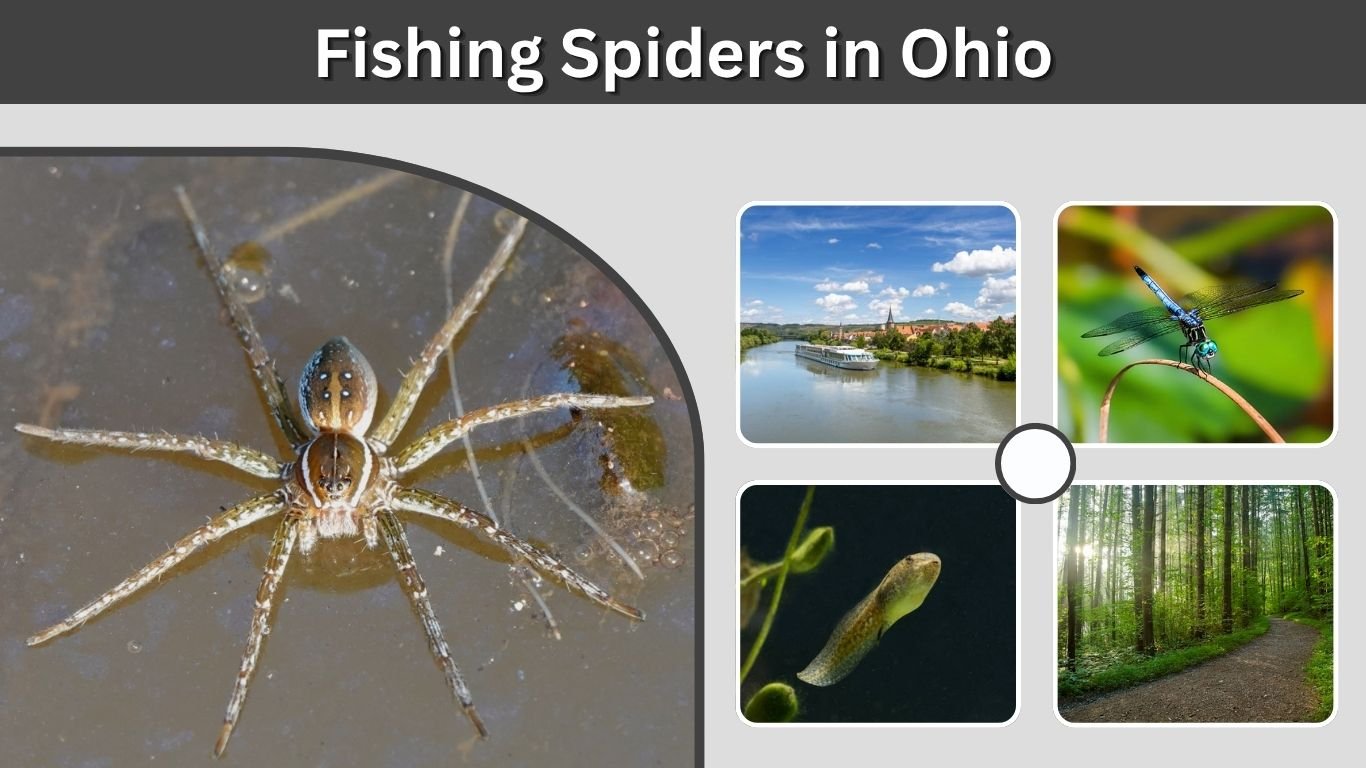
Fishing spiders in Ohio are large hunting spiders commonly associated with ponds, streams, wetlands, forests, and wooded properties. Several Dolomedes species occur in or have been documented from the state, including the dark fishing spider, six-spotted fishing spider, and striped fishing spider. Despite their intimidating size, they generally avoid people and are not considered medically dangerous. Some species spend most of their time beside water, while the dark fishing spider frequently wanders through forests and occasionally enters Ohio homes.
Are Fishing Spiders Common in Ohio?
Fishing spiders are established members of Ohio’s spider fauna and can be encountered in different parts of the state. Their abundance varies with habitat because some species are strongly associated with water while others readily occupy wooded environments. Sightings are especially likely around freshwater habitats, forested parks, cabins, docks, and properties located near natural areas.
Where Are They Found in Ohio?
Fishing spiders have been reported from northeastern, central, southwestern, and other parts of Ohio. The striped fishing spider, for example, has documented Ohio records, while dark fishing spiders are widespread in the eastern United States and commonly occur in wooded habitats.
A person in Dayton, Columbus, northeast Ohio, or another suitable part of the state could therefore encounter one if appropriate habitat is nearby.
Common Types of Fishing Spiders in Ohio
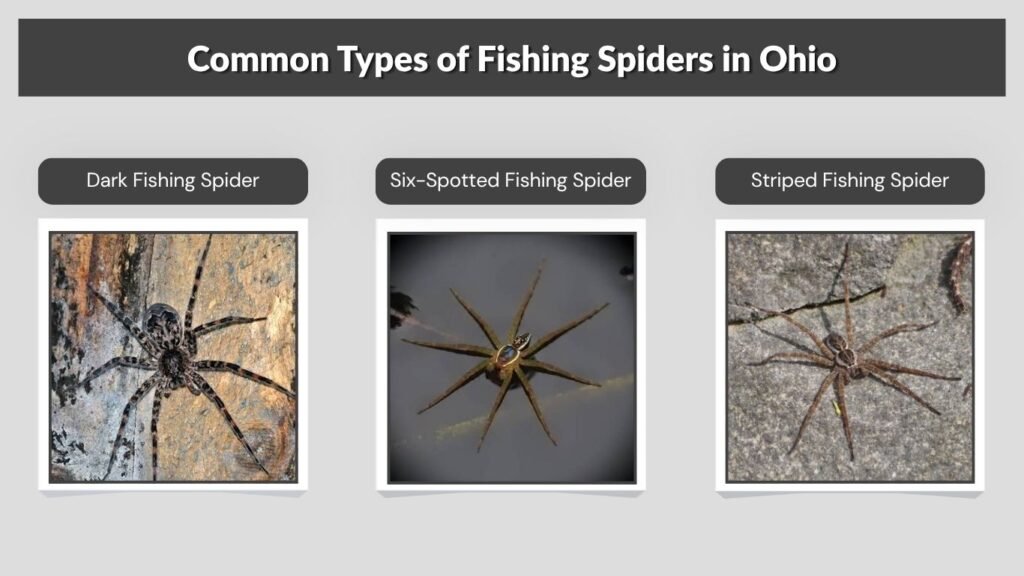
“Fishing spider” does not refer to a single species. It describes spiders in the genus Dolomedes. Ohio’s ponds, streams, forests, and wetlands provide habitat for several members of this group. Although the species can look similar at first, their coloration, markings, and preferred habitats provide useful clues for identification.
Dark Fishing Spider
The dark fishing spider (Dolomedes tenebrosus) is probably the species most likely to alarm Ohio homeowners. It is a large mottled brown spider with banded legs and dark markings on its abdomen.
Unlike its name suggests, the dark fishing spider is often found far from water. Penn State Extension notes that it commonly occurs in wooded settings and may wander onto buildings or into homes.
Its bark-like coloration gives it excellent camouflage on tree trunks, logs, and wooden structures.
Six-Spotted Fishing Spider
The six-spotted fishing spider (Dolomedes triton) is much more closely associated with water. It occurs around ponds, marshes, slow-moving waterways, and other freshwater habitats throughout North America.
This species typically has pale stripes running along the sides of its body. Its common name comes from six dark spots located on the underside of the cephalothorax rather than six obvious spots on its back.
Six-spotted fishing spiders are especially impressive because they can move across the water’s surface and dive beneath it while pursuing prey.
Striped Fishing Spider
The striped fishing spider (Dolomedes scriptus) has also been documented in Ohio. It is most strongly associated with streams, rivers, and other flowing-water habitats rather than quiet ponds.
Individuals are usually brown or grayish with pale lateral stripes, while markings on the abdomen can resemble broad W-shaped patterns. Females are noticeably larger than males.
How Big Are Fishing Spiders in Ohio?
Size is one reason Ohio fishing spiders are frequently mistaken for something dangerous. Their bodies are not enormous, but their extremely long legs produce an impressive overall span. Females are generally larger than males, and a fully grown dark fishing spider can rank among the largest spiders a homeowner is likely to encounter in the region.
Dark Fishing Spider Size
Large female dark fishing spiders can have a leg span of roughly 3 inches or more, giving them a palm-sized appearance. Their long legs make them look much larger than their actual body length.
Striped fishing spiders can also become large; females may reach around a 2.5-inch leg span or more.
Male vs. Female Size
Female fishing spiders are usually substantially larger and more robust than males. Mature males tend to have smaller bodies with proportionally long legs.
This difference becomes particularly noticeable during the breeding season when adults are active.
Where Do Fishing Spiders Live in Ohio?
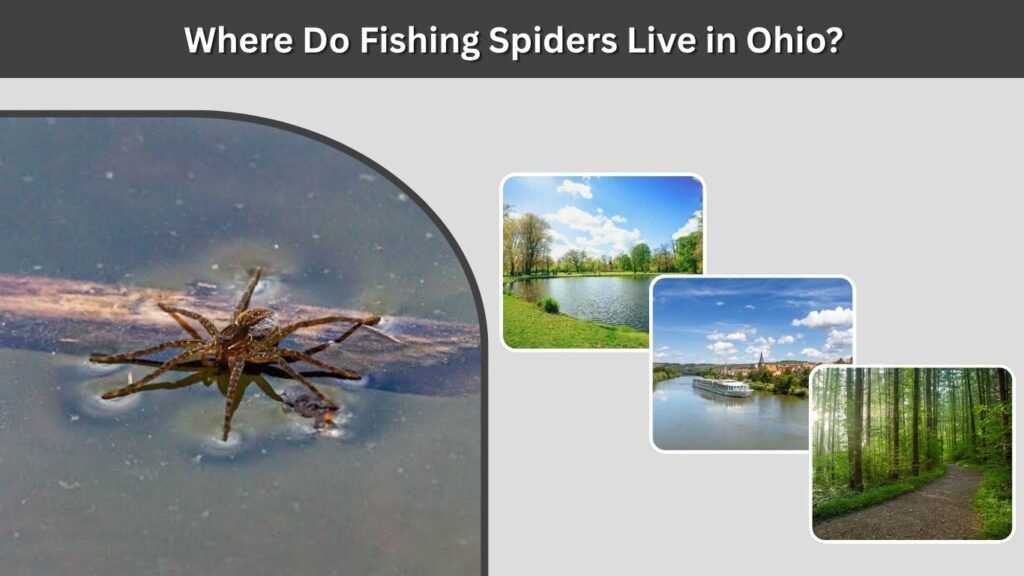
Habitat depends heavily on the species. Six-spotted and striped fishing spiders are genuinely semi-aquatic hunters, while dark fishing spiders frequently occupy terrestrial wooded environments. This explains why one Ohio resident may find a fishing spider on a dock while another discovers one on a tree, garage wall, basement, or cabin far from obvious water.
Common Fishing Spider Habitats
Ohio fishing spiders may be encountered around:
- Ponds and lakes
- Rivers and streams
- Marshes and wetlands
- Boat docks
- Rocks beside water
- Wooded parks
- Tree trunks and fallen logs
- Cabins, sheds, and garages near forests
Striped fishing spiders show a particular preference for streams and rivers, while six-spotted fishing spiders are frequently associated with ponds and similar quiet freshwater habitats.
What Do Ohio Fishing Spiders Eat?
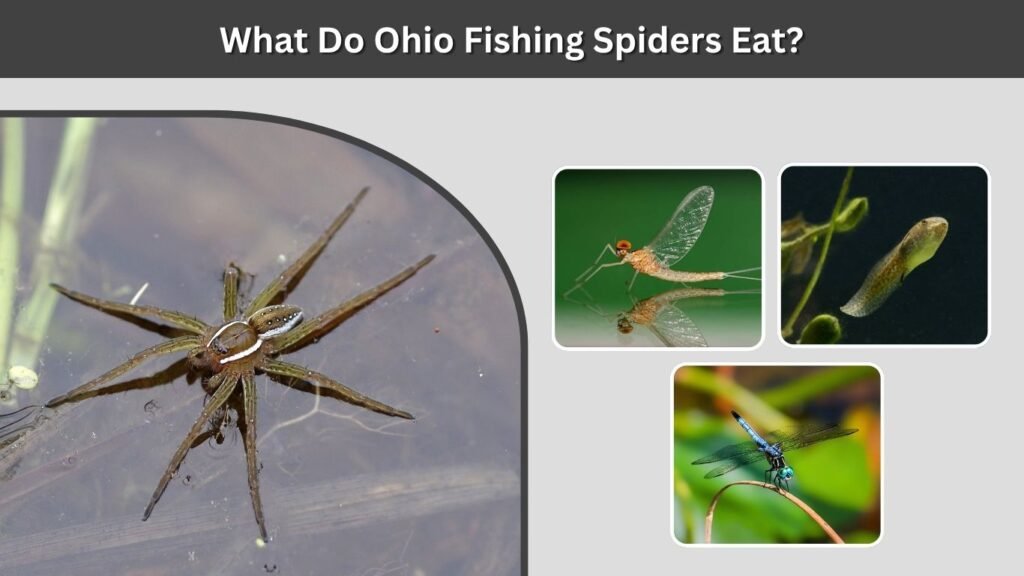
Fishing spiders are active predators rather than spiders that depend on sticky webs for capturing meals. Aquatic species detect vibrations produced by prey at or near the surface of the water and rush toward the disturbance. Although their name emphasizes fish, most of their meals consist of insects and other relatively small animals.
Fishing Spider Diet
Depending on species and opportunity, prey can include:
- Aquatic insects
- Mosquito and fly larvae
- Water striders
- Grasshoppers and other terrestrial insects
- Dragonflies
- Tadpoles
- Small frogs
- Small fish
- Occasionally other spiders
Striped fishing spiders mainly consume insects associated with water, although large Dolomedes are capable of overpowering small vertebrates as well.
Do Ohio Fishing Spiders Really Catch Fish?
Yes. Fishing spiders can capture small fish, although fish should not be viewed as their only or necessarily primary food.
They detect movement through water vibrations, move across the surface using water-repellent legs, and seize appropriately sized prey. Six-spotted fishing spiders are particularly well adapted to this semi-aquatic hunting style.
Are Fishing Spiders in Ohio Dangerous?
Their large size and quick movements can make fishing spiders frightening, but they are not regarded as medically significant spiders. They normally retreat when approached and rarely bite even when handled. Like other spiders, they possess venom for subduing prey, but that does not mean they present a serious threat to people.
Do Ohio Fishing Spiders Bite?
Fishing spiders are physically capable of biting if trapped, squeezed, or deliberately handled. A defensive bite may cause temporary localized pain or irritation, but serious effects are not expected in most people.
The easiest way to avoid a bite is simply not to pick one up with bare hands. Allow the spider to move away or relocate it using a container.
Why Are Dark Fishing Spiders Found Inside Ohio Homes?
The dark fishing spider in Ohio is especially likely to cause confusion because people expect any fishing spider to remain beside water. D. tenebrosus, however, regularly inhabits forests away from aquatic environments. Individuals may wander onto homes, sheds, cabins, garages, and other structures while searching for shelter, prey, or mates.
Keeping Fishing Spiders Outside
To reduce accidental indoor encounters:
- Seal gaps around doors and windows.
- Repair damaged screens.
- Reduce clutter in garages and basements.
- Move stacked firewood away from exterior walls.
- Seal openings around pipes and utility lines.
- Avoid leaving doors open at night.
Finding one fishing spider indoors does not necessarily indicate an infestation because these spiders are roaming hunters rather than social pests.
How to Identify an Ohio Fishing Spider
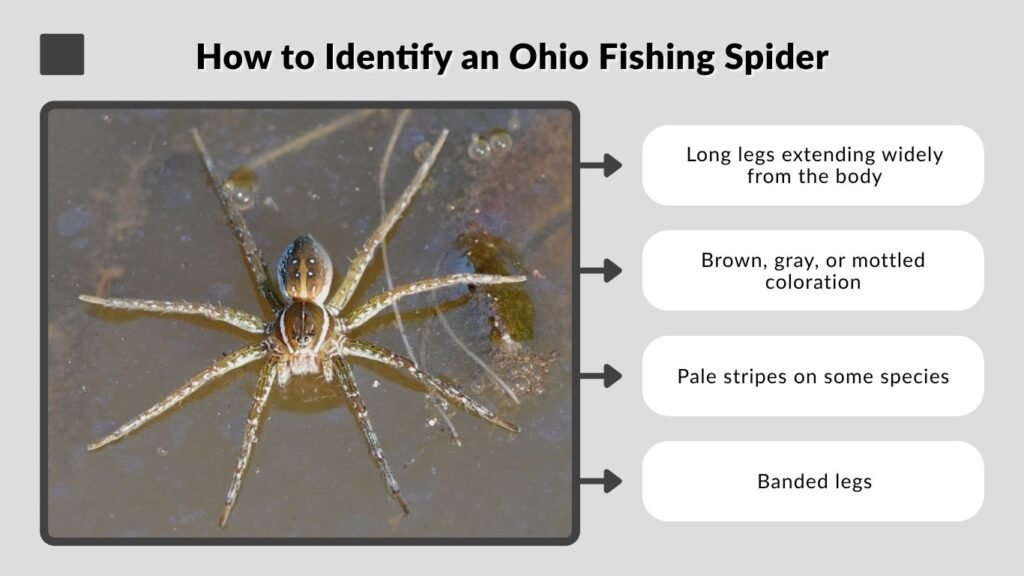
Fishing spiders are often confused with wolf spiders because both groups include large, brown, long-legged hunters. Identification becomes easier when you consider the spider’s markings, proportions, habitat, and behavior together instead of relying only on size. Exact species identification from photographs can still be difficult because several Dolomedes species look remarkably similar.
Fishing Spider Identification Features
Look for characteristics such as:
- Long legs extending widely from the body
- Brown, gray, or mottled coloration
- Pale stripes on some species
- Banded legs
- W- or chevron-shaped abdominal markings in some species
- Large females and smaller males
- Association with water in many species
- Ability to run across the water’s surface
Dark fishing spiders tend to have particularly effective tree-bark camouflage, whereas six-spotted fishing spiders often show clearer pale stripes along the sides.
Fishing Spider vs. Wolf Spider
A large Ohio fishing spider can easily be mistaken for a wolf spider. Both are fast hunters and can have brown mottled bodies.
Fishing spiders generally have longer, more widely spread legs, and many are associated with water. Eye arrangement is also an important technical distinction. Habitat and photographs of the entire spider are therefore much more useful for identification than simply describing it as a “large brown spider.”
Fishing Spider Eggs and Nursery Webs
Fishing spiders belong to a group known for unusual parental care. Females carry their egg sacs in their jaws rather than attaching them to the spinnerets as wolf spiders do. When the eggs are ready to hatch, the female places the sac inside a protective nursery web constructed among vegetation and remains nearby guarding the spiderlings.
Why Are They Called Nursery Web Spiders?
The name comes from this protective silk nursery. The web is not primarily intended to catch prey.
Instead, it gives newly hatched spiderlings a protected place to remain during their earliest stage of life. After a short period, they disperse and begin living independently.
FAQs
Large fishing spiders naturally generate questions because their size is far greater than that of many spiders regularly noticed around Ohio homes and waterways. Most encounters involve harmless native predators performing an important ecological role by consuming insects and other small animals. Knowing their preferred habitat and appearance can prevent unnecessary concern when one unexpectedly appears nearby.
Are Fishing Spiders Common in Ohio?
Yes. Several fishing spider species occur or have documented records in Ohio, including dark, six-spotted, and striped fishing spiders.
What Is the Biggest Fishing Spider in Ohio?
The dark fishing spider is among the largest commonly encountered types. Large females can span around 3 inches or more across the legs.
Are Dark Fishing Spiders in Ohio Poisonous?
They have venom for subduing prey, as spiders normally do, but dark fishing spiders are considered harmless to people and rarely bite.
Can Fishing Spiders Swim?
Yes. Semi-aquatic species can move across the water’s surface and dive beneath it. Water-repellent hairs help them function effectively around water.
Why Did I Find a Fishing Spider Far From Water?
It may be a dark fishing spider. Unlike strongly aquatic species, dark fishing spiders commonly inhabit wooded areas away from water and occasionally wander into buildings.
