
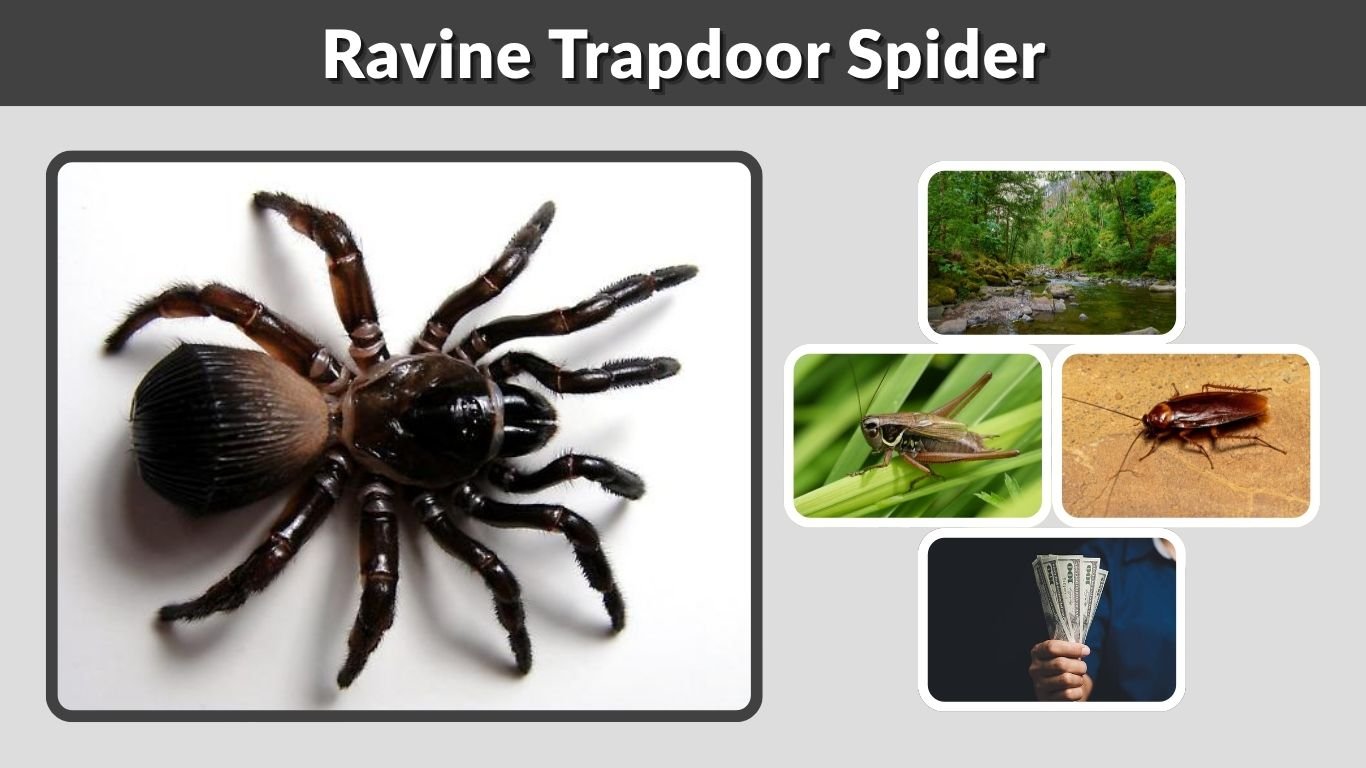
The ravine trapdoor spider (Cyclocosmia truncata) is one of North America’s most unusual spiders. Its most striking feature is a hard, flattened disc at the end of its abdomen that resembles a carved seal, coin, or patterned shield. When threatened, the spider retreats headfirst into its burrow and uses this disc to block the tunnel behind it. Native to parts of the southeastern United States, it spends most of its life underground and is rarely encountered. Here’s what to know about its size, habitat, diet, bite, venom, and remarkable defensive behavior.
What Is a Ravine Trapdoor Spider?
The ravine trapdoor spider is a mygalomorph spider in the family Halonoproctidae, making it a distant relative of tarantulas and other primitive burrowing spiders. Its scientific name is Cyclocosmia truncata. Unlike spiders that construct exposed aerial webs, it spends most of its life inside a concealed underground burrow.
Ravine Trapdoor Spider Identification
Look for these characteristics:
- Thick, compact body
- Brown to very dark coloration
- Strong legs adapted for digging
- Large downward-pointing fangs
- Abruptly flattened rear of abdomen
- Hard circular abdominal disc
- Raised ribs and grooves across the disc
- Short hairs and spines around the abdominal edge
- Association with concealed burrows
The abdominal disc is the easiest feature to recognize. Members of Cyclocosmia are distinguished partly by the arrangement of ribs, grooves, and other features on this unusual structure.
Ravine Trapdoor Spider Abdomen
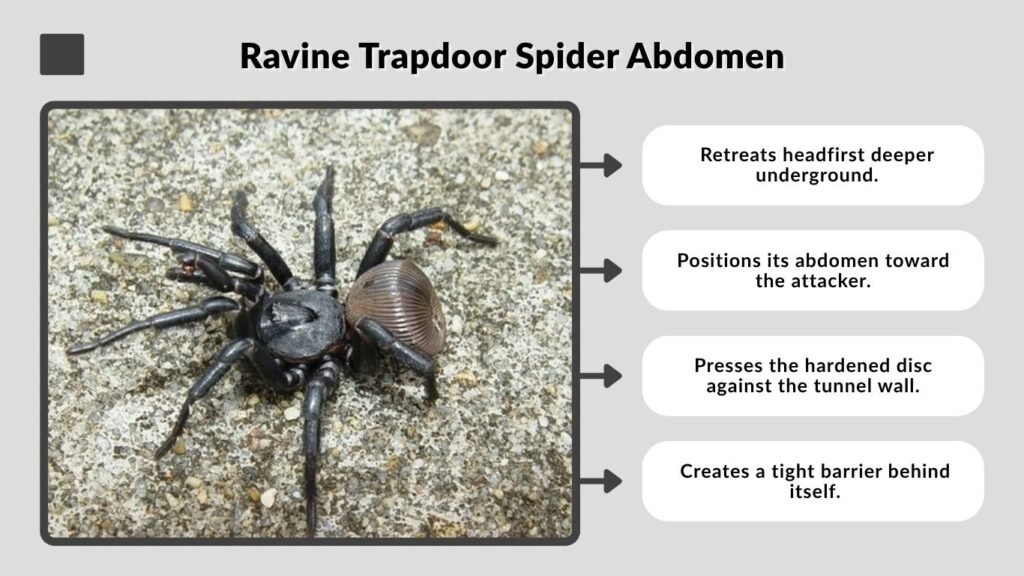
The rear end of Cyclocosmia truncata looks unlike that of an ordinary spider. Instead of tapering into a rounded abdomen, it ends abruptly in a hardened disc. The structure has such a regular pattern that photographs sometimes make it look artificial.
Why Does It Have a Flat “Butt”?
The strange abdomen is actually an impressive defensive adaptation.
When danger enters the burrow, the spider:
- Retreats headfirst deeper underground.
- Positions its abdomen toward the attacker.
- Presses the hardened disc against the tunnel wall.
- Creates a tight barrier behind itself.
- Makes it difficult for a predator to pull the spider out.
This use of part of the body to block an opening is called phragmosis. Research on Cyclocosmia describes the disc as fitting tightly into the burrow, effectively forming a false barrier behind the spider.
Is the Pattern a Symbol?
The abdomen can resemble a carved seal, geometric symbol, coin, or even an Oreo cookie in online photographs.
However, the pattern is a natural anatomical structure rather than a deliberately created symbol. The raised ribs, grooves, and muscle impressions are biological features of the abdominal disc.
Claims that the markings are specifically Mayan, Aztec, or another human symbol are visual comparisons rather than biological explanations.
Ravine Trapdoor Spider Size
Despite dramatic close-up photographs, ravine trapdoor spiders are not enormous. Adult females are substantially more robust than males. A modern North American spider guide lists C. truncata females at about 33 mm in total body length and males at about 19 mm.
Male vs Female Size
Approximate adult sizes are:
- Female: around 33 mm, or about 1.3 inches
- Male: around 19 mm, or about 0.75 inch
- Females: heavier and more robust
- Males: smaller and more mobile
The legs make either sex appear wider than its actual body length.
Females spend much of their lives associated with their burrows, whereas sexually mature males become more mobile while searching for females.
Why Does It Look Bigger in Pictures?
Macro photography greatly enlarges small anatomical details.
When photographed close to the camera, the spider’s:
- Large fangs
- Thick legs
- Circular abdomen
- Heavy body
- Dark coloration
can create the impression of a much larger animal.
In reality, a mature female’s body is only a little over an inch long.
Ravine Trapdoor Spider Habitat
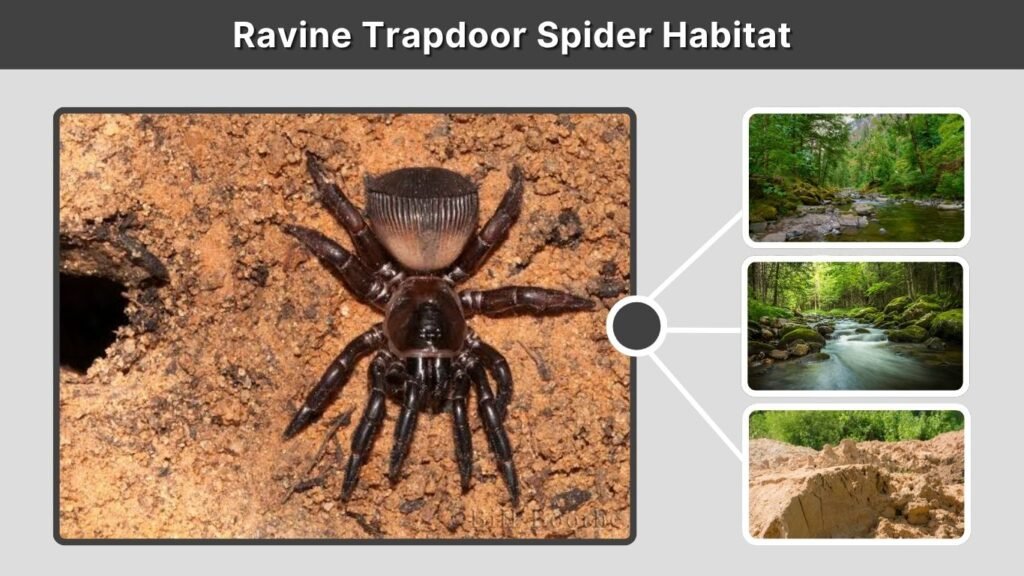
Cyclocosmia truncata is associated with the southeastern United States. Recent research places it in Alabama, central-to-southern Tennessee, and northwestern Georgia. The spiders are strongly associated with relatively undisturbed forest habitats, humid ravines, and stream-bank environments.
Where Do Ravine Trapdoor Spiders Live?
Typical habitat includes:
- Forested ravines
- Moist slopes
- Stream banks
- Undisturbed woodland
- Sandy-clay soils
- Shaded hillsides
- Areas with moist leaf litter
These spiders have limited dispersal and can occur in localized populations rather than being evenly distributed across an entire region.
Ravine Trapdoor Spider in Florida
A related American species, Cyclocosmia torreya, occurs in southwestern Georgia and northwestern Florida. It has historically been confused with C. truncata. Modern research separates the two, so a Cyclocosmia found in Florida should not automatically be identified as the ravine trapdoor spider C. truncata.
Are Ravine Trapdoor Spiders in Australia?
No known native population of Cyclocosmia truncata occurs in Australia.
Australia has many trapdoor spiders, but they belong to several other groups. The true C. truncata discussed here is a North American species.
The phrase “Australian ravine trapdoor spider” therefore commonly reflects confusion between different types of trapdoor spiders.
Ravine Trapdoor Spider Burrow
The spider’s burrow is central to nearly every part of its life. It provides protection from predators, stable humidity, and a hidden position from which the spider can capture passing prey.
How the Trapdoor Works
Cyclocosmia spiders construct vertical burrows in suitable soil and conceal the entrance with a hinged door made from silk, soil, and surrounding material. Studies of the genus describe burrows in sandy-clay banks and note that the entrance can be exceptionally well camouflaged.
The spider waits inside rather than constructing a large prey-catching web.
When suitable prey approaches the entrance, the spider can rapidly emerge, capture it, and retreat underground.
Its remarkable abdominal shield provides a second defensive barrier if something manages to penetrate the outer door.
What Does the Ravine Trapdoor Spider Eat?
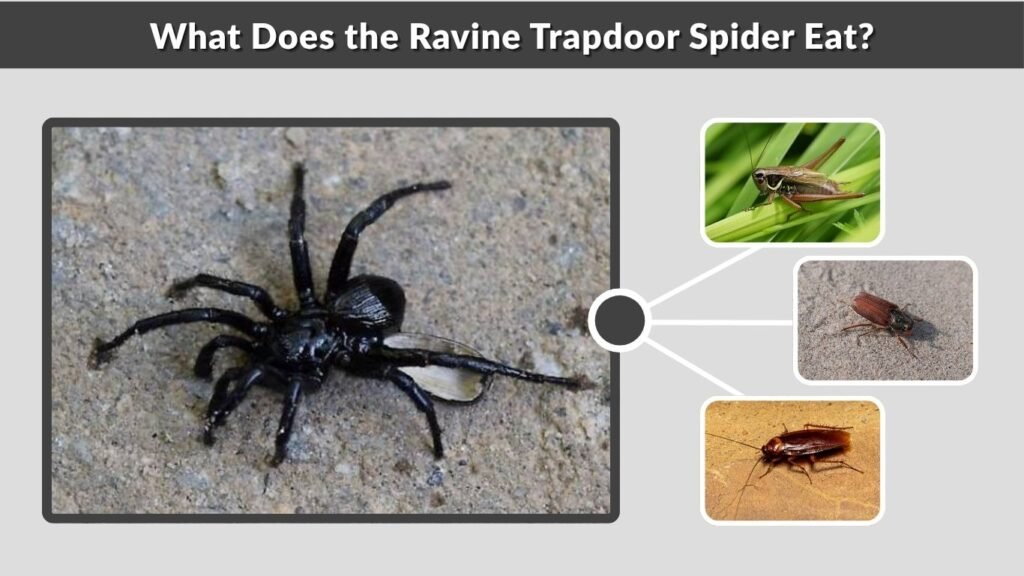
Ravine trapdoor spiders are sit-and-wait predators. They remain close to their burrows and capture arthropods that move within striking distance. Related conservation accounts describe Cyclocosmia trapdoor spiders as feeding on a variety of arthropod prey.
Common Prey
Potential foods include:
- Crickets
- Beetles
- Cockroaches
- Small grasshoppers
- Other spiders
- Various ground-dwelling insects
- Other appropriately sized arthropods
The spider uses its powerful fangs to seize prey and venom to help subdue it before feeding.
Because the spider remains underground much of the time, patience and ambush are more important hunting strategies than actively chasing prey.
Ravine Trapdoor Spider Bite and Venom
The intimidating fangs naturally raise questions about whether a ravine trapdoor spider is poisonous or dangerous. Like other predatory spiders, it uses venom while capturing prey. However, reliable clinical information specifically documenting human bites from C. truncata is sparse.
Can a Ravine Trapdoor Spider Bite?
Yes. A spider with functional fangs can potentially bite if restrained, squeezed, or handled.
However, ravine trapdoor spiders are highly secretive animals that spend most of their lives hidden underground. Their first defensive strategy is typically retreating and blocking the burrow rather than interacting with humans.
A bite is therefore much less likely during normal encounters than someone might assume from the spider’s appearance.
Is Ravine Trapdoor Spider Venom Dangerous?
There is not strong clinical evidence establishing Cyclocosmia truncata as a medically important spider species.
That does not mean a bite should be deliberately tested or assumed harmless. Large mygalomorph fangs can cause mechanical injury even when venom does not produce severe systemic effects.
If a suspected spider bite causes severe pain, spreading swelling, breathing difficulty, vomiting, muscle symptoms, or other significant effects, seek medical care.
Ravine Trapdoor Spider Life Cycle
Ravine trapdoor spiders follow the familiar spider development pattern of egg, spiderling, juvenile, and adult. Their lifestyle differs dramatically from fast-growing house spiders because trapdoor spiders generally develop slowly and remain closely associated with burrows.
From Spiderling to Adult
The basic development includes:
- Eggs develop inside an egg sac.
- Tiny spiderlings emerge.
- Juveniles establish small burrows.
- Young spiders grow through repeated molts.
- Burrows become larger as spiders mature.
- Mature males eventually wander in search of females.
- Females remain much more closely associated with permanent burrows.
Closely related American Cyclocosmia are considered slow-growing, long-lived spiders, reflecting the sedentary lifestyle typical of this group.
Ravine Trapdoor Spiders for Sale
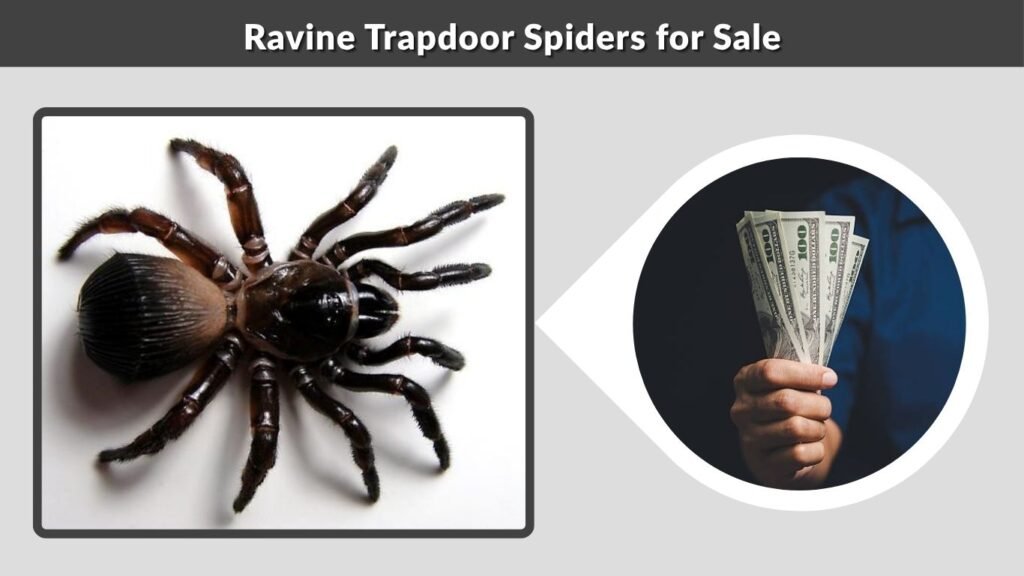
Cyclocosmia spiders occasionally appear in the exotic pet trade because of their bizarre abdominal discs. However, they are highly specialized burrowing animals rather than display spiders that remain visible.
Before Buying One
Potential keepers should consider:
- Most of the spider’s life is spent underground.
- Correct species identification can be difficult.
- They need a suitable deep substrate.
- Humidity and burrow stability matter.
- Wild collection can damage localized populations.
- Regulations may vary by location.
- Captive-bred specimens are preferable to wild-collected spiders.
Recent research has also shown that North American Cyclocosmia diversity is more complex than older classifications suggested, so spiders sold under a simple common name may not always be identified accurately.
Interesting Ravine Trapdoor Spider Facts
The unusual anatomy and secretive lifestyle of this spider make it especially fascinating.
Quick Facts
- Its scientific name is Cyclocosmia truncata.
- It belongs to the family Halonoproctidae.
- It is a mygalomorph spider.
- Females can reach around 33 mm in body length.
- The back of its abdomen forms a hardened disc.
- The disc contains distinctive ribs and grooves.
- It uses the abdomen to block its burrow.
- This defensive behavior is called phragmosis.
- It spends most of its life underground.
- It is associated with humid forest ravines.
- It occurs naturally in parts of the southeastern United States.
- Florida populations of similar spiders may belong to C. torreya, not C. truncata.
FAQs
Is the ravine trapdoor spider poisonous?
The more accurate term is venomous, because spiders inject venom through their fangs rather than being poisonous when touched or eaten. C. truncata uses venom to subdue prey, but there is limited clinical information on human bites and it is not established as a major medically important spider.
How big is a ravine trapdoor spider?
Adult female Cyclocosmia truncata are reported at around 33 mm, or approximately 1.3 inches, in body length. Males are smaller at roughly 19 mm, or around three-quarters of an inch. Their thick legs and compact bodies can make them appear larger.
Why does the ravine trapdoor spider have a strange abdomen?
Its flattened abdomen is a defensive shield. When threatened, the spider retreats headfirst into its burrow and presses the hardened abdominal disc against the tunnel walls, creating a barrier that helps stop predators from reaching its vulnerable front end.
Where are ravine trapdoor spiders found?
Current research places C. truncata primarily in Alabama, central-to-southern Tennessee, and northwestern Georgia. It favors well-preserved forests, humid ravines, slopes, and stream-bank habitats. Closely related Cyclocosmia species occur elsewhere in the southeastern United States.
Is the ravine trapdoor spider’s abdomen a Mayan symbol?
No evidence indicates that its pattern has any connection with Mayan or other human symbols. The apparent design consists of natural ribs, grooves, and muscle impressions on a hardened abdominal disc. Its regular geometric appearance simply makes it resemble carved artwork or a decorative seal.
