
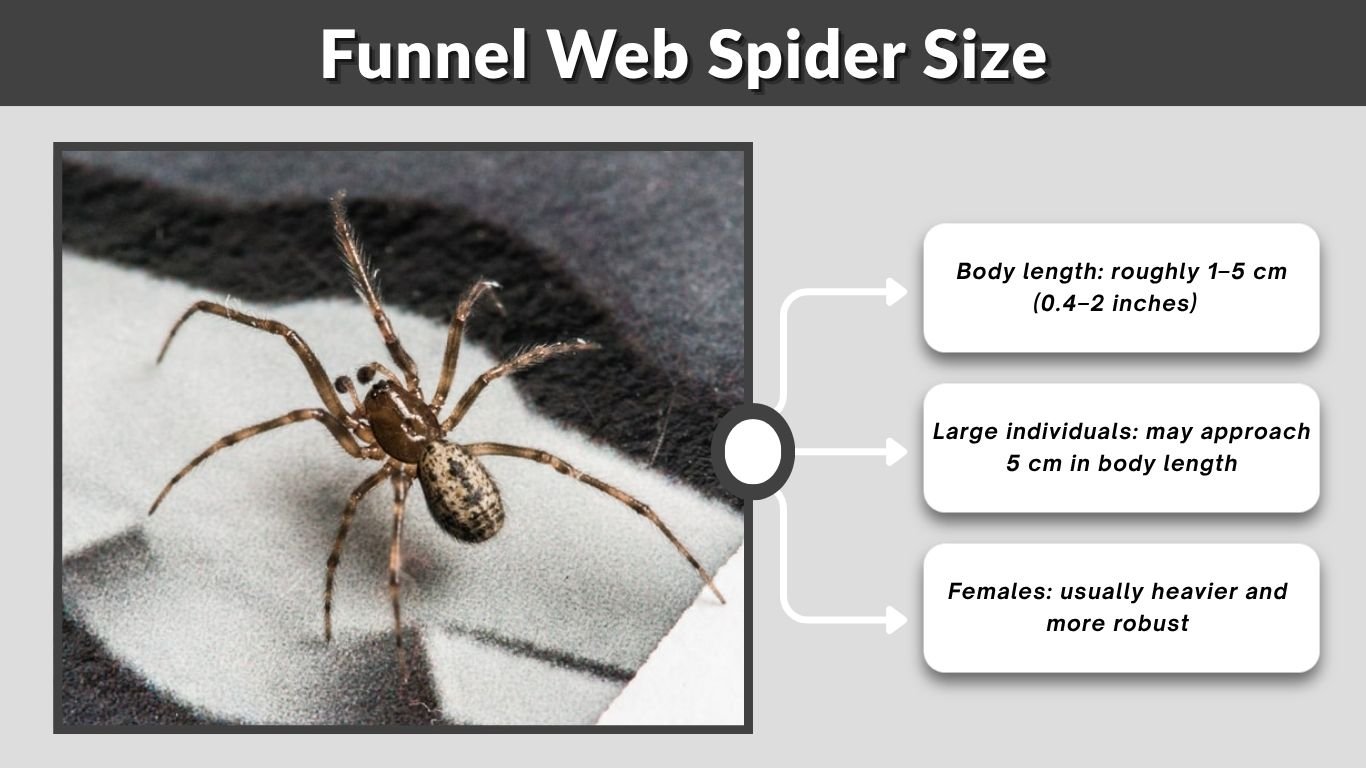
Funnel web spider size varies considerably depending on the species, sex, and age of the spider. Australian funnel-web spiders generally have body lengths of about 1–5 cm (0.4–2 inches), although their legs make them appear considerably larger. The famous Sydney funnel-web spider is a robust, dark spider whose females are usually heavier-bodied than males. Despite their intimidating appearance and powerful fangs, funnel-web spiders are much smaller than giant tarantulas. Here is a closer look at their actual size, leg span, fang size, and comparisons.
How Big Is a Funnel Web Spider?
Australian funnel-web spiders belong to a group containing numerous species that differ in size. Most have compact, muscular bodies, shiny dark coloration, and thick legs. Their heavy build can make them look larger than their measurements suggest, particularly when they raise their front legs defensively.
Average Funnel Web Spider Size
Typical measurements include:
- Body length: roughly 1–5 cm (0.4–2 inches)
- Large individuals: may approach 5 cm in body length
- Leg span: commonly several centimeters wider than the body
- Females: usually heavier and more robust
- Males: often slimmer with proportionally longer legs
- Young spiders: only a fraction of adult size
Size differs among species, so not every funnel-web spider reaches the upper end of this range.
Why Do They Look So Large?
Several physical characteristics exaggerate their apparent size.
Funnel-web spiders have thick legs, large mouthparts, a solid body, and a glossy carapace. When threatened, some raise their front legs and expose their fangs.
This defensive posture increases their apparent height and makes them look particularly intimidating.
Their dark coloration also makes individual body parts less visually distinct, creating the impression of one large, solid spider.
Sydney Funnel Web Spider Size
The Sydney funnel-web spider (Atrax robustus) is one of Australia’s best-known spiders. It occurs around the Sydney region and is famous primarily because of its medically significant venom. Although often portrayed as enormous, its actual body size is moderate compared with large tarantulas.
How Big Is a Sydney Funnel-Web Spider?
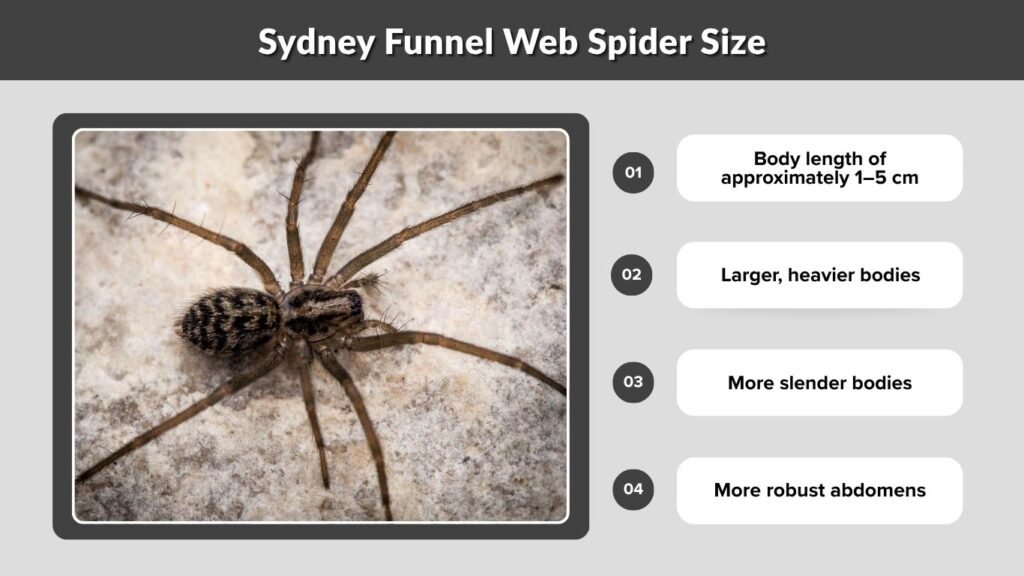
Sydney funnel-web spiders generally have a body length of approximately 1–5 cm, with larger females at the upper end of the range.
A mature female may have a substantial, compact body, while males are generally slimmer.
Including the legs, a large specimen can appear several inches across, particularly when moving or assuming a defensive stance.
The spider’s thick legs and prominent fangs contribute significantly to its intimidating appearance.
Male vs Female Sydney Funnel-Web Size
Females and males differ noticeably in proportions.
Females typically have:
- Larger, heavier bodies
- More robust abdomens
- Shorter-looking legs relative to body size
- Long lifespans spent primarily around burrows
Males typically have:
- More slender bodies
- Longer-looking legs
- Smaller abdomens
- A more mobile appearance
Mature males wander in search of females, which is one reason people are more likely to encounter them away from established burrows.
Female Funnel Web Spider Size
Female Australian funnel-web spiders are typically the more robust sex. They spend much of their adult lives inside silk-lined retreats and therefore have a heavier, less mobile-looking build.
Why Females Look Bigger
A female’s abdomen is often noticeably larger than a male’s, particularly when she is well fed or carrying developing eggs.
Her overall appearance may include:
- Thick legs
- Large abdomen
- Broad body
- Powerful chelicerae
- Compact proportions
Although males may sometimes appear wider because of their long legs, females generally have greater body mass.
Female funnel-web spiders can also live considerably longer than adult males.
Male Funnel Web Spider Size
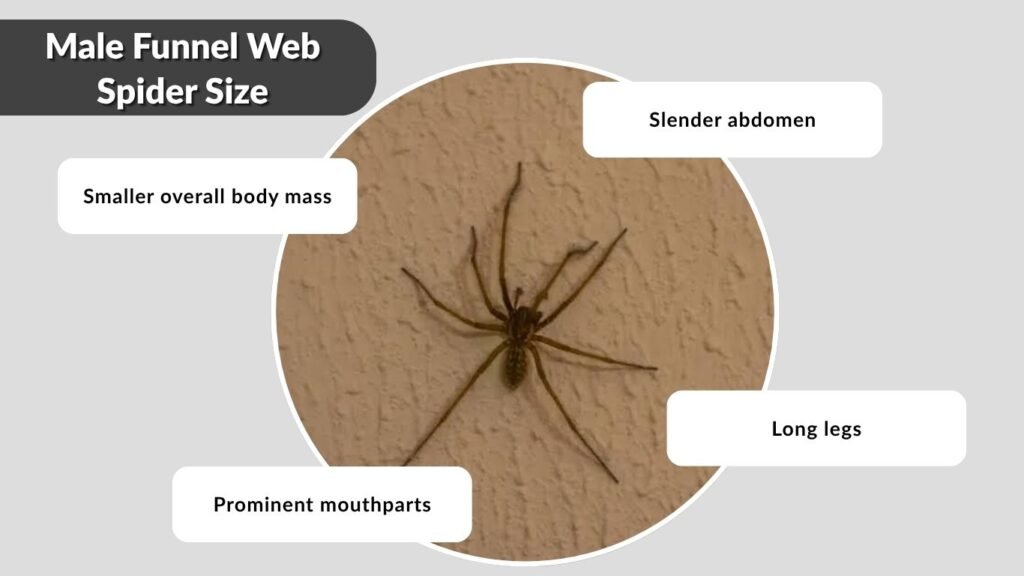
Male funnel-web spiders tend to have slimmer bodies and proportionally longer legs. Their anatomy reflects a more active adult lifestyle because mature males leave their retreats and search for females.
Male Size and Appearance
A mature male may have:
- Slender abdomen
- Long legs
- Smaller overall body mass
- Prominent mouthparts
- Specialized structures on the legs for mating
A male can therefore look surprisingly large when viewed from above even though his body is lighter and narrower than that of a female.
Sex should not be determined from overall size alone because individual variation occurs.
Funnel Web Spider Fang Size
The fangs are one of the most remarkable features of Australian funnel-web spiders. Their large chelicerae point downward, allowing the spider to deliver a powerful bite.
How Big Are Sydney Funnel-Web Fangs?
Large Sydney funnel-web spiders can have fangs several millimeters long. In large specimens, they may be approximately 5 mm or more, although size varies with the individual.
Their fangs are strong enough to penetrate relatively tough surfaces, including thin footwear or fingernails in some circumstances.
When threatened, the spider may raise its front body and visibly display these fangs.
Because Australian funnel-web bites can be medically serious, suspected bites require urgent medical attention.
Baby Funnel Web Spider Size
Young funnel-web spiders, called spiderlings, are tiny compared with adults. They emerge after developing in an egg sac and gradually increase in size through repeated molts.
How Funnel-Web Spiders Grow
Growth occurs in stages:
- Spiderlings hatch from eggs.
- They remain very small during early development.
- The young spiders molt repeatedly.
- Each molt allows the body and legs to increase in size.
- Juveniles eventually establish their own retreats.
- Adults reach species- and sex-specific sizes.
Young funnel-web spiders may resemble miniature adults, although their coloration and proportions can change as they mature.
Australian Funnel Web Spider Size
Australia contains many funnel-web species, not just the Sydney funnel-web. They belong primarily to the family Atracidae and vary in body size, coloration, and habitat.
Size Differences Among Australian Species
Depending on species, funnel-web spiders may differ in:
- Body length
- Leg length
- Abdomen width
- Fang size
- Overall robustness
Large tree-dwelling funnel-web species can appear especially impressive because of their substantial bodies.
The Sydney funnel-web is therefore not automatically the largest member of the group, even though it is the most famous.
Funnel Web Spider vs Tarantula Size
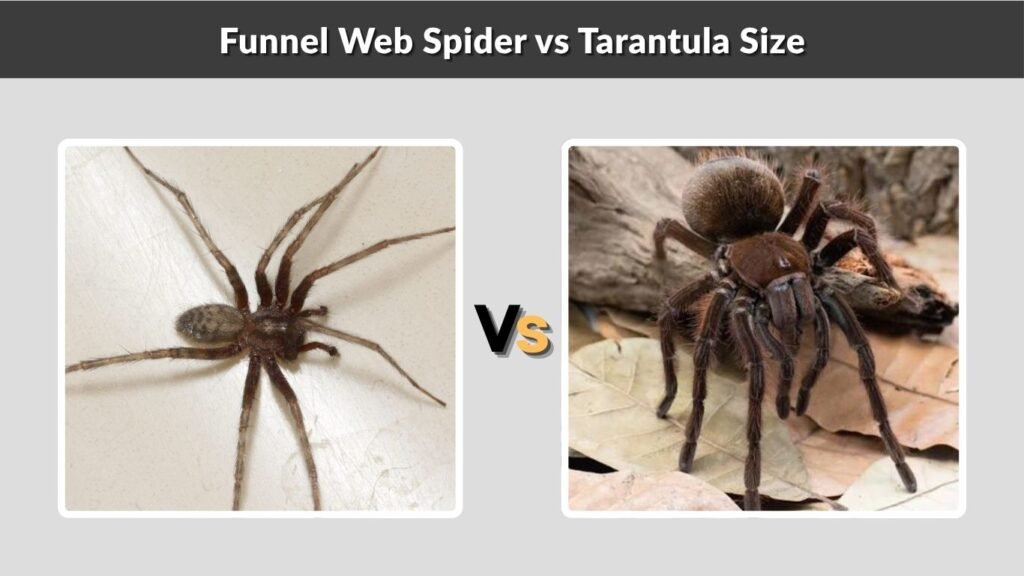
Tarantulas are generally much larger than Australian funnel-web spiders. Confusion sometimes occurs because both can have thick legs and robust bodies.
Size Comparison
| Feature | Funnel-Web Spider | Large Tarantula |
| Body length | About 1–5 cm | Often 5–10+ cm |
| Leg span | Several centimeters | Can exceed 15–20 cm |
| Body build | Compact and robust | Large and hairy |
| Hair | Usually relatively smooth | Usually very hairy |
| Fangs | Large for body size | Large |
A large funnel-web can look intimidating, but giant tarantulas can have several times its overall leg span.
Funnel Web Spider vs Grass Spider Size
The term “funnel web spider” can cause confusion because many harmless spiders make funnel-shaped webs. North American grass spiders, for example, build funnel retreats but are unrelated to medically significant Australian funnel-web spiders.
Grass Spider vs Australian Funnel-Web
Grass spiders usually have:
- Slender bodies
- Long thin legs
- Visible spinnerets
- Brown coloration
- Sheet-like webs leading into funnels
Australian funnel-web spiders generally have:
- Heavier bodies
- Thick legs
- Dark coloration
- Powerful downward-pointing fangs
- Silk-lined burrows or retreats
A funnel-shaped web by itself does not mean an Australian funnel-web spider is present.
Spanish Funnel-Web Spider Size
The Spanish funnel-web spider (Macrothele calpeiana) is another large dark spider sometimes compared with Australian funnel-webs. It occurs naturally in parts of the Iberian Peninsula.
How Big Is a Spanish Funnel-Web Spider?
Large females can reach body lengths of several centimeters, with the legs making them appear considerably wider.
They are robust, dark spiders with prominent spinnerets.
Despite the shared common term “funnel-web,” they should not be confused with the Sydney funnel-web spider. They belong to a different lineage and have different medical significance.
Funnel Web Spider Size Compared to a Human Hand
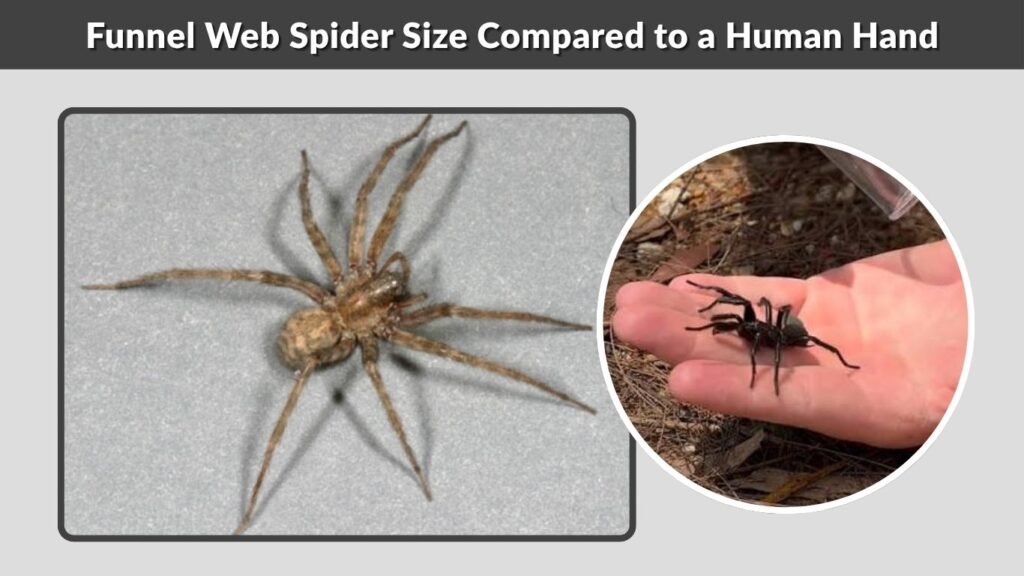
A large Australian funnel-web can occupy a noticeable portion of an adult palm when its legs are extended, but claims that typical funnel-web spiders are “hand-sized” can be misleading.
Actual Size on a Hand
The body itself is usually only a few centimeters long.
The legs increase the apparent width considerably, but even a large funnel-web remains much smaller than a human hand.
Close-up photographs can exaggerate spider size because the animal is positioned near the camera.
Using body length rather than photographs is therefore a more reliable way to understand actual size.
Does Size Make a Funnel-Web More Dangerous?
A bigger spider may have larger fangs and potentially deliver more venom, but size alone cannot determine the medical seriousness of a bite.
Species, sex, circumstances of the bite, and amount of venom delivered all matter.
Male Sydney Funnel-Webs and Venom
Male Sydney funnel-web spiders are particularly important medically despite being less robust than females.
This demonstrates why simply assuming that the largest spider is the most dangerous can be misleading.
If you are in an area where medically significant Australian funnel-web spiders occur, avoid handling any suspected specimen regardless of its size.
FAQs
1. What is the average size of a funnel web spider?
Australian funnel-web spiders generally range from around 1–5 cm in body length, depending on species, age, and sex. Their legs increase their overall width substantially. Females tend to be more robust, while adult males often have slimmer bodies and proportionally longer legs.
2. How big is a Sydney funnel-web spider?
A Sydney funnel-web spider may have a body approximately 1–5 cm long, with larger females approaching the upper end. Including the legs, the spider appears considerably larger. Its heavy body, thick legs, and prominent fangs can make it seem bigger than its actual dimensions.
3. Are female funnel-web spiders bigger than males?
Females are usually heavier-bodied and more robust than males. Mature males often have proportionally longer legs and slimmer abdomens, so they can appear large despite having less body mass. Individual measurements overlap, meaning size alone is not a completely reliable method for determining sex.
4. How big are Sydney funnel-web spider fangs?
Large Sydney funnel-web spiders can have fangs several millimeters long, with substantial individuals having fangs around 5 mm or more. Their strong, downward-pointing fangs can penetrate skin effectively, which contributes to the seriousness of medically significant funnel-web bites.
5. Is a funnel-web spider bigger than a tarantula?
Usually not. Many tarantulas are considerably larger than Australian funnel-web spiders. Large tarantulas can reach leg spans exceeding 15 cm, while funnel-web spiders generally have body lengths under about 5 cm and much smaller total leg spans.
