
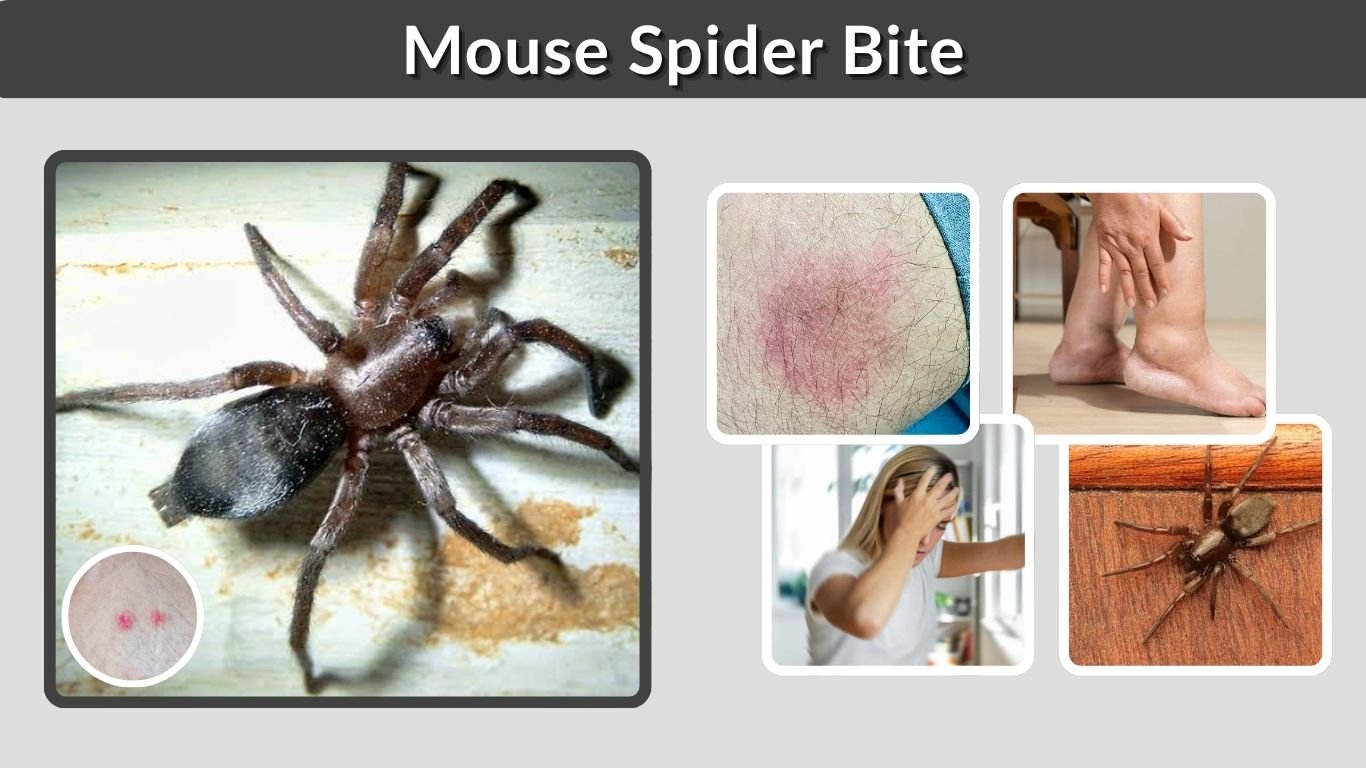
A mouse spider bite can range from localized pain and swelling to, in rare cases, more serious neurological symptoms. The level of danger depends heavily on which “mouse spider” is involved. Australian mouse spiders in the genus Missulena have medically significant venom and should be treated cautiously. However, the spider called a mouse spider in the UK, Scotophaeus blackwalli, belongs to a completely different family. Understanding the difference is essential when evaluating bite symptoms, treatment, and potential risk.
Are Mouse Spider Bites Dangerous?
Australian mouse spiders belong to the genus Missulena. Their venom can have neurotoxic effects and has similarities to venom from Australian funnel-web spiders. Despite their potentially powerful venom, serious human envenomation appears to be uncommon.
A systematic review of 40 definite Australian mouse spider bites found only one case of severe neurotoxic envenomation. Most bites produced minor or moderate effects instead.
How Serious Can a Bite Become?
Most confirmed bites cause localized symptoms rather than life-threatening illness. However, because severe reactions are possible and mouse spiders may be confused with funnel-web spiders, Australian health guidance recommends treating a suspected mouse spider bite seriously.
A person bitten by a large dark Australian spider should not wait for severe symptoms to develop before seeking emergency medical help.
Do Mouse Spiders Bite Humans?
Yes. Mouse spiders can bite humans, although biting usually occurs defensively rather than because the spider is actively attacking a person.
Australian mouse spiders live mainly in burrows, while males may wander above ground while searching for females. Human encounters therefore occur more often when spiders are accidentally disturbed or handled.
Mouse Spider Bite Symptoms
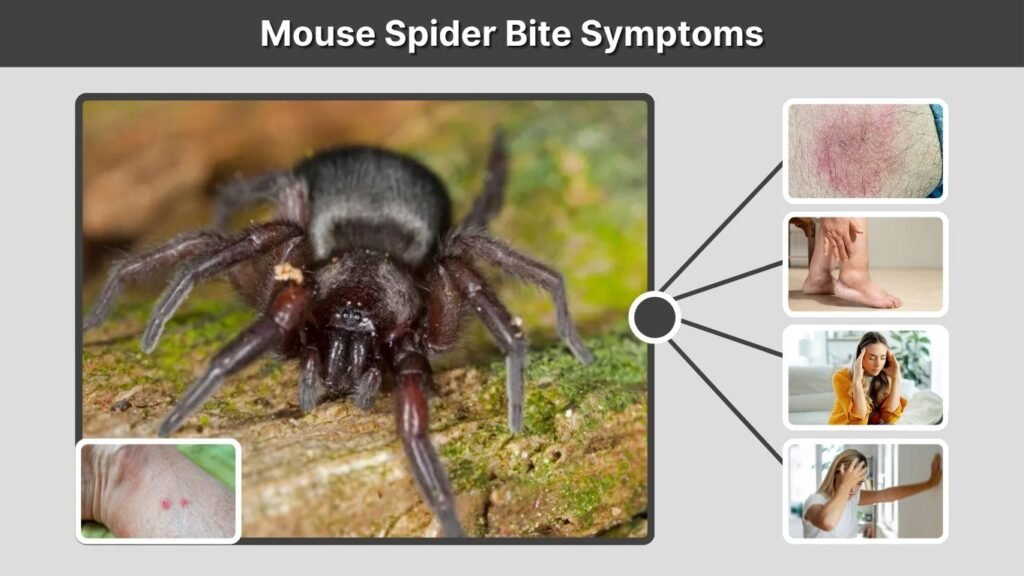
Symptoms vary considerably. Some bites may cause only pain around the puncture site, while uncommon cases can involve neurological effects.
Common Bite Symptoms
Possible symptoms include:
- Immediate pain
- Redness
- Swelling
- Tingling or numbness
- Sweating around the bite
- Headache
- Nausea
- Local tenderness
In one prospective Australian study of identified spider bites, local pain occurred in 97% of cases overall, while redness occurred in 47% and swelling in 24%. Two patients bitten by northern mouse spiders developed systemic effects.
Symptoms of Severe Envenomation
Severe mouse spider envenomation is rare but can potentially produce symptoms resembling funnel-web envenomation.
Warning signs can include:
- Heavy sweating
- Excessive saliva or tearing
- Muscle twitching or spasms
- Numbness around the mouth
- Rapid pulse
- High blood pressure
- Difficulty breathing
- Confusion
- Loss of consciousness
These symptoms require immediate emergency medical treatment.
What Does a Mouse Spider Bite Look Like?
There is no distinctive skin mark that can reliably identify a mouse spider bite.
Mouse Spider Bite on a Human
A bite may initially appear as a small puncture accompanied by redness, swelling, tenderness, or pain. Visible appearance alone cannot confirm that a mouse spider caused the injury.
Spider bites can resemble insect bites, skin infections, allergic reactions, and other conditions. Correct identification is more reliable when the spider itself has been safely identified by an expert. Research on confirmed Australian spider bites has emphasized the importance of accurate spider identification.
Can Mouse Spider Bites Cause Skin Necrosis?
Severe skin destruction is not considered a typical feature of confirmed mouse spider bites.
A prospective study of identified spider bites in Australia reported no confirmed cases of necrotic arachnidism. Therefore, rapidly developing ulcers or worsening skin lesions should not automatically be assumed to result from mouse spider venom and should be medically evaluated.
Pictures found online can provide general context, but mouse spider bite pictures cannot reliably diagnose a bite.
Mouse Spider Bite Treatment and First Aid
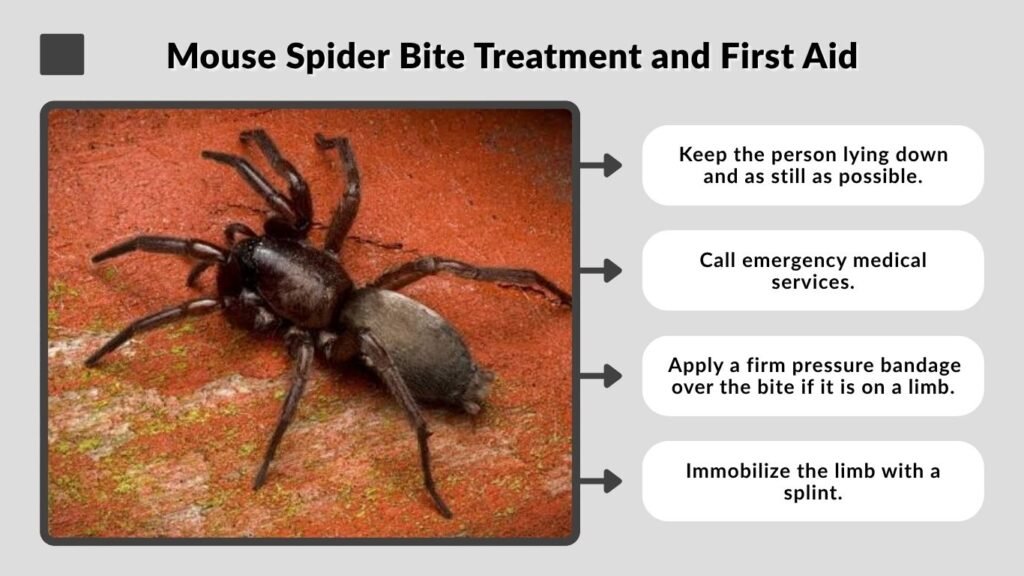
Treatment depends on whether the spider could be an Australian Missulena mouse spider.
A suspected Australian mouse spider bite should receive the same emergency first-aid approach recommended for funnel-web spider bites.
Mouse Spider Bite First Aid
If someone may have been bitten by an Australian mouse spider:
- Keep the person lying down and as still as possible.
- Call emergency medical services.
- Apply a firm pressure bandage over the bite if it is on a limb.
- Continue bandaging the entire limb from near the fingers or toes upward.
- Immobilize the limb with a splint.
- Record the time the bite occurred.
- Mark the bite location if possible.
- Keep the person still until medical help arrives.
Australian health authorities specifically recommend pressure immobilization for mouse spider and funnel-web spider bites because it can slow movement of venom through the lymphatic system.
What Not to Do
Do not cut the wound, suck out the venom, or use a tourniquet.
For a suspected Australian mouse spider bite, health guidance also advises against washing venom from the bite area before medical assessment because residue may potentially assist identification.
Eastern, Northern, and Red-Headed Mouse Spider Bites
Several Australian Missulena species may be encountered, and searches for bites commonly involve eastern, northern, and red-headed mouse spiders.
Eastern Mouse Spider Bite
The eastern mouse spider (Missulena bradleyi) is one of the better-studied species.
In a review of confirmed bites, six bites from M. bradleyi produced minor local neurological symptoms such as tingling, numbness, and sweating. One severe neurotoxic case was documented among the 40 confirmed mouse spider bites reviewed.
Because appearance alone cannot determine how much venom has been injected, suspected bites should still receive appropriate emergency first aid.
Northern Mouse Spider Bite
The northern mouse spider (Missulena pruinosa) occurs in northern Australia.
In one Australian study, seven confirmed bites involved this species, and two victims experienced systemic effects. The researchers nevertheless found no severe outcomes among the identified spider bites in that particular study.
Red-Headed Mouse Spider Bite
The red-headed mouse spider (Missulena occatoria) is recognizable particularly in males, which can have a bright red head and jaws with a dark abdomen. Females are generally larger and much darker.
Although bites are uncommon, the Australian Museum considers mouse spider venom potentially dangerous and advises taking bites seriously.
Male vs. Female Mouse Spider Bite
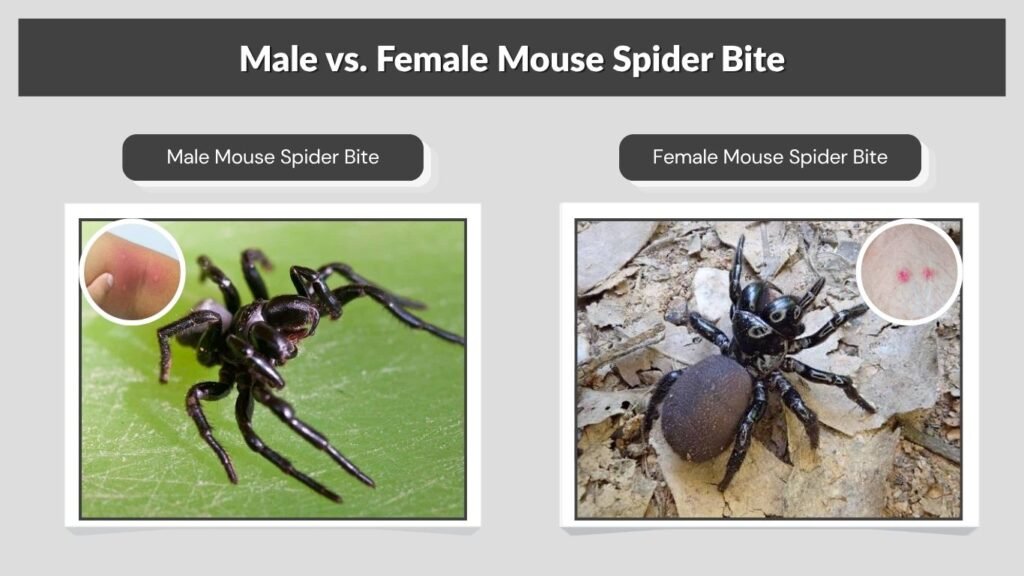
Male and female mouse spiders can both possess venom, so sex should not be used to decide whether a bite needs treatment.
Male mouse spiders are more likely to be noticed wandering above ground while searching for females, whereas females generally spend much more time associated with their burrows.
Color is also unreliable for judging bite danger. Terms such as brown mouse spider, black mouse spider, or “red-headed mouse spider” may describe appearance, but medical decisions should be based on the suspected species, location, and symptoms rather than color alone.
Mouse Spider Bites in the UK, California, and Oregon
The name “mouse spider” creates considerable confusion outside Australia.
Mouse Spider Bite in the UK
In Britain, “mouse spider” commonly refers to Scotophaeus blackwalli, a ground spider belonging to the family Gnaphosidae. It is not an Australian Missulena mouse spider.
Scotophaeus blackwalli is widespread in much of England and also occurs in Wales and Scotland. It commonly lives inside houses, sheds, and similar structures and may be seen walking across walls or ceilings at night.
Therefore, articles describing the potentially serious Australian mouse spider should not automatically be applied to UK mouse spiders.
California and Oregon Mouse Spiders
Scotophaeus blackwalli has also been recorded in California, including museum collection records, and records exist from Oregon.
Consequently, someone searching for a “California mouse spider bite” or “Oregon mouse spider bite” may be referring to Scotophaeus blackwalli, rather than the medically significant Australian genus Missulena.
Correct species identification is particularly important in these cases.
FAQs
Can a Mouse Spider Bite Kill a Human?
Australian Missulena mouse spiders possess potentially significant venom, but severe envenomation is rare. A review of 40 confirmed bites found only one severe neurotoxic case. Nevertheless, suspected Australian mouse spider bites should be treated as medical emergencies.
How Painful Is a Mouse Spider Bite?
A mouse spider bite can be painful. Australian studies of identified spider bites found local pain to be the most common effect. Pain intensity varies according to the bite, amount of venom delivered, species, and individual response.
How Do You Treat a Mouse Spider Bite?
For a suspected Australian mouse spider bite, keep the person still, call emergency services, apply a pressure immobilization bandage to a bitten limb, and immobilize it with a splint. Do not cut or suck the wound.
Is a UK Mouse Spider Bite Dangerous?
The UK mouse spider usually refers to Scotophaeus blackwalli, which is completely different from Australian Missulena mouse spiders. The British species belongs to the ground spider family Gnaphosidae, so Australian mouse spider envenomation guidance should not automatically be applied to it.
Should I Go to the Hospital After a Mouse Spider Bite?
If you are in Australia and a mouse spider or unidentified large dark spider may have bitten you, seek emergency medical assistance and use pressure immobilization first aid. Severe envenomation is uncommon, but symptoms can potentially become serious.
