
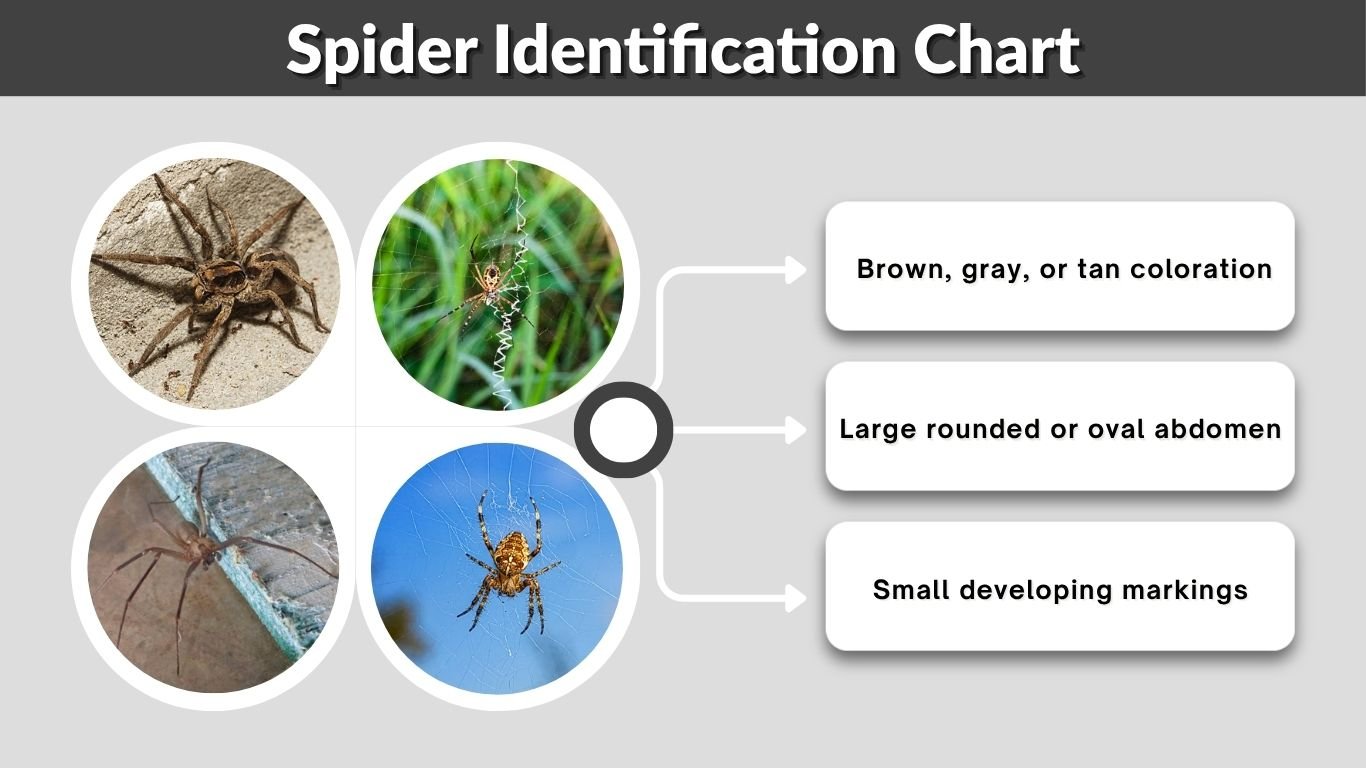
Identifying a spider can be difficult because many species share similar colors, markings, and body shapes. A spider identification chart makes the process easier by comparing features such as size, color, leg shape, web type, habitat, and distinctive markings.
Most spiders found around homes and gardens are harmless to humans and actually help control insects. However, correctly identifying a spider is useful when distinguishing common house spiders from species such as black widows or recluse spiders. This guide covers some of the most recognizable spiders and the characteristics that can help you tell them apart.
Spider Identification Chart
The following chart provides a quick comparison of several commonly encountered spiders.
| Spider | Typical Color | Main Identification Feature | Common Location | Medical Concern |
|---|---|---|---|---|
| Wolf Spider | Brown, gray, tan | Hairy body, long legs | Ground, yards, houses | Low |
| Black Widow | Glossy black | Red hourglass marking | Sheds, garages, woodpiles | Significant |
| Brown Recluse | Light to dark brown | Violin-like marking | Dark indoor spaces | Significant |
| Jumping Spider | Black, brown, colorful | Large front eyes | Walls, windows, gardens | Low |
| Orb Weaver | Brown, orange, yellow | Large abdomen, circular web | Gardens | Low |
| Cellar Spider | Pale brown or gray | Extremely long thin legs | Basements, ceilings | Low |
| House Spider | Brown or tan | Patterned abdomen | Corners, windows | Low |
| Grass Spider | Brown | Long spinnerets | Lawns, shrubs | Low |
| Fishing Spider | Brown or gray | Large body, banded legs | Near water | Low |
| Yellow Sac Spider | Pale yellow or cream | Small light-colored body | Walls, ceilings, vegetation | Usually low |
Because color can vary considerably within a species, identification should rely on several characteristics rather than color alone.
How to Identify a Spider
The easiest way to identify an unknown spider is to examine several visible features together.
Start with body shape, markings, leg proportions, behavior, web design, and where the spider was found.
Spider Identification Features
Important characteristics include:
- Body color
- Abdomen shape
- Body size
- Leg length
- Hairiness
- Stripes or spots
- Eye arrangement
- Web type
- Spinneret length
- Hunting behavior
- Habitat
- Geographic location
Spiders have eight legs and two major body sections: the cephalothorax and abdomen. Unlike insects, they do not have antennae.
Wolf Spider Identification
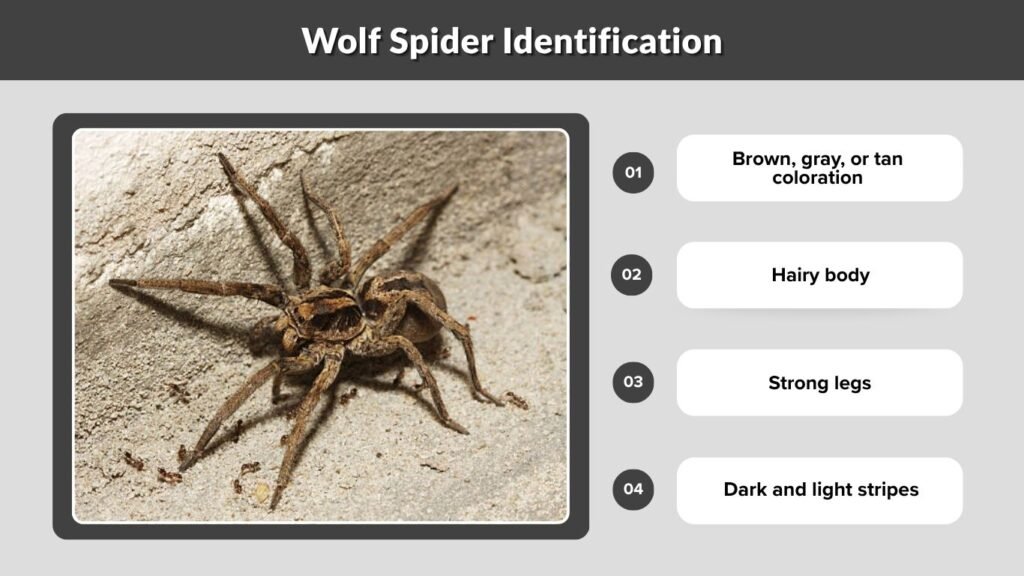
Wolf spiders belong to a large group of active hunting spiders. They don’t rely on traditional prey-catching webs and are often seen running across the ground.
Their speed and relatively large size can make them intimidating.
What Does a Wolf Spider Look Like?
A wolf spider commonly has:
- Brown, gray, or tan coloration
- Hairy body
- Strong legs
- Dark and light stripes
- Large forward-facing eyes
- Stocky appearance
- Fast ground-running behavior
One particularly distinctive characteristic is maternal behavior. Female wolf spiders carry their egg sacs behind them, and after hatching, numerous baby spiders may ride on the mother’s back.
Where Are Wolf Spiders Found?
Wolf spiders commonly live around:
- Lawns
- Gardens
- Forest floors
- Rocks
- Woodpiles
- Garages
- Basements
- Sheds
They sometimes enter houses accidentally while searching for prey or shelter.
Brown Recluse Spider Identification
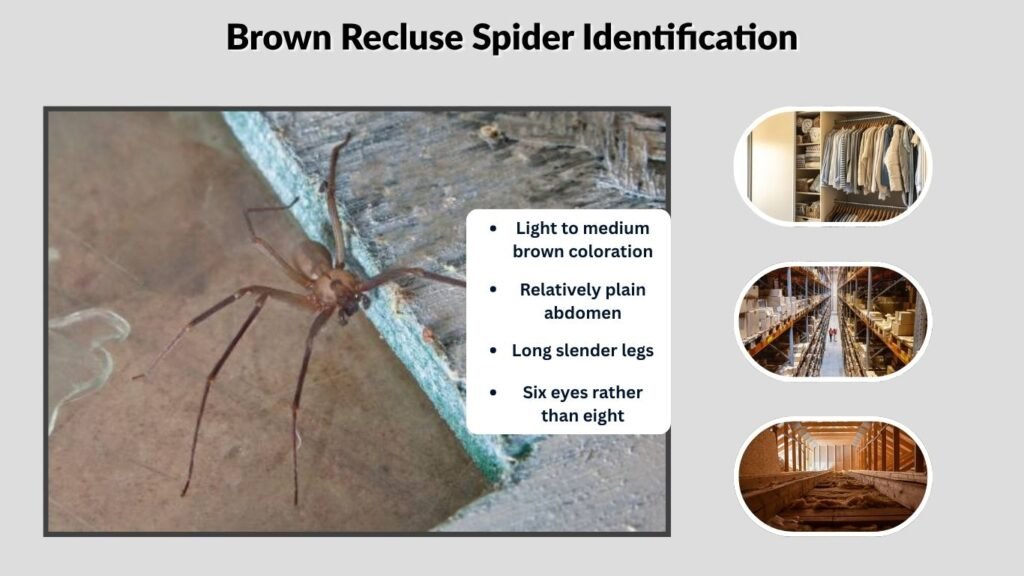
The brown recluse is one of the spiders people are most concerned about identifying correctly.
However, many harmless brown spiders are mistakenly identified as brown recluses.
What Does a Brown Recluse Look Like?
A brown recluse generally has:
- Light to medium brown coloration
- Relatively plain abdomen
- Long slender legs
- Six eyes rather than eight
- Violin-shaped marking on the cephalothorax
- Body without heavy hair or obvious spines
The darker violin-shaped marking may help with identification, but it should never be the only feature used.
Young individuals may have less obvious markings.
Where Do Brown Recluse Spiders Hide?
They prefer sheltered, relatively undisturbed locations such as:
- Cardboard boxes
- Closets
- Attics
- Storage areas
- Shoes
- Clothing piles
- Behind furniture
- Under objects
Bites usually occur when a spider becomes trapped against the skin rather than actively attacking someone.
Black Widow Spider Identification
Adult female black widows are among the easiest medically important spiders to recognize.
Their coloration and markings are distinctive.
What Does a Black Widow Look Like?
Typical female black widow characteristics include:
- Glossy black body
- Rounded abdomen
- Long slender legs
- Red or orange hourglass-shaped marking underneath the abdomen
Some individuals may also have red markings on the upper abdomen.
Male and immature black widows can look substantially different from adult females. They may have lighter colors and additional markings.
Where Do Black Widows Live?
They favor protected locations such as:
- Woodpiles
- Garages
- Sheds
- Outdoor furniture
- Crawl spaces
- Storage areas
- Under debris
Their webs tend to look irregular and tangled rather than symmetrical.
Jumping Spider Identification
Jumping spiders are small, energetic spiders commonly seen during daylight.
They are known for excellent vision and the ability to jump several times their body length.
What Does a Jumping Spider Look Like?
Look for:
- Compact body
- Relatively short strong legs
- Large front-facing eyes
- Hairy appearance
- Quick movements
- Sudden jumping behavior
Colors vary tremendously.
Depending on species, jumping spiders can be black, brown, gray, orange, green, or even metallic-looking.
Some have bright spots, stripes, or colorful mouthparts.
Orb Weaver Spider Identification
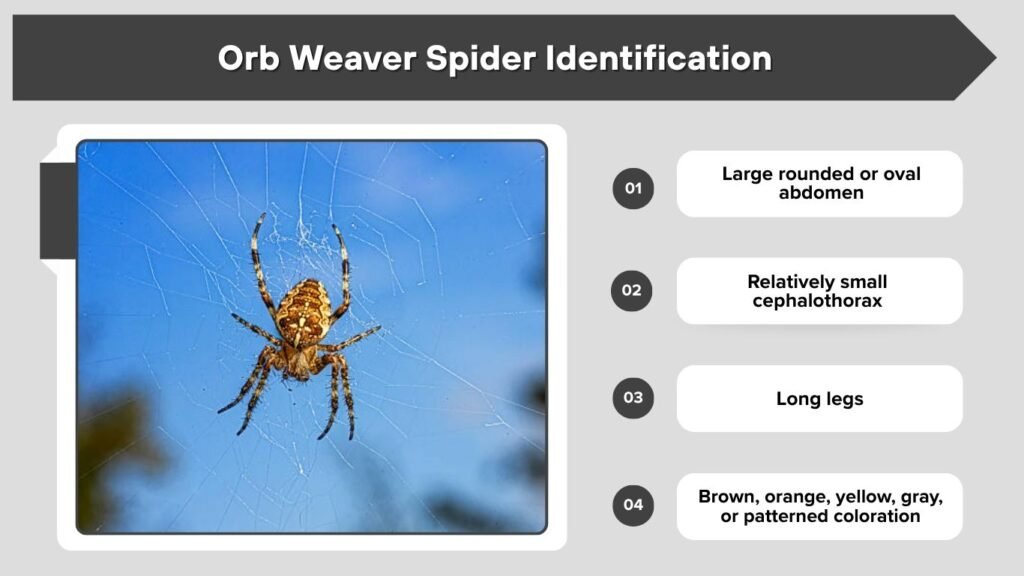
Orb weavers are famous for constructing the classic circular spider web commonly seen in gardens.
Their appearance varies considerably between species.
What Does an Orb Weaver Look Like?
Common characteristics include:
- Large rounded or oval abdomen
- Relatively small cephalothorax
- Long legs
- Brown, orange, yellow, gray, or patterned coloration
- Large circular web
Many orb weavers sit in the center of their web, especially during evening and nighttime hours.
Orb Weaver Web Identification
Their web often consists of:
- Radial support lines
- Circular spiral silk
- Large symmetrical shape
- Open center area
These webs are commonly built between shrubs, trees, fences, and structures.
Cellar Spider Identification
Cellar spiders are frequently called “daddy longlegs spiders,” although true harvestmen are different animals.
Their extremely long legs make them easy to recognize.
What Does a Cellar Spider Look Like?
A cellar spider usually has:
- Tiny elongated body
- Pale gray, tan, or brown coloration
- Extremely long thin legs
- Delicate appearance
They often hang upside down inside irregular webs.
Cellar spiders commonly live in:
- Basements
- Cellars
- Garages
- Ceiling corners
- Storage rooms
When disturbed, some rapidly vibrate their bodies and webs.
Common House Spider Identification
Common house spiders are responsible for many irregular cobwebs found indoors.
Their exact appearance varies between species.
Common Characteristics
They may have:
- Brown or tan body
- Rounded abdomen
- Darker abdominal patterns
- Thin legs
- Small to medium body size
House spiders frequently construct messy webs in quiet areas.
Look around:
- Windows
- Ceiling corners
- Garages
- Storage spaces
- Behind furniture
- Basements
Finding one occasionally does not necessarily indicate an infestation.
Grass Spider Identification
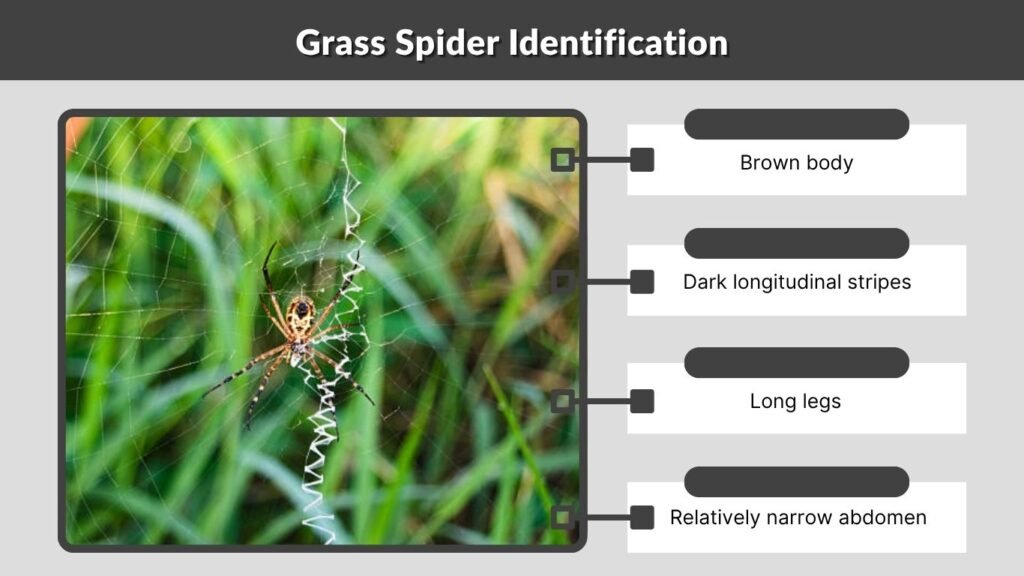
Grass spiders are frequently confused with wolf spiders because both are brown, fast-moving ground spiders.
The easiest visible difference is often found at the rear of the abdomen.
What Does a Grass Spider Look Like?
Grass spiders commonly have:
- Brown body
- Dark longitudinal stripes
- Long legs
- Relatively narrow abdomen
- Two conspicuous spinnerets extending from the abdomen
Those elongated spinnerets may appear like two small tails.
Grass Spider Web
Grass spiders construct sheet-like webs with a funnel-shaped retreat.
These webs commonly appear:
- Across grass
- Around shrubs
- Against foundations
- In dense vegetation
The spider waits inside the funnel and rushes toward prey landing on the web.
Fishing Spider Identification
Fishing spiders can grow quite large and are sometimes mistaken for wolf spiders.
They belong to the genus Dolomedes and many species occur near water.
What Does a Fishing Spider Look Like?
Common features include:
- Large body
- Long powerful legs
- Brown or gray coloration
- Striped or patterned body
- Legs extending widely around the body
Some species can move across the surface of water and capture aquatic prey.
Others can also occur some distance from water and occasionally enter buildings.
Yellow Sac Spider Identification
Yellow sac spiders are relatively small and pale-colored.
They are wandering hunters rather than traditional web-building spiders.
What Does a Yellow Sac Spider Look Like?
Typical features include:
- Pale yellow body
- Cream or light tan coloration
- Relatively long front legs
- Small narrow abdomen
- Darker mouthparts in some individuals
Rather than producing large prey-catching webs, they make small silken sacs where they rest.
These sacs can occur in corners, behind objects, under leaves, and where walls meet ceilings.
Garden Spider Identification
Several orb-weaving spiders are commonly referred to as garden spiders.
One particularly recognizable example is the yellow garden spider.
Yellow Garden Spider
Identification features commonly include:
- Black body
- Bright yellow markings
- Long legs
- Large abdomen
- Large circular web
A distinctive zigzag band of thick silk may appear through the center of the web.
Despite their dramatic size, garden spiders generally prefer remaining in their webs and avoiding human contact.
Spider Web Identification Chart
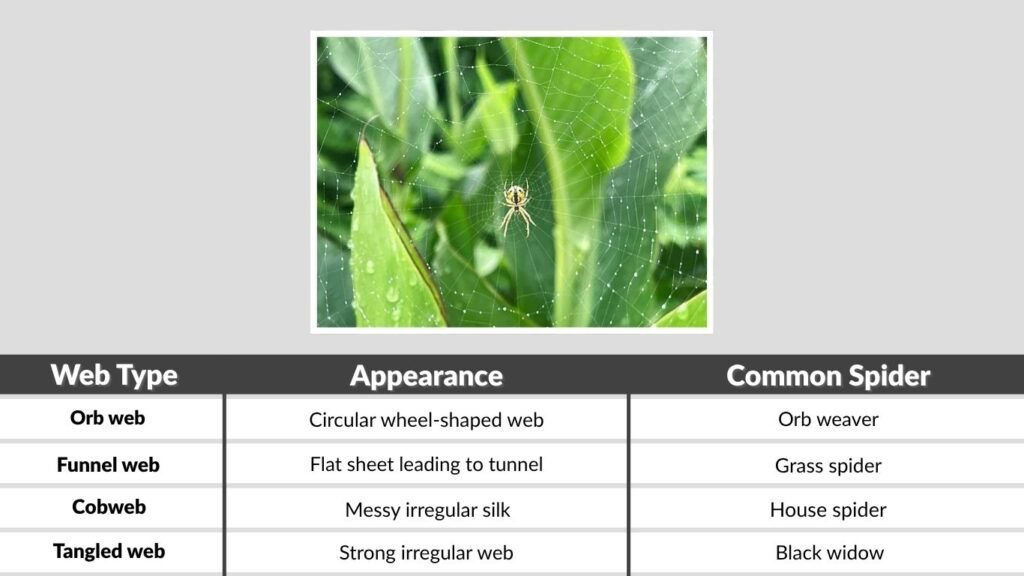
Sometimes identifying the web is easier than identifying the spider.
| Web Type | Appearance | Common Spider |
|---|---|---|
| Orb web | Circular wheel-shaped web | Orb weaver |
| Funnel web | Flat sheet leading to tunnel | Grass spider |
| Cobweb | Messy irregular silk | House spider |
| Tangled web | Strong irregular web | Black widow |
| Sheet web | Horizontal sheet of silk | Various sheet-web spiders |
| No capture web | Spider hunts directly | Wolf spider, jumping spider |
Remember that not every spider builds a web for catching food.
Wolf spiders and jumping spiders actively hunt instead.
Brown Spider Identification
Finding a brown spider does not automatically mean you have found a brown recluse.
Numerous harmless spiders are primarily brown.
These include:
- Wolf spiders
- Grass spiders
- House spiders
- Fishing spiders
- Orb weavers
- Nursery web spiders
When identifying a brown spider, examine markings, hairiness, spinnerets, body proportions, web type, and location.
Black Spider Identification
Black coloration also occurs in many unrelated spiders.
A black spider may be:
- Jumping spider
- Black widow
- House spider
- Trapdoor spider
- Ground spider
A glossy black spider with a rounded abdomen should be examined carefully for the characteristic markings associated with black widows.
However, avoid handling an unknown spider to inspect its underside.
Small Spider Identification
Very small spiders are particularly difficult to identify because important features may not be visible without magnification.
Baby spiders can also look different from mature adults.
When examining a tiny spider, consider:
- Color
- Leg length
- Body proportions
- Movement
- Web structure
- Location
Avoid relying only on size because juveniles of normally large species can be extremely small.
Baby Spider Identification
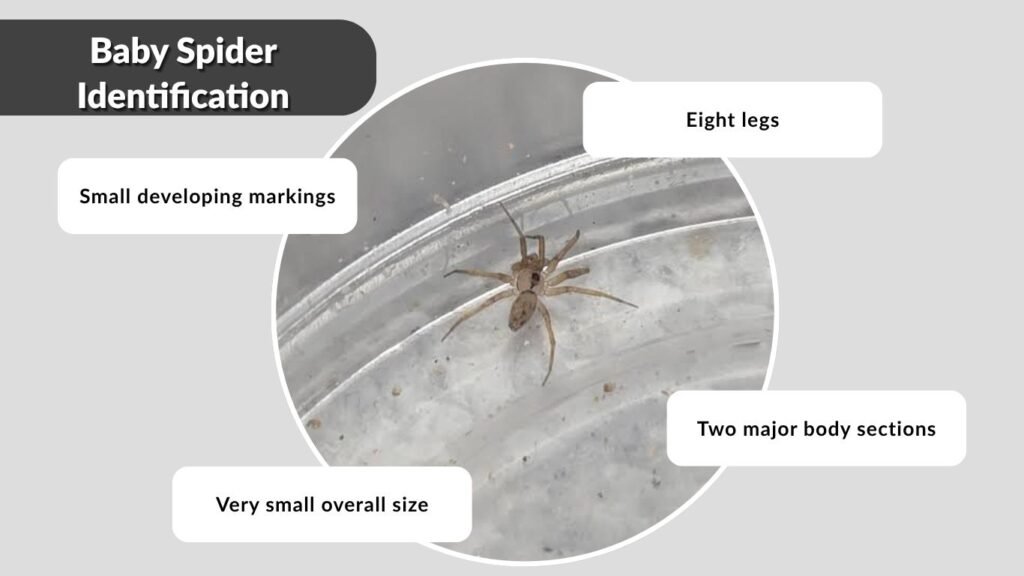
Baby spiders are known as spiderlings.
They usually resemble miniature spiders rather than larvae.
A spiderling generally has:
- Eight legs
- Two major body sections
- Small developing markings
- Very small overall size
The colors and patterns of some spiders change significantly as they mature, making species-level identification of young spiderlings difficult.
How to Tell a Spider From an Insect
Spiders are arachnids, not insects.
| Feature | Spider | Insect |
|---|---|---|
| Legs | 8 | 6 |
| Main body sections | 2 | 3 |
| Antennae | No | Usually yes |
| Wings | Never | Some species |
| Class | Arachnida | Insecta |
If an animal has six legs and antennae, it is not a spider.
Which Spiders Should You Be Careful Around?
Most spiders prefer avoiding people, and relatively few species pose significant medical concerns.
Still, unidentified spiders should be handled cautiously.
Do not pick up a spider with bare hands simply to identify it.
Pay particular attention when you suspect:
- Black widow
- Recluse spider
- Another medically important species native to your region
If someone develops severe pain, widespread muscle cramping, breathing difficulty, severe swelling, vomiting, rapidly worsening skin damage, or other serious symptoms following a suspected bite, medical attention is appropriate.
Tips for Identifying an Unknown Spider
When possible, take a clear photograph without touching the spider.
Photograph:
- The spider from above.
- The body markings.
- The legs.
- The web, if present.
- The surrounding habitat.
Also consider where you found it.
A spider sitting in the middle of a circular garden web is likely to belong to a very different group than one running rapidly across a basement floor.
Using multiple characteristics provides a much more reliable identification than matching body color alone.
FAQs
What is the easiest way to identify a spider?
Start by examining the spider’s size, body shape, color, markings, leg length, web type, and behavior. Location is also important. Combining several features is much more reliable than identifying a spider based solely on color.
How can I identify a brown recluse spider?
Brown recluses generally have six eyes arranged in three pairs, relatively plain brown bodies, slender legs, and a darker violin-like marking on the cephalothorax. Because many harmless brown spiders resemble them, professional identification may sometimes be necessary.
How do I know if a spider is a wolf spider?
Wolf spiders tend to have hairy brown or gray bodies, strong legs, prominent eyes, and fast running behavior. They are ground hunters and generally don’t build traditional prey-catching webs. Females may also carry spiderlings directly on their backs.
What spider has a red hourglass on its body?
Adult female black widow spiders are known for a red or orange hourglass-shaped marking on the underside of their glossy black abdomen. Their appearance varies by species and life stage, so not every widow looks exactly the same.
Can you identify a spider by its web?
The web can provide strong clues. Orb weavers create circular webs, grass spiders make funnel-shaped sheet webs, and many house spiders create irregular cobwebs. However, some spiders, including wolf spiders and jumping spiders, hunt without using capture webs.
