
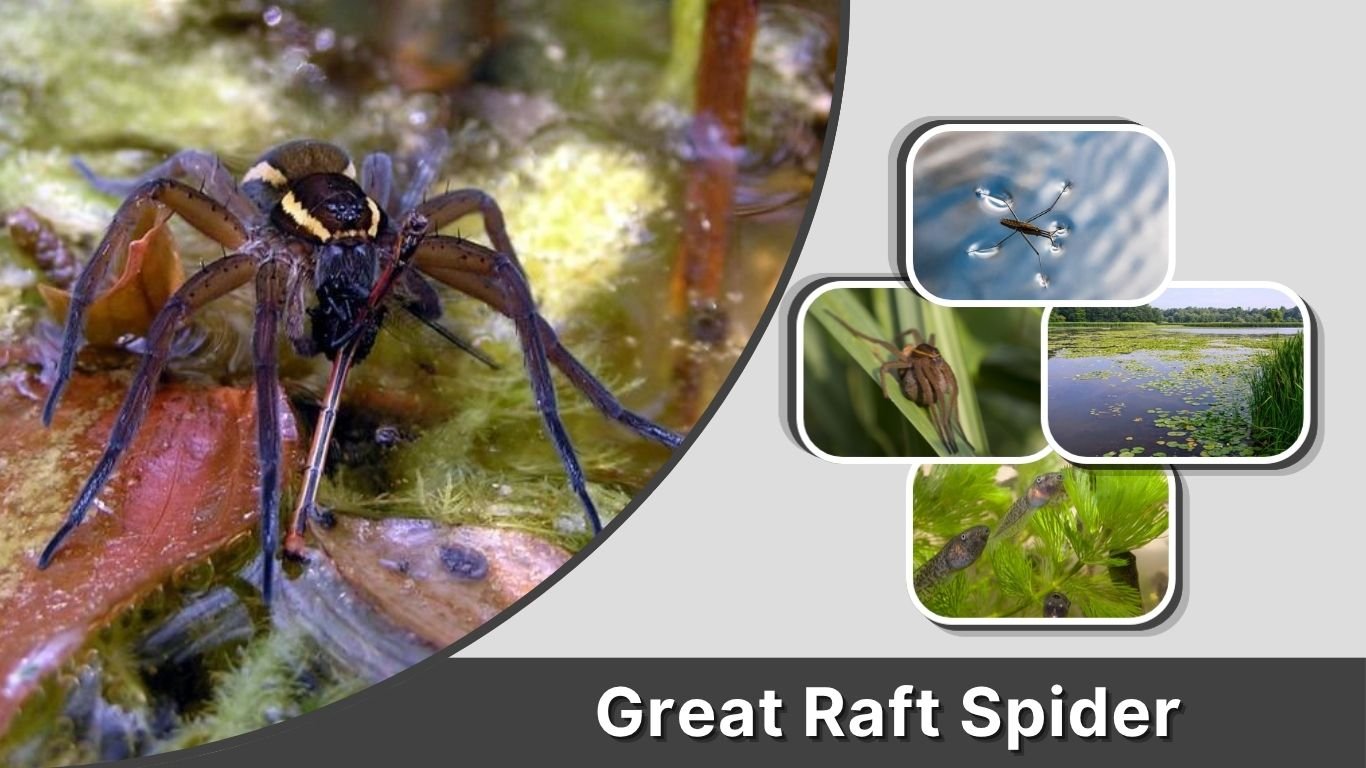
The great raft spider is a large semi-aquatic spider famous for walking across water and occasionally catching small fish. Also called the fen raft spider, this impressive European species lives around clean ponds, marshes, canals, and grazing ditches. Its long, hairy legs allow it to detect vibrations, move over the water’s surface, and dive when threatened. Despite its intimidating size, the great raft spider is shy and is not considered dangerous to humans.
What Is a Great Raft Spider?
The great raft spider’s scientific name is Dolomedes plantarius. It belongs to the nursery web spider family, Pisauridae, and is one of only two Dolomedes species found naturally in Europe.
In the United Kingdom, the species is usually called the fen raft spider, although “great raft spider” is also widely used. It should not be confused with the common raft spider, Dolomedes fimbriatus.
| Feature | Description |
| Scientific name | Dolomedes plantarius |
| Other name | Fen raft spider |
| Family | Pisauridae |
| Body length | Up to approximately 23 mm |
| Leg span | Around 7 cm |
| Color | Brown or black with pale side stripes |
| Habitat | Fens, marshes, ponds, canals, and ditches |
| Diet | Aquatic insects, spiders, tadpoles, and small fish |
| Lifestyle | Semi-aquatic ambush predator |
Great Raft Spider Identification
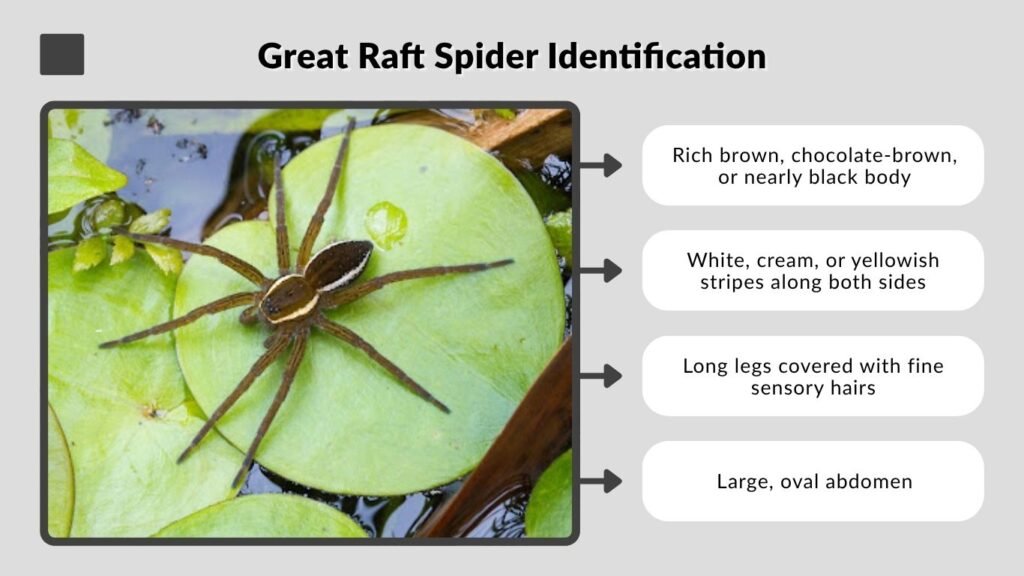
The great raft spider has a strong, elongated body and widely spreading legs. Its colors help it blend into wet vegetation, muddy banks, and dark water.
Physical Description
A great raft spider can often be identified by the following features:
- Rich brown, chocolate-brown, or nearly black body
- White, cream, or yellowish stripes along both sides
- Long legs covered with fine sensory hairs
- Large, oval abdomen
- Eight eyes positioned across the front of the head
- Pale stripe running along the edge of the cephalothorax
- Silvery appearance when submerged underwater
The pale side stripes are helpful identification features, but their visibility varies between individuals. Some spiders have bold cream markings, while others are much darker and less clearly striped.
Great Raft Spider vs. Common Raft Spider
The great raft spider and common raft spider can look extremely similar. Both are brown, long-legged, semi-aquatic spiders with pale stripes.
However, the great raft spider is more strongly associated with open, standing water in lowland wetlands. The common raft spider is frequently found in acidic bogs, wet heathlands, and upland mires. Accurate separation may require examination by an experienced spider specialist.
Great Raft Spider Size
The great raft spider is one of the largest spiders found in the United Kingdom. Adult females can reach approximately 23 mm in body length, excluding their legs.
When the legs are fully extended, a large female may span around 7 cm, or approximately 2.75 inches. This makes it roughly palm-sized, although the actual body is much smaller than the complete leg span.
Male vs. Female Size
Females are generally larger and more heavily built than males. Their larger abdomen allows them to produce eggs and carry a substantial egg sac.
Males tend to have slimmer bodies and proportionally long legs. During the breeding season, adult males travel through wetland vegetation searching for females.
Great Raft Spider Habitat
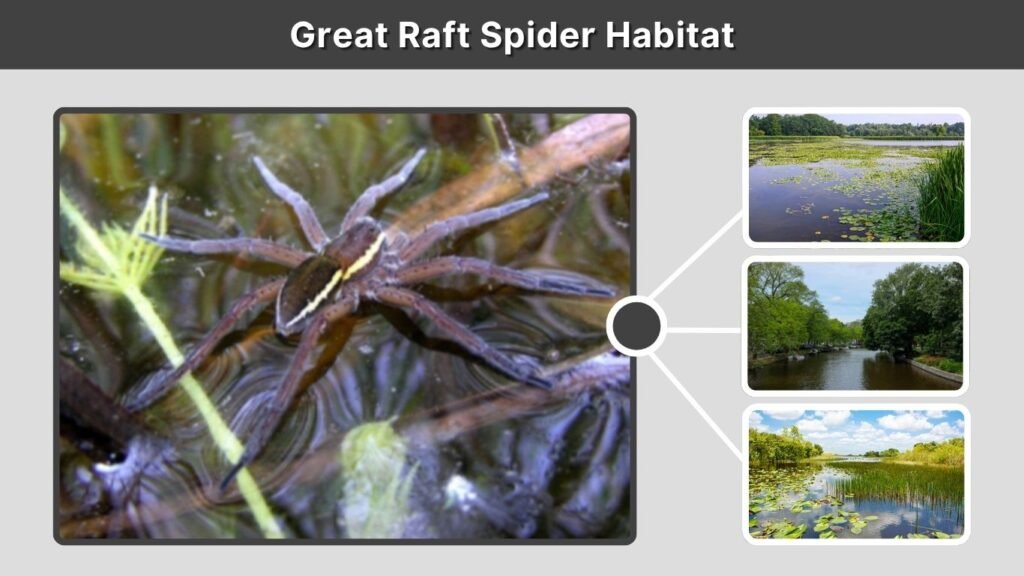
Great raft spiders depend on healthy freshwater wetlands. They require permanent or relatively stable water, abundant prey, and vegetation strong enough to support their nursery webs.
Preferred Habitats
Great raft spiders may be found around:
- Fen pools
- Grazing-marsh ditches
- Slow canals
- Shallow ponds
- Wetland lakes
- Marshes and swamps
- Old peat-cutting pools
- Areas with sedges, rushes, and aquatic plants
The species generally prefers unpolluted, neutral to alkaline water. Complex marginal vegetation is especially important because females attach their nursery webs to strong leaves and stems above the water.
Where Do Great Raft Spiders Live?
The species occurs across parts of central, northern, and western Europe. Its distribution is fragmented because many suitable wetlands have been drained, polluted, or converted for agriculture and development.
In the UK, important populations occur in southern England, East Anglia, and South Wales. Conservation programs have also established additional populations in restored wetlands in the Norfolk and Suffolk Broads.
Great Raft Spider Behavior
The great raft spider does not build a sticky web to catch prey. Instead, it is an ambush hunter that waits beside the water with its rear legs supported by plants and its front legs resting on the surface.
How Does It Walk on Water?
Fine water-repellent hairs cover the spider’s legs and help distribute its weight across the water’s surface tension. The spider can move slowly by rowing or travel quickly with a high-stepping gallop.
Sensitive hairs also detect vibrations caused by insects, predators, or struggling animals. These signals help the spider determine the direction and approximate distance of potential prey.
Can Great Raft Spiders Swim?
Great raft spiders can break through the surface and move underwater. They often climb down submerged plant stems rather than swimming freely because air trapped around their hairy bodies makes them buoyant.
The trapped air gives the spider a bright silver appearance underwater. Diving is used for hunting and escaping frogs, birds, or other predators.
What Do Great Raft Spiders Eat?
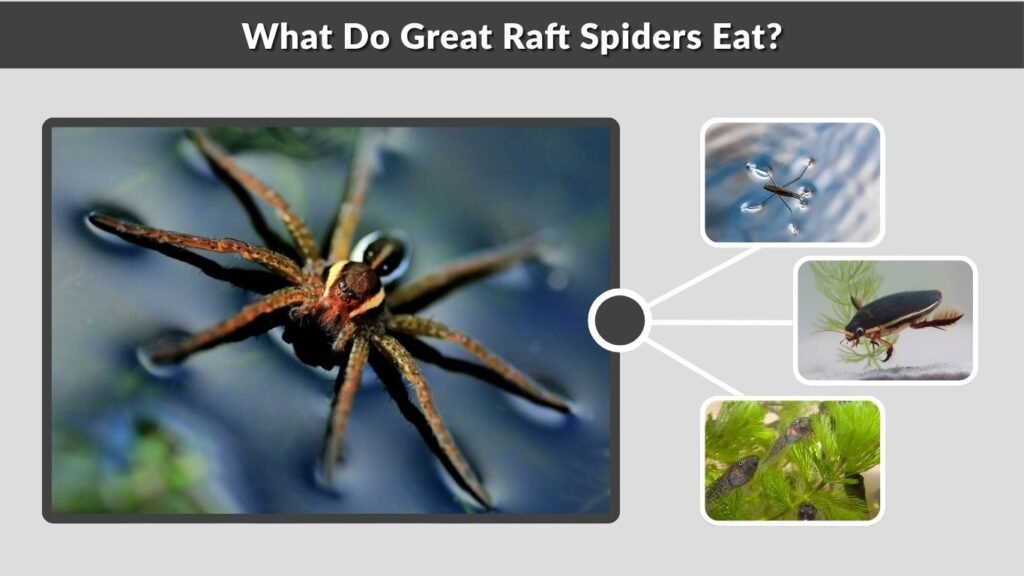
Great raft spiders are carnivorous predators that mainly feed on animals found around freshwater. Despite being called fishing spiders, fish form only a small part of their normal diet.
Common foods include:
- Pond skaters
- Water beetles
- Aquatic spiders
- Damselflies
- Adult and larval dragonflies
- Insects that fall into the water
- Tadpoles
- Very small fish
When prey creates vibrations, the spider rushes forward and grabs it with its legs. It then uses its fangs to inject venom, immobilizing the animal before feeding.
Great Raft Spider Predators
Relatively little is known about all the animals that prey on great raft spiders. Young spiderlings are especially vulnerable because of their small size.
Recorded or likely predators include frogs, insect-eating birds, hornets, other wasps, and possibly fish. Adult spiders may escape by diving, jumping from the water, or dropping from vegetation. They can remain concealed beneath the surface while holding a layer of air against their bodies.
Reproduction and Nursery Webs
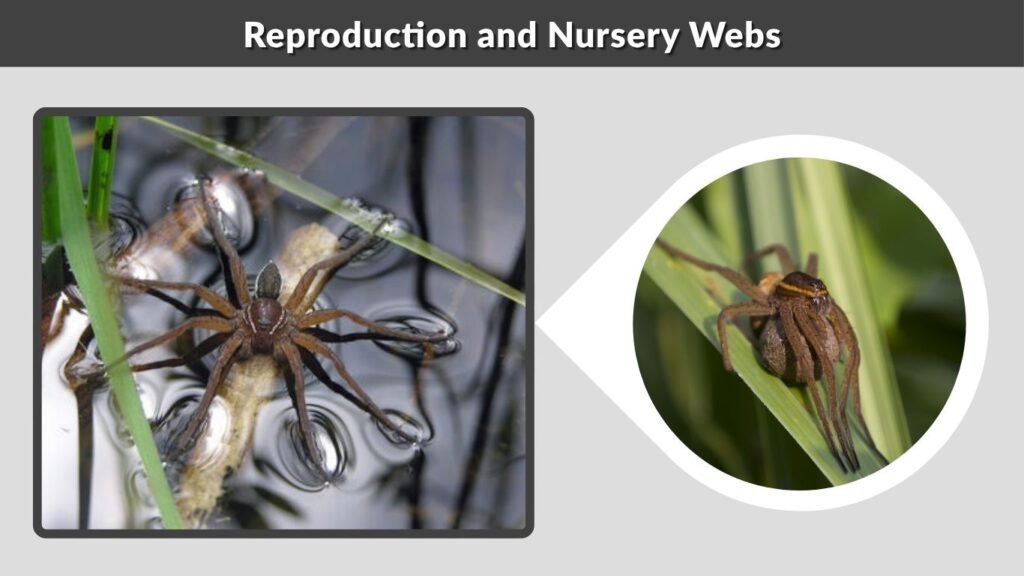
Female great raft spiders are highly protective mothers. After mating, a female produces a large round egg sac and carries it beneath her body using her mouthparts.
She carries the sac for approximately three weeks and regularly dips it into the water to prevent the eggs from drying out. During this period, she may stop feeding.
Shortly before the spiderlings hatch, the female attaches the egg sac inside a silk nursery web suspended among vegetation. The nursery may measure up to approximately 25 cm across. She guards the young for about a week before they disperse.
Is the Great Raft Spider Poisonous?
The great raft spider is venomous rather than poisonous. It injects venom through its fangs to control insects and other small prey.
However, it is considered harmless to humans. Great raft spiders are shy wetland animals that normally escape by running or diving when disturbed. They do not deliberately approach or attack people.
Can a Great Raft Spider Bite?
A bite may be physically possible if the spider is trapped, squeezed, or handled roughly. Nevertheless, confirmed bites are extremely uncommon, and the species is not regarded as medically dangerous.
Anyone encountering one should avoid touching or capturing it. Leave the spider in its wetland habitat and observe it from a reasonable distance.
Is the Great Raft Spider Endangered?
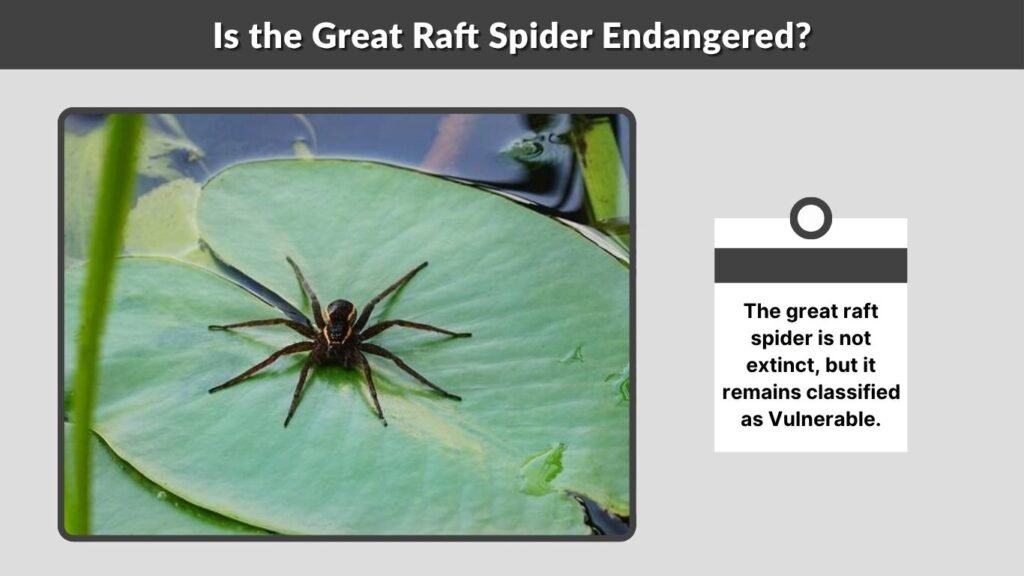
The great raft spider is not extinct, but it remains classified as Vulnerable. Its primary threats are wetland drainage, habitat fragmentation, declining water quality, agricultural runoff, drought, water extraction, and changing water levels.
The species became dangerously rare in the UK, with only a few isolated populations remaining. Captive breeding, habitat restoration, and translocation projects have since increased the number of sustainable populations. However, continued wetland management is necessary to protect this recovery.
FAQs
How big is a great raft spider?
An adult female can reach approximately 23 mm in body length. Including its fully extended legs, a large individual may span around 7 cm. The long legs make it appear much larger than its actual body.
Is a great raft spider dangerous?
Great raft spiders are not considered dangerous to humans. They possess venom for controlling prey, but they are shy and generally flee when disturbed. A defensive bite would be unlikely unless the spider were handled or trapped.
Can great raft spiders catch fish?
Yes, large individuals can capture very small fish and tadpoles. However, they mainly eat insects and other invertebrates, including pond skaters, water beetles, aquatic spiders, damselflies, and dragonfly larvae.
Why can great raft spiders walk on water?
Water-repellent hairs on their legs help spread their weight across the water’s surface tension. These hairs also detect vibrations, allowing the spider to locate prey and sense approaching predators.
Are great raft spiders found inside houses?
They are extremely unlikely to live inside houses. Great raft spiders depend on freshwater wetlands, aquatic prey, and waterside vegetation. A spider found indoors is almost certainly a different species.
