
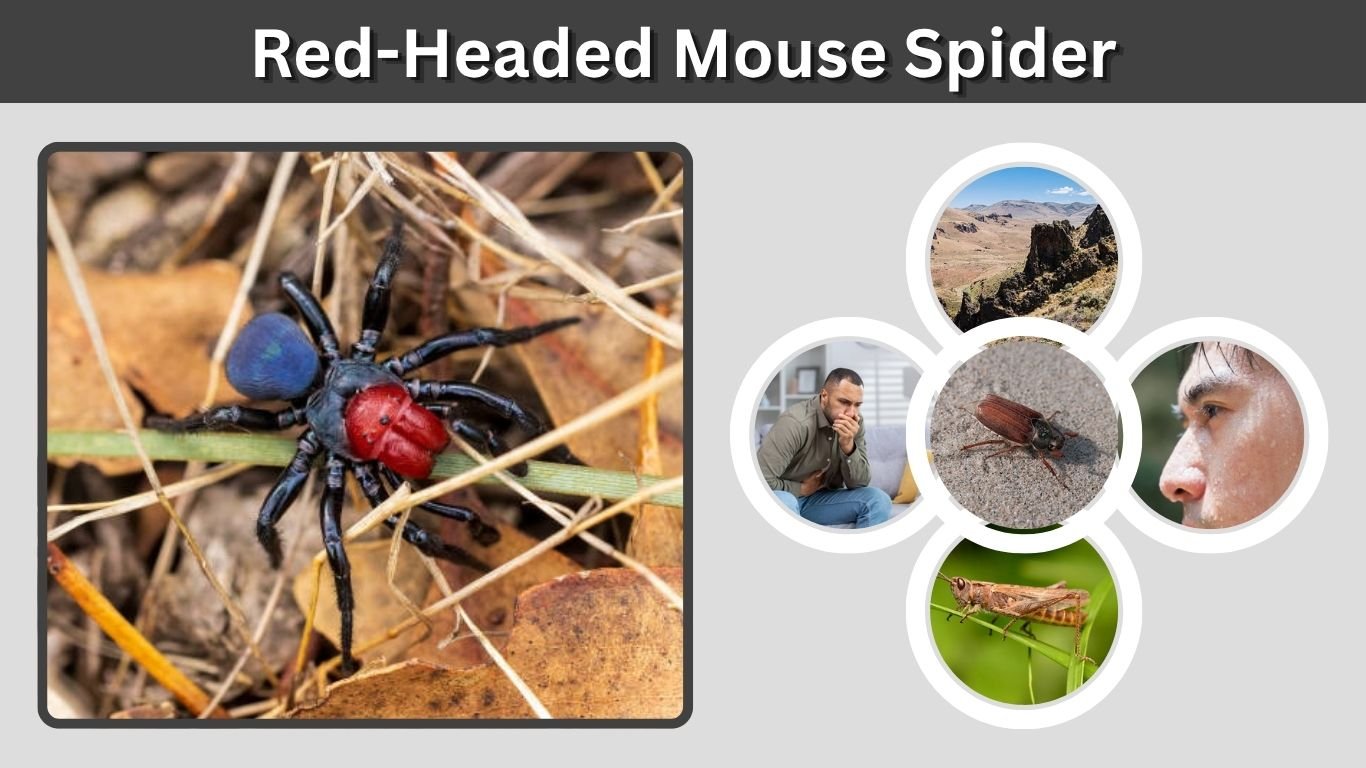
The red-headed mouse spider (Missulena occatoria) is one of Australia’s most striking burrowing spiders. Adult males have a bright red head and jaws, while females are usually dark brown or black. Although its appearance can be alarming, this spider spends most of its life underground and rarely interacts with people. Its venom is potentially dangerous, but serious bites are uncommon. Understanding its size, distribution, habitat, behaviour, and bite risk can help people identify the species and respond safely during an encounter.
What Is a Red-Headed Mouse Spider?
The red-headed mouse spider is a mygalomorph spider belonging to the family Actinopodidae. This makes it a relative of other primitive, heavy-bodied spiders, including trapdoor and funnel-web spiders.
Its common name refers primarily to the male’s vivid red head and jaws. The female does not have the same red colouring and can look like a completely different spider. Despite the name, this species does not hunt mice. It mainly eats insects and other spiders.
| Feature | Description |
| Scientific name | Missulena occatoria |
| Family | Actinopodidae |
| Maximum body size | Approximately 3.5 cm |
| Male colour | Red head and jaws with a dark blue-black abdomen |
| Female colour | Dark brown to black |
| Distribution | Widely distributed across mainland Australia |
| Habitat | Burrows in forests, shrublands and semi-arid areas |
| Diet | Insects, spiders and occasional small vertebrates |
| Venom | Potentially dangerous |
| Behaviour | Secretive and ground-dwelling |
Red-Headed Mouse Spider Identification
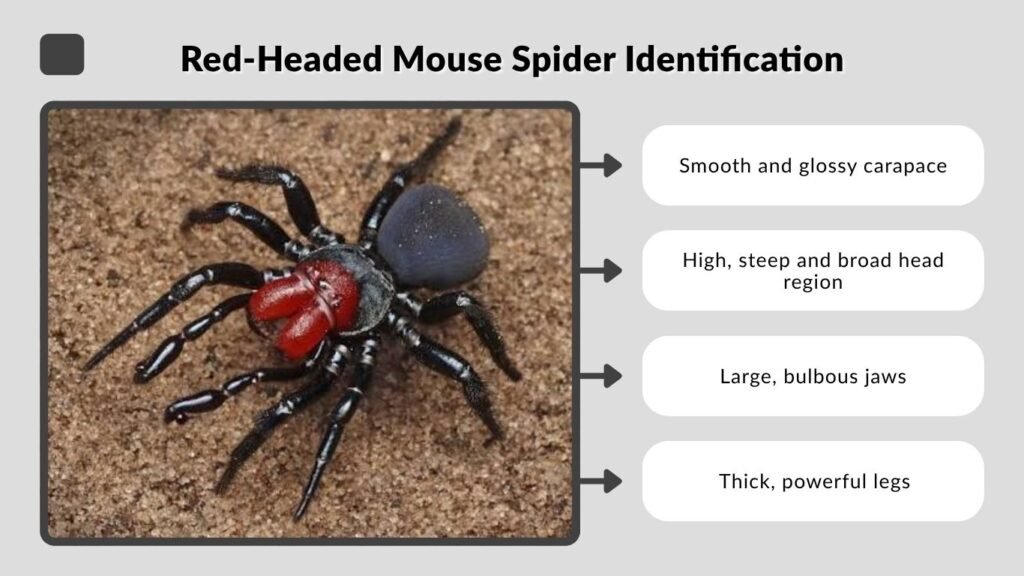
The red-headed mouse spider has a strong, compact body adapted for digging and living underground. Males are usually easier to identify because of their bright colouring. Females are larger but may be confused with other dark burrowing spiders.
Male Red-Headed Mouse Spider
The adult male is the form most commonly photographed. It has a vivid red or reddish-orange carapace and large red jaws. Its abdomen is generally gunmetal blue, dark blue or nearly black. The contrast between the red front section and dark abdomen makes the male especially noticeable.
Male red-headed mouse spiders have relatively slender bodies compared with females. Mature males leave their burrows to search for females, which is why people sometimes see them crossing gardens, paths, roads or driveways.
Female Red-Headed Mouse Spider
The female red-headed mouse spider does not have a red head. She is generally uniform dark brown, deep reddish-brown or black. Females are more heavily built than males and have powerful jaws suited to digging and capturing prey.
A female usually remains inside her burrow, so sightings are much less common. She may leave briefly if her burrow is flooded, damaged or disturbed. Because of her dark colour and glossy body, she may be mistaken for a funnel-web or another trapdoor spider.
Main Identification Features
- Smooth and glossy carapace
- High, steep and broad head region
- Large, bulbous jaws
- Thick, powerful legs
- Eyes spread across the front of the head
- Short and blunt spinnerets
- Rounded, soft-looking abdomen
- Red head and jaws in mature males
- Uniform dark colouring in females
- Heavy and compact body shape
The bright red colouring is therefore not enough to identify every individual. Only mature males display the species’ best-known colour pattern.
Red-Headed Mouse Spider Size
Red-headed mouse spiders can reach a body length of approximately 3.5 cm, excluding the legs. Females are generally larger and more robust than males. When the legs are included, a mature individual may appear considerably bigger.
The large head and jaws can make this spider look larger than its actual measurements. Its legs are relatively short and thick rather than long and widely spread like those of a huntsman spider.
Young spiders are much smaller and lack the dramatic proportions of mature adults. Their size and colouring can also change as they grow and pass through successive moults.
Location and Distribution in Australia
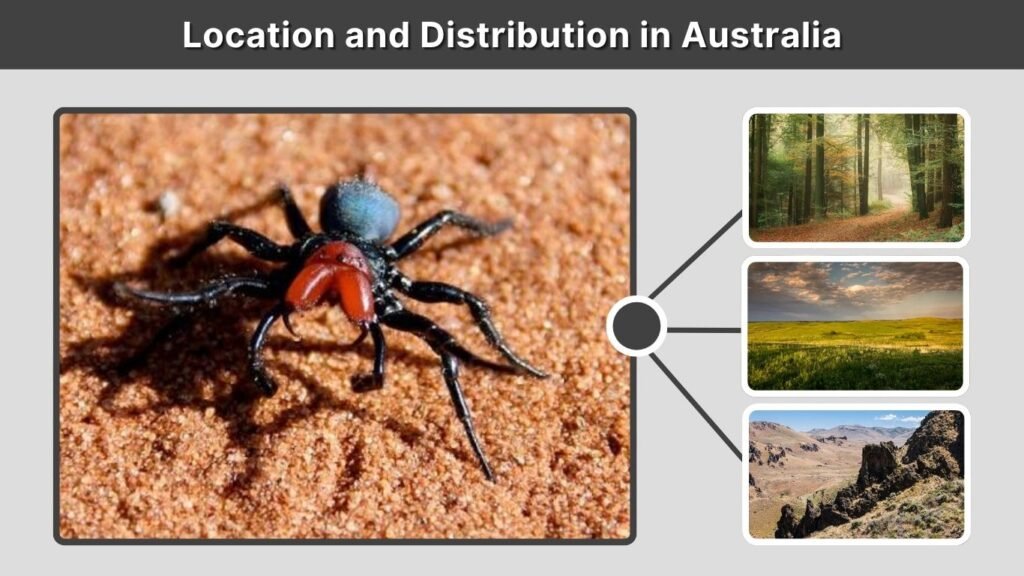
The red-headed mouse spider has one of the widest distributions among Australian mouse spiders. It occurs across mainland Australia, although sightings and population density vary according to soil, rainfall, habitat and season.
Where Is It Found?
Records of the species come from Western Australia, South Australia, Victoria, New South Wales, Queensland and the Northern Territory. It is particularly associated with inland, western and central areas but may also appear in suitable habitats closer to populated regions.
Red-headed mouse spiders have been recorded around Perth and in parts of regional Western Australia. They also occur in South Australia and Victoria, where wandering males may be found after rainfall.
Natural Habitat
The species occupies several relatively dry habitats, including open forest, woodland, grassland and semi-arid shrubland. It requires soil in which it can construct a stable underground retreat.
Burrows are sometimes built along the banks of rivers, creeks and other waterways. They may also occur in paddocks, roadside soil, bushland and suburban gardens. Museums Victoria notes that males commonly wander between late summer and early winter, especially after rain.
Burrow Structure
A red-headed mouse spider builds a silk-lined burrow in the ground. The entrance is usually covered with a camouflaged trapdoor made from silk, soil and small pieces of plant material. This door makes the burrow difficult for predators and people to detect.
The female spends most of her life inside this protected retreat. The burrow provides stable humidity and temperature while protecting her from predators, fire, dry weather and sudden environmental changes. It also functions as a hunting base and nursery for her young.
Diet and Hunting Behaviour
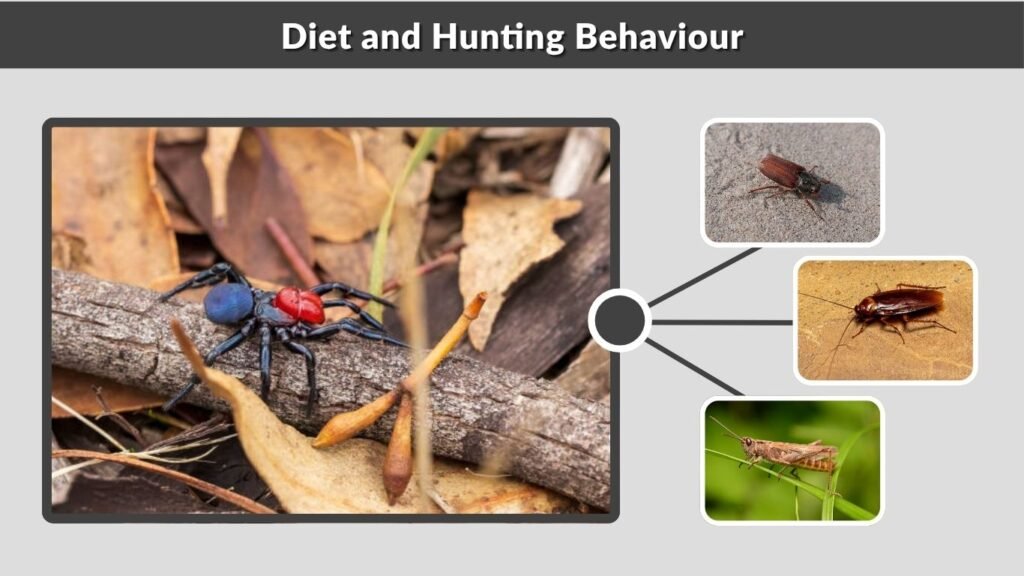
Red-headed mouse spiders are carnivorous ambush predators. They normally wait inside or near the burrow entrance for prey to approach rather than actively travelling long distances to hunt.
What Do Red-Headed Mouse Spiders Eat?
Their diet primarily includes:
- Beetles
- Cockroaches
- Crickets
- Ants
- Moths and larvae
- Other spiders
- Ground-dwelling insects
- Small frogs or lizards on rare occasions
The spider detects vibrations created by animals moving across the surrounding ground or silk lines. It quickly emerges, seizes the prey with its jaws and delivers venom through its fangs. The captured animal is then dragged into the burrow and consumed.
Although the spider is capable of taking a small vertebrate, insects and other spiders make up the majority of its diet.
Reproduction and Life Cycle
Mature males leave their underground retreats to locate females. This wandering period generally occurs from late summer through early winter, although local weather conditions can affect the timing. Rain may encourage males to emerge and move across the surface.
After mating, the female produces an egg sac inside a separate brood chamber connected to her main burrow. A single egg sac may contain 60 or more eggs. The spiderlings hatch during summer and initially remain protected inside the mother’s burrow.
Young red-headed mouse spiders may disperse through ballooning. They release silk that catches moving air and carries them away from the maternal burrow. This behaviour is unusual among mygalomorph spiders and may help explain the species’ extensive distribution.
The exact lifespan of the red-headed mouse spider has not been firmly established. Females likely live for several years because they remain protected underground, while mature males have shorter adult lives after leaving to find mates.
Is the Red-Headed Mouse Spider Dangerous?
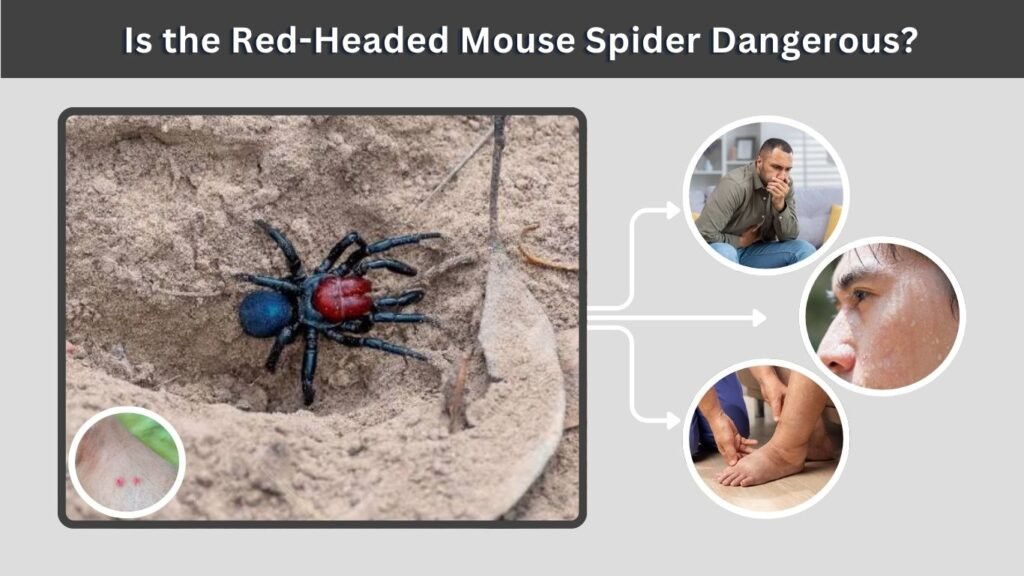
The red-headed mouse spider is venomous and should be treated cautiously. However, “venomous” does not mean that every encounter results in a bite or that every bite causes severe illness.
The spider usually tries to escape or retreat into its burrow. It is most likely to bite when handled, trapped against the skin or disturbed inside its shelter.
Venom and Bite Symptoms
Mouse spider venom contains neurotoxic components with similarities to funnel-web spider venom. Nevertheless, serious envenomation from confirmed mouse spider bites is rare. Some bites may inject little or no venom.
Possible symptoms include:
- Immediate pain at the bite site
- Puncture marks from the fangs
- Redness and swelling
- Numbness or tingling
- Sweating
- Headache
- Nausea or vomiting
- Muscle twitching
- Breathing difficulty
- Confusion or unconsciousness in a severe case
Mouse spider bites are uncommon, but their symptoms can resemble those of a funnel-web bite. The two spiders can also be difficult for an untrained person to distinguish.
What to Do After a Bite
Treat a suspected bite from a mouse spider or an unidentified large, dark Australian spider as a medical emergency. Call Triple Zero (000), keep the person calm and still, and follow the emergency operator’s instructions.
Australian sources currently differ regarding pressure immobilisation for a positively identified mouse spider bite. Healthdirect recommends it for mouse spiders and unidentified large black spiders, while the Australian Venom Research Unit does not currently recommend it for a confirmed mouse spider bite. Because identification is difficult, the safest approach is to obtain immediate professional instructions.
Do not cut the wound, suck out venom, use an arterial tourniquet or attempt to catch the spider by hand. A photograph can help identification, but only take one if it can be done safely.
Can You Keep a Red-Headed Mouse Spider as a Pet?
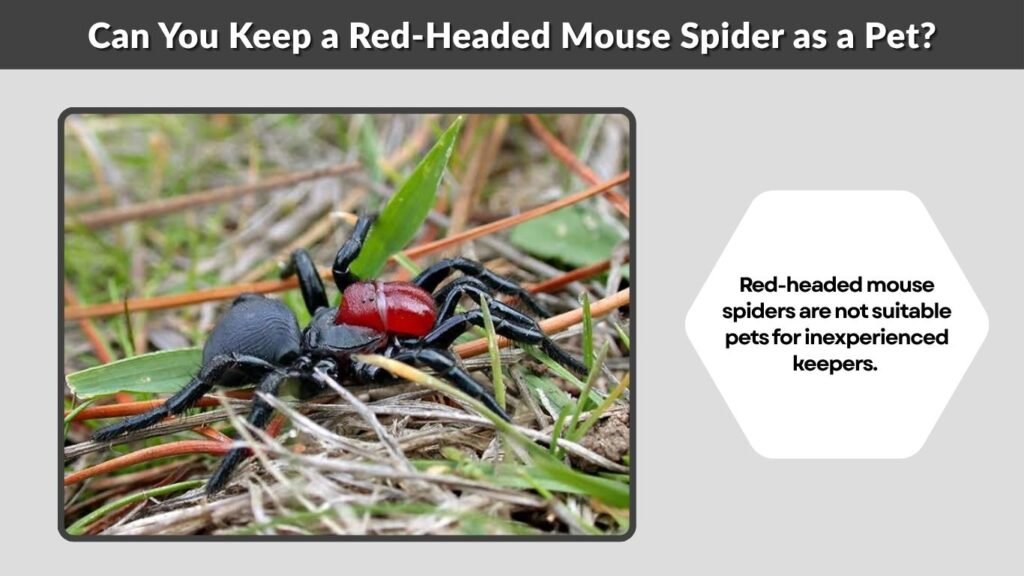
Red-headed mouse spiders are not suitable pets for inexperienced keepers. They are venomous, secretive and spend most of their time hidden underground. This provides limited opportunities for safe observation.
They are not commonly available for sale through ordinary pet stores. Collecting or keeping native spiders may also be controlled by state or territory wildlife regulations. Anyone considering ownership must check local laws and use a secure, professionally designed enclosure. Handling should always be avoided.
FAQs
Are female red-headed mouse spiders venomous?
Yes. Female red-headed mouse spiders possess venom and large fangs capable of piercing human skin. Females are generally larger and more powerful than males, but bites are uncommon because they normally stay inside their underground burrows and avoid contact with people.
Why is the female red-headed mouse spider black?
Only mature males display the famous bright red head and jaws. Females are usually dark brown or black, which provides camouflage inside soil and burrows. Their different appearance is an example of sexual dimorphism, where males and females of one species look noticeably different.
Where are red-headed mouse spiders found?
They are widely distributed across mainland Australia, including Western Australia, South Australia, Victoria, New South Wales, Queensland and the Northern Territory. They inhabit open forests, woodlands, shrublands, semi-arid areas, creek banks, farmland and occasionally suburban gardens with suitable soil.
What should I do if I find one?
Do not touch or provoke the spider. Keep children and pets away and allow it to move into a protected area. If it is inside a house or another unsafe location, contact an experienced spider relocator or pest-management professional for assistance.
Can a red-headed mouse spider kill you?
Its venom is potentially serious, but severe envenomation is rare, and most confirmed mouse spider bites cause minor or moderate effects. However, it can be confused with a funnel-web spider. A suspected bite should therefore be treated as an emergency, with Triple Zero called immediately.
