
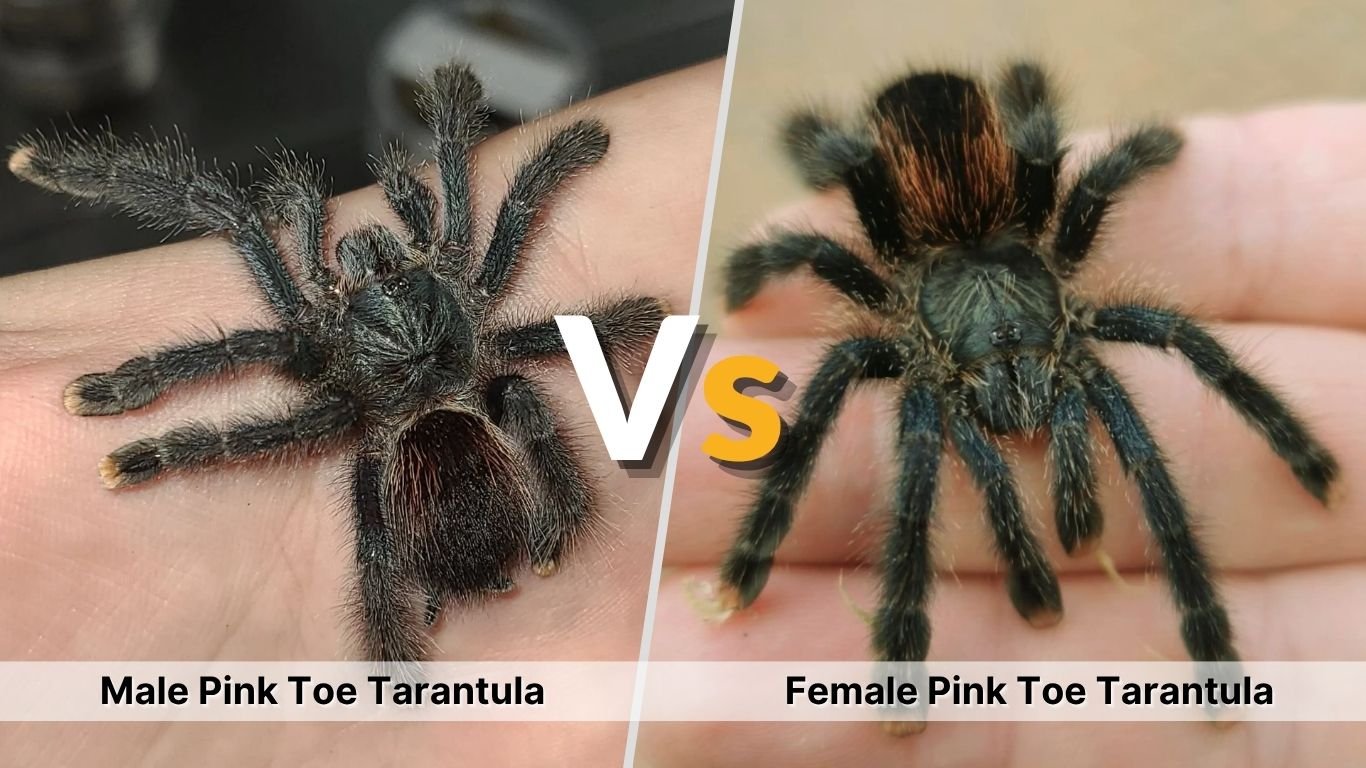
Male and female pink toe tarantulas can look almost identical while young. Once they mature, however, differences appear in their body proportions, pedipalps, front legs, behavior, molting frequency, and lifespan. Adult females are generally heavier-bodied and live much longer, while mature males become slimmer, leggier, and more active as they search for mates. Examining a shed exoskeleton is the most dependable way to determine the sex before maturity.
Male vs Female Pink Toe Tarantula Comparison
The common pink toe tarantula, Avicularia avicularia, is an arboreal species with a dark body, long legs, and pink or orange tips on its feet. Both sexes require the same basic enclosure and feeding conditions, but their appearance and behavior change after sexual maturity.
| Feature | Male pink toe | Female pink toe |
| Overall build | Slim and long-legged | Heavier and more robust |
| Abdomen | Usually smaller and narrower | Usually broader and rounder |
| Pedipalps | Enlarged ends after maturity | Normal leg-like ends |
| Front legs | Mature males develop mating hooks | No mating hooks |
| Molting | Usually stops after maturity | Continues molting as an adult |
| Adult behavior | Often roams in search of a mate | Usually remains near her web retreat |
| Lifespan | Much shorter | Commonly 10–12 years |
| Best sexing method | Shed skin or mature features | Shed skin showing spermathecae |
Females can live approximately 10–12 years in human care. Male pink toes have substantially shorter lives, especially after reaching maturity.
How to Tell a Male Pink Toe Tarantula
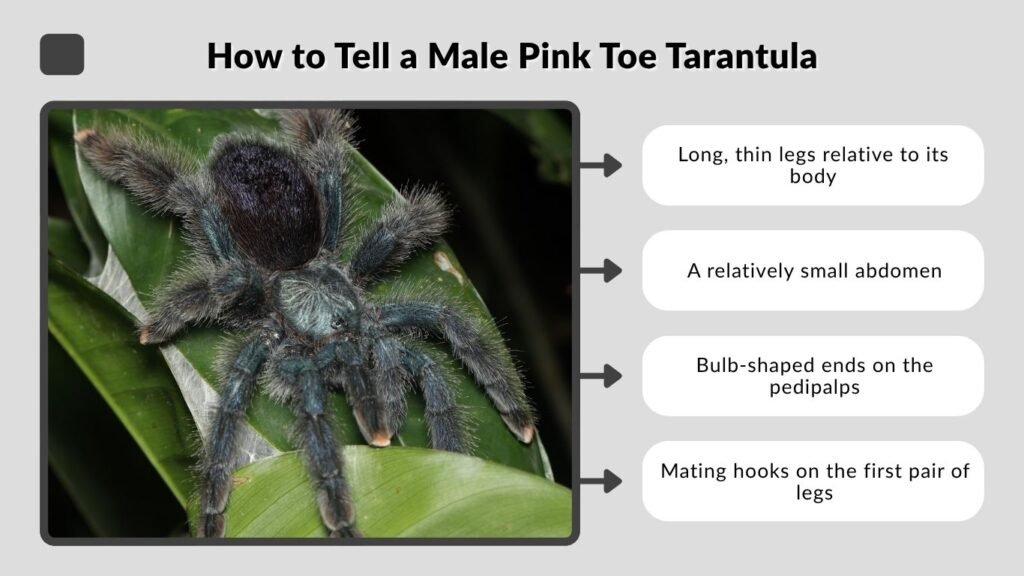
A mature male is usually much easier to identify than a juvenile male. His final developmental molt produces specialized reproductive structures that are not present in females.
Male Identification Features
A mature male pink toe commonly has:
- Long, thin legs relative to its body
- A relatively small abdomen
- Bulb-shaped ends on the pedipalps
- Mating hooks on the first pair of legs
- A lighter or less bulky overall appearance
- Increased roaming around the enclosure
- Periodic construction of a sperm web
Male-biased relative leg length is common among spiders, while females are often heavier-bodied. However, body shape alone cannot reliably identify a juvenile or well-fed specimen.
Enlarged Pedipalps or “Boxing Gloves”
Pedipalps are the short appendages beside a tarantula’s mouth. In immature spiders and adult females, they resemble a small pair of legs.
After a male’s ultimate molt, the ends of his pedipalps develop reproductive bulbs containing emboli. These enlarged tips are often described as looking like boxing gloves. The male transfers sperm into the bulbs after constructing a special sperm web.
Swollen pedipalps are among the clearest signs that a pink toe is a mature male. The rounded ends should not be confused with the spider’s pink feet or “paws.”
Hooks on the Male’s Front Legs
Mature male Avicularia avicularia develops tibial apophyses, commonly called tibial hooks, on the first pair of walking legs. During mating, these structures help the male control the female’s fangs and position her body.
These hooks are not visible in young males. Therefore, the absence of hooks only proves that the tarantula is not currently a mature hooked male; it does not prove that the spider is female. Scientific descriptions of A. avicularia document both the male palpal bulb and the tibial apophysis on the first leg.
How to Identify a Female Pink Toe Tarantula
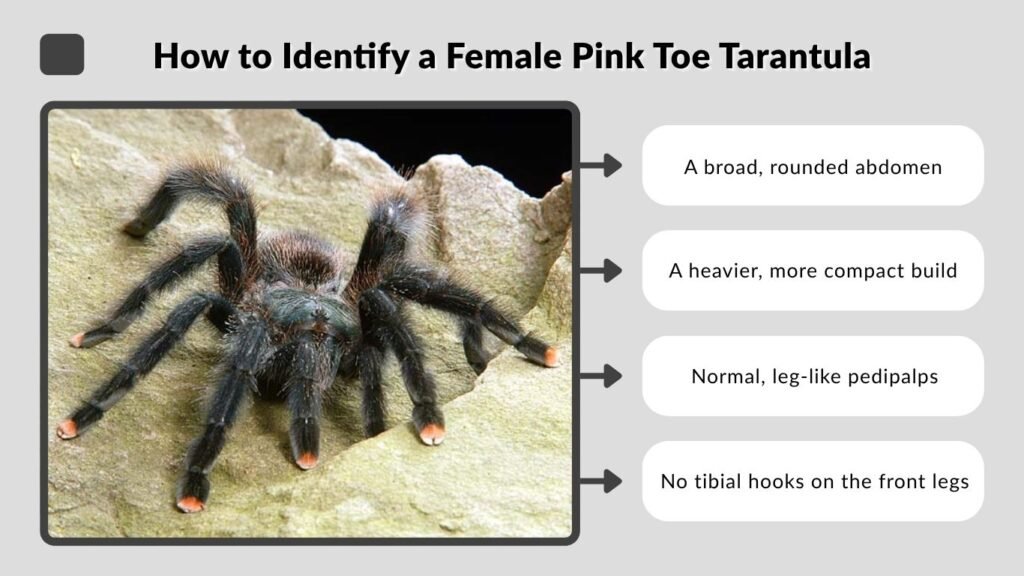
Females usually have broader abdomens and more substantial bodies than mature males. Their legs often appear shorter and thicker relative to the abdomen, although individual proportions vary.
Female Characteristics
An adult female commonly has:
- A broad, rounded abdomen
- A heavier, more compact build
- Normal, leg-like pedipalps
- No tibial hooks on the front legs
- Continued molting after reaching maturity
- A longer lifespan
- More consistent use of an established web retreat
A female may remain inside or close to her arboreal web tunnel for long periods. However, behavior alone cannot confirm sex because immature males can also create large web retreats and remain relatively inactive.
Adult female A. avicularia continues to molt after maturity. A long-term study found that females continued annual molting and lived for more than seven years, while modern zoo guidance reports captive female lifespans of about 10–12 years.
The Best Way to Sex a Pink Toe Tarantula
Examining the tarantula’s shed exoskeleton, also called an exuvia or molt, is the most dependable method of identifying its sex before mature male features develop.
Sexing From a Shed Molt
The reproductive area is located on the inside of the abdomen between the upper pair of book lungs.
A female molt contains a visible reproductive structure called the spermathecae. It may appear as a small flap, pouch, or pair of raised structures, depending on the spider’s maturity.
A male molt lacks this female structure. The area usually appears flatter and may show a small patch of hairs instead.
The British Tarantula Society considers examination of the cast exoskeleton the accurate way to sex a tarantula.
For examination:
- Remove the molt carefully after the tarantula has finished.
- Soak the abdominal section in slightly soapy water.
- Gently unfold it with soft tools.
- Examine the area between the first pair of book lungs.
- Use magnification for small juveniles.
A damaged or folded molt may make identification impossible. Young spiderlings can also be difficult to sex because their reproductive structures are extremely small.
Is Ventral Sexing Reliable?
Ventral sexing involves looking at the underside of the living spider through clear plastic or glass. Females and males may show different markings around the epigastric furrow.
This method can provide an educated guess, but it is less dependable than examining a good shed skin. Lighting, hairs, body size, posture, and natural variation can lead to mistakes. Never force the spider against the enclosure wall or handle it solely to view its underside.
Pink Toe Male vs Female Size
Both sexes can have a similar diagonal leg span. The main difference is usually proportion rather than maximum length.
A mature male may look larger because his legs are long and thin, but his body and abdomen are generally smaller. A mature female usually appears heavier and may have a larger abdomen despite having proportionally shorter legs.
Feeding also affects appearance. An overfed male can temporarily have a large abdomen, while a female that recently produced eggs or refused food before a molt may look unusually thin. Size should therefore be combined with molt examination or mature reproductive features.
Male vs Female Lifespan
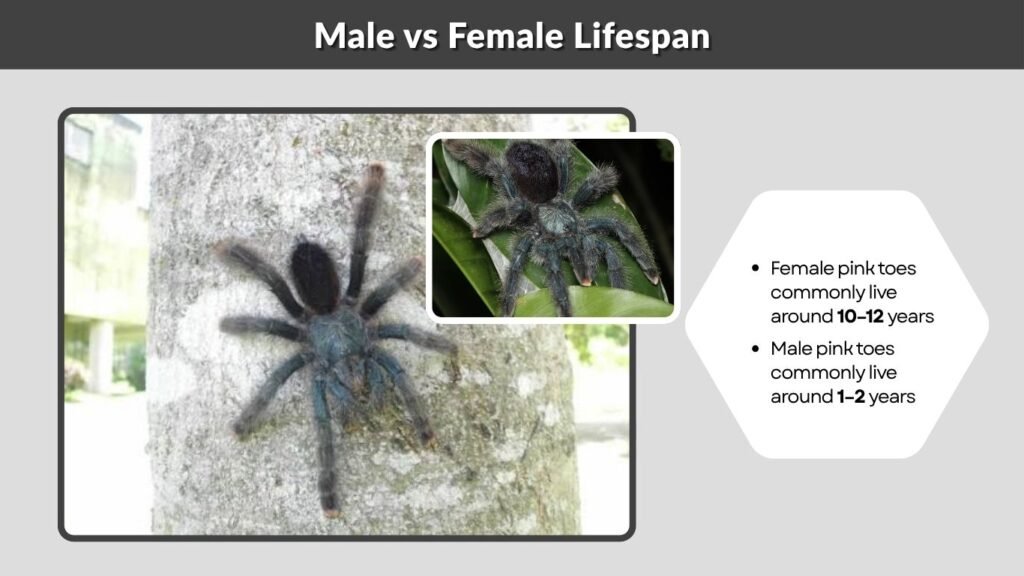
Female pink toes commonly live around 10–12 years in human care. They continue molting after maturity and may slowly grow throughout adulthood.
Males mature earlier and have much shorter adult lives. Across tarantulas, mature males often have approximately one to two years remaining, although individual pink toes may survive for shorter or longer periods. Mating can further shorten the remaining period, and Smithsonian notes that males may die within a few months after mating.
A mature male may gradually:
- Eat less frequently
- Develop a smaller abdomen
- Spend more time roaming
- Search around the enclosure at night
- Produce sperm webs
- Show less interest in maintaining a permanent retreat
These changes are usually associated with maturity rather than poor enclosure care, although dehydration and illness should still be ruled out.
Do Mature Male Pink Toe Tarantulas Molt?
A male’s molt into adulthood is called his ultimate molt. During this molt, he develops reproductive bulbs and, in A. avicularia, hooks on the first pair of legs.
Mature males generally stop molting. Rare post-ultimate molts can occur, but they are dangerous because the hooks or reproductive structures may become trapped in the old exoskeleton. Females, by contrast, normally continue molting throughout adulthood.
Male and Female Web-Building Behavior
Both male and female pink toes can build elevated silk retreats around cork bark, branches, plants, and enclosure corners.
Females often maintain and enlarge the same retreat. Mature males may abandon established webs and roam more often while searching for receptive females. They may also create a temporary sperm web, deposit sperm on it, and transfer the sperm to their palpal bulbs.
Finding a web does not prove that the spider is female. Finding a sperm web strongly suggests a mature male, especially when swollen pedipalps and front-leg hooks are visible.
Do Male Pink Toe Tarantulas Bite?
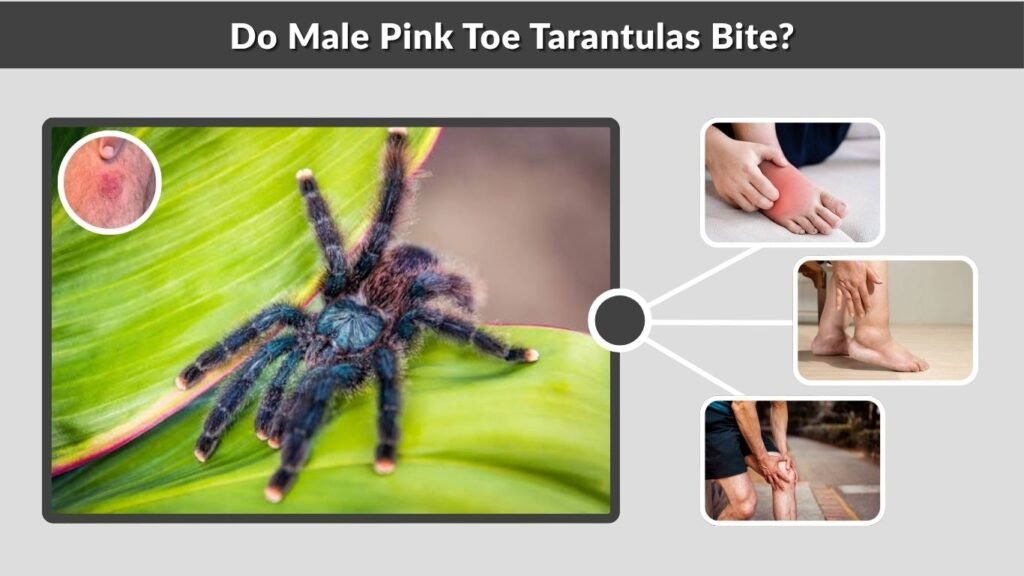
Both males and females possess fangs and venom. A mature male is not automatically more dangerous, and pink toe tarantulas generally prefer escaping or jumping away rather than biting.
A bite may cause localized pain, redness, swelling, or muscle discomfort. Reactions vary, so handling either sex is not recommended. Their speed and arboreal jumping ability also create a greater risk of the spider falling and suffering a fatal abdominal injury.
Which Sex Makes the Better Pet?
A confirmed female is generally the better choice for someone seeking a long-term display tarantula. She lives longer and usually becomes more settled in an established web retreat.
A mature male can still be an interesting animal, but the owner must understand that his remaining lifespan may be limited. He may roam frequently, eat inconsistently, and appear less settled than a female.
FAQs
How can I tell whether my pink toe is male or female?
Examine a well-preserved shed exoskeleton for female spermathecae. A mature male can also be identified by enlarged pedipalps and mating hooks on the first pair of legs.
How long does a male pink toe tarantula live?
Its exact lifespan varies, but males live much shorter lives than females. After the ultimate molt, a male may have approximately one to two years remaining, sometimes less after mating.
Does a male pink toe have hooks on its front legs?
A mature male Avicularia avicularia develops tibial hooks on the first pair of walking legs. Juvenile males do not have these structures.
Can body size reveal the sex?
Body shape can provide clues but is not conclusive. Mature males are usually slimmer and leggier, while females are heavier and broader. A shed molt provides stronger evidence.
Will a female pink toe continue molting?
Yes. Adult females continue molting, often at increasingly long intervals. A mature male normally stops after his ultimate molt.
