
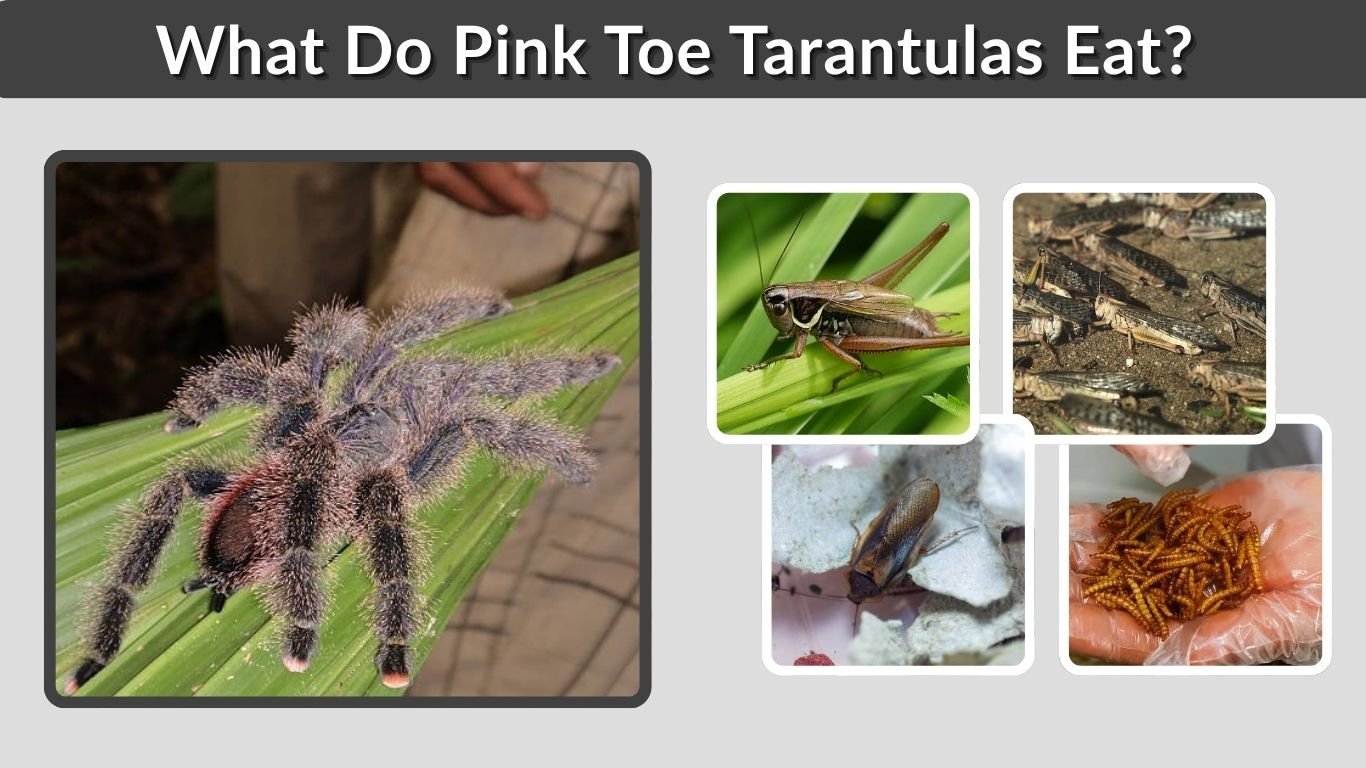
Pink toe tarantulas primarily eat live insects and other small invertebrates. In captivity, crickets, roaches, locusts, flies, and soft-bodied larvae can provide a varied diet. Prey should be captive-bred, appropriately sized, and removed if the spider does not eat it. Although wild pink toes may occasionally capture small vertebrates, pet tarantulas do not need mice, frogs, birds, or lizards. A balanced rotation of feeder insects is safer, cleaner, and easier to manage.
What Do Pink Toe Tarantulas Eat in the Wild?
The common pink toe tarantula, Avicularia avicularia, is an arboreal predator native to northern South America. It hunts from trees, plants, and silk retreats, primarily catching invertebrates that move within striking distance. Wild tarantulas may also overpower small vertebrates such as frogs or lizards when the opportunity arises.
Captive pink toes should receive a varied selection of commercially raised feeder insects. The Royal Veterinary College recommends captive-bred invertebrates and discourages feeding meat or vertebrate prey because these foods may contribute to obesity and other health problems.
10 Foods Pink Toe Tarantulas Can Eat
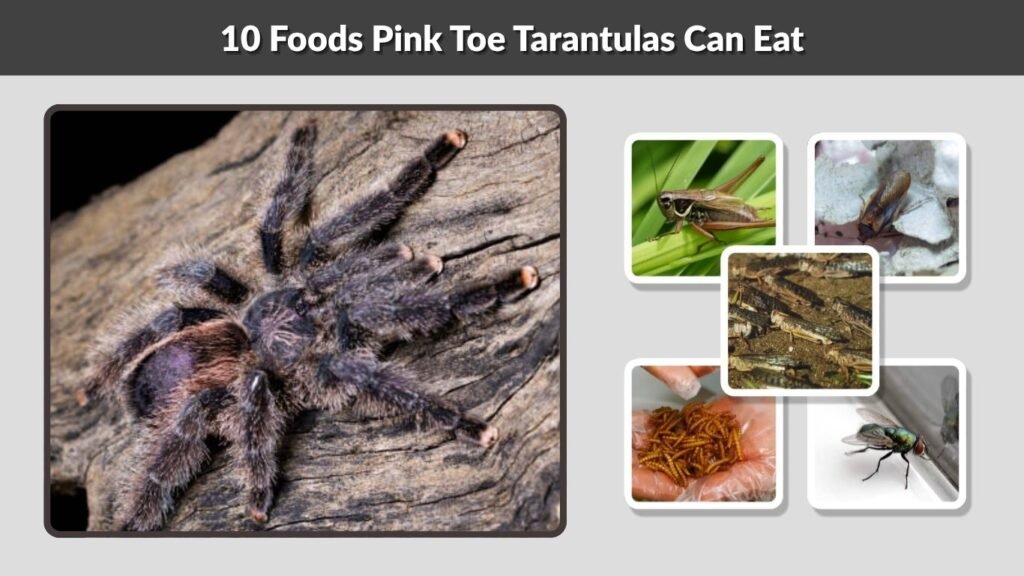
The best feeder depends on the tarantula’s size. Choose prey no larger than the spider’s abdomen or body and avoid adding several insects simultaneously.
1. Crickets
Crickets are one of the most convenient staple foods for pink toe tarantulas. They move actively, making them easy for the spider to detect through vibrations.
Offer appropriately sized crickets and remove them if they remain uneaten. Loose crickets can disturb or bite a vulnerable tarantula, especially during molting. Both brown and black crickets can be used, provided they come from a safe captive source.
2. Dubia Roaches
Dubia roaches are another suitable staple feeder. They are relatively easy to maintain, cannot climb smooth surfaces well, and are available in numerous sizes.
Pink toes sometimes ignore roaches that remain motionless on the enclosure floor. Place the roach on cork bark or close to the entrance of the tarantula’s web retreat. Do not leave it hidden inside the habitat indefinitely. Dubia roaches are among the live foods recommended by veterinary husbandry guidance.
3. Locusts
Small locusts or hoppers provide active prey and encourage natural hunting behavior. They can be especially useful for adult pink toes that readily attack moving insects.
Choose a locust smaller than the tarantula and avoid powerful adult specimens that might injure a young spider. Remove the locust if it remains uneaten overnight. Locusts are included among the captive-bred feeders recommended by the Royal Veterinary College.
4. Mealworms
Pink toe tarantulas can eat mealworms, but they are better used occasionally than as the only food. Mealworms may quickly bury themselves in loose substrate, making them difficult for an arboreal tarantula to find.
Offer one in a smooth-sided feeding dish or near the spider’s web. Veterinary sources differ slightly: the University of Illinois lists mealworms as an acceptable feeder, while the Royal Veterinary College considers them less suitable because they can burrow and offer limited dietary value.
5. Superworms or King Worms
Superworms, sometimes called king worms, can be offered to larger juveniles and adults. Their strong movement often triggers a feeding response.
These larvae have powerful mouthparts, so they should not be left with a tarantula that refuses to attack. Select a small specimen rather than one approaching the spider’s own body size. King worms are included among the live feeder options recommended by the University of Illinois College of Veterinary Medicine.
6. Silkworms
Silkworms are soft-bodied feeders that can add variety to the diet. They may be useful for spiders that temporarily reject crickets or roaches.
Because silkworms do not move as quickly as crickets, place one close to the tarantula’s web entrance rather than dropping it at the bottom of a tall enclosure. Remove it when ignored. Veterinary husbandry guidance recognizes silkworms as an appropriate live food for tarantulas.
7. Hornworms
A small hornworm can be offered occasionally to a juvenile or adult pink toe. Its movement and soft body may attract a tarantula that has become uninterested in its usual feeders.
Hornworms grow rapidly, so check their size before feeding. A large larva may be excessive for a medium-sized pink toe. Offer only one and remove it if the tarantula shows no interest.
8. Houseflies
Captive-bred houseflies can be useful for an arboreal tarantula because they climb and fly through the upper enclosure. Their movement may bring them close to the spider’s elevated web retreat.
Do not collect flies from outdoors because they may have encountered pesticides, parasites, or contaminated material. The Royal Veterinary College specifically lists captive-raised Musca flies among suitable tarantula foods.
9. Fruit Flies
Flightless fruit flies are suitable for very small pink toe spiderlings. Their tiny size allows young spiders to capture them without facing an oversized or dangerous prey item.
Fruit flies are not substantial enough for most juveniles or adults. As the spider grows, transition it to pinhead crickets, small roaches, or similarly sized prey. Veterinary guidance identifies Drosophila fruit flies as an option for young tarantulas.
10. Waxworms
Waxworms can encourage a reluctant tarantula to feed, but they should be offered only in small quantities as part of a varied diet.
Because waxworms may remain relatively still, place one close to the web tunnel or in a shallow feeding cup. Do not allow it to disappear into the enclosure and develop into a moth unnoticed. The Royal Veterinary College recommends waxworms only in limited amounts.
Pink Toe Tarantula Feeding Schedule
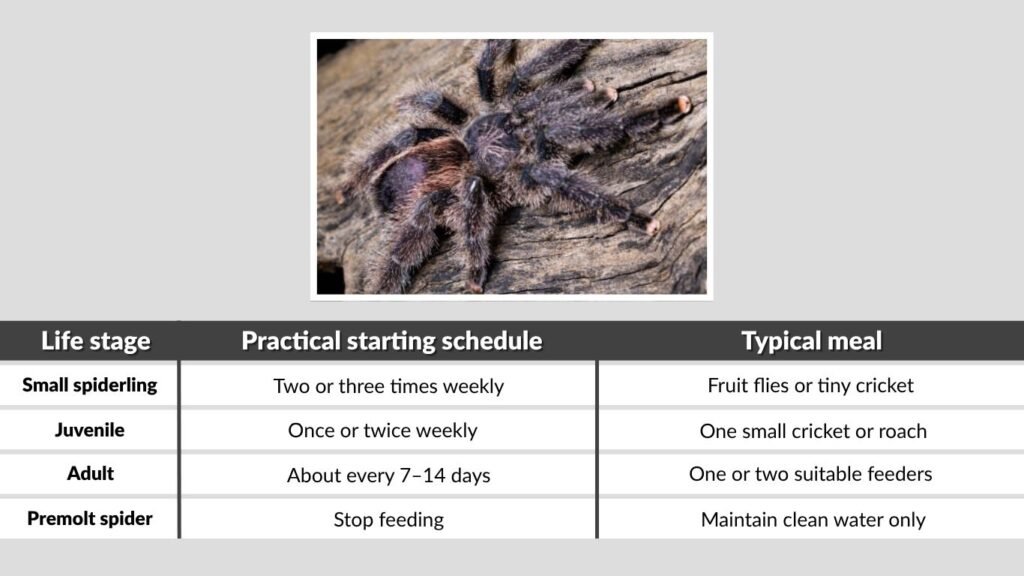
Feeding frequency depends on the spider’s age, body condition, temperature, and proximity to a molt.
| Life stage | Practical starting schedule | Typical meal |
| Small spiderling | Two or three times weekly | Fruit flies or tiny cricket |
| Juvenile | Once or twice weekly | One small cricket or roach |
| Adult | About every 7–14 days | One or two suitable feeders |
| Premolt spider | Stop feeding | Maintain clean water only |
These are starting points rather than strict rules. Feed according to the abdomen’s condition instead of forcing the spider to follow a calendar. An extremely swollen abdomen suggests that meals should be reduced.
Offer food during the evening, when pink toes are more likely to be active. Place prey near the web entrance or on an elevated surface rather than always dropping it onto the enclosure floor.
Why Is My Pink Toe Tarantula Not Eating?
Food refusal is often normal. Common explanations include:
- The tarantula is preparing to molt
- It recently completed a molt
- Its abdomen is already full
- It is adjusting after rehousing
- The prey is too large or unsuitable
- The enclosure is too hot, wet, dry, or poorly ventilated
- A mature male is focused on finding a mate
- The spider is stressed by repeated disturbance
Tarantulas routinely fast before molting. Remove all feeders when premolt is suspected because a cricket or other insect can injure the motionless spider. Do not disturb a tarantula lying on its back; this is a normal molting position.
After a molt, wait until the spider’s fangs become dark and hardened before offering food. Small spiderlings recover faster than large adults.
How Long Can a Pink Toe Tarantula Go Without Eating?
A healthy pink toe may refuse food for weeks, particularly before or after molting. Some individuals fast longer, but there is no single “safe” limit that applies to every age, sex, and physical condition.
Food refusal is less concerning when the abdomen remains reasonably rounded, the spider behaves normally, and clean water is always available. Dehydration is generally more urgent than missing several meals.
Seek advice from an experienced exotic veterinarian when the abdomen becomes severely shrunken, the spider cannot climb or stand normally, fluid is leaking from its body, or white material appears around its mouth. Decreased appetite combined with white oral material can indicate nematode infection.
Foods Pink Toe Tarantulas Should Not Eat
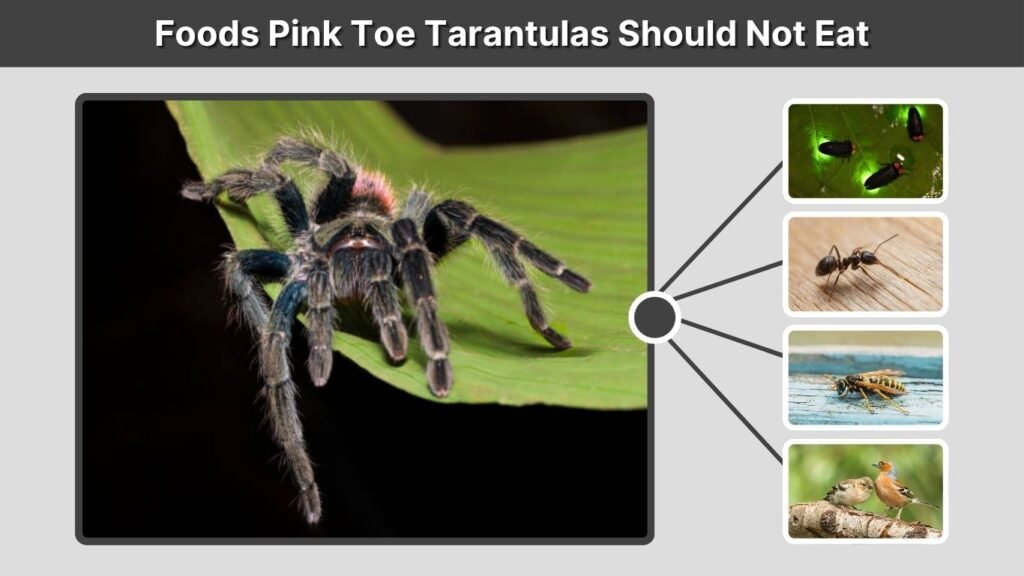
Avoid feeding:
- Wild-caught insects exposed to pesticides
- Fireflies or other potentially toxic insects
- Ants, wasps, and stinging prey
- Large insects capable of fighting back
- Raw meat or processed human food
- Wild spiders or unknown invertebrates
- Mice, birds, frogs, or lizards as routine meals
Although pink toes may capture small vertebrates in nature, vertebrate prey is unnecessary in captivity and creates more waste. A varied diet of properly sized, captive-bred invertebrates is the safer choice.
FAQs
Can pink toe tarantulas eat mealworms?
Yes, but mealworms are better as occasional feeders. They can burrow into the substrate before the tarantula catches them. Present one in a shallow dish or near the web entrance, and remove it when uneaten.
Can pink toe tarantulas eat Dubia roaches?
Yes. Dubia roaches are suitable feeders for pink toes when appropriately sized. Place the roach near the tarantula’s elevated retreat because a pink toe may not pursue a motionless roach hiding on the enclosure floor.
How often should an adult pink toe eat?
An adult can generally be offered food every one to two weeks. Adjust the schedule according to abdomen size, recent feeding, activity, and premolt signs. Refusing one or several meals does not automatically indicate illness.
Do pink toe tarantulas eat birds?
A large wild tarantula might opportunistically overpower a very small vertebrate, but birds are not a normal or appropriate captive food. Pet pink toes should receive captive-bred insects instead of birds, mice, frogs, or lizards.
Should uneaten prey remain in the enclosure?
No. Remove uneaten prey promptly, particularly when the tarantula is inactive or preparing to molt. Crickets, superworms, and other feeders may bite a soft, defenseless spider or cause ongoing stress inside its retreat.
