
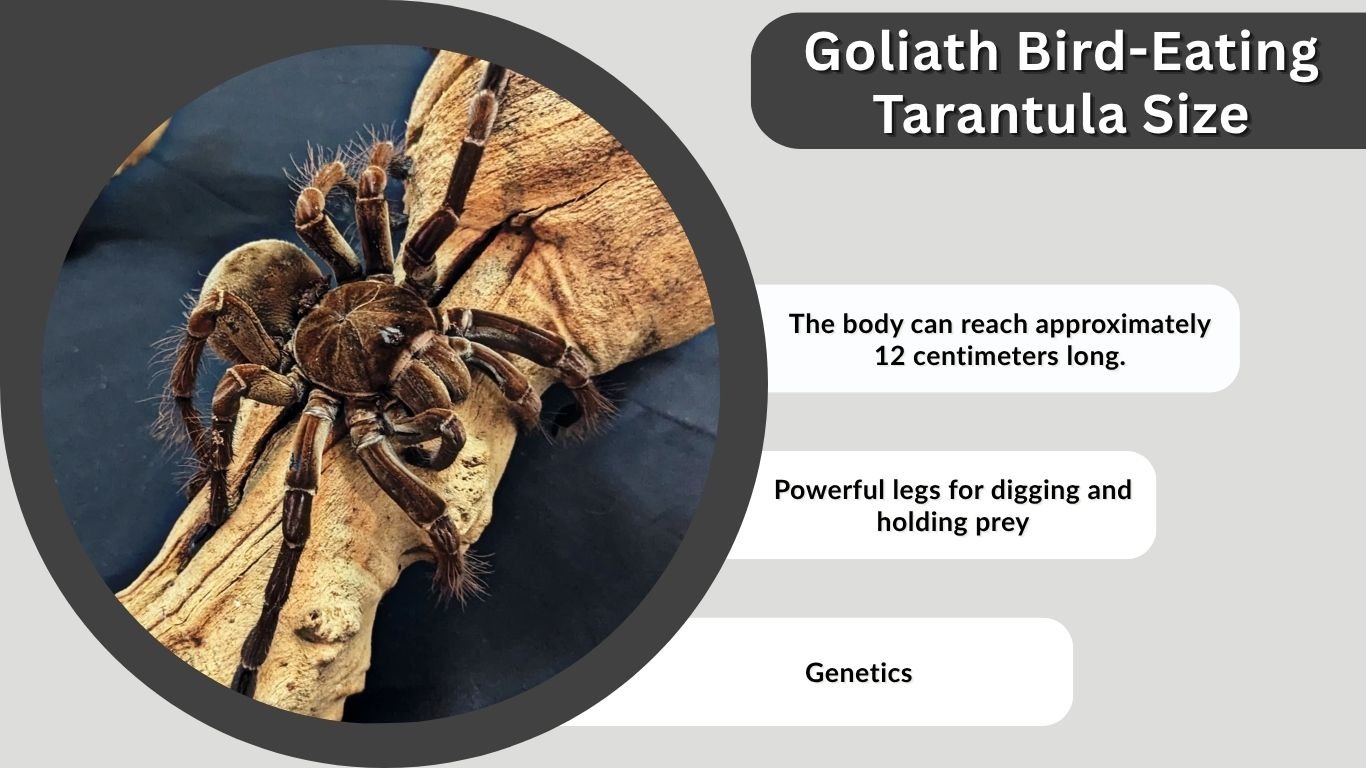
The Goliath bird-eating tarantula is famous for its enormous body, thick legs, and intimidating appearance. Scientifically named Theraphosa blondi, it is generally recognized as the largest tarantula and the heaviest spider in the world. A full-grown specimen may have a leg span approaching the width of a large dinner plate, making it much bigger than the spiders commonly found around homes. Its exact size varies with sex, age, genetics, nutrition, and environmental conditions. This guide explains its adult size, body length, weight, growth, sex differences, and how it compares with other large spiders.
How Big Is a Goliath Bird-Eating Tarantula?
An adult Goliath bird-eating tarantula can have a body measuring up to approximately 4.75 inches, or 12 centimeters, long. When its legs are fully extended, its total leg span can reach around 11 inches, or 28 centimeters.
These maximum figures describe exceptionally large adults. Not every specimen reaches the same measurements, and younger spiders may be considerably smaller.
Goliath Birdeater Size at a Glance
| Measurement | Maximum approximate size |
|---|---|
| Body length | 4.75 inches or 12 cm |
| Leg span | 11 inches or 28 cm |
| Weight | Around 6 ounces or 170–175 grams |
| Fang length | Up to about 1 inch or 2.5 cm |
| Overall comparison | Similar in width to a large dinner plate |
Its large size is not caused only by long legs. Unlike some wide but lightly built spiders, the Goliath birdeater has a bulky abdomen, broad body, and thick, powerful legs.
What Does “Tarantula Size” Mean?
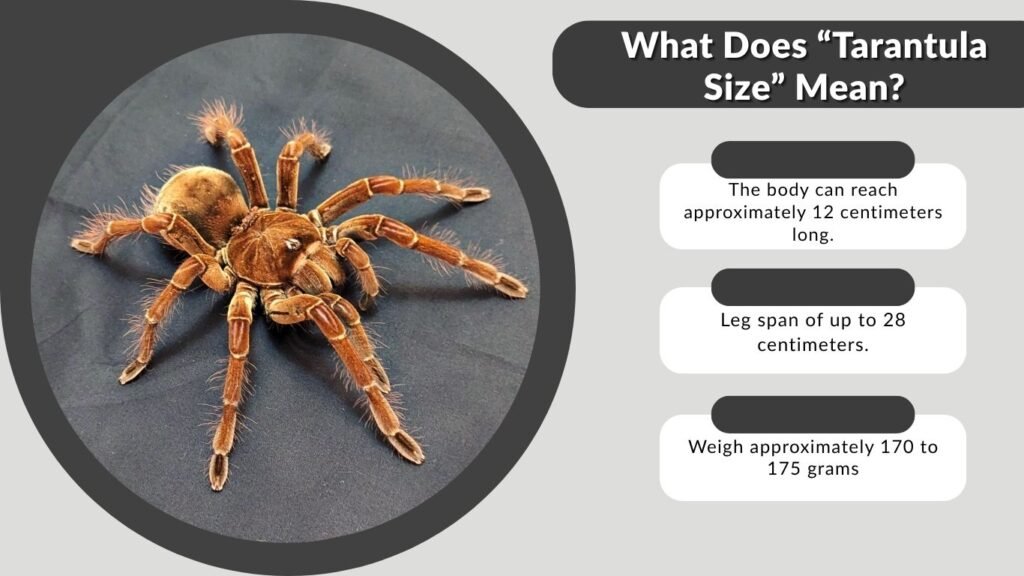
Spider size can be described in several ways, which sometimes causes confusion. Body length, leg span, and weight measure different parts of the animal.
Body Length
Body length is measured from the front of the cephalothorax to the end of the abdomen. It does not include the legs, fangs, or spinnerets.
The Goliath birdeater’s body can reach approximately 12 centimeters long. This is exceptionally large for a spider and contributes to its reputation as the world’s biggest by overall mass and body size.
Leg Span
Leg span is usually measured from the tip of one leg to the opposite leg when the spider is positioned naturally. A mature Goliath birdeater may have a leg span of up to 28 centimeters.
Its span makes it look extremely broad, although measuring a living tarantula can be difficult because its legs may not remain fully extended.
Weight
Large female Goliath birdeaters may weigh approximately 170 to 175 grams, or close to 6 ounces. Weight can change depending on the spider’s age, feeding condition, hydration, and whether it is preparing to molt.
This substantial body mass is one reason the species is commonly called the heaviest spider in the world.
Goliath Bird-Eating Tarantula Size Comparison
Numbers alone may not clearly communicate how large this spider looks. Comparing it with familiar objects provides a better picture.
Compared With a Dinner Plate
A fully grown Goliath birdeater can spread its legs across an area similar to a large dinner plate. Its maximum leg span of about 11 inches is close to the diameter of many household plates.
However, the spider does not have a plate-sized solid body. Most of that width comes from its eight extended legs.
Compared With a Human Hand
A large adult can cover most or all of an adult person’s open hand. Its legs may extend beyond the fingers, especially when fully stretched.
Handling is not recommended for size comparison. Tarantulas can be injured by even a short fall, and this species can defend itself with urticating hairs, stridulation, or a bite.
Compared With a Smartphone
The spider’s body alone may approach or exceed the length of a modern smartphone. Its full leg span can be almost twice the length of many phones.
Compared With Common House Spiders
Most house spiders have relatively small bodies and thin legs. The Goliath birdeater is dramatically heavier, thicker, and more robust. Even when its legs are not fully extended, its broad abdomen and muscular limbs make it appear far larger.
Is It the Largest Spider in the World?
The Goliath bird-eating tarantula is widely regarded as the world’s largest spider by body mass and overall body size. However, the title of largest spider by leg span may sometimes be given to the giant huntsman spider, Heteropoda maxima.
The giant huntsman has very long, laterally extended legs and may reach a span similar to or slightly greater than that of a Goliath birdeater. However, it has a much flatter and lighter body.
Therefore, the distinction is generally:
- Goliath birdeater: largest or heaviest by mass and body size
- Giant huntsman spider: possible largest by maximum leg span
- Goliath birdeater: largest tarantula species overall
The Smithsonian identifies the Goliath bird-eating tarantula as the biggest tarantula in the world.
Male vs. Female Goliath Birdeater Size
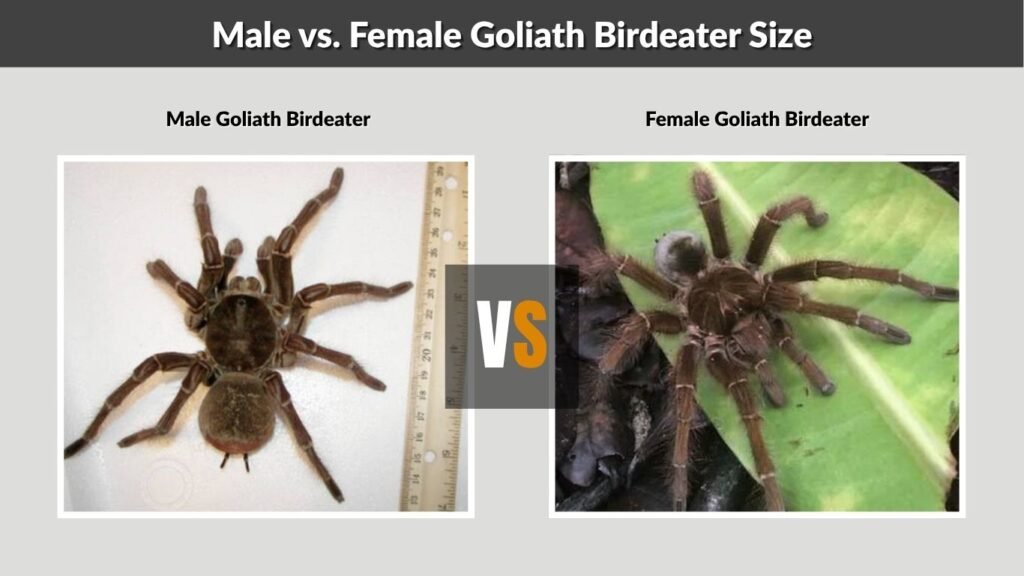
Female and male Goliath birdeaters can both become large, but mature females are generally more heavily built. Females tend to have broader abdomens and thicker bodies, while mature males may appear slimmer and more leggy.
Female Size
Adult females usually have:
- Larger, heavier bodies
- Broader abdomens
- Thick, powerful legs
- Greater overall mass
- Longer lifespans
Females continue molting after reaching sexual maturity and may gradually become larger over time. They can live for up to approximately 20 years, giving them more opportunities to grow.
Male Size
Adult males may achieve a similar leg span but usually have:
- Slimmer abdomens
- Lighter body weight
- Longer-looking legs
- Reproductive structures on the pedipalps
- Shorter adult lifespans
Males generally live for around three to six years and may die within months after mating. They usually stop growing significantly after their final maturity molt.
How Fast Does a Goliath Birdeater Grow?
Goliath birdeaters do not grow continuously. Like other tarantulas, they must shed their rigid exoskeleton through molting.
Young spiderlings grow more rapidly than adults and may molt five or six times during their first year. The species generally takes approximately two to three years to reach maturity, although growth can vary with temperature, food availability, sex, and individual health.
Growth Stages
- Spiderling: Very small and vulnerable after emerging from the egg sac
- Juvenile: Grows quickly and molts regularly
- Subadult: Begins developing adult proportions and greater body mass
- Mature adult: Reaches reproductive size and nearly full leg span
- Older female: May continue growing slowly through later molts
A tarantula may appear noticeably larger immediately after molting because the new exoskeleton allows its body and legs to expand.
Does Diet Affect Its Size?
Nutrition influences growth rate and body condition, but overfeeding cannot make a Goliath birdeater grow beyond its natural genetic limits.
In the wild, it eats cockroaches, beetles, worms, frogs, lizards, small rodents, and other animals it can overpower. Despite its name, birds are not a regular part of its diet. At the Smithsonian’s National Zoo, the species is fed cockroaches.
A well-fed juvenile may grow steadily, while an underfed spider may develop more slowly. Excessive feeding, however, can create an overly swollen abdomen that is more vulnerable to injury.
How Large Are Its Fangs?
A mature Goliath birdeater has large downward-pointing fangs that may approach approximately 1 inch, or 2.5 centimeters, in length.
Its fangs fold beneath the body and strike downward into prey. The chelicerae contain the fangs and venom, while the nearby pedipalps help the spider sense and handle food.
The size of the fangs does not mean the spider actively hunts people. It usually uses defensive displays before biting, such as raising its front legs, producing a hissing sound, or releasing irritating hairs.
Why Does the Goliath Birdeater Grow So Large?
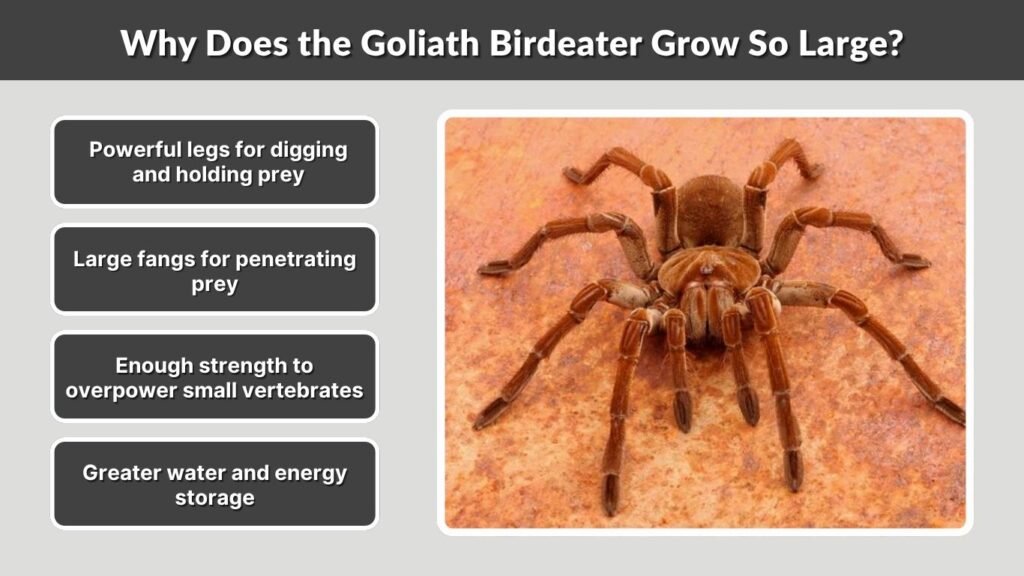
Its size is likely supported by its warm, humid rainforest environment and its ground-dwelling hunting lifestyle. The species inhabits northern South American rainforests, including regions of Venezuela, Brazil, Guyana, French Guiana, and Suriname. It spends much of its time inside silk-lined burrows beneath roots, rocks, or forest debris.
Its large body offers several advantages:
- Powerful legs for digging and holding prey
- Large fangs for penetrating prey
- Enough strength to overpower small vertebrates
- Greater water and energy storage
- A strong defensive presence against predators
However, large size also makes the spider vulnerable to injury from falls. Its abdomen is heavy and can rupture if dropped onto a hard surface.
What Cage Size Does a Goliath Birdeater Need?
A captive Goliath birdeater requires a wide, secure, terrestrial enclosure rather than a tall climbing cage. The enclosure should allow the spider to turn around, walk, burrow, and retreat into a hide.
A practical adult setup should provide floor space several times the spider’s leg span. An enclosure approximately 18 to 24 inches long and 12 to 18 inches wide may suit many adults, although the spider’s actual size should determine the final dimensions.
Important enclosure features include:
- Deep, moisture-retaining substrate
- A secure hide or starter burrow
- A broad water dish
- Good ventilation without excessive dryness
- Limited height above the substrate
- A tightly secured lid
Because this is a heavy terrestrial species, excessive vertical space increases the risk of a damaging fall. The enclosure should prioritize floor area and substrate depth instead of height.
Does Every Goliath Birdeater Reach Full Size?
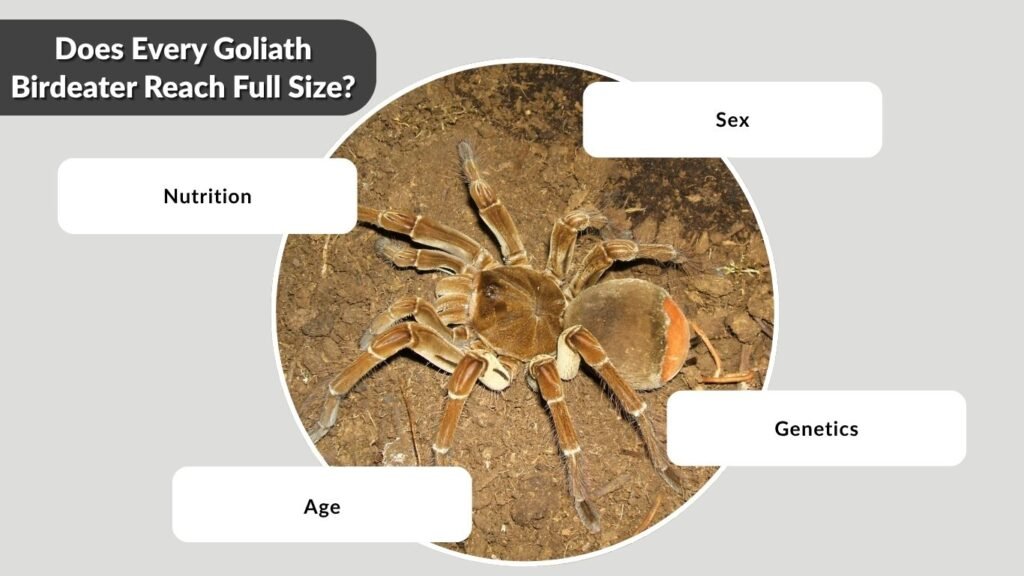
No. The maximum published size represents the upper end of the species’ range. Many adults remain smaller.
Final size depends on:
- Sex
- Genetics
- Age
- Nutrition
- Molting history
- Health
- Environmental stability
- Individual variation
A mature spider with a 9- or 10-inch leg span is still exceptionally large, even if it does not reach the maximum 11-inch measurement.
FAQs
What is the average adult size of a Goliath bird-eating tarantula?
Large adults commonly have a leg span of approximately 8 to 11 inches. Their bodies may grow several inches long, with the largest individuals reaching about 4.75 inches in body length.
How much does a Goliath bird-eating tarantula weigh?
A particularly large adult female may weigh around 6 ounces, or approximately 170 to 175 grams. Males usually weigh less because their bodies and abdomens are slimmer.
Is a Goliath birdeater bigger than a human hand?
Yes. A full-grown individual can cover an adult hand and may extend beyond the fingers when its legs are spread. Its maximum span is similar to the width of a large dinner plate.
Are female Goliath birdeaters larger than males?
Females are normally heavier and more strongly built. Males may develop long legs and an impressive span, but their abdomens are usually narrower and their overall body mass is lower.
What is the biggest Goliath birdeater ever recorded?
Reliable sources generally give a maximum body length of about 12 centimeters and a leg span of approximately 28 centimeters. Individual record claims may vary because measuring a living spider accurately can be difficult.
