
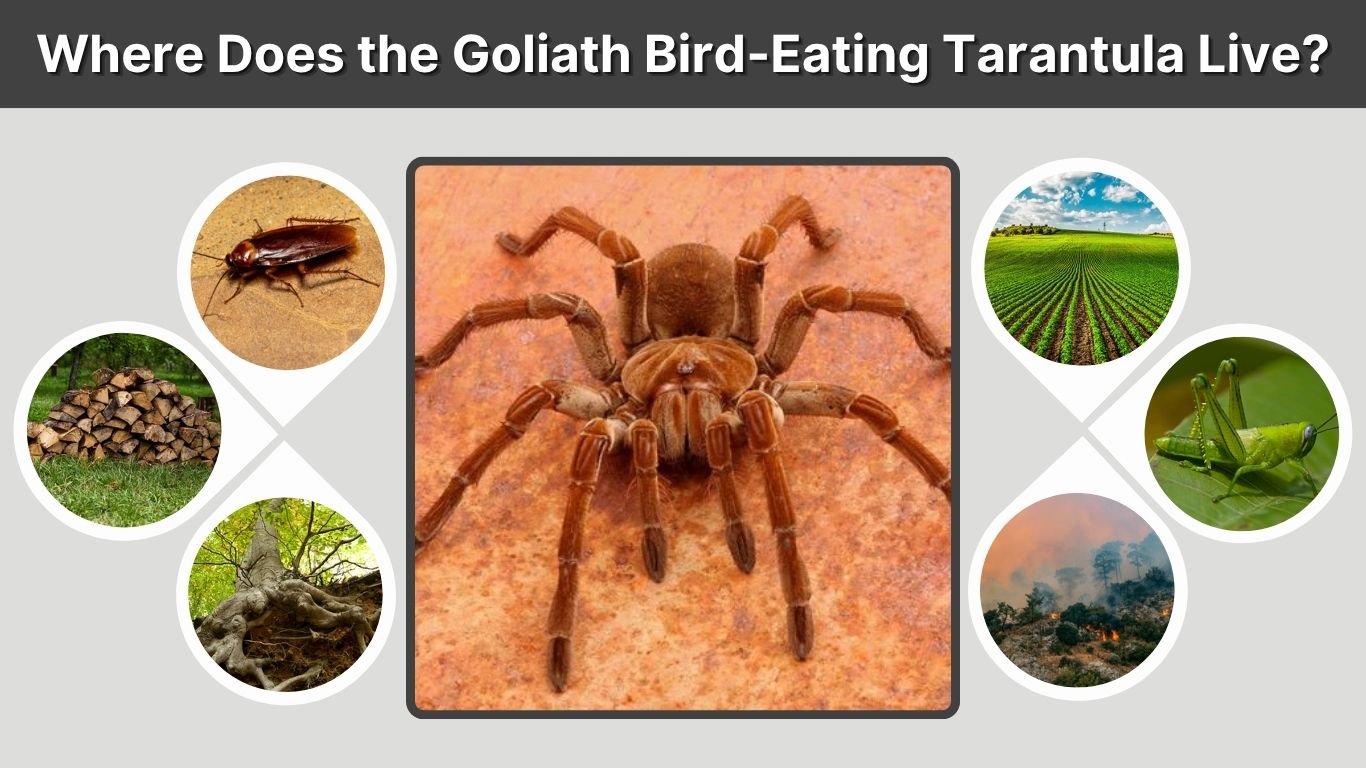
The Goliath bird-eating tarantula, scientifically known as Theraphosa blondi, lives in the warm, wet rainforests of northern South America. Despite its frightening name and enormous size, this spider normally stays hidden on the forest floor rather than wandering through open areas. It spends much of its life inside a deep burrow, emerging mainly at night to search for food. Its habitat provides high humidity, warm temperatures, loose soil, leaf litter, and plenty of prey. Understanding where this tarantula lives also helps explain its behavior, body size, hunting habits, and dependence on moist rainforest environments.
Where Is the Goliath Bird-Eating Tarantula Found?
The natural range of the Goliath bird-eating tarantula is limited to northern South America. It is most strongly associated with the Guiana Shield and nearby Amazonian rainforest regions.
It can be found in:
- Venezuela
- Guyana
- Suriname
- French Guiana
- Northern Brazil
The Smithsonian’s National Zoo identifies rainforest regions of Venezuela, northern Brazil, Guyana, French Guiana, and Suriname as part of the species’ native habitat.
The spider is not naturally found in Africa, Asia, Australia, Europe, or North America. Specimens seen outside South America are normally kept in zoos, research collections, educational facilities, or private exotic-pet collections.
The Rainforest Habitat of the Goliath Bird-Eater
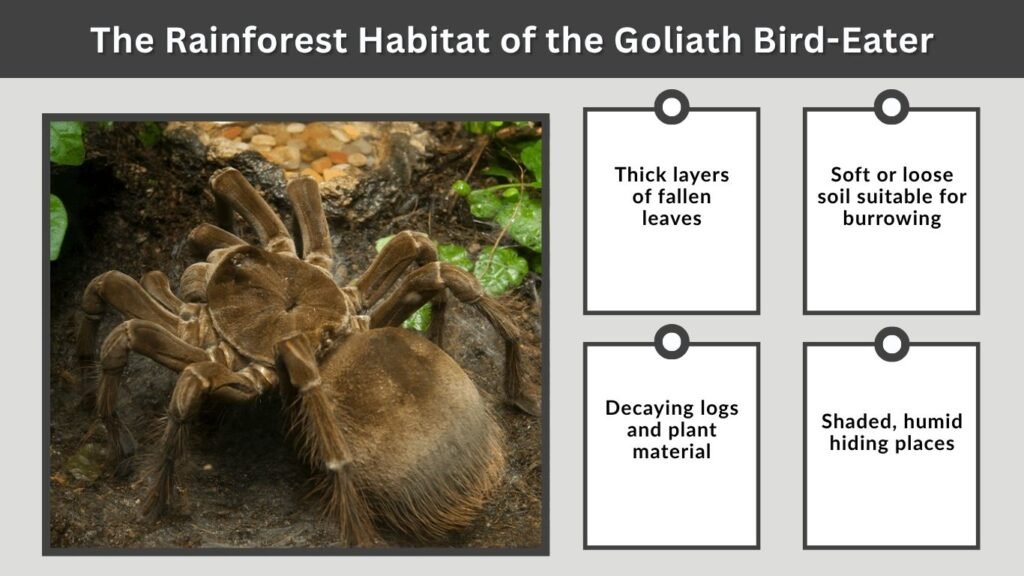
Goliath bird-eating tarantulas live in tropical rainforests characterized by heavy rainfall, high humidity, dense vegetation, and consistently warm conditions. However, they do not usually live high in the trees. They are terrestrial spiders that remain close to the ground.
The rainforest floor provides several important habitat features:
- Thick layers of fallen leaves
- Soft or loose soil suitable for burrowing
- Decaying logs and plant material
- Shaded, humid hiding places
- Large numbers of insects and small animals
- Protection from extreme heat and direct sunlight
The forest canopy blocks much of the sunlight, keeping the ground cooler and moister than exposed areas. This stable environment is important because tarantulas can lose moisture through their bodies if conditions become too dry.
Does the Goliath Bird-Eating Tarantula Live in the Amazon?
Yes, the Goliath bird-eating tarantula occurs in parts of the greater Amazon rainforest region, especially in northern Brazil and neighboring countries. However, it is not distributed throughout the entire Amazon Basin.
Its range is concentrated mainly in the humid forests of northern South America. Therefore, it should not be assumed that every large tarantula found in the Amazon is a Goliath bird-eater.
South America contains many large tarantula species that can look similar. Two closely related species, Theraphosa stirmi and Theraphosa apophysis, are sometimes confused with Theraphosa blondi. Proper identification may require close examination of the hairs, leg structures, body proportions, and collection location.
Where Does It Live Within the Forest?
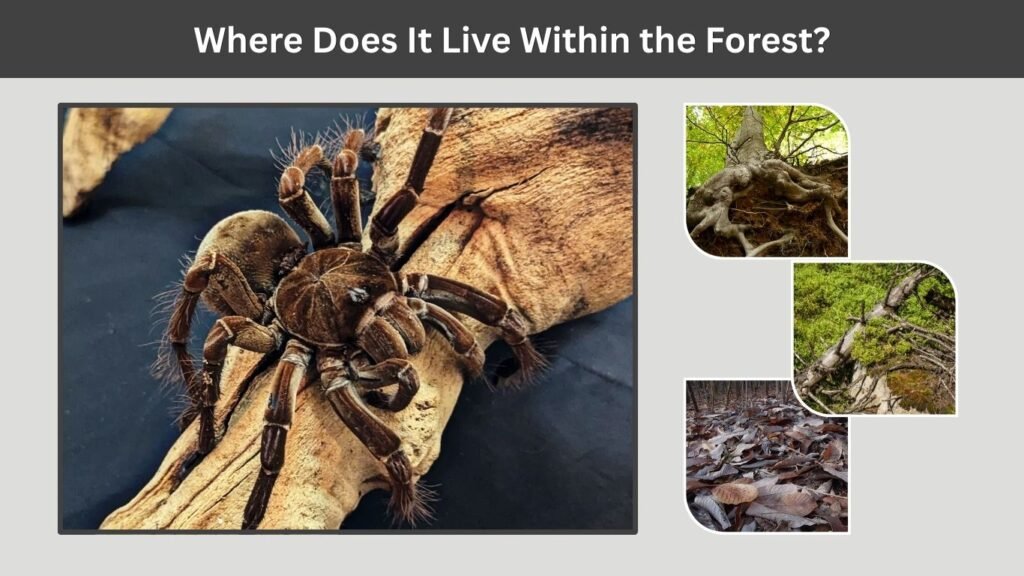
The Goliath bird-eating tarantula normally lives at ground level. It chooses protected places where the soil remains moist but is not constantly flooded.
Common locations include:
- Beneath tree roots
- Under fallen logs
- Between rocks
- Inside abandoned animal burrows
- Along shaded forest banks
- Beneath thick leaf litter
- In naturally formed holes in the ground
The spider may dig its own burrow or enlarge an existing hole made by another animal. The entrance is often surrounded by silk, loose soil, and plant material.
Although the species lives in rainy environments, it still needs a burrow that offers some protection from excessive water. A completely flooded burrow would force the spider to leave and search for higher, drier ground.
The Importance of Underground Burrows
A burrow is the center of a Goliath bird-eater’s life. It provides shelter, stable humidity, protection from predators, and a safe place for resting and molting.
National Geographic notes that Goliath bird-eaters use silk to line their burrows beneath the forest floor rather than constructing webs to capture flying prey.
Protection from Predators
Despite its enormous size, the Goliath bird-eater has natural enemies. Predators may include large wasps, snakes, frogs, coatis, and other animals capable of attacking spiders.
A deep burrow allows the tarantula to retreat quickly when it senses danger. It can position itself near the entrance and move farther underground if threatened.
Stable Temperature and Humidity
Conditions on the open forest floor can change during heavy rain, dry periods, or unusually hot weather. Underground temperatures are generally more stable.
A burrow helps the spider conserve moisture and avoid sudden environmental changes. This is particularly important during molting, when the tarantula sheds its old exoskeleton and becomes temporarily soft and vulnerable.
A Place to Ambush Prey
The burrow also acts as a hunting base. The tarantula often waits near its entrance during the evening or night. It detects movement through vibrations traveling across the ground and silk placed around the burrow.
When an insect or other small animal approaches, the spider can rush forward, capture it, and return underground to feed.
What Type of Climate Does It Need?
The Goliath bird-eating tarantula is adapted to a tropical climate. Its natural environment remains warm throughout most of the year and receives frequent rainfall.
High Humidity
High humidity helps protect the tarantula from dehydration. Moist soil also makes burrowing easier and supports the insects and other animals on which the spider feeds.
However, high humidity does not mean the tarantula lives underwater or in standing water. Its habitat must still have airflow and soil that is not permanently waterlogged.
Warm Temperatures
Northern South American rainforests usually remain warm throughout the year. The spider avoids excessive daytime heat by staying inside its burrow and becoming more active after sunset.
The dark forest floor and underground shelter provide a more comfortable environment than open, sunlit ground.
Frequent Rainfall
Regular rain maintains the damp soil and dense vegetation needed by the species. Rain also supports a rich community of insects, worms, amphibians, and other small animals.
Heavy rainfall may temporarily flood low-lying areas. During such conditions, a tarantula may move closer to the surface or leave its burrow until the water level falls.
Is the Goliath Bird-Eater Arboreal or Terrestrial?
The Goliath bird-eating tarantula is terrestrial, meaning it lives primarily on or below the ground. It is not an arboreal species that normally lives in trees.
Its large, heavy body is better suited to walking across the forest floor than climbing high branches. A fall from even a relatively low height can seriously injure its abdomen.
It may climb over roots, rocks, logs, or low vegetation while exploring, but it does not build a permanent home in the forest canopy. Arboreal tarantulas typically have lighter bodies and longer legs that help them move across vertical surfaces.
Does It Live in Swamps?
Goliath bird-eating tarantulas are sometimes described as inhabitants of swampy or marshy rainforest areas. They can occur in very wet regions near rivers, streams, and seasonal wetlands, but they still require suitable ground for their burrows.
They generally prefer damp, shaded environments rather than open swamps covered by deep water. Slightly raised soil, forest banks, root systems, and areas beneath logs may provide protection from flooding.
Rainforest conditions can vary greatly over short distances. One section may be waterlogged, while a nearby raised area provides suitable burrowing habitat.
Is the Goliath Bird-Eater Nocturnal?
Yes, the Goliath bird-eating tarantula is primarily nocturnal. It normally remains hidden during daylight and becomes more active after dark.
Nighttime activity provides several advantages:
- Temperatures are cooler.
- Humidity is often higher.
- The spider is less visible to predators.
- Many insects and frogs become active.
- The ground is easier to explore without direct sunlight.
The tarantula may wait at the burrow entrance with its front legs positioned outside. Sensitive hairs on its body help detect vibrations, air movement, and nearby activity.
It does not need excellent eyesight to hunt. Instead, it depends mainly on touch and vibration.
What Animals Share Its Habitat?
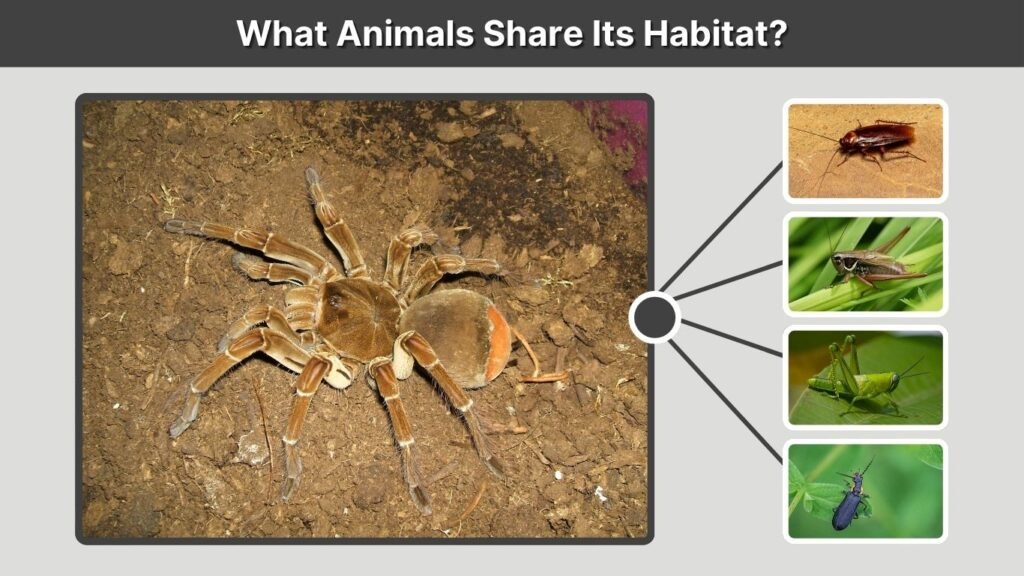
The tropical forests of northern South America contain extremely high levels of biodiversity. The Goliath bird-eater shares its habitat with thousands of other species.
Animals that may live nearby include:
- Cockroaches
- Beetles
- Crickets
- Grasshoppers
- Moths
- Earthworms
- Centipedes
- Frogs
- Lizards
- Small snakes
- Rodents
- Other spiders
Many of these animals may become prey, while others may compete with or threaten the tarantula.
Despite the name “bird-eating tarantula,” birds are not its main food. Smithsonian information explains that birds are not a regular part of its diet, although the spider can capture various animals smaller than itself.
How Does Its Habitat Affect Its Diet?
The damp rainforest floor is filled with invertebrates, giving the Goliath bird-eater many feeding opportunities. Its diet mainly includes insects and other ground-dwelling animals.
Common prey may include:
- Crickets
- Cockroaches
- Beetles
- Worms
- Grasshoppers
- Other spiders
- Small frogs
- Small lizards
The spider does not spin a sticky web to catch prey. It hunts by waiting, detecting vibrations, and launching a rapid attack.
Its burrow location is important because an entrance positioned near insect pathways can provide a regular supply of food without requiring the tarantula to travel far.
Do Males and Females Use the Same Habitat?
Adult males and females generally occupy the same type of rainforest environment, but their behavior can differ.
Females usually spend much of their lives in or near established burrows. They may remain in the same suitable area for a long time if food, humidity, and shelter are available.
Mature males become more active as they search for females. They may travel across the forest floor at night and are therefore more likely to be seen away from burrows.
This roaming behavior exposes males to predators, unsuitable weather, and human activity. Females are usually more secretive and easier to find only by locating their burrows.
Can Goliath Bird-Eaters Live Near Humans?
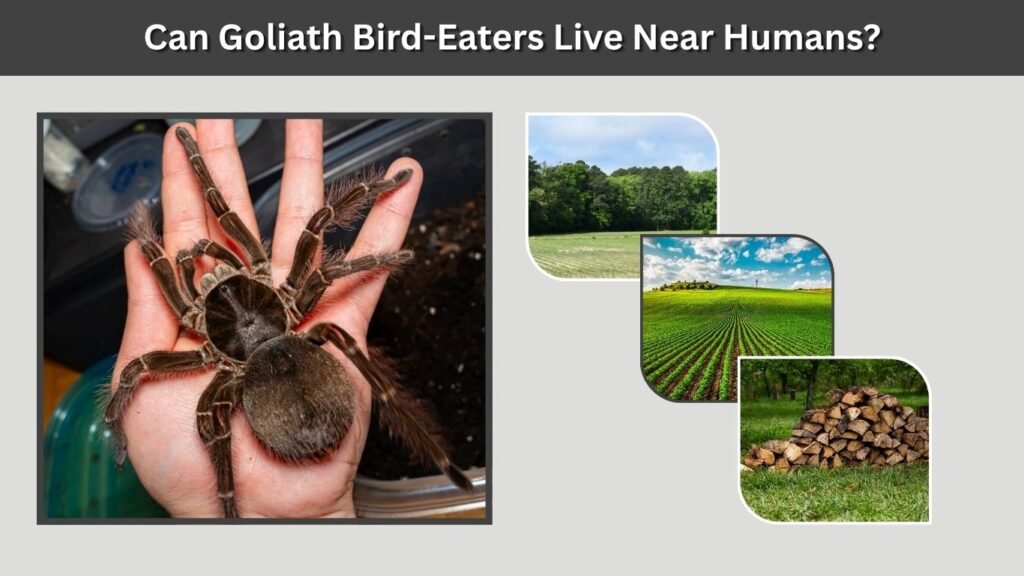
The species is mainly associated with natural rainforest, but individuals may occasionally appear near rural settlements surrounded by suitable habitat.
They might be found near:
- Forest-edge farms
- Plantations
- Storage buildings
- Wood piles
- Gardens beside rainforests
- Roads passing through forested areas
However, they are not typical household spiders and do not usually establish populations inside cities. Dry buildings, concrete surfaces, heavy traffic, and a lack of burrowing sites make urban environments unsuitable.
When encountered, the spider generally attempts to escape or defend itself rather than chase a person.
Threats to Its Natural Habitat
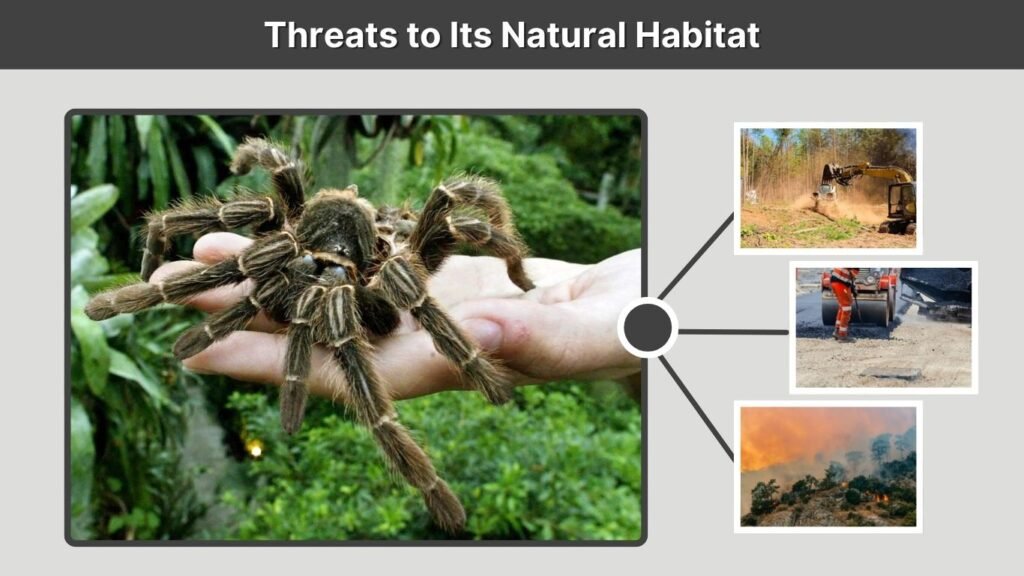
The Goliath bird-eating tarantula depends on healthy rainforest ecosystems. Activities that remove vegetation or alter soil conditions can reduce suitable habitat.
Potential threats include:
- Deforestation
- Mining
- Road construction
- Agricultural expansion
- Forest fires
- Illegal wildlife collection
- Pollution
- Changes in rainfall patterns
The loss of mature forest can remove shaded soil, natural burrows, prey populations, and the humid conditions the spider needs.
Fragmented forests may also isolate populations and increase encounters with people. Because detailed population information is limited, it can be difficult to measure the full effect of habitat change on this secretive species.
Can It Survive Outside a Rainforest?
A Goliath bird-eating tarantula may survive temporarily outside ideal rainforest conditions, but it is specially adapted to warm, humid environments.
It would have difficulty surviving for long in:
- Cold climates
- Dry deserts
- Open grasslands
- Highly urbanized areas
- Places with frozen winters
- Environments without suitable soil
Captive specimens can live outside South America because keepers reproduce important parts of their natural habitat, including warmth, humidity, deep substrate, shelter, and access to water.
However, an artificial enclosure is not identical to a rainforest. Careful environmental control is necessary to prevent dehydration, mold, flooding, or poor ventilation.
FAQs
What country has the most Goliath bird-eating tarantulas?
The species occurs across several northern South American countries, and reliable population totals for each country are not widely available. It is especially associated with Guyana, Suriname, French Guiana, Venezuela, and northern Brazil.
Does the Goliath bird-eater live in trees?
No. It is primarily a ground-dwelling tarantula that lives in underground burrows. It may climb over logs, roots, and low plants, but it does not normally live high in trees like an arboreal tarantula.
Does it live only in the Amazon rainforest?
It lives in northern South American tropical forests, including parts of the wider Amazon region and the Guiana Shield. Its distribution does not cover the entire Amazon rainforest.
How deep is a Goliath bird-eater’s burrow?
Burrow depth varies depending on soil, location, weather, and the availability of existing holes. The spider needs enough depth to maintain humidity, hide from predators, and create a protected space for resting and molting.
Can Goliath bird-eating tarantulas live in houses?
They are not naturally adapted to living inside ordinary houses. An individual might enter a building near rainforest habitat, but homes generally lack the moist soil, deep shelters, and stable humidity required for a permanent burrow.
