
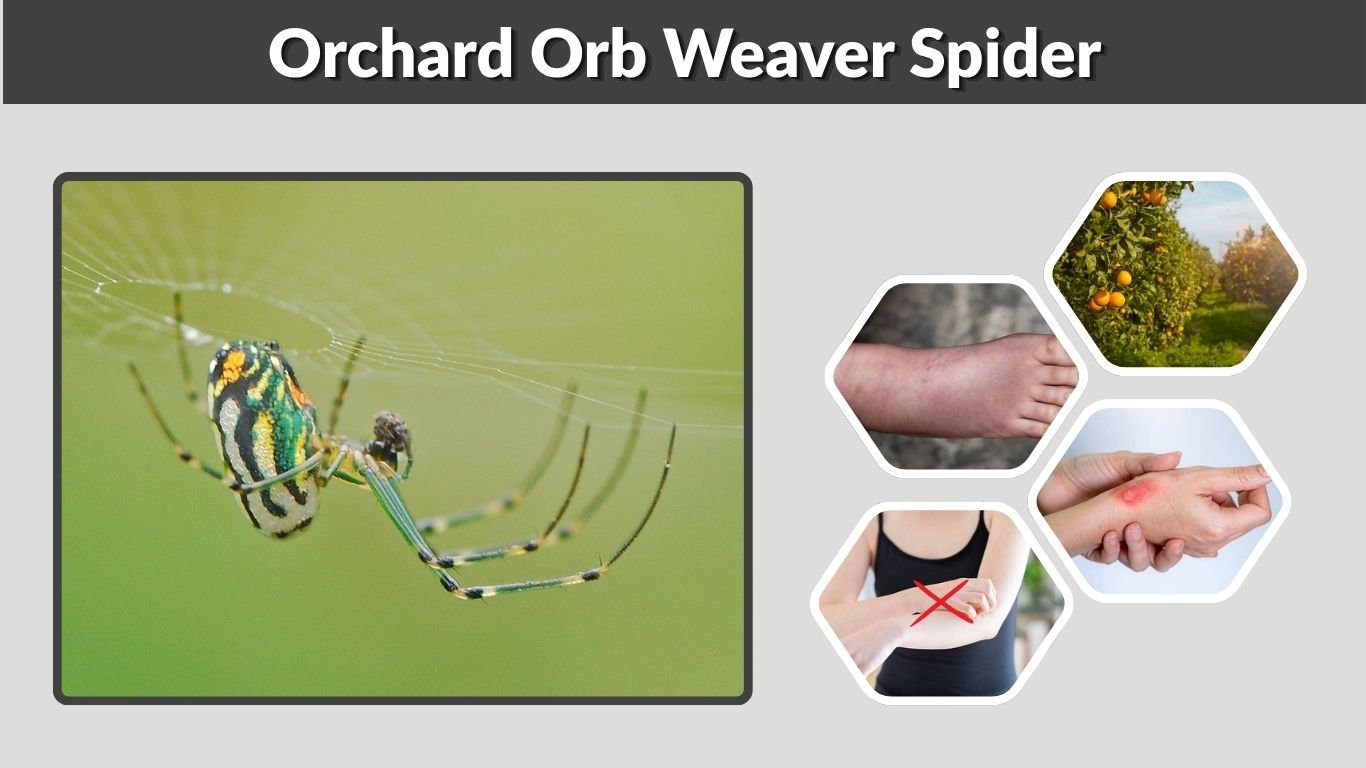
The orchard orb weaver is a small, jewel-colored spider commonly found in gardens, woodland edges, orchards, and low-growing shrubs. Its metallic silver abdomen, green legs, and bright orange or yellow markings make it one of North America’s most colorful spiders. Despite its striking appearance, the orchard orb weaver is harmless to humans and rarely bites. It builds delicate circular webs that capture small insects, making it a beneficial visitor rather than a household pest.
What Is an Orchard Orb Weaver?
“Orchard orb weaver” commonly refers to spiders in the genus Leucauge, especially Leucauge venusta. These spiders belong to Tetragnathidae, the long-jawed orb-weaver family. Unlike many garden orb weavers that construct vertical webs, orchard orb weavers usually build circular webs at a horizontal or slightly angled position.
| Feature | Description |
| Common name | Orchard orb weaver or orchard spider |
| Scientific name | Leucauge venusta |
| Family | Tetragnathidae |
| Female body size | Approximately ¼ inch |
| Male body size | Smaller than the female |
| Web type | Horizontal or angled circular web |
| Diet | Small insects |
| Dangerous to humans | No |
| Common habitat | Shrubs, gardens, orchards, and woodland edges |
How to Identify an Orchard Orb Weaver
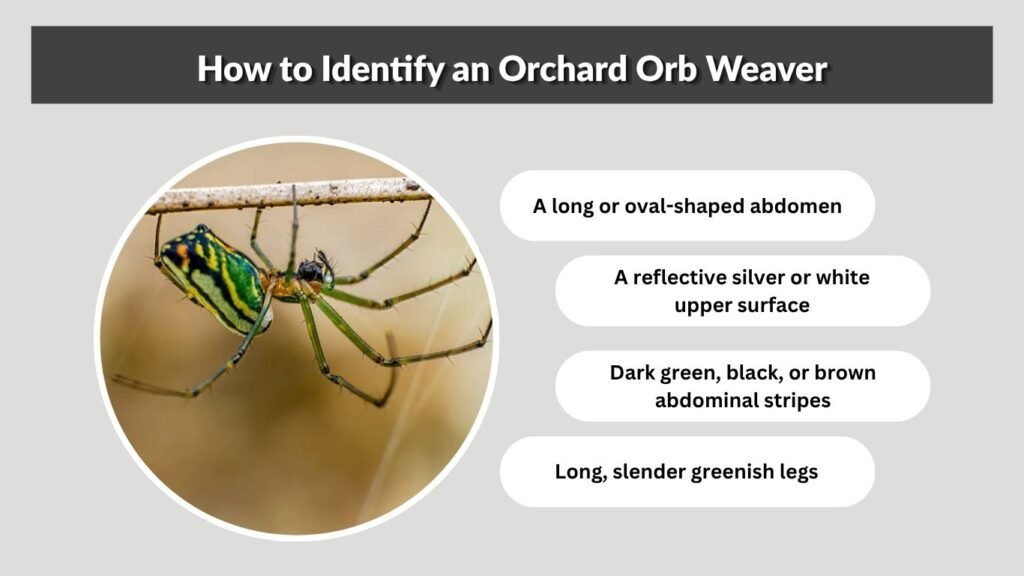
The spider’s shiny colors and slender body make it relatively easy to recognize. However, its appearance can change depending on lighting, viewing angle, age, and geographical location.
Identification Features
Look for the following characteristics:
- A long or oval-shaped abdomen
- A reflective silver or white upper surface
- Dark green, black, or brown abdominal stripes
- Bright yellow, orange, pink, or red markings near the rear
- Long, slender greenish legs
- A yellow-green head and thorax
- A bright orange or reddish mark on the underside
- A small circular web built among low plants
The reflective abdomen may appear silver, green, blue, or gold as sunlight moves across it. The spider frequently rests upside down at the center of its web, so people usually notice its colorful underside first.
Orchard Orb Weaver Underside
The underside may display yellow, black, green, and orange markings. One particularly noticeable feature is a curved orange or red spot that can resemble a smile.
This marking sometimes causes people to mistake orchard orb weavers for immature or male black widows. However, orchard orb weavers have slimmer green legs, silvery abdomens, and a different body shape. Mississippi State University Extension describes them as harmless to humans.
Orchard Orb Weaver Size
Adult female orchard orb weavers are small, measuring approximately ¼ inch in body length without the legs. Males are generally smaller but may appear long because of their slender legs.
The spider may look larger while stretched across its web. Its delicate legs can create a total span much wider than the abdomen and head combined.
Male vs. Female Orchard Orb Weaver
| Characteristic | Female | Male |
| Body size | Larger | Smaller |
| Abdomen | Broader and more colorful | Narrower and slimmer |
| Legs | Long and slender | Often proportionally longer |
| Pedipalps | Small | Enlarged tips in mature males |
| Primary activity | Builds a hunting web | Searches for females when mature |
Adult males may remain near a female’s web during the breeding season. Their smaller bodies and proportionally long legs sometimes make them difficult to recognize as the same type of spider.
Mabel’s Orchard Orb Weaver
Mabel’s orchard orb weaver is currently recognized as Leucauge argyrobapta. It was formerly confused with Leucauge venusta, and the two remain extremely similar in color and body shape.
Current records place L. argyrobapta primarily in Florida and southward through tropical regions to Brazil. L. venusta occurs from Canada through much of the eastern United States to Georgia, with a separate population reported in Southern California. The exact boundary and possible overlap between the species remain uncertain.
How Are the Two Species Different?
The difference is often easier to estimate from location than appearance. In areas where both may occur, the markings near the rear of the abdomen can offer a clue:
- L. argyrobapta commonly has brighter orange or red markings.
- L. venusta more commonly has silver or yellow rear markings.
These color differences are not always reliable, so photographs alone may not provide a definite identification.
Are Orchard Orb Weaver Spiders Poisonous?
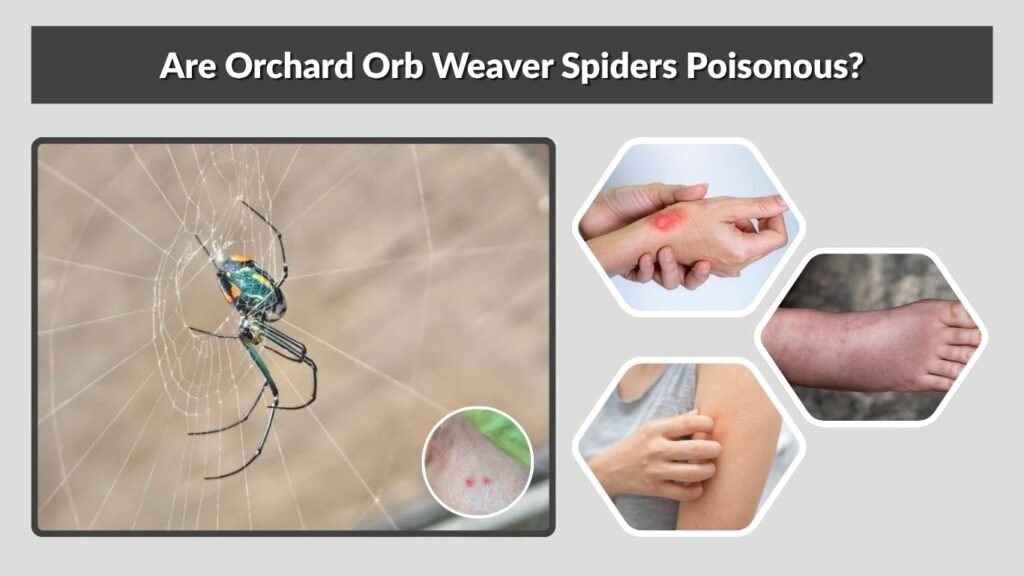
Orchard orb weavers are not poisonous. They are technically venomous because they use venom and their small fangs to immobilize insects caught in their webs.
However, their venom is not considered dangerous to humans. Orchard orb weavers are shy spiders that have no reason to chase or attack people. Extension specialists classify them as harmless.
Do Orchard Orb Weavers Bite?
They are physically capable of biting, but bites are extremely uncommon. A defensive bite would be most likely if someone picked up, squeezed, or trapped the spider against the skin.
An orchard orb weaver normally remains in its web, drops into vegetation, or moves away when disturbed. Leaving the spider alone almost completely eliminates the risk of being bitten.
Orchard Orb Weaver Bite Symptoms
Detailed medical reports involving confirmed orchard orb-weaver bites are scarce. A defensive bite would be expected to cause a minor local reaction rather than serious poisoning.
Possible symptoms may include:
- Brief pinching or stinging
- Minor redness
- Mild swelling
- Itching
- Temporary tenderness
A severe wound, spreading discoloration, muscle cramps, intense pain, or significant illness would not be typical of this harmless species. The person should seek medical evaluation because the spider may have been misidentified or another condition may be responsible.
Treating a Suspected Bite
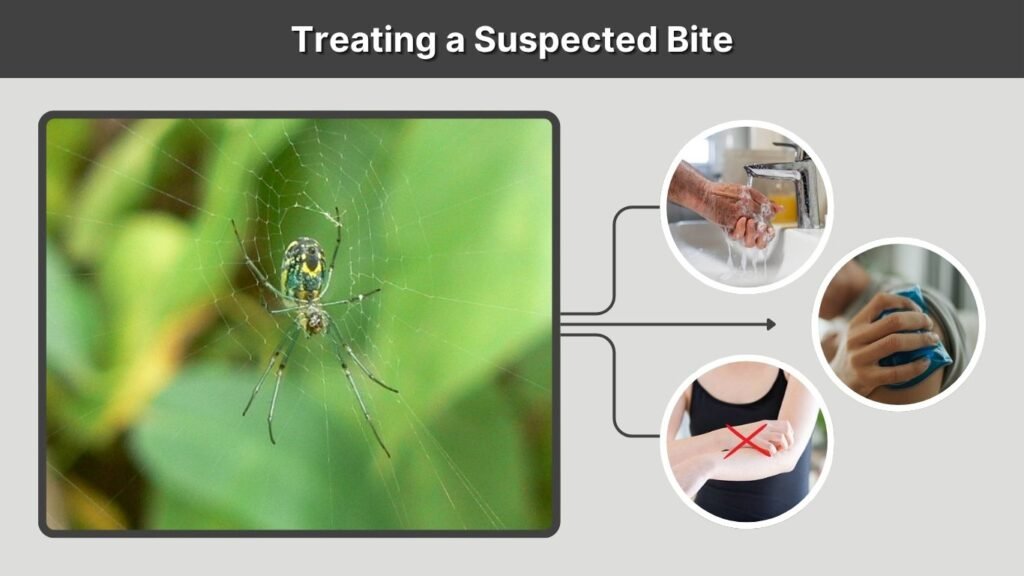
Basic first aid is generally appropriate for a mild suspected spider bite:
- Wash the affected skin with mild soap and water.
- Apply a cold, cloth-wrapped compress for 10–20 minutes.
- Elevate the affected arm or leg when practical.
- Avoid scratching, squeezing, or cutting the bite.
- Monitor the skin for worsening symptoms.
A nonprescription antihistamine, calamine lotion, or low-strength hydrocortisone cream may help with itching when used according to the label.
Seek urgent medical attention for breathing or swallowing difficulty, severe pain, expanding swelling, spreading red streaks, significant skin discoloration, or a wound that continues to enlarge. Medical advice is also appropriate when the spider cannot be identified confidently.
Orchard Orb Weaver Web
Female orchard orb weavers construct delicate wheel-shaped webs in low shrubs, hedges, gardens, and woodland vegetation. The web is commonly horizontal or slightly angled rather than completely vertical.
A mature web may reach approximately 12 inches across. The spider typically hangs upside down at the center, waiting for vibrations caused by trapped prey.
How the Web Works
The web contains supporting lines, radiating spokes, and sticky spiral silk. When a small insect touches the sticky strands, the spider detects the vibrations through its legs.
The spider then approaches, bites the prey, and wraps it in silk. Common food consists of small insects that move through low vegetation.
Habitat and Range
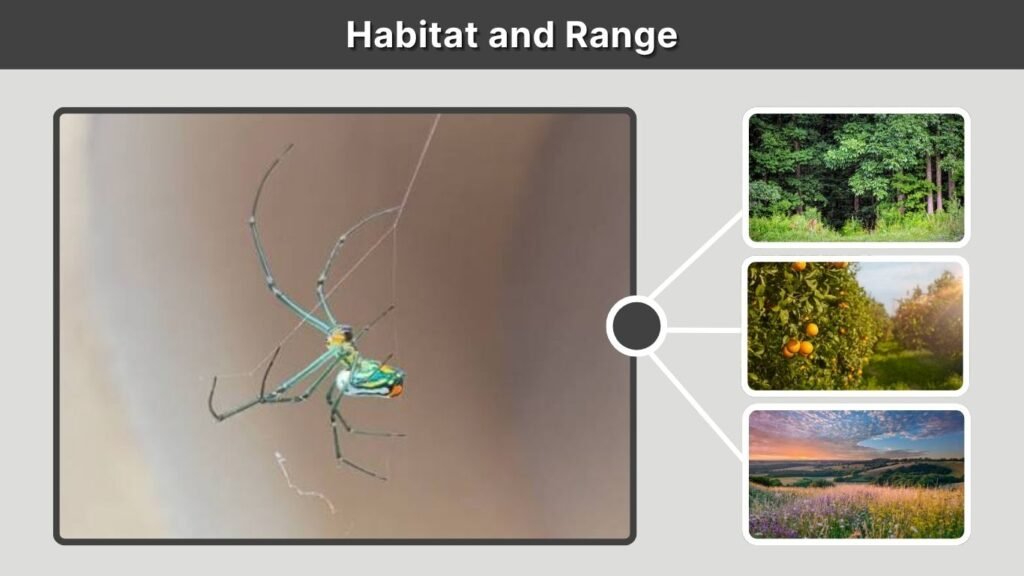
Orchard orb weavers favor shaded, humid environments with abundant vegetation. Common locations include:
- Woodland edges
- Low bushes and shrubs
- Orchards and gardens
- Meadows and tree lines
- Hedges
- Shaded structures
- Vegetation near streams and damp areas
They are frequently found close to the ground, although mature spiders may position their webs higher as suitable supports become available.
Finding several orchard orb weavers does not indicate an infestation. It usually means the area provides suitable vegetation, moisture, and an abundant supply of small insects.
Eggs, Babies, and Life Cycle
After mating, a female attaches her egg mass to a leaf or twig near her web. The young eventually emerge and build tiny individual webs.
In colder parts of the range, adults commonly die after the first frost. The young may hatch but remain protected inside the egg sac during winter. They disperse in spring, sometimes traveling through the air on strands of silk in a process called ballooning.
Juveniles construct smaller webs closer to the ground. As they grow through successive molts, their metallic coloration becomes more noticeable.
Should You Remove Orchard Orb Weavers?
Removal is rarely necessary. Orchard orb weavers do not damage plants, bite leaves, harm buildings, or reproduce inside homes. Their webs capture small insects, making them useful garden predators.
When a web blocks a doorway or path, gently remove its outer supporting lines with a long broom. Avoid touching the spider directly. It will often move away and construct a new web in a quieter location.
FAQs
Are orchard orb weaver spiders dangerous?
Orchard orb weavers are not considered dangerous. They have venom for subduing small insects but rarely bite people. Their small size, shy behavior, and harmless venom make them beneficial garden spiders rather than a health threat.
Is Mabel’s orchard orb weaver poisonous?
Mabel’s orchard orb weaver is not poisonous or medically dangerous. It is technically venomous, like most spiders, but its venom is intended for small prey. The spider is unlikely to bite unless someone traps or handles it.
How big does an orchard or weaver get?
A mature female is usually approximately ¼ inch long when measured without the legs. Males are smaller and slimmer. The spider may appear larger because its long legs spread widely while it rests at the center of its web.
Where do orchard orb weavers build webs?
They usually construct horizontal or angled circular webs among low bushes, shrubs, hedges, gardens, and woodland vegetation. Their webs are often positioned in shaded, humid locations where small flying insects are plentiful.
Can orchard orb weavers live in Florida?
Yes, orchard orb weavers occur in Florida. Many Florida individuals are currently identified as Leucauge argyrobapta, commonly called Mabel’s orchard orb weaver, rather than the closely related northern species Leucauge venusta.
