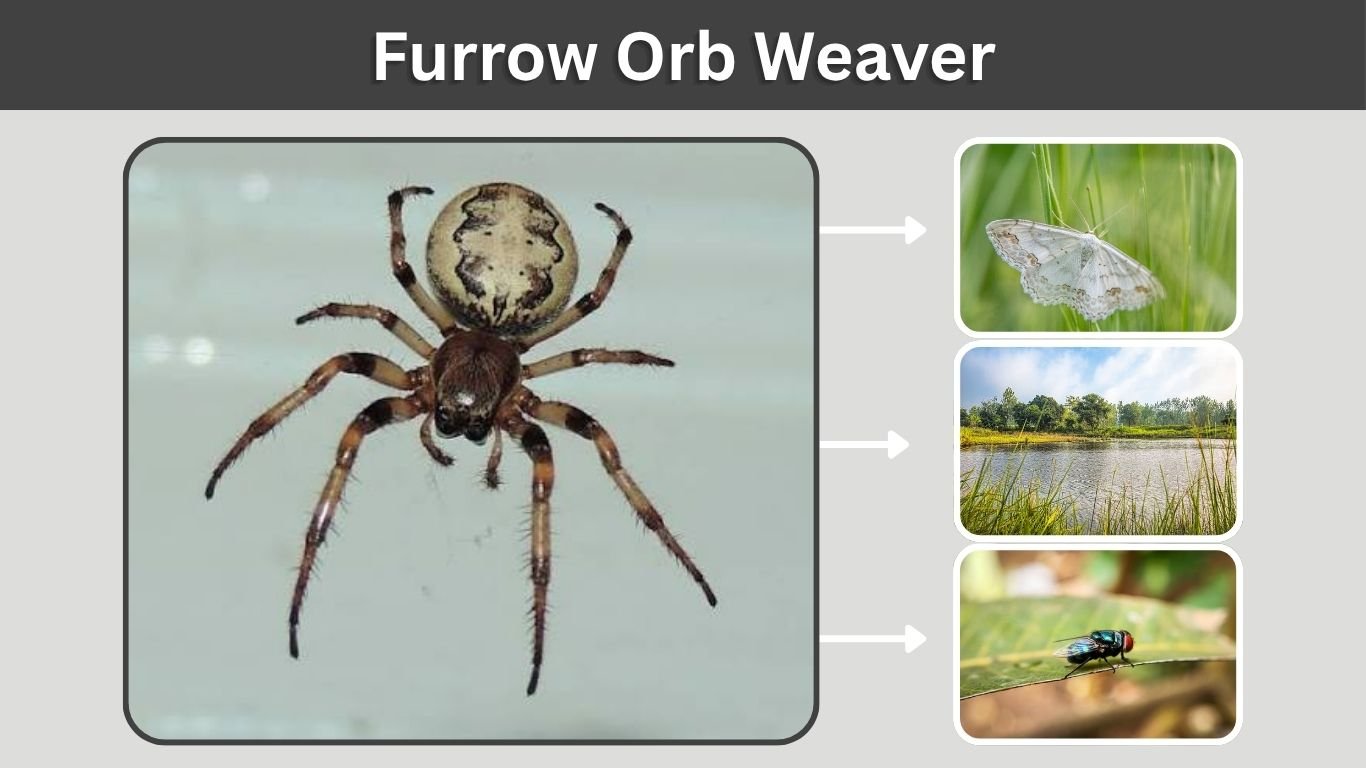
The furrow orb weaver is a medium-sized spider commonly found near lakes, porches, bridges, windows, and outdoor lights. Its rounded abdomen carries a dark, leaf-shaped pattern that resembles a plowed furrow. Although the spider may look intimidating when hanging in its large circular web, it is considered harmless to people. Furrow orb weavers are beneficial predators that catch mosquitoes, moths, gnats, and other flying insects, particularly during the evening and nighttime.
What Is a Furrow Orb Weaver?
The furrow orb weaver’s scientific name is Larinioides cornutus. It belongs to Araneidae, the family containing spiders that construct wheel-shaped orb webs. The species has an extensive distribution covering North America, Europe, northern Africa, parts of the Middle East, Russia, China, Korea, and Japan.
It may also be called the furrow spider or foliate orb weaver.
| Feature | Description |
| Scientific name | Larinioides cornutus |
| Family | Araneidae |
| Typical body length | Around ½ inch or less |
| Colors | Brown, gray, tan, reddish, or olive |
| Habitat | Moist areas, buildings, bridges, and porches |
| Diet | Mosquitoes, gnats, moths, and other insects |
| Dangerous to humans | No |
| Maximum lifespan | Up to about two years |
How to Identify a Furrow Orb Weaver
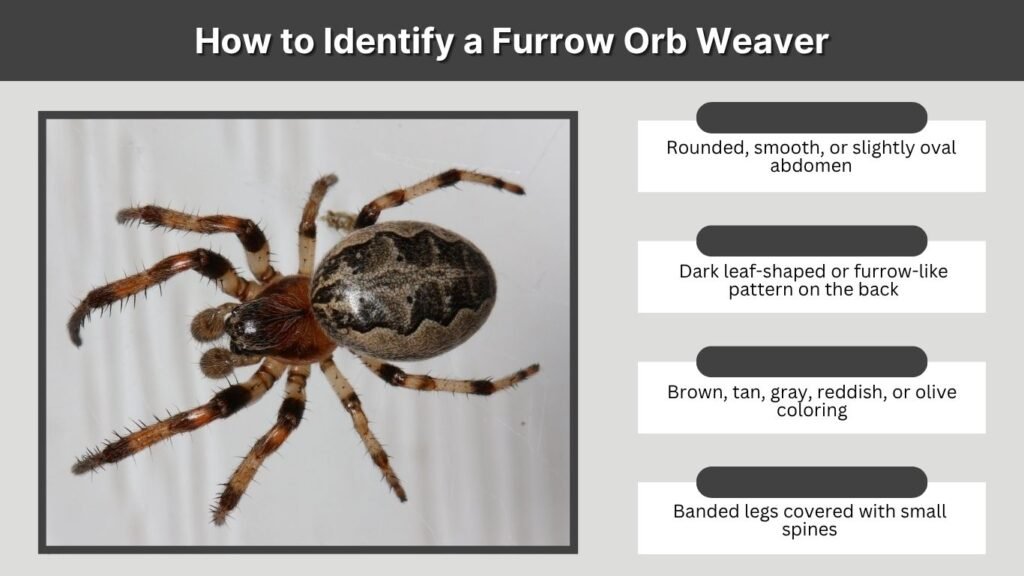
The spider’s color varies considerably, so identification should not be based on color alone. Its abdominal pattern, body shape, legs, and web provide better clues.
Identification Features
- Rounded, smooth, or slightly oval abdomen
- Dark leaf-shaped or furrow-like pattern on the back
- Wavy or zigzag edges surrounding the abdominal marking
- Brown, tan, gray, reddish, or olive coloring
- Banded legs covered with small spines
- Front two pairs of legs longer than the back pairs
- Shiny abdomen and finely haired head region
- Large, wheel-shaped web with widely spaced spirals
The central marking may be very dark on some spiders and much paler on others. Furrow orb weavers can therefore appear brown, gray, cream, orange, or almost black while still belonging to the same species.
Furrow Orb Weaver Underside
The familiar furrow pattern is located on the upper abdomen, so it may not be visible when the spider is hanging head-down in its web. Looking at the spider’s back from a safe angle is more useful than examining its belly.
Avoid picking up the spider to see its underside. Photographs of its back, legs, and web are generally safer and more helpful for identification.
Furrow Orb Weaver Size
A mature furrow orb weaver is generally around ½ inch long when measured without the legs. Illinois wildlife information places females at approximately one-quarter to one-half inch in body length, while males are usually around one-fifth to one-third inch long.
A female carrying eggs can look much larger because her rounded abdomen becomes noticeably swollen. Leg position also affects the spider’s apparent size, especially when it is stretched across the center of its web.
Male vs. Female Furrow Orb Weaver
Male and female furrow orb weavers are more similar than the sexes of many other orb-weaver species.
| Characteristic | Female | Male |
| Body size | Usually larger | Slightly smaller |
| Abdomen | Rounder and fuller | Somewhat narrower |
| Coloring | Variable | Similar to female |
| Pedipalps | Small and leg-like | Enlarged tips in mature males |
| Behavior | Builds and occupies a hunting web | Searches for females during mating |
Males approach females cautiously and pluck the strands of the female’s web. These deliberate vibrations may help distinguish a potential mate from trapped prey.
Are Furrow Orb Weaver Spiders Poisonous?
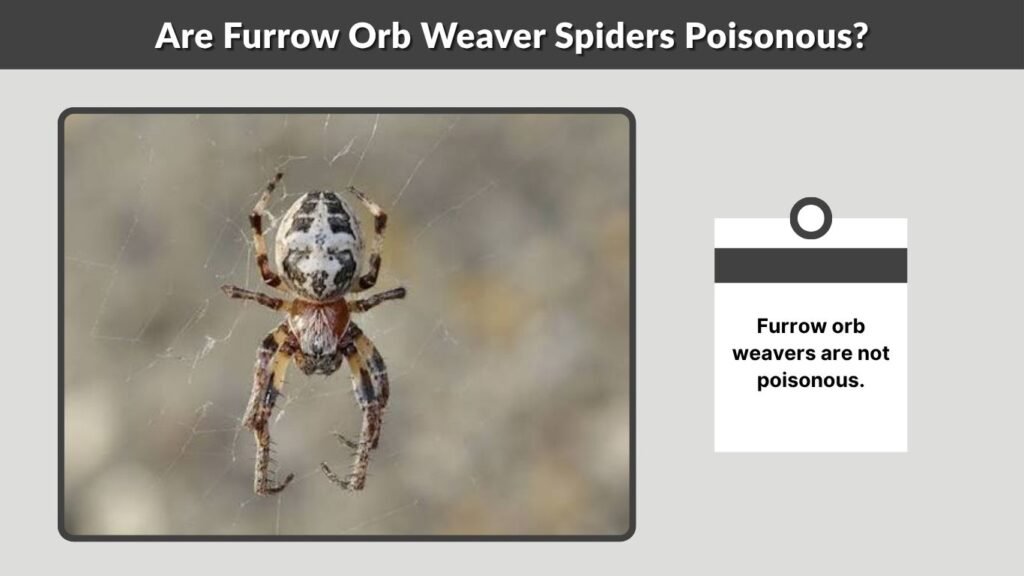
Furrow orb weavers are not poisonous. They are technically venomous because they inject venom through their fangs to paralyze insects.
However, their venom is not considered medically significant to humans. Wildlife authorities describe furrow orb weavers as harmless spiders, and they do not normally attack people.
Do Furrow Orb Weavers Bite?
A furrow orb weaver is physically capable of biting, but bites are uncommon. The spider normally remains in its web, retreats into a nearby crevice, or attempts to escape when disturbed.
A defensive bite is most likely when someone:
- Picks up the spider
- Squeezes it accidentally
- Traps it between clothing and skin
- Reaches blindly into its hiding place
- Attempts to remove it with bare hands
Simply walking near the web does not normally cause the spider to attack.
Furrow Orb Weaver Bite Symptoms
There is limited published information about confirmed bites from this particular species. Based on the generally mild nature of most spider bites, a defensive bite could produce localized pain, redness, tenderness, or swelling. Many suspected spider bites are never confirmed because insect bites, skin infections, and allergic reactions can look similar.
A severe wound, spreading tissue damage, intense muscle cramps, or major whole-body symptoms would not be expected from a correctly identified furrow orb weaver. Such symptoms require medical evaluation because another cause may be responsible.
How to Treat a Suspected Bite
For a mild suspected bite:
- Wash the area carefully with soap and water.
- Apply a cloth-wrapped cold pack for 10–20 minutes.
- Elevate the affected arm or leg when practical.
- Avoid scratching or squeezing the area.
- Monitor the skin for increasing redness, pain, or swelling.
A nonprescription antihistamine or anti-itch cream may help minor itching when used according to the product instructions.
Seek medical attention when the person develops breathing difficulty, facial swelling, severe pain, vomiting, weakness, rapidly spreading redness, pus, red streaks, or other worsening symptoms. Medical advice is also appropriate when the spider was not positively identified.
Furrow Orb Weaver Web
The furrow orb weaver constructs a circular web with spoke-like radial lines and a sticky spiral. Its spiral strands tend to be more widely spaced than those in many other orb-weaver webs.
The web is commonly built:
- Under porch roofs and house eaves
- Beside windows and outdoor lights
- Under bridges
- Between low plants
- Near ponds, lakes, and other damp places
- Against exterior walls and railings
Webs near buildings are frequently positioned parallel to a wall or window and only a few inches from the surface. Outdoor lights provide especially productive hunting locations because they attract moths, mosquitoes, and other flying insects.
How It Hunts
The spider often repairs or rebuilds its web during the late evening. It may sit in the center at night or wait inside a silk-lined hiding place connected to the web.
When prey strikes the silk, the spider detects its vibrations. It approaches the insect, wraps it with silk, bites it to inject venom, and either feeds immediately or stores the wrapped prey temporarily.
What Do Furrow Orb Weavers Eat?
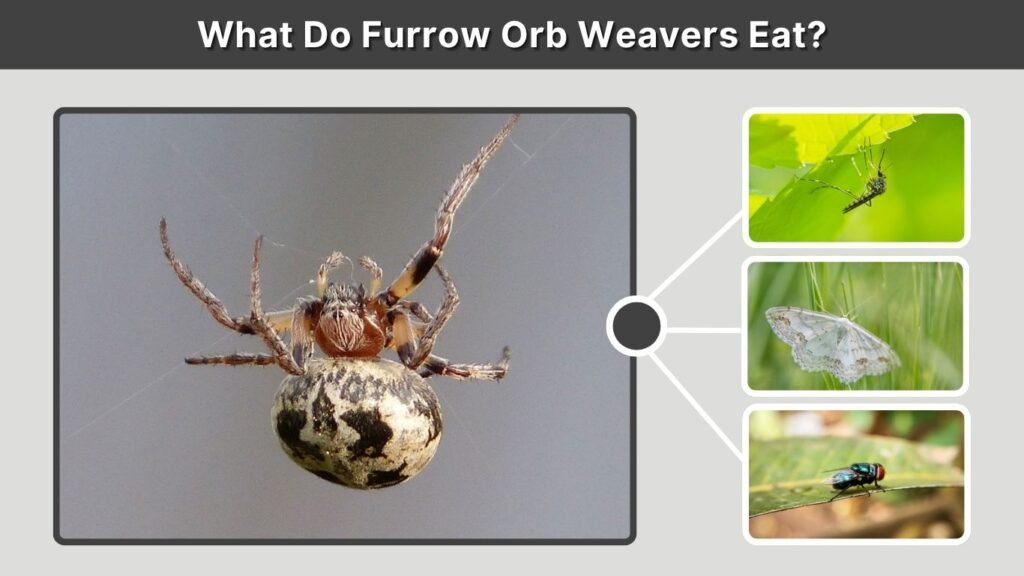
Furrow orb weavers primarily eat flying insects, including:
- Mosquitoes
- Gnats
- Moths
- Flies
- Damselflies
- Small beetles
- Other small invertebrates
Because they consume numerous insects around windows, porches, and outdoor lights, furrow orb weavers can provide useful natural pest control. They do not eat plants, damage wood, contaminate food, or create structural damage.
Habitat and Range
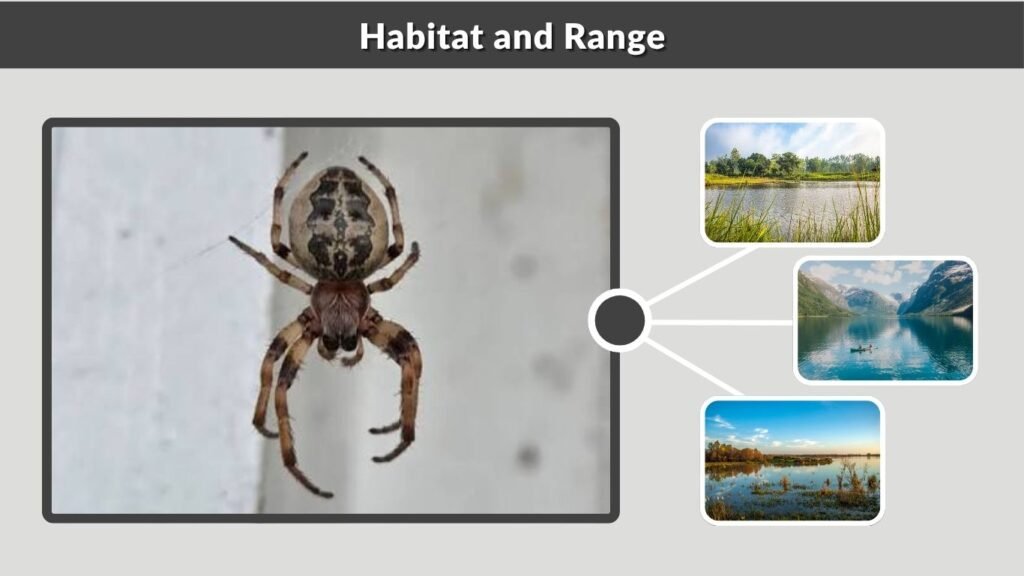
Furrow orb weavers prefer moist locations such as low vegetation around ponds, lakes, wetlands, and riverbanks. However, they adapt well to human structures and are frequently found under porches, below roof eaves, on bridges, and beside exterior lights.
Their broad Northern Hemisphere range explains reports from states such as Illinois, Ohio, Virginia, North Carolina, Missouri, Massachusetts, and Pennsylvania. Their presence around a house does not usually represent an indoor infestation. Multiple webs commonly indicate that the property provides suitable supports and plenty of flying insects.
Eggs, Spiderlings, and Lifespan
After mating, the female creates egg sacs and hides them inside protective silk cocoons attached to vegetation or placed near her web. The young hatch inside the sac after approximately three to four weeks but may remain protected inside it for several more weeks.
Unlike many seasonal orb weavers, furrow orb weavers can sometimes survive cold weather and appear as full-sized adults during spring. Their total lifespan may reach approximately two years.
How to Remove Furrow Orb Weavers
A spider living in an unused corner can generally be left alone. It will catch insects without damaging the building.
When webs block a doorway or frequently used space:
- Remove the web gently with a long broom.
- Wear gloves while moving stored outdoor materials.
- Reduce unnecessary exterior lighting at night.
- Seal gaps around windows and doors.
- Clear clutter where spiders can hide during the day.
- Avoid spraying pesticides directly around ponds or beneficial garden areas.
Repeatedly removing a web often encourages the spider to move to a quieter location.
FAQs
Are furrow orb weavers dangerous to humans?
Furrow orb weavers are not considered dangerous to humans. They possess venom for subduing insects but rarely bite people. A defensive bite would generally be expected to cause only a temporary local reaction unless the person experiences an unusual sensitivity.
Can a furrow orb weaver bite kill you?
A furrow orb weaver bite is not considered fatal. These spiders are not classified with medically important spiders such as widows or recluses. Nevertheless, breathing problems, facial swelling, severe pain, or rapidly worsening symptoms require immediate medical attention.
How large can a furrow orb weaver become?
Most adults measure about ½ inch or less in body length, excluding their legs. Females are generally larger and have rounder abdomens, while males are slightly smaller and slimmer. Egg-carrying females may appear unusually large.
Why are furrow orb weavers around my house?
Homes provide excellent supports for orb webs, while porch lights attract mosquitoes, moths, gnats, and other prey. The spiders commonly build near windows, roof eaves, porches, and exterior lights because these locations offer reliable feeding opportunities.
Should I kill a furrow orb weaver?
Killing one is usually unnecessary. Furrow orb weavers are harmless predators that reduce flying-insect populations. When a web causes inconvenience, gently remove it with a broom and allow the spider to relocate rather than handling it directly.
