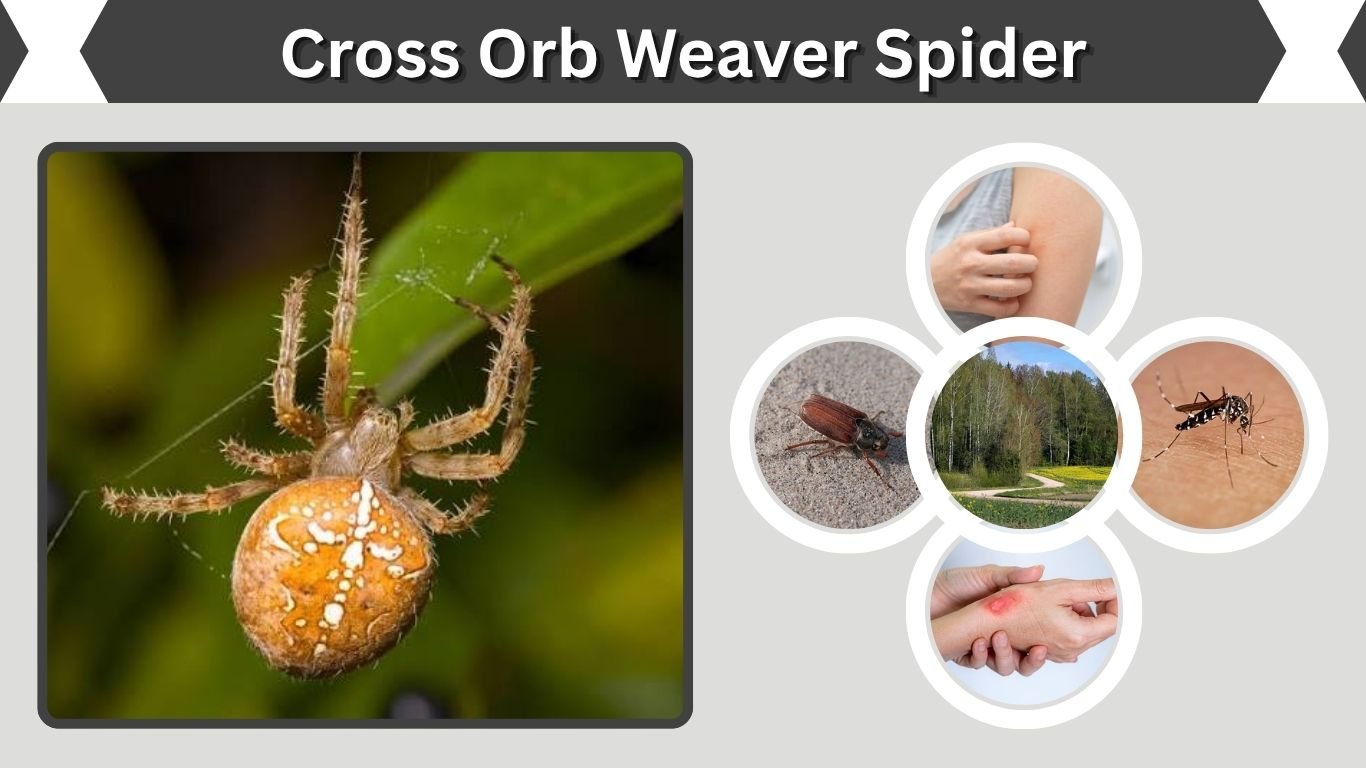
The cross orb weaver is a colorful garden spider best recognized by the pale cross-shaped markings on its rounded abdomen. Also called the European garden spider or cross spider, it builds large circular webs between plants, fences, trees, and buildings. Although its size can alarm people, it is not considered dangerous to humans. Cross orb weavers are shy predators that spend most of their time catching flies, moths, wasps, beetles, and other insects in their webs.
What Is a Cross Orb Weaver?
The cross orb weaver’s scientific name is Araneus diadematus. It belongs to Araneidae, the orb-weaver family. The species is native across much of Europe and parts of Asia and was introduced into North America. It is frequently found in gardens, hedges, woodland edges, shrubs, and around buildings.
| Feature | Description |
| Scientific name | Araneus diadematus |
| Other names | Cross spider, European garden spider |
| Family | Araneidae |
| Female body length | About 6–22.5 mm |
| Male body length | About 4–13 mm |
| Diet | Flying and crawling insects |
| Venomous | Yes, but not medically significant |
| Common habitat | Gardens, hedges, fences, shrubs, and buildings |
How to Identify a Cross Orb Weaver
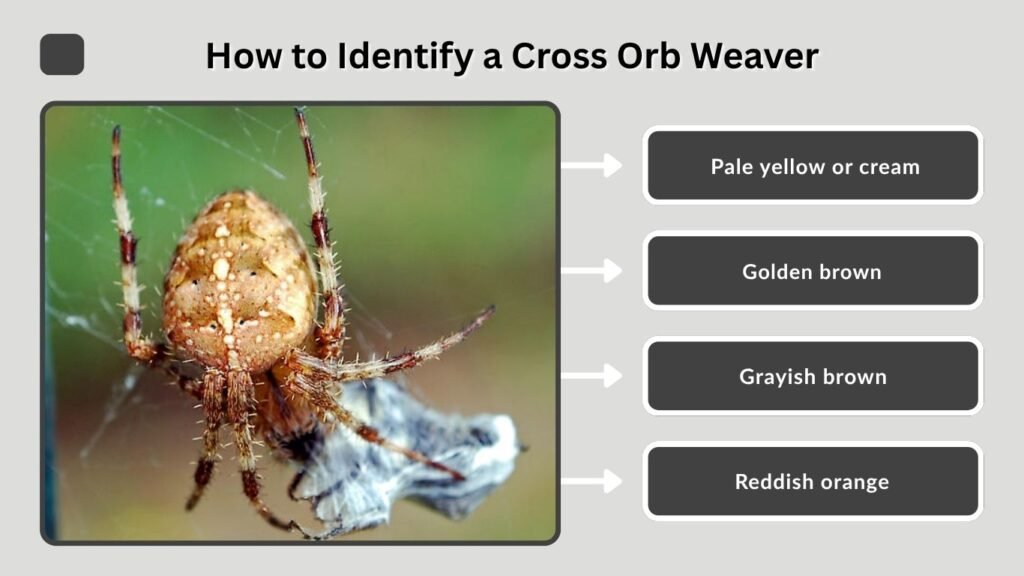
A cross orb weaver can vary greatly in appearance, so color alone is not reliable. The pale cross on its back, rounded abdomen, banded legs, and classic circular web provide the strongest identification clues.
Cross-Shaped Back Marking
The most distinctive feature is a group of white or cream-colored spots forming a cross on the upper abdomen. Some individuals have a clear, complete cross, while others have separated dots or irregular pale patches.
A small number of cross orb weavers may have weak or incomplete cross markings, making them easier to confuse with other Araneus spiders.
Color Variations
Cross orb weavers occur in numerous colors, including:
- Pale yellow or cream
- Golden brown
- Grayish brown
- Reddish orange
- Dark chocolate brown
- Almost black
Therefore, an orange, gray, red, pale, or dark cross orb weaver may still belong to the same species. The abdomen is usually broad and rounded, while the hairy legs have alternating light and dark bands.
Underside and Belly
When viewed from below, the famous white cross may not be visible because it is located on the spider’s back. The underside generally appears darker and may contain lighter markings, but these patterns are less convenient for identification.
It is better to examine the spider’s back, body shape, leg bands, and web without handling it.
Cross Orb Weaver Size
Female cross orb weavers are noticeably larger and heavier than males. Published measurements differ slightly among references, but females generally reach approximately 6–22.5 mm in body length, excluding the legs. Males usually measure around 4–13 mm.
A female carrying eggs may look exceptionally large because her abdomen becomes swollen during late summer or fall.
Male vs. Female Cross Orb Weaver
| Characteristic | Female | Male |
| Overall size | Larger | Smaller |
| Abdomen | Broad, rounded, and heavy | Narrower and less swollen |
| Web building | Builds a large hunting web | Mature males often stop building hunting webs |
| Pedipalps | Small and leg-like | Enlarged tips resembling boxing gloves |
| Behavior | Remains near her web | Wanders in search of females |
Adult males resemble small females but can be distinguished by their enlarged pedipalps. Mature males search for females and may gently pluck a female’s web to signal that they are potential mates rather than trapped prey.
Are Cross Orb Weaver Spiders Poisonous?
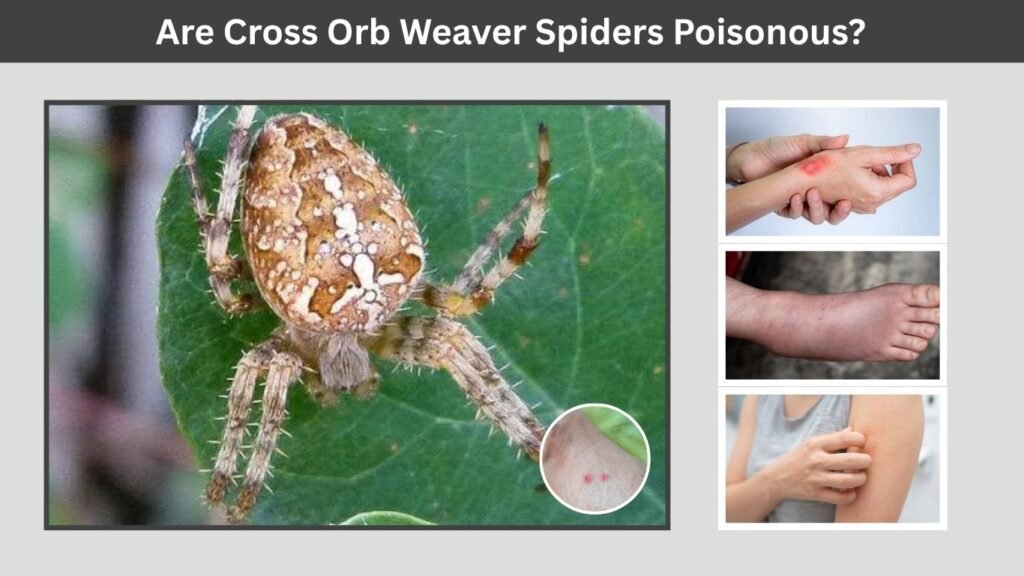
Cross orb weavers are not poisonous, but they are venomous. Poison causes harm when swallowed or touched, while venom is injected through fangs.
The spider uses venom to immobilize insects caught in its web. However, cross orb weavers are not classified among medically important spiders, and they do not normally present a serious danger to humans.
Do Cross Orb Weaver Spiders Bite?
Cross orb weavers can bite, but bites are uncommon. A spider is most likely to defend itself when it is grabbed, squeezed, trapped against the skin, or disturbed while protecting itself.
Spiders generally avoid biting people unless threatened. Even when a skin reaction is blamed on a spider, confirming the cause can be difficult unless the spider was actually observed biting.
Cross Orb Weaver Bite Symptoms
A bite may cause minor symptoms such as:
- Immediate mild pain
- Redness
- Local swelling
- Itching
- Tenderness around the bite
Reactions can vary, but serious whole-body effects are not normally expected from a correctly identified cross orb weaver.
Treating a Suspected Bite
Wash the area gently with soap and water. Apply a cool, cloth-wrapped compress for approximately 10–20 minutes to reduce discomfort and swelling. Avoid scratching the area, and monitor it for changes.
Obtain medical assistance when pain or swelling becomes severe, redness continues spreading, the wound appears infected, or the person develops vomiting, weakness, facial swelling, breathing difficulty, or another serious reaction. Medical care is also advisable when the spider was not confidently identified.
Cross Orb Weaver Web
The cross orb weaver constructs the classic wheel-shaped web associated with garden spiders. Its web contains strong outer supports, radial lines extending from the center, and a spiral of sticky capture silk.
Webs are generally positioned vertically across open spaces where insects regularly fly. They may be built between shrubs, fence posts, tree branches, porch railings, windows, or outdoor lights. A mature web can measure around 40 centimeters across, although its supporting threads may stretch much farther.
How the Spider Hunts
The spider often hangs head-down at the center of its web. Alternatively, it may wait in a nearby retreat while keeping one leg connected to a signal thread.
When an insect becomes trapped, vibrations travel through the silk. The spider approaches, bites the prey, wraps it in silk, and may eat it immediately or save it for later. Cross orb weavers may rebuild damaged sections and recycle old silk by eating it.
What Do Cross Orb Weavers Eat?
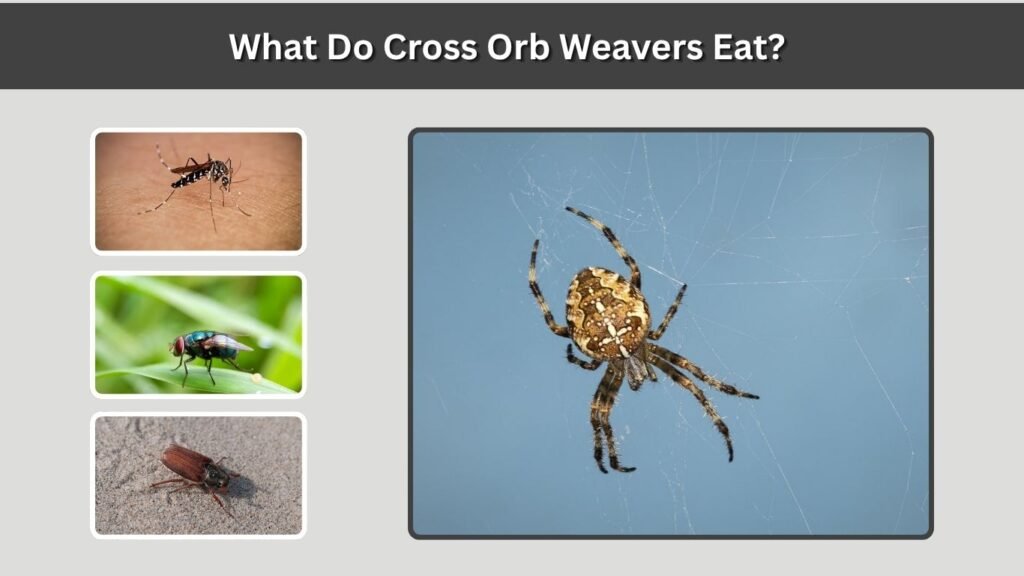
Cross orb weavers primarily catch insects that fly or jump into their webs. Common prey includes flies, mosquitoes, moths, beetles, wasps, leafhoppers, and other small arthropods.
Their webs are often placed near lights because outdoor lighting attracts flying insects. For this reason, cross orb weavers can provide natural pest control around gardens and homes. They do not feed on plants, damage buildings, or infest stored food.
Habitat and Range
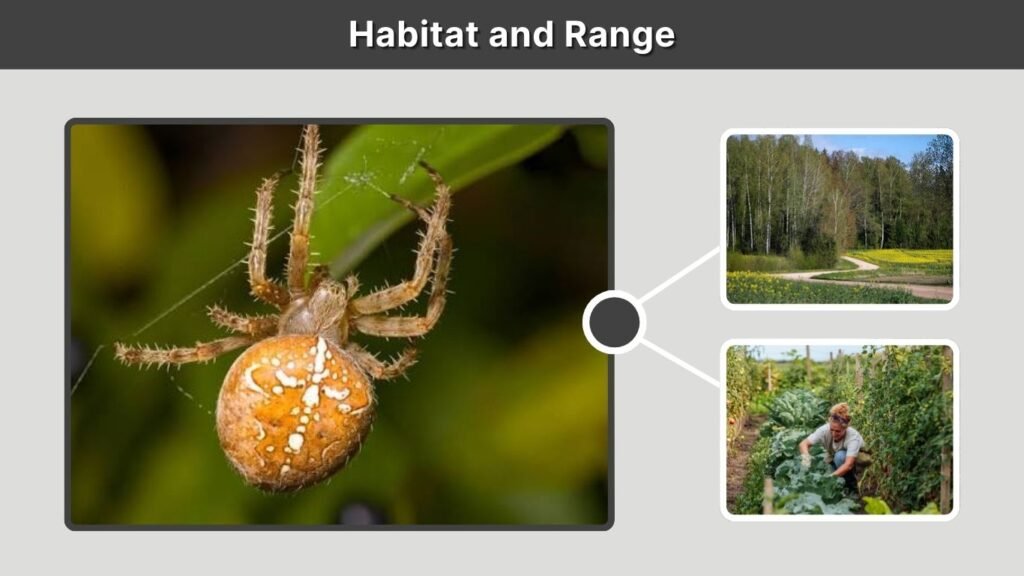
Cross orb weavers live among herbs, bushes, hedges, fences, woodland edges, gardens, and exterior building surfaces. They prefer places that offer secure web supports and a steady supply of insects.
The species occurs widely across Europe and parts of Asia. It was introduced into North America and is established in regions of the United States and Canada, especially parts of the Pacific Northwest and Northeast. Records also occur farther inland and in states such as California, Oregon, Washington, Michigan, Wisconsin, and surrounding regions.
Eggs, Spiderlings, and Life Cycle
After mating and feeding heavily, the female leaves her regular web and selects a protected location for her eggs. She produces an egg sac covered with tough yellowish silk, often hiding it in vegetation, near the base of a wall, or inside an outdoor structure.
The female initially guards the sac but dies before the young emerge. Spiderlings hatch or emerge during spring and may gather together in a bright yellow cluster. When disturbed, the cluster rapidly scatters before forming again.
Juvenile Development and Lifespan
Young cross orb weavers eventually separate and construct miniature orb webs. They grow through several molts before becoming adults.
Development time depends on climate. In cooler parts of Britain, juveniles may overwinter and mature during their second year. In warmer southern areas, some may reach adulthood within their first year. Mature females generally die after producing and guarding their egg sacs.
Should You Remove a Cross Orb Weaver?
A cross orb weaver in a quiet garden location can usually be left alone. It catches insects and rarely causes problems for people or pets.
When a web blocks a doorway or walkway, gently break the outer supporting silk with a long broom during daylight, when the spider can be seen clearly. Avoid crushing or handling the spider. Repeatedly removing the web may encourage it to rebuild in a less disruptive location.
FAQs
Are cross orb weaver spiders dangerous to humans?
Cross orb weavers are not considered dangerous to humans. They possess venom for catching insects but rarely bite unless trapped or handled. A bite may cause temporary localized discomfort, redness, itching, or swelling rather than a serious medical emergency.
Can a cross orb weaver bite a dog or cat?
A bite is possible when a pet presses or bites the spider, but cross orb weavers do not hunt or attack pets. Contact a veterinarian if an animal develops substantial swelling, persistent pain, drooling, weakness, vomiting, or breathing difficulties.
Why does a cross orb weaver have a cross on its back?
The cross is formed by pale spots and streaks on the upper abdomen. Its exact function is not fully established, but the pattern is a normal physical characteristic of the species and provides a useful identification feature.
How big can a cross orb weaver get?
Large females can reach approximately 20–22.5 mm in body length, excluding their legs. Males are considerably smaller and usually have slimmer abdomens. A pregnant female may appear particularly large during late summer or autumn.
Are European garden spiders and cross orb weavers the same?
Yes. European garden spider, cross spider, garden cross spider, and cross orb weaver are common names used for Araneus diadematus. However, the term “garden spider” can also refer to unrelated species, so the scientific name prevents confusion.
