
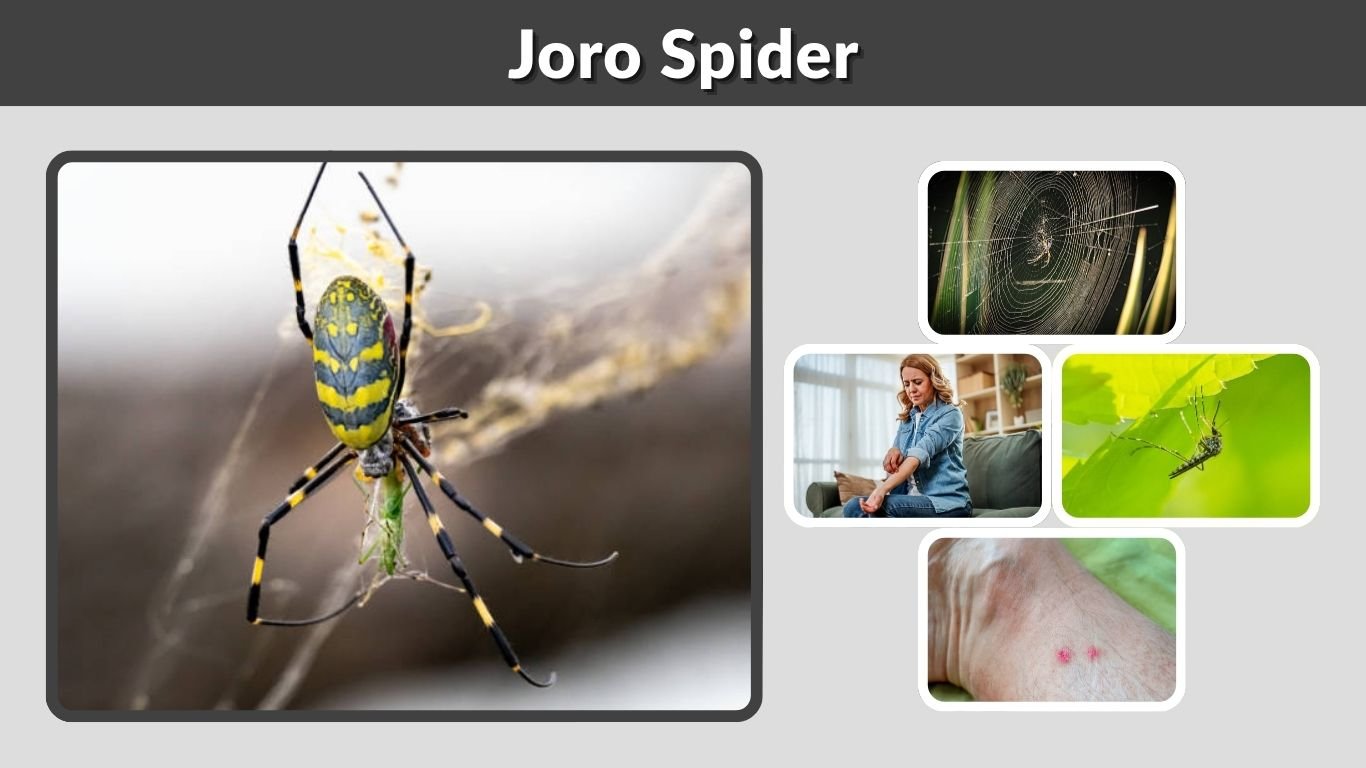
The Joro spider (Trichonephila clavata) is a large golden orb-weaver native to East Asia. It became established in northern Georgia after being discovered there in 2014 and has gradually spread into nearby regions. Adult females are recognizable by their bright yellow abdomen, blue-gray bands, red underside, and long black legs marked with yellow bands. Despite their intimidating appearance, Joro spiders are shy and pose little danger to people or pets.
Joro Spider Identification
Female and male Joro spiders look dramatically different. The large, colorful spiders commonly seen in photographs are mature females. Males are much smaller and usually remain near the edge of a female’s web.
Female Joro Spider
An adult female typically has:
- A long, cylindrical abdomen
- Bright yellow coloring with blue-gray or greenish bands
- A large red marking underneath the abdomen
- Long black legs with yellow or orange bands
- Golden or silver hairs covering the cephalothorax
- A large, multilayered web with yellowish silk
A mature female may reach approximately one inch in body length and have a leg span approaching four inches. Her bright pattern becomes most noticeable from late summer through fall.
Male Joro Spider
Adult males are less colorful, with narrow brown bodies and dark legs. They measure less than one-third the size of a mature female and may be difficult to notice among the silk and captured insects.
Several males can sometimes occupy the same female’s web. Unlike adult females, males do not produce large capture webs of their own.
Joro Spider Size Comparison
| Feature | Adult female | Adult male |
| Body length | Up to about 1 inch | Much less than 1 inch |
| Leg span | Up to about 4 inches | Considerably smaller |
| Main colors | Yellow, blue-gray, black, and red | Brown, yellow, and black |
| Web building | Builds a large orb web | Lives near a female’s web |
| Visibility | Bright and easy to recognize | Small and easily overlooked |
The spider may look palm-sized when its legs are fully extended, but its actual body is much smaller than its complete leg span.
Joro Spider Web
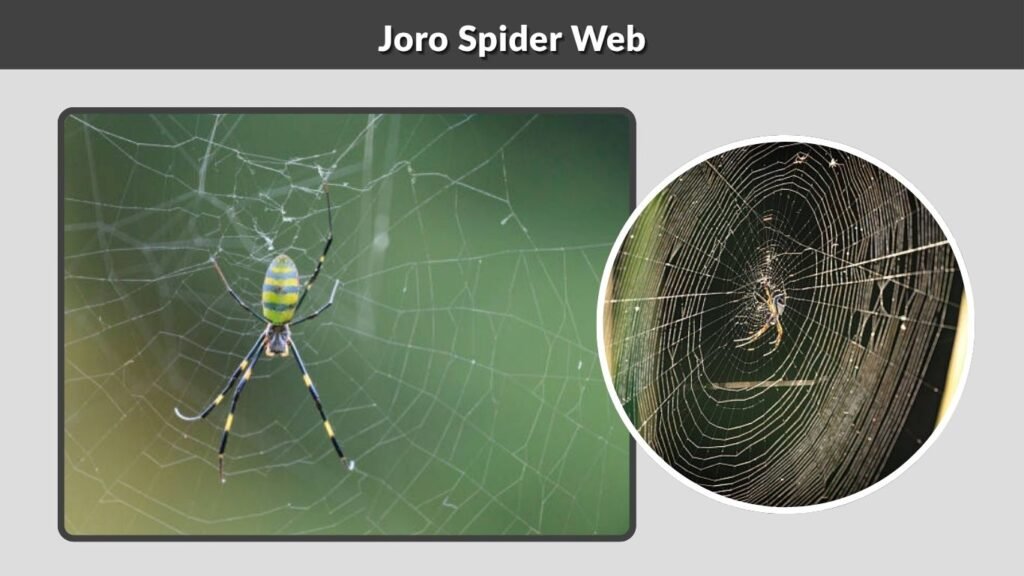
A mature female constructs a large golden orb web between trees, shrubs, utility structures, fences, porches, and other stable supports. The circular capture area is surrounded by additional supporting and barrier silk, giving the web a thick, three-dimensional appearance.
The central web may be several feet wide. Some webs span ten feet or more, while support strands can extend approximately twenty feet between trees or structures. Mature females produce particularly thick, strong, sticky silk with a yellow or golden appearance.
Why Is the Web Golden?
The silk produced by mature females has a naturally yellow tint. It becomes especially noticeable when direct sunlight reflects from the strands.
The web is strong enough to trap relatively large insects and withstand many ordinary disturbances. However, rain, wind, falling branches, birds, and human activity may damage portions of it. The spider usually repairs usable sections rather than abandoning the entire structure immediately.
Where Do Joro Spiders Come From?
Joro spiders are native to parts of Asia, including Japan, Korea, China, Taiwan, Vietnam, and India. They were probably transported accidentally to North America in shipping materials, containers, or potted plants. The first confirmed U.S. discoveries were made in three Georgia counties in 2014.
The Japanese name “joro-gumo” is commonly translated as “entangling bride” or “binding bride.” The name is connected to Japanese folklore, although the real spider is a harmless insect predator rather than a dangerous mythical creature.
Joro Spider Spread in the United States
The spider’s main established U.S. range is centered in northern Georgia and neighboring parts of Alabama, North Carolina, South Carolina, and Tennessee. An established population has also been documented around Elkridge, Maryland. Individual reports from distant states do not necessarily indicate that reproducing populations have become established there.
Joro spiders are expected to continue expanding because they tolerate relatively cool conditions, live successfully around human development, and can be transported accidentally in vehicles or cargo. Current reports can be submitted to Joro Watch or EDDMapS, where specialists review photographs and location information.
Do Joro Spiders Fly?
Adult Joro spiders do not fly with wings. Newly hatched spiderlings disperse through a process called ballooning.
A spiderling releases fine silk that catches moving air and carries it away. Most movements are relatively local, but strong winds and storms may transport young spiders much farther. Human-assisted transportation can also create isolated sightings far beyond the established range.
Are Joro Spiders Invasive?
The Joro spider is unquestionably an introduced species in the United States. However, its long-term ecological effects are still being investigated.
Researchers are examining whether it competes with native orb-weavers, changes local food webs, or significantly affects pollinators. Early observations show that it consumes several common insects and is also eaten by birds and predatory wasps. It may coexist with some native spiders, but more research is needed before its full ecological impact can be determined.
What Do Joro Spiders Eat?
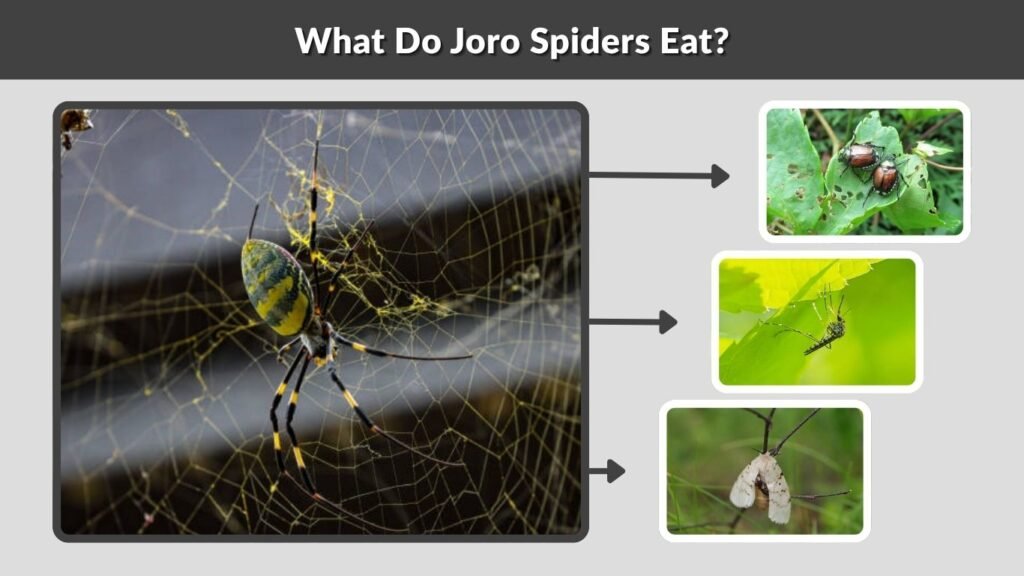
Joro spiders are predators that eat animals trapped in their webs. Their diet consists mainly of flying and climbing insects, including:
- Flies
- Mosquitoes
- Moths
- Beetles
- Wasps
- Bees
- Cicadas
- Grasshoppers
- Brown marmorated stink bugs
- Other small arthropods
When prey strikes the web, the spider detects vibrations, approaches the animal, and uses silk and venom to subdue it. Joro spiders can capture the brown marmorated stink bug, an introduced agricultural pest that some native spiders may avoid.
Are Joro Spiders Poisonous or Venomous?
Joro spiders are venomous, not poisonous. They deliver venom through their fangs to immobilize insect prey. A poisonous animal causes harm when touched or swallowed.
Their venom is not considered medically important to humans. University extension specialists describe them as reluctant to bite, and their small fangs may have difficulty penetrating human skin.
Does a Joro Spider Bite?
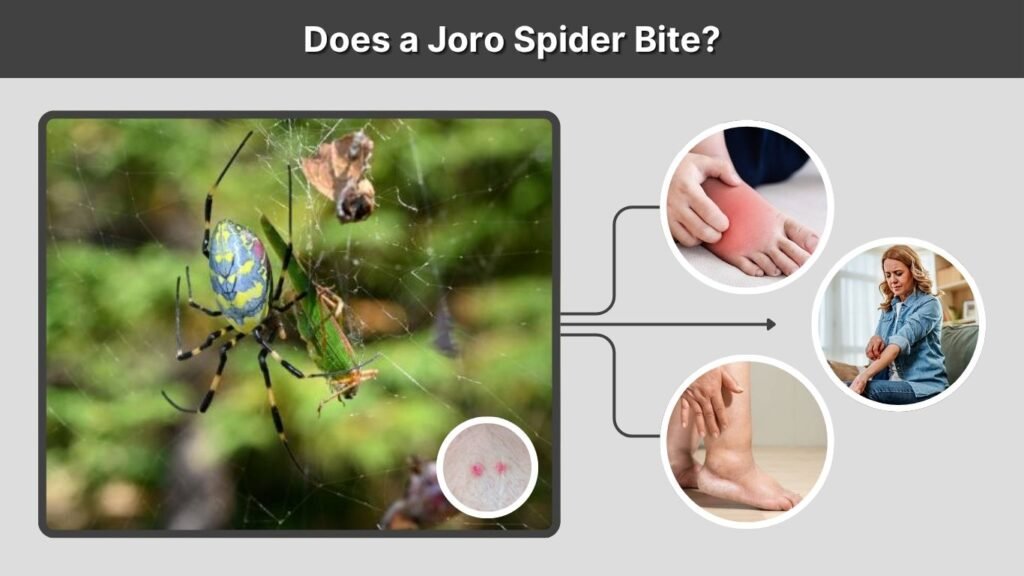
A Joro spider can bite if it is trapped, squeezed, or handled roughly, but bites are very uncommon. Its usual response to disturbance is to remain motionless, retreat, or escape rather than attack.
A successful bite may produce temporary localized pain, redness, itching, or swelling. Serious effects are not expected for most people, although anyone can potentially experience an allergic reaction.
Wash a suspected bite with soap and water and apply a cold pack wrapped in cloth. Seek medical care for increasing pain, spreading redness, signs of infection, breathing difficulty, widespread hives, dizziness, or swelling of the face or throat.
Joro Spider Life Cycle
Joro spiders complete a one-year seasonal life cycle in much of their introduced U.S. range.
Females lay a single papery silk egg sac during fall. A sac commonly contains about 400–500 eggs and is attached to bark, leaves, buildings, or another sheltered surface. Adults die after freezing weather arrives, while the eggs remain protected through winter.
Spiderlings hatch during spring and begin building small webs. They grow and molt throughout summer, with mature males usually appearing before mature females. Large adult females and their golden webs are easiest to find from August through October in the southeastern United States.
Joro Spider vs. Similar Spiders
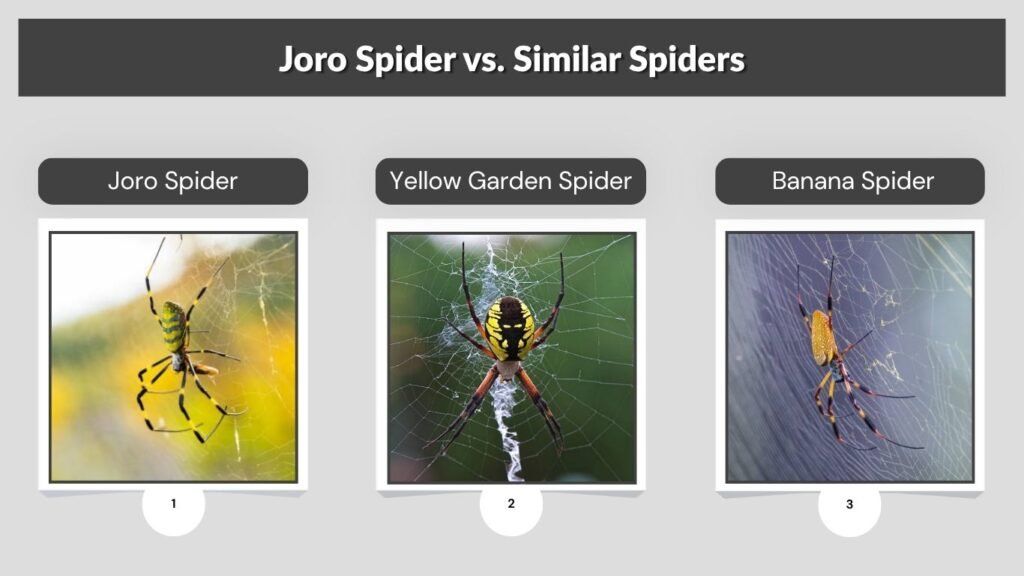
Joro Spider vs. Yellow Garden Spider
The yellow garden spider, also called the writing spider, has a broad black-and-yellow abdomen. Its web usually contains a thick white zigzag pattern.
The Joro spider has a longer abdomen with horizontal blue-gray and yellow bands, a red underside, and a multilayered golden web without the garden spider’s prominent central zigzag.
Joro Spider vs. Banana Spider
“Banana spider” commonly refers to the native golden silk orb-weaver in the southeastern United States. Both species have long legs and golden webs.
Female Joro spiders usually display stronger horizontal abdominal bands and a conspicuous red ventral marking. Identification can be difficult from a distance, so clear photographs of both sides of the abdomen are helpful.
How to Remove Joro Spiders
Chemical treatment is rarely necessary. When a web blocks a doorway, path, porch, or work area, use a broom or long stick to remove the silk and encourage the spider to relocate.
Repeatedly removing newly constructed webs can make the location unsuitable. Crushing egg sacs before spring may reduce the number emerging in a limited area, but permanent regional eradication is unrealistic once populations are established. Avoid unnecessary spraying because pesticides may also kill native spiders, pollinators, and other beneficial animals.
FAQs
Are Joro Spiders Dangerous to Humans?
No. They are large and venomous, but their venom is weak from a human-health perspective. They are shy, rarely bite, and usually attempt to avoid contact.
Are Joro Spiders Dangerous to Pets?
They are not considered a meaningful threat to dogs or cats. A curious pet could disturb one, but Joro spiders are more likely to escape or remain motionless than bite.
How Big Can a Joro Spider Get?
A mature female’s body may reach about one inch long, while her extended legs can create a span of approximately three to four inches. Males are much smaller.
What Should I Do After Finding One?
Photograph the spider and submit the sighting to Joro Watch or EDDMapS, especially when it is outside the known range. Leave it alone when its web is not causing a problem.
Can Joro Spiders Survive Cold Weather?
Adults generally die after hard freezes, but their protected egg sacs survive winter. Their cold tolerance and seasonal life cycle may allow them to continue spreading through much of eastern North America.
