
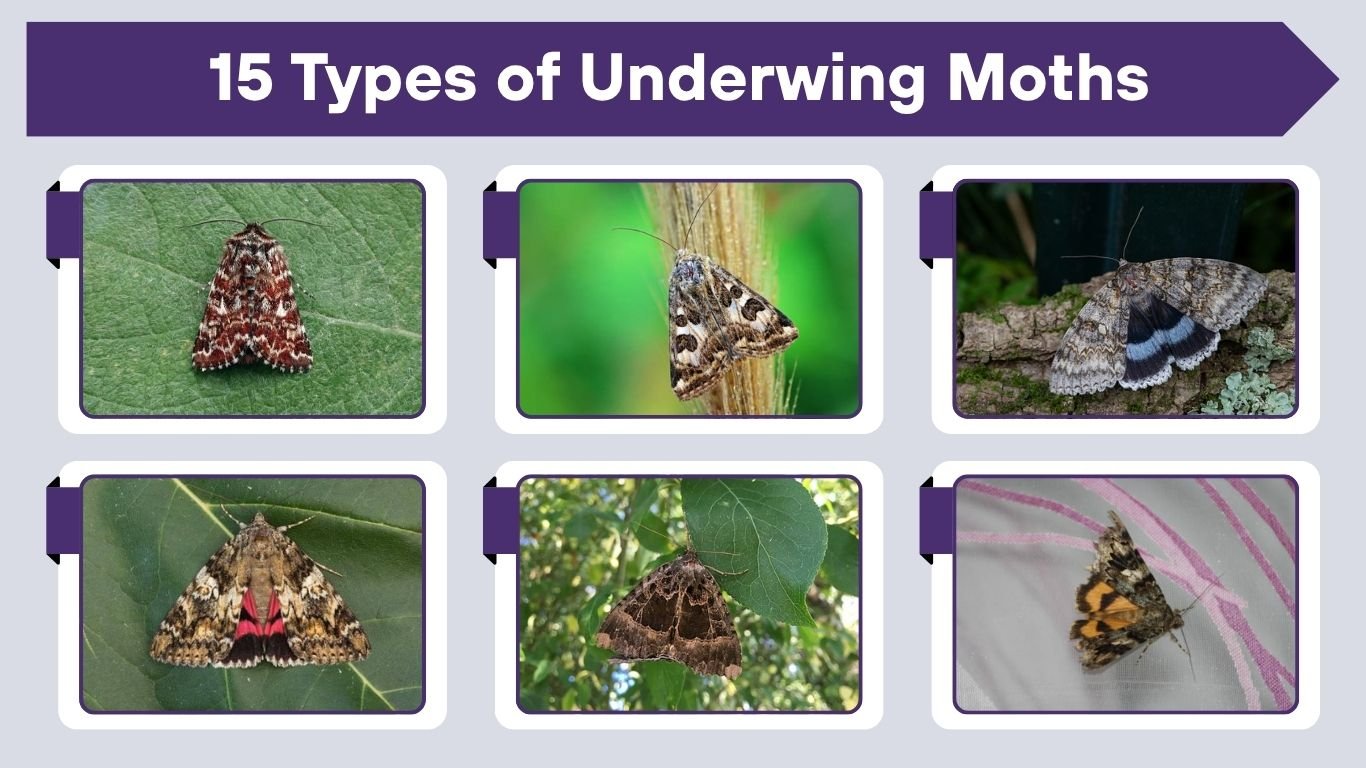
Underwing moths can look like pieces of bark until they spread their wings, revealing colors hidden beneath their patterned forewings. Many species display red, orange, or yellow hindwings, while others have striking black wings with pale fringes. These mostly nocturnal moths belong to the genus Catocala and depend on particular trees or shrubs during their caterpillar stage. This guide explores 15 types of underwing moths, covering their identification features, habitats, behaviors, diets, and life cycles to help you recognize and better understand these woodland insects.
1. Red Underwing

The Red Underwing (Catocala nupta) is a large moth whose appearance changes dramatically when it opens its wings. Its gray forewings provide camouflage, while the hidden hindwings display vivid red and black. This contrast makes it a memorable species to encounter, particularly when a resting moth suddenly takes flight from a tree trunk.
Identification
- Wingspan: Usually 65–75 mm.
- Forewings: Mottled gray with irregular dark lines and paler patches.
- Hindwings: Red with a black central band and broad black outer border.
- Resting position: Forewings conceal most of the red coloring.
- Overall appearance: A broad-winged moth that resembles weathered bark when resting.
Habitat and Distribution
Red Underwings occur across much of Europe and into Asia. In Britain, they are familiar across many parts of England and Wales. They inhabit woodland, riverbanks, parks, and gardens where willows and poplars grow. Suitable food trees allow them to occupy some developed areas as well as more natural habitats.
Behavior
Adults are mainly nocturnal and may visit lights or sugar bait. During daylight, they often remain inconspicuous against their surroundings. If disturbed, a moth can flash its bright hindwings while escaping. Once it lands and covers those wings again, the sudden disappearance of red can make it difficult to follow visually.
Diet
Caterpillars feed on willow and poplar leaves, including aspen. Adults take sugary liquids rather than chewing leaves. This difference matters when describing their diet: the trees support growing caterpillars, while adult feeding supplies energy during the moth’s winged stage.
Life Cycle
The species produces one generation each year and overwinters as an egg. In Britain, caterpillars are generally present from May to July. They eventually pupate inside a cocoon before emerging as adults, usually in late summer or early autumn. These seasonal dates vary geographically and do not describe the lifespan of an individual adult.
2. Ilia Underwing

The Ilia Underwing (Catocala ilia), also known as the Beloved Underwing, is strongly associated with oak trees. Its forewings vary considerably in color, ranging from relatively pale gray to nearly black. Despite that variation, a pale marking around the kidney-shaped forewing spot often provides a useful clue when identifying this attractive North American moth.
Identification
- Wingspan: Approximately 65–82 mm.
- Forewings: Variable gray, brown, or almost black, with irregular darker markings.
- Distinctive spot: Kidney-shaped forewing marking often outlined or filled with white.
- Hindwings: Orange to reddish orange, crossed by black bands.
- Identification caution: Forewing color alone is unreliable because individuals differ substantially.
Habitat and Distribution
Ilia Underwings inhabit oak woodland and other wooded landscapes containing suitable host trees. They occur widely in eastern North America, including southern Canada and much of the eastern United States. Their connection with oaks makes tree composition more informative than simply describing their habitat as “forest.”
Behavior
Adults are primarily active at night. During the day, their mottled forewings help them blend into bark and other uneven backgrounds. As with many underwings, the bright hindwings are largely concealed at rest. For identification, compare the complete wing pattern rather than relying entirely on the pale spot or overall darkness.
Diet
Caterpillars eat oak leaves. Recorded hosts include black, bur, red, and white oaks. These food plants distinguish the Ilia Underwing from species associated with willows, poplars, or hickories. Established oak woodland provides both the foliage required by its caterpillars and the wooded surroundings in which adults can find shelter.
Life Cycle
Ilia Underwings have one annual generation. Eggs survive winter, then hatch into caterpillars that grow and molt before pupation. Adults are generally recorded between June and September, depending on location. The overwintering eggs connect one year’s adults with the following year’s caterpillars. This seasonal sequence places the feeding and growth stages in the warmer part of the year.
3. Sweetheart Underwing

The Sweetheart Underwing (Catocala amatrix) is among the larger species in this group. Its broad reddish hindwings contrast with subdued forewings that often carry diffuse dark streaks. Although impressive in flight, it can be surprisingly unobtrusive when resting. Cottonwoods are especially important to its ecology, providing food for the caterpillars and helping define suitable breeding habitat.
Identification
- Wingspan: Approximately 75–95 mm.
- Forewings: Grayish to purplish brown with wavy dark lines.
- Typical marking: Diffuse dark streaking extending along the forewing.
- Hindwings: Pinkish red to orange-red with contrasting black bands.
- Wing fringe: Pale, often appearing yellowish white.
Some forms lack the typical dark streaking, so identification should consider several features together.
Habitat and Distribution
This species occurs widely in eastern North America and extends westward through the Great Plains. Cottonwood woodland beside rivers and creeks is characteristic habitat. It can also occur in urban landscapes containing suitable trees, showing that breeding habitat need not be restricted to extensive, undisturbed forest.
Behavior
Adults fly at night and may visit lights or sugar bait. Their large size helps distinguish them from smaller underwings, but size alone cannot separate them from similarly large relatives. The Joined Underwing is one potential source of confusion; its forewings usually appear more powdery and lack the Sweetheart’s broad dark streaks.
Diet
Caterpillars feed on members of the willow family, particularly cottonwoods. Eastern cottonwood is an important host in the Great Plains. Adults are attracted to sugary food sources, whereas caterpillars obtain their nutrition by consuming foliage. The two life stages therefore use different feeding resources.
Life Cycle
The Sweetheart Underwing produces one generation annually, with adults appearing in late summer. Development follows the moth sequence of egg, caterpillar, pupa, and adult. The eggs overwinter, and the next generation develops during the following growing season. Caterpillars must complete their feeding and pass through the pupal stage before the large, colorful adults emerge.
4. Darling Underwing
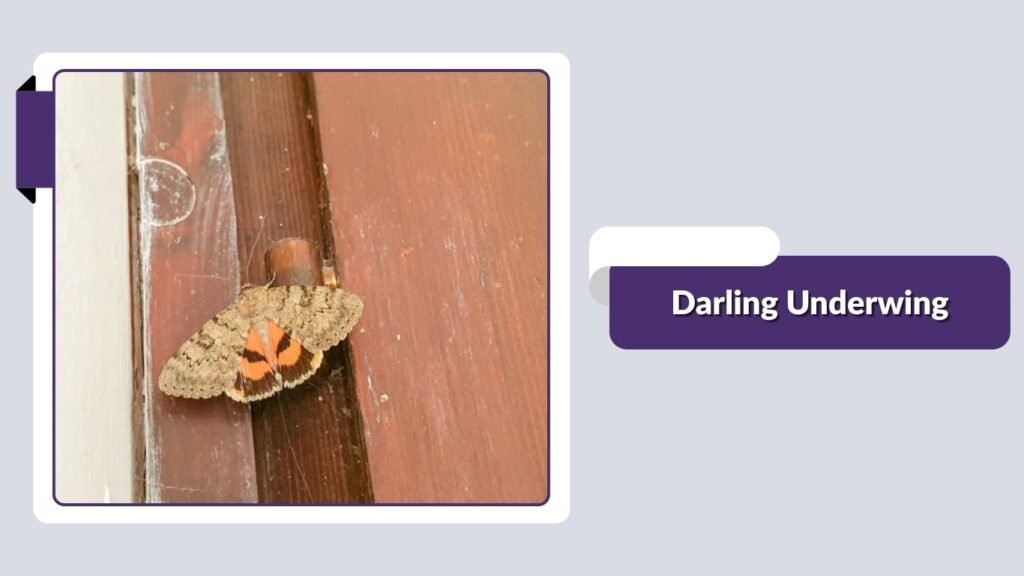
The Darling Underwing (Catocala cara) combines rich brown forewings with striking pink hindwings. Its name is easily confused with that of the Sweetheart Underwing, but they are separate species. Both belong to the same genus and share the familiar underwing arrangement: subdued forewings cover much brighter hindwings while the adult rests.
Identification
- Wingspan: Approximately 70–85 mm.
- Forewings: Deep brown, sometimes showing greenish shading.
- Forewing pattern: Dark lines crossing the brown background.
- Hindwings: Bright pink to reddish pink with bold black bands.
- General impression: A large, dark moth with a strong contrast between its two wing pairs.
Habitat and Distribution
Darling Underwings occur mainly in eastern North America. Wooded landscapes containing willows and poplars provide suitable breeding habitat. These trees frequently grow near waterways, making wooded river margins and similar places useful areas to investigate. A sheltered resting place alone, however, does not necessarily indicate where the caterpillars developed.
Behavior
Adults fly at night and retreat into protected places during daylight. Recorded shelters include caves, spaces beneath bridges, and building eaves. This habit means that an adult may be found on a structure rather than on a tree. Observing a resting moth without disturbing it helps preserve the natural position of its wings.
Diet
Caterpillars feed on willow and poplar foliage, with black willow an especially important host. These trees supply the foliage needed for larval growth. Its diet resembles that of the Sweetheart and Joined Underwings, while differing from the oak-based diet of the Ilia Underwing and the hickory association of the Tearful Underwing.
Life Cycle
Adults are generally recorded from July through October, depending on location. Like the other North American underwings described here, this species follows an annual cycle that includes overwintering eggs, growing caterpillars, pupae, and winged adults. The adults reproduce to begin the next generation, while the egg stage carries the cycle through winter until conditions allow larval development to resume.
5. Oldwife Underwing

The Oldwife Underwing (Catocala palaeogama) is a woodland moth with mottled forewings and orange-yellow hindwings. Its resting appearance can closely resemble that of the Tearful Underwing. Seeing the hindwings is therefore particularly helpful: the Oldwife displays warm coloring crossed by dark bands, while the Tearful Underwing has predominantly black hindwings with a pale fringe.
Identification
- Wingspan: Approximately 60–70 mm.
- Forewings: Mottled gray and brown with irregular dark markings.
- Hindwings: Yellow-orange with contrasting black bands.
- Resting appearance: Barklike, with most hindwing color concealed.
- Similar species: The Tearful Underwing can be difficult to exclude from a closed-wing photograph.
Habitat and Distribution
This species inhabits deciduous woodland containing suitable hickories and walnuts. Its range includes parts of southern Canada and much of the eastern and central United States. These food-tree associations help explain its woodland distribution and provide a more useful habitat clue than the presence of any large tree.
Behavior
Adults are mainly nocturnal, remaining camouflaged while resting during daylight. Their patterned forewings can make them difficult to distinguish from their surroundings. A moth disturbed from its resting place may briefly reveal its colored hindwings as it flies away. When it settles and covers them again, its subdued forewing pattern becomes the most visible feature.
Diet
Caterpillars feed mainly on hickories, although walnut is also recorded. Field observations identify shagbark, mockernut, and pignut hickories among important hosts. This dependence on particular trees links its development to the composition of the woodland. An area with abundant trees but few suitable hosts may offer less breeding habitat than its appearance suggests.
Life Cycle
The Oldwife Underwing produces one generation per year. Eggs deposited on bark in autumn survive winter, with caterpillars developing during the following growing season. After pupation, adults appear between June and October across the species’ range. Local climate influences the timing, so the whole range should not be treated as one uniform flight season.
6. Joined Underwing
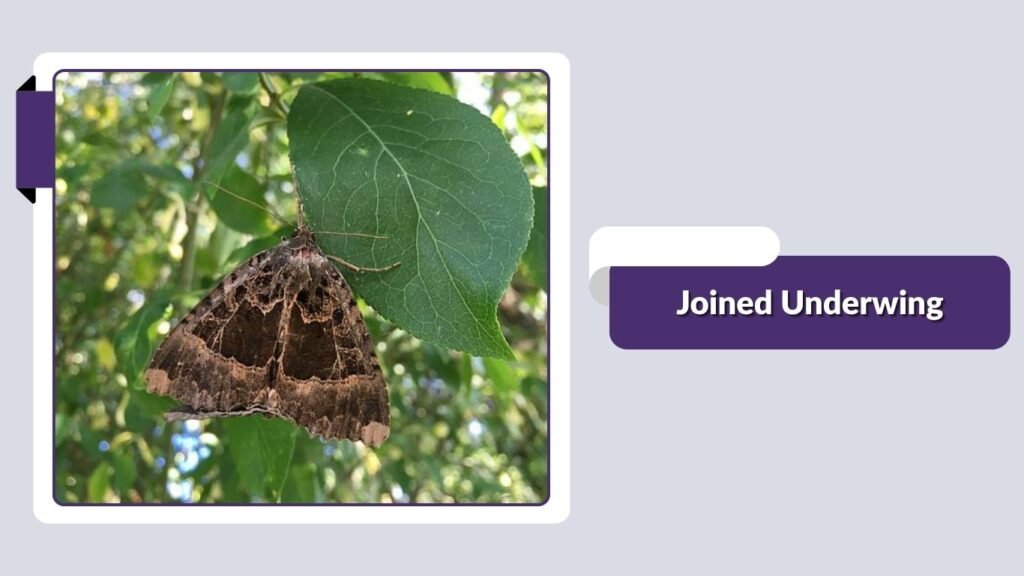
The Joined Underwing (Catocala junctura) is a large moth with sandy forewings and orange-red hindwings. In western North America, it is strongly associated with cottonwoods along waterways. These wooded strips can support the species even when the surrounding landscape is dry, illustrating how a relatively narrow corridor of suitable trees can provide important habitat.
Identification
- Wingspan: Approximately 67–85 mm.
- Forewings: Powdery sandy gray or tan, sometimes with a yellowish tint.
- Hindwings: Orange-red with a broad dark outer border.
- Central band: Relatively narrow, with a hooked bend.
- Comparison clue: Usually lacks the broad, diffuse forewing streaks typical of the Sweetheart Underwing.
Habitat and Distribution
The Joined Underwing occurs across much of western and central North America and extends into parts of the Midwest. In the Pacific Northwest, it occupies cottonwood stands along rivers and creeks, often at low elevations in dry regions. Its habitat is therefore better described by the riverside trees than by the surrounding desert or grassland.
Behavior
Adults are nocturnal and come to lights and sugar bait. Their powdery forewing appearance is useful when comparing them with similar underwings, although worn specimens may be harder to identify. Both wing pattern and geographic location should be considered before assigning a name to an unfamiliar individual.
Diet
Caterpillars feed on willows and cottonwoods. Large cottonwoods appear particularly important in some habitats. These host plants belong to the willow family, linking the moth to the same broad group of trees used by several other red-winged underwings.
Life Cycle
Adults have been recorded from late June into early October in the Pacific Northwest. Development proceeds through eggs, feeding caterpillars, pupae, and adults. Like other Missouri underwings, the species has an annual generation and survives winter as eggs. Caterpillars develop during the growing season, using willow or cottonwood foliage before pupating. Summer and autumn adults then reproduce, beginning the next year’s cycle.
7. Tearful Underwing

The Tearful Underwing (Catocala lacrymosa) is an exception to the familiar image of an underwing moth with bright red or orange hindwings. Its hindwings are black with a largely white fringe. The intricately mottled forewings still provide the camouflage associated with the group, making a resting adult difficult to notice against a suitably patterned background.
Identification
- Wingspan: Approximately 60–82 mm.
- Forewings: Mottled dark gray, brown, and black.
- Useful markings: Whitish crescents near the inner forewing margin.
- Hindwings: Predominantly black rather than red, orange, or yellow.
- Fringe: Mostly white, becoming dark near the inner corner of the hindwing.
Habitat and Distribution
This species occurs in eastern and central North America, from parts of the northeastern United States south to Florida and west toward Wisconsin, Kansas, and Texas. Woodland containing hickories provides the caterpillar food supply. The presence of those trees is therefore a useful starting point when considering whether an area offers breeding habitat.
Behavior
Adults are mainly active at night and remain inconspicuous while resting during daylight. Their forewings can resemble those of the Oldwife Underwing closely enough to complicate identification. Unlike that species, however, the Tearful Underwing does not reveal orange-yellow hindwings. A view of the black hindwings and pale fringe is especially valuable.
Diet
Caterpillars eat hickory foliage. Their association with these trees helps explain the moth’s woodland distribution. Hickories also support the Oldwife Underwing, so finding a moth near these trees does not distinguish the two species. The host association is useful context, but wing markings remain essential for identifying an adult.
Life Cycle
Adults are recorded from July through October, depending on location. The species follows the single-generation pattern described for Missouri underwings: eggs survive winter, caterpillars develop in spring, and pupation occurs before adult emergence. The winter egg stage separates the adults of one season from the caterpillars of the next, while the feeding and pupal stages occupy the intervening growing season.
8. Mother Underwing

The Mother Underwing (Catocala parta) is a large North American moth with patterned gray forewings and warm orange or salmon-colored hindwings. It belongs to the group of underwings associated with willows and poplars. Its combination of pale patches, dark streaks, and concealed hindwing bands makes it attractive but easily overlooked when resting.
Identification
- Wingspan: Approximately 70–85 mm.
- Forewings: Light gray mixed with darker gray or brown.
- Distinctive markings: Whitish patches and several dark streaks across the forewings.
- Hindwings: Yellow-orange to salmon with black bands.
- Central band: Relatively narrow and usually stops before reaching the inner hindwing margin.
Habitat and Distribution
Mother Underwings occur across parts of southern Canada and the northern and central United States, extending westward into the Rocky Mountain region. Wooded floodplains and riverside habitats are particularly suitable because they support its food trees. These associations place it alongside other willow-feeding underwings, although several species may share the same woodland.
Behavior
Adults are nocturnal and come to lights and bait. During daylight, the forewings conceal most of the brighter hindwings. Their irregular markings help break up the moth’s outline against bark. When watching a resting individual, the arrangement of pale patches and dark streaks is more informative than its overall gray color.
Diet
Caterpillars eat poplar and willow leaves. These are the larval food plants, rather than plants whose leaves are eaten by adults. The species’ attraction to bait also illustrates the difference between the leaf-feeding caterpillar and the adult moth, which can take sugary liquids.
Life Cycle
The Mother Underwing produces one generation annually and survives winter as an egg. Caterpillars develop during the growing season before pupating. Adults have been recorded from June through October across its range, with a narrower season at individual locations. The eggs laid by those adults carry the next generation through winter.
9. Charming Underwing

The Charming Underwing (Catocala blandula) is considerably smaller than large species such as the Sweetheart Underwing. Its patterned forewings and orange hindwings place it among several closely similar moths associated with plants in the rose family. Identification can be challenging because the expected markings overlap with those of the Wonderful and Hawthorn Underwings.
Identification
- Wingspan: Approximately 42–50 mm.
- Forewings: Gray and brown with a darker brown area near the base.
- Crosslines: Inner and outer dark lines approach or meet near the inner wing margin.
- Hindwings: Orange with black bands and a usually continuous dark outer border.
- Identification caution: Adult photographs may not reliably separate it from closely related species.
Habitat and Distribution
This species has a mainly northern distribution, extending from Atlantic Canada west toward Alberta and south into parts of the northern United States. Its food plants suggest that woodland margins and shrubby areas containing hawthorns offer useful places to look. A small underwing in such habitat still needs careful examination.
Behavior
Adults are mainly active after dark and conceal their hindwings while resting. The caterpillars are also patterned rather than uniformly colored. Some have dark stripes along the back and an orange saddle-like marking, but these features vary. They are clues to compare, not markings that guarantee identification.
Diet
Hawthorns are important caterpillar hosts, and apple is also used. Older host lists additionally include serviceberry. Current observations emphasize hawthorn as a typical food plant. These associations distinguish the species from underwings dependent on oak, willow, or hickory foliage.
Life Cycle
The Charming Underwing follows an annual cycle through egg, caterpillar, pupa, and adult. Adults are usually recorded in July and August in its northern range. Caterpillars complete their feeding before entering the pupal stage. Because immature stages resemble those of related moths, reliable records benefit from linking a caterpillar with the adult it becomes.
10. Youthful Underwing

The Youthful Underwing (Catocala subnata) is a large species with gray forewings and yellow-orange hindwings. Despite its common name, it is a distinct species rather than a young stage of another underwing. It belongs to a group whose caterpillars use trees in the walnut family, making mature deciduous woodland an important setting for its life cycle.
Identification
- Wingspan: Approximately 75–90 mm.
- Forewings: Gray with clear dark crosslines and areas of brown shading.
- Kidney-shaped spot: Large and often reddish brown.
- Hindwings: Broad yellow-orange areas separated by black bands.
- Similar species: The Bride Underwing can be extremely difficult to distinguish from photographs.
Male Youthful Underwings lack the black streak at the forewing base that occurs in the Bride Underwing; females require more caution.
Habitat and Distribution
Youthful Underwings occur across eastern North America and extend into parts of the central United States. Deciduous woodland containing hickories and walnuts provides breeding habitat. A stand of suitable host trees matters more than the simple presence of dense vegetation, since caterpillars cannot feed equally well on every woodland plant.
Behavior
Adults are mainly nocturnal and rest with their colorful hindwings concealed. Their large size becomes more apparent in flight. When identifying a moth, the complete forewing pattern should be considered alongside sex and location. Some individuals cannot be confidently separated from similar species using an ordinary photograph alone.
Diet
Caterpillar hosts include walnut, butternut, and hickory. Butternut is itself a walnut species, so these records represent plants within the same family. Their foliage supports larval growth, while the adult moth uses liquid food rather than chewing tree leaves.
Life Cycle
There is one summer generation, with adults generally flying from July into September. Caterpillars grow before pupating and emerging as adults. The seasonal cycle is tied to the availability of host-tree foliage, and local flight dates vary across the species’ broad range.
11. Judith’s Underwing
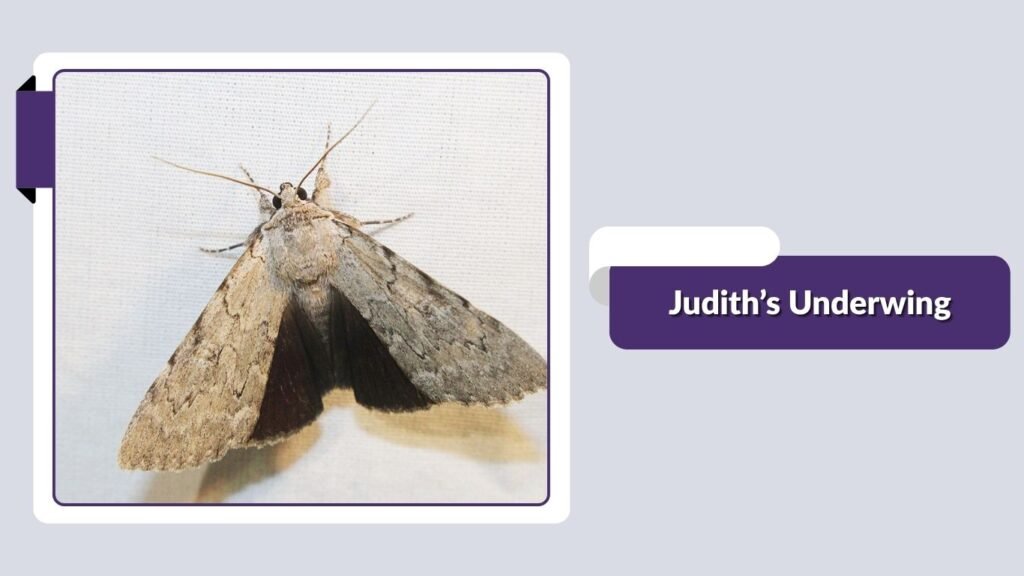
Judith’s Underwing (Catocala judith) is a relatively small member of the black-hindwing group. Its subdued appearance differs from the bright red and orange species often pictured in underwing guides. Both its size and its dark hindwing fringe are useful features, although accurate identification still requires comparison with other similarly patterned moths.
Identification
- Wingspan: Approximately 45–55 mm.
- Forewings: Gray to greenish gray.
- Wing pattern: Fine, dark crosslines rather than broad colorful patches.
- Hindwings: Black on the upper surface.
- Fringe: Dark, unlike the conspicuously pale fringe of some other black-hindwing underwings.
Habitat and Distribution
This species occurs in eastern North America, including parts of southern Canada and the eastern United States. Its breeding habitat is closely linked to hickory woodland. Established trees provide more than leaves: their bark also offers places where caterpillars can remain concealed between feeding periods.
Behavior
Adults are principally active at night. The caterpillars belong to a group that hides beneath the loose bark plates of shagbark hickory. Their flattened bodies suit these narrow retreats. This behavior makes them less obvious than caterpillars resting openly on leaves or twigs, even when they are present on a suitable tree.
Diet
Recent specialist observations emphasize shagbark hickory as the principal host. Older accounts also list pecan and black walnut. For understanding its natural habitat, the strong association with shagbark hickory is particularly useful. The caterpillars feed on foliage; the bark serves as shelter rather than food.
Life Cycle
Judith’s Underwing has one generation per year and overwinters in the egg stage. Caterpillars develop during spring and early summer, then pupate before adult emergence. Adults are most often recorded between June and September, with timing influenced by location. Its common name identifies the species and does not indicate a special behavior or breeding role.
12. Robinson’s Underwing

Robinson’s Underwing (Catocala robinsonii) is a large moth with pale gray forewings and black hindwings edged in a lighter fringe. Adults occur in noticeably different forms: some are comparatively plain, while others carry a broad dark streak. These differences can make photographs of the same species appear to show unrelated moths.
Identification
- Size: A large underwing, noticeably larger than Judith’s Underwing.
- Forewings: Usually pale gray with fine black crosslines.
- Variable marking: Some individuals have a broad, slanting black band.
- Hindwings: Solid black with a contrasting grayish-white fringe.
- Forewing spot: The kidney-shaped marking may show reddish-brown shading.
The combination of wing color, fringe, and pattern is more useful than any single streak.
Habitat and Distribution
Robinson’s Underwing occurs in eastern and central North America, although it is not equally common throughout that area. Hickory woodland provides important habitat. In North Carolina, records are associated with the Piedmont, mountains, and some richer river floodplains where suitable hickories grow.
Behavior
Adults are mainly nocturnal. Caterpillars hide beneath the peeling bark of shagbark hickory, using the spaces between bark plates as retreats. They have flattened bodies and dark markings that complement this sheltered way of life. Finding one may therefore require noticing bark-associated caterpillars rather than looking only at exposed foliage.
Diet
Shagbark hickory is the key host emphasized by current specialist accounts. The caterpillars eat its leaves and use the bark for concealment. This close relationship explains why the presence of suitable mature hickories is a better habitat clue than simply finding an area with many hardwood trees.
Life Cycle
There is one annual generation. Eggs survive winter, followed by the feeding caterpillar stage and pupation during the growing season. Adults appear in summer and can persist into autumn at suitable locations. During pupation, the caterpillar transforms inside a protective cocoon before the adult emerges, expands its wings, and begins its reproductive stage.
13. Yellow-gray Underwing

The Yellow-gray Underwing (Catocala retecta) has pale forewings that may carry yellowish-brown shading, but its hindwings are black. Its name should not be interpreted as a promise of yellow hindwings. It is also part of a difficult identification pair with Hulst’s Underwing, and ordinary photographs may not distinguish the two reliably.
Identification
- Wingspan: Approximately 60–75 mm.
- Forewings: Pale gray, sometimes shaded with yellowish brown.
- Dark markings: Short black streaks near the wing base and outer portions.
- Hindwings: Black with a pale, checkered fringe.
- Identification caution: Very similar in external appearance to Hulst’s Underwing.
A tentative identification is more appropriate than certainty when the necessary distinguishing evidence is unavailable.
Habitat and Distribution
The species is associated with deciduous woodland in eastern North America. Hickories and walnuts provide its caterpillar food plants. Because some recording resources group it with Hulst’s Underwing, combined maps should not automatically be treated as precise distribution maps for the Yellow-gray Underwing alone.
Behavior
Adults follow the nocturnal habits typical of underwings. While resting, their light and dark forewing markings help conceal the outline of the body. The black hindwings remain largely covered. A photograph showing the full wing pattern can document an observation, even when it cannot establish the exact species.
Diet
Caterpillars feed on hickory and walnut foliage, both belonging to the walnut family. These host associations link the species to established woodland. However, related underwings use the same plants, so the tree beneath a moth cannot by itself provide a definite identification.
Life Cycle
The species follows an annual cycle with overwintering eggs, developing caterpillars, pupae, and adults. Adult records generally fall between July and October. Local conditions influence emergence, and records may require review where similar species have historically been combined. The egg, feeding larva, and pupa all precede the winged adult seen during moth watching.
14. Orba Underwing
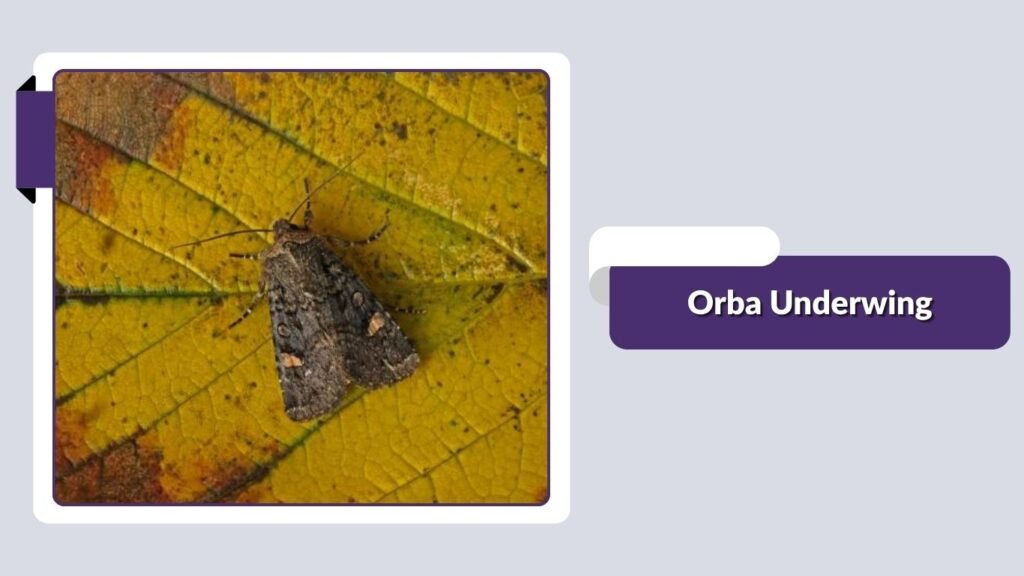
The Orba Underwing (Catocala orba), also called the Orb Underwing, is a pale gray species with black hindwings. It is particularly associated with southern woodland habitats containing hawthorns. Its resemblance to other small and medium-sized underwings has caused identification difficulties, making reliable information about size, wing pattern, and location especially valuable.
Identification
- Forewings: Fairly uniform pale gray with fine darker markings.
- Hindwings: Black rather than orange or red.
- Wing shape: Relatively narrow compared with Judith’s Underwing.
- Size: Some documented North Carolina specimens exceed 50 mm in wingspan.
- Similar species: Miranda Underwing and Judith’s Underwing require careful comparison.
Published size estimates vary, so size should support identification rather than determine it alone.
Habitat and Distribution
The Orba Underwing is primarily southern in distribution. North Carolina records are associated with rich river-bottom forests and other productive hardwood habitats. Hawthorns growing in these areas provide potential larval resources. This association is more specific than simply describing the moth as a species of any forest.
Behavior
Adults have been recorded at ultraviolet lights and bait, although regional observations are too few to measure how strongly they respond. Caterpillars have conspicuous dark dorsal spots and a heavily blackened face. Their side fringes and small abdominal projection add to their irregular outline.
Diet
Documented caterpillar hosts are hawthorns. Parsley hawthorn is recorded in Florida, and specialist observations report wild larvae on several hawthorn species. Older suggestions that its larvae probably feed on hickory or walnut should not replace these documented host records.
Life Cycle
The Orba Underwing produces one generation annually. In North Carolina, adults have been recorded in June and early July. Caterpillars feed and grow before pupating and emerging as adults. Identification of immature stages remains difficult, and linking a caterpillar with its resulting adult provides stronger evidence than relying on larval appearance alone.
15. Wonderful Underwing

The Wonderful Underwing (Catocala mira) is a smaller species with orange hindwings and intricately patterned forewings. It is associated mainly with hawthorns and can occur in shrubby landscapes as well as woodland. Its appearance overlaps with the Charming and Hawthorn Underwings, so identification requires more care than its appealing common name might suggest.
Identification
- Wingspan: Approximately 40–50 mm.
- Forewings: Gray and brown, often with a relatively pale basal area.
- Pale marking: An oblique whitish area running inward from the leading wing edge.
- Hindwings: Deep orange with a black central band and dark outer border.
- Identification caution: These features overlap with those of several related species.
Habitat and Distribution
Wonderful Underwings occur from parts of southern Canada through much of the eastern and central United States, extending south to Florida and Texas. Habitats include woodland edges, shrubby pastures, and river floodplains. The presence of hawthorns helps connect these otherwise different landscapes.
Behavior
Adults are mainly nocturnal, while resting moths conceal their orange hindwings beneath patterned forewings. Caterpillars often have a raised projection on the fifth abdominal segment and darkened head lobes. These features vary, however, and should be compared with the rest of the body rather than treated as an infallible identification shortcut.
Diet
Hawthorn foliage is the principal caterpillar food. Apple is also used occasionally, according to specialist observations. Both belong to the rose family. This feeding association places the Wonderful Underwing alongside several other small underwings, which helps explain why related species may occur together in the same patch of shrubs.
Life Cycle
There is one generation per year. Eggs laid on bark survive winter and hatch the following spring. After feeding and growing, caterpillars pupate at ground level. Adults usually fly in July and August, although southern populations may appear earlier, including June. Local seasonal records are therefore more useful than assuming identical timing throughout the species’ range.
FAQs
Underwing moths share a recognizable resting shape, but their colors, food plants, and identification features differ considerably. Some reveal brilliant hindwings, while others remain mostly black and gray. These common questions explain the traits shared by the group and the differences that matter when observing an unfamiliar moth.
1. Why Are They Called Underwing Moths?
Their hindwings lie beneath the forewings and are largely hidden when the moth rests. In many species, flight reveals bright colors that were previously concealed. The name describes the wings’ position, not a requirement that every species has colorful hindwings.
2. What Do Underwing Moths Eat?
Caterpillars eat leaves from particular trees or shrubs, including oaks, willows, poplars, hickories, walnuts, and hawthorns, depending on the species. Adults take liquid food, including sugary substances. Their diet therefore changes substantially between the caterpillar and adult stages.
3. How Long Is an Underwing Moth’s Life Cycle?
The North American species discussed here generally produce one generation each year. Much of that annual cycle is spent as eggs, caterpillars, or pupae. The adult flight season describes when adults are present in a population; it does not mean each moth lives for that entire period.
4. Can You Identify Every Underwing Moth From a Photo?
No. Some species have overlapping wing patterns, and even clear photographs may be insufficient. Images of both wing pairs, size, date, and location can help. Difficult groups may require specialist examination or other evidence, especially the Charming–Wonderful group and Yellow-gray–Hulst’s pair.
5. Do Underwing Moths Eat Clothes?
No. These Catocala moths are not clothes moths. Their caterpillars feed on living plant foliage rather than wool, fur, or stored fabrics. A wandering adult found indoors does not indicate a clothing infestation.