
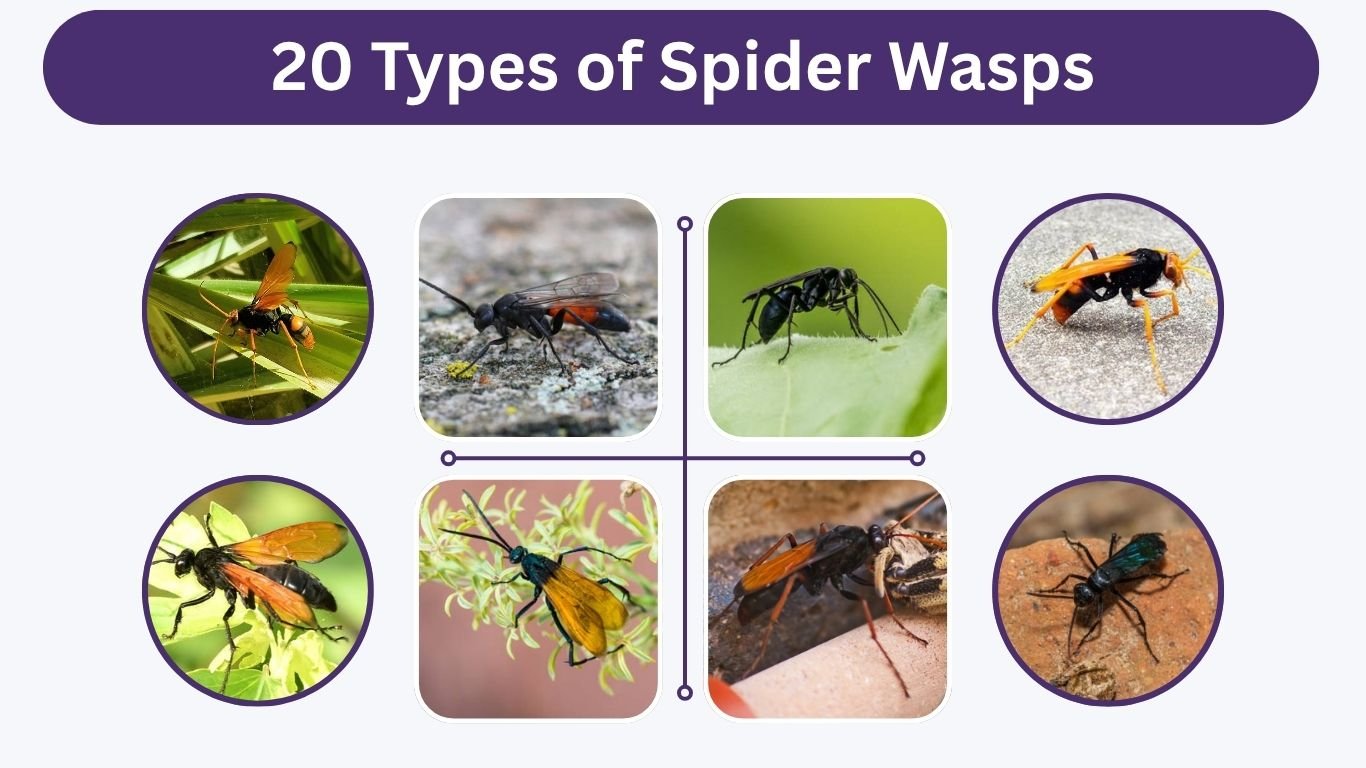
Spider wasps are solitary hunting wasps in the family Pompilidae, best known for capturing and paralyzing spiders for their offspring. They range from small dark species to large, colorful tarantula hawks with orange wings and powerful stings. Females use their long legs, strong jaws, and venom to subdue prey, while adults usually feed on nectar. These wasps occur in many habitats worldwide and play an important role in natural food webs. Below are 20 types of spider wasps, with their identification, habitat, hunting behavior, and diet.
1. Tarantula Hawk
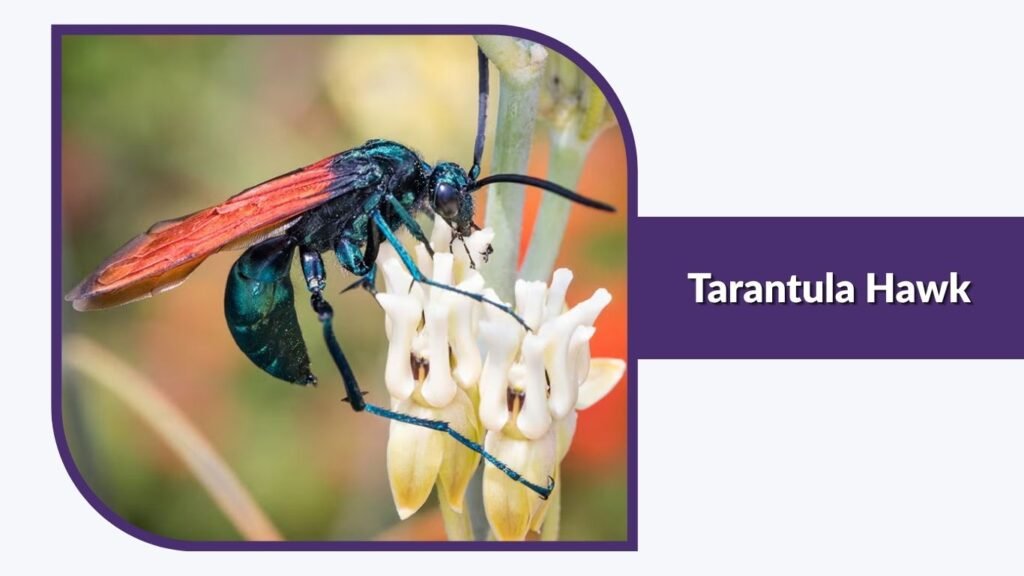
The Tarantula Hawk is a large spider wasp best known for hunting tarantulas. Rather than referring to one single species, the name is commonly used for several wasps in the genera Pepsis and Hemipepsis. These solitary wasps are famous for their powerful sting, bright coloration, and unusual reproductive behavior in which females paralyze tarantulas to provide food for their developing larvae.
Identification
- Family: Pompilidae
- Commonly belongs to the genera Pepsis or Hemipepsis
- Large body, often about 25–50 mm long
- Usually metallic blue-black or dark blue
- Wings often bright orange, reddish-orange, or amber
- Long, powerful legs adapted for handling spiders
- Slender waist between thorax and abdomen
- Females possess a strong stinger
- Males are generally unable to sting
- Antennae are long and slightly curved
Habitat and Distribution
Tarantula hawks are most common in warm, dry regions where tarantulas are abundant. They occur throughout parts of North America, Central America, and South America. In the United States, they are especially associated with the Southwest, including deserts, scrublands, grasslands, and open woodland. Adults may also be seen around flowering plants where they feed.
Hunting and Reproduction
A female Tarantula Hawk actively searches the ground for a tarantula. After locating one, she provokes the spider into a defensive position and delivers a powerful sting that paralyzes it. She then drags the immobilized tarantula to a burrow or sheltered location, lays a single egg on its body, and leaves it there.
When the egg hatches, the larva feeds on the still-living but paralyzed spider. It carefully consumes the tarantula over time before eventually pupating and emerging as an adult wasp.
Diet and Importance
Adult Tarantula Hawks mainly feed on nectar from flowers and other sugary plant sources. The larvae rely on tarantulas as their primary food. Despite their intimidating size and painful sting, adults are generally not aggressive toward humans. They usually sting only when handled or severely threatened and play an important role in naturally regulating spider populations.
2. Flamed Tarantula-Hawk Wasp
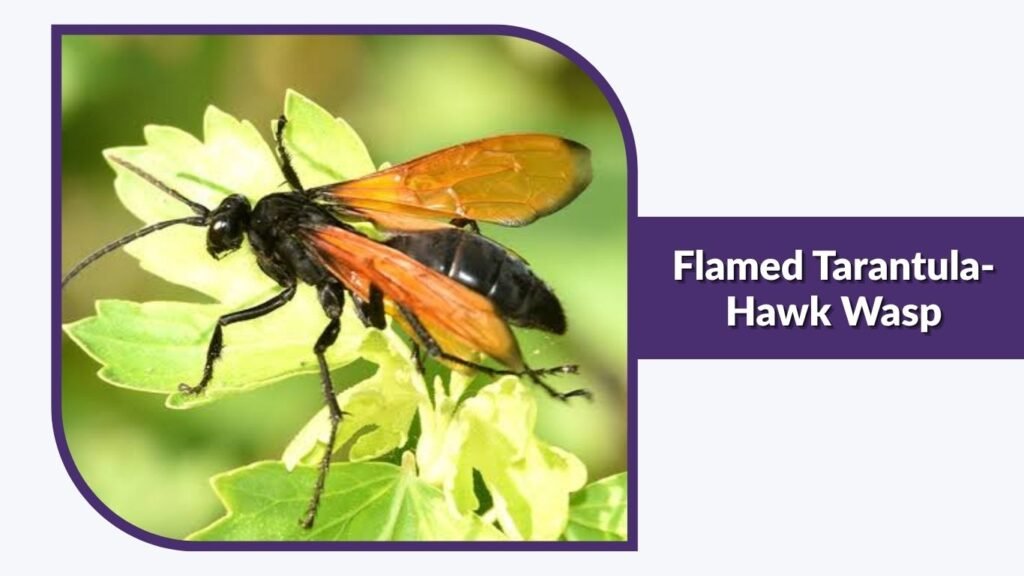
The Flamed Tarantula-Hawk Wasp is a large and striking spider wasp recognized for its dark body and vivid orange to reddish wings. Like other tarantula hawks, females specialize in hunting large spiders, especially tarantulas, which they paralyze and use as food for their larvae. Adults are solitary and spend much of their time searching for prey or visiting flowers.
Identification
- Large, robust spider wasp
- Dark blue-black or metallic body
- Bright orange or flame-colored wings
- Long, powerful legs
- Narrow waist
- Long antennae
- Females have a strong stinger
- Usually much larger than common garden wasps
Habitat and Distribution
Flamed Tarantula-Hawk Wasps are associated mainly with warm, dry habitats where large spiders occur. They can be found in deserts, scrublands, grasslands, rocky slopes, and open woodland. Adults often visit flowering plants for nectar and may be seen flying close to the ground while females search for spider burrows.
Hunting and Reproduction
A female locates a suitable tarantula and uses her sting to paralyze it. She then drags or pulls the immobilized spider into a burrow. After placing a single egg on the spider, she seals the nest. The larva later hatches and gradually consumes the paralyzed spider before pupating.
Diet and Importance
Adults mainly feed on nectar, while larvae consume spiders supplied by their mothers. These wasps help regulate spider populations and form an important part of dry-region food webs. Although females can deliver an extremely painful sting, they are generally not aggressive unless handled or trapped.
3. Milde’s Tarantula-Hawk Wasp
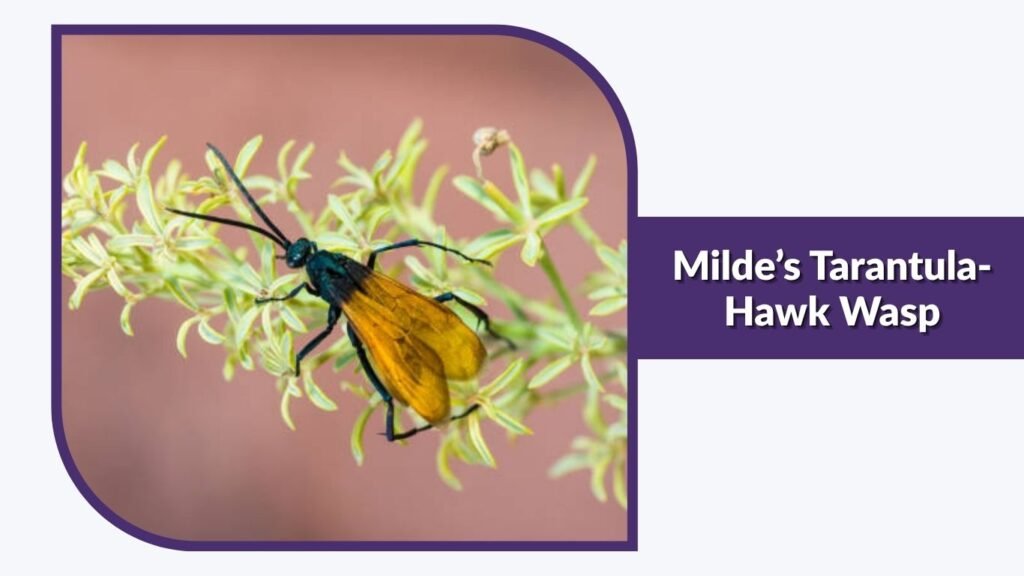
Milde’s Tarantula-Hawk Wasp is another large member of the spider wasp family Pompilidae. It shares the dramatic appearance and hunting behavior typical of tarantula hawks, with females capable of overpowering spiders much larger than themselves. Its powerful legs, strong sting, and ability to locate spider burrows make it a highly specialized predator.
Identification
- Large spider wasp
- Mostly dark or metallic blue-black body
- Orange to reddish wings
- Long legs covered with strong spines
- Narrow waist
- Long antennae
- Females larger and capable of stinging
- Wings often held flat over the abdomen at rest
Habitat and Distribution
Milde’s Tarantula-Hawk Wasp favors warm, open environments such as desert scrub, dry grassland, rocky areas, and woodland margins. Its presence is closely connected with suitable spider prey. Adults may also appear in gardens or other flower-rich areas when feeding on nectar.
Hunting and Reproduction
Females spend considerable time walking over the ground and investigating holes where spiders may be hiding. Once a suitable spider is found, the wasp attacks and paralyzes it. The spider is transported to a protected nest, where the female lays one egg before closing the chamber.
Diet and Importance
Adult wasps rely on nectar and other sugary substances for energy. Their larvae are carnivorous and develop by feeding on the spider provided by the female. By preying on large spiders, Milde’s Tarantula-Hawk Wasps contribute to natural predator-prey balance within their habitats.
4. Thisbe’s Tarantula-Hawk Wasp

Thisbe’s Tarantula-Hawk Wasp is a large solitary spider wasp associated with the spectacular tarantula-hawk group. It is built for hunting, with long legs, a powerful sting, and a sturdy body capable of handling large spiders. Females do all of the hunting and nesting work, while adult males primarily focus on feeding and locating mates.
Identification
- Large body with a dark metallic appearance
- Blue-black or black thorax and abdomen
- Orange, amber, or reddish wings
- Long legs suited for dragging spiders
- Narrow waist
- Long curved antennae
- Females equipped with a long stinger
- Strong jaws used while handling prey
Habitat and Distribution
Thisbe’s Tarantula-Hawk Wasp is most likely to be encountered in warm landscapes with abundant spider prey. Dry scrub, desert margins, open grassland, and rocky terrain provide suitable hunting grounds. Adults are also attracted to flowering vegetation because nectar provides the energy needed for flight and reproduction.
Hunting and Reproduction
A female searches actively for tarantulas and other suitable large spiders. After delivering a precisely placed sting, she paralyzes the spider and transports it to a prepared or existing burrow. A single egg is laid on the prey, providing the future larva with a large supply of fresh food.
Diet and Importance
Adults primarily consume nectar and may help pollinate flowers during feeding. The larvae feed entirely on the spider stored in the nest. Despite their formidable appearance, these solitary wasps usually avoid unnecessary conflict and reserve their sting mainly for prey or self-defense.
5. Rusty Spider Wasp

The Rusty Spider Wasp is a solitary spider-hunting wasp characterized by reddish, rusty, or orange-brown coloration on parts of its body or wings. Like other members of Pompilidae, females specialize in capturing spiders and provisioning individual nests for their offspring. They are agile ground hunters and are often seen running quickly over vegetation or soil.
Identification
- Slender spider-wasp body
- Black or dark body with rusty-red markings
- Reddish or orange-brown wings in some individuals
- Long, spiny legs
- Narrow waist
- Long antennae
- Females possess a functional sting
- Rapid running movement on the ground
Habitat and Distribution
Rusty Spider Wasps occur in habitats where both spiders and suitable nesting locations are plentiful. Open woodland, meadows, sandy areas, gardens, field edges, and scrubland can all provide suitable conditions. Females spend much of their time searching low vegetation, leaf litter, and the ground for spiders.
Hunting and Reproduction
After finding a spider, the female attacks and paralyzes it with her sting. Depending on the species, she may drag the prey backward across the ground or carry it partly in flight. The spider is placed inside a burrow or another protected cavity, where a single egg is laid.
Diet and Importance
Adult Rusty Spider Wasps mainly obtain energy from nectar. Their larvae depend on spiders stored by females. These wasps are beneficial predators because they naturally regulate spider populations and contribute to ecological food webs. They generally avoid humans and sting primarily when directly threatened.
6. Red-Tailed Spider Wasp
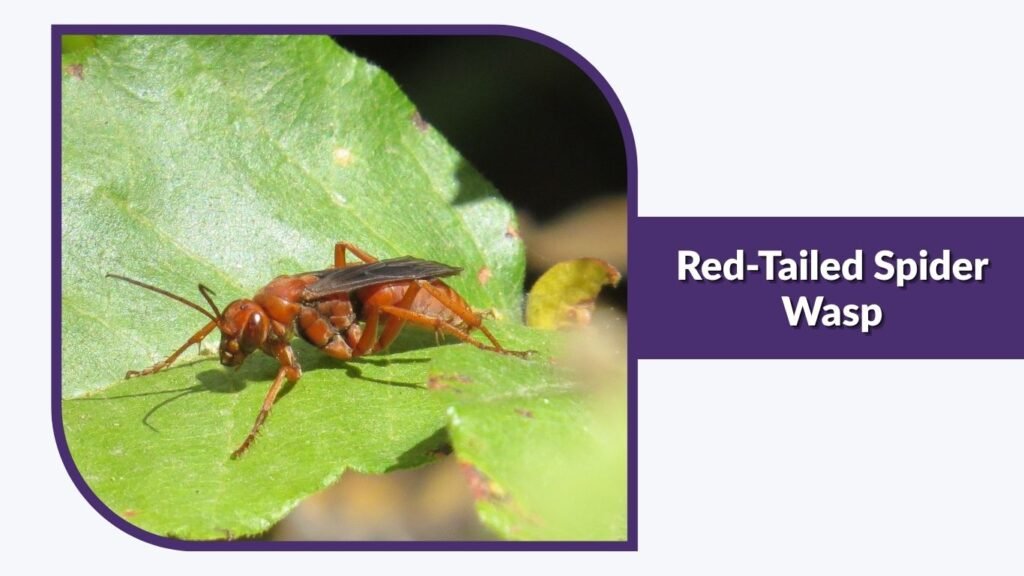
The Red-Tailed Spider Wasp is a solitary wasp known for its dark body and reddish or orange coloration toward the end of the abdomen. Like other members of the spider wasp family, females actively hunt spiders and use them as living food for their developing larvae. These wasps are agile hunters and are often noticed moving rapidly across the ground.
Identification
- Dark black or blue-black body
- Reddish or orange tip on the abdomen
- Long, slender legs
- Narrow waist
- Dark or slightly smoky wings
- Long antennae
- Females possess a functional sting
- Fast-running behavior when hunting
Habitat and Distribution
Red-Tailed Spider Wasps are typically associated with warm open environments such as grasslands, woodland margins, scrub, gardens, and sandy ground. Females require an abundant supply of spiders as well as loose soil, natural cavities, or sheltered spaces where they can prepare nests.
Hunting and Reproduction
The female searches vegetation and the ground for a suitable spider. After locating prey, she stings it and causes paralysis without immediately killing it. The spider is then transported to a burrow or cavity. A single egg is laid on the prey before the female closes the nest.
Diet and Importance
Adults mainly obtain energy from flower nectar and other sugary substances. Their larvae feed on the paralyzed spider provided by the female. By hunting spiders, Red-Tailed Spider Wasps contribute to predator-prey balance and form an important part of natural insect communities.
7. Rain Spider Wasp
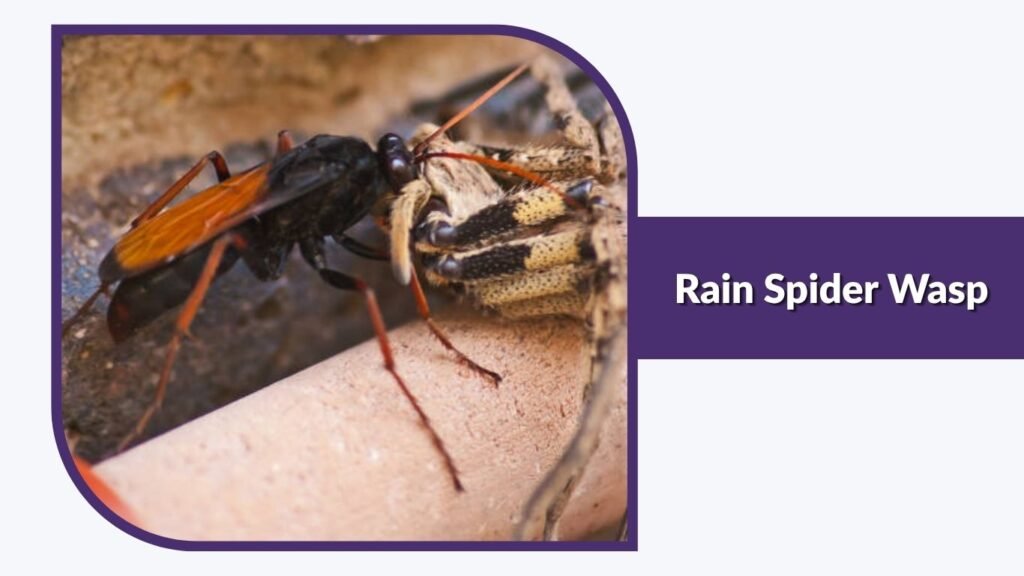
The Rain Spider Wasp is best known for hunting large rain spiders, particularly in southern Africa. Females can overpower spiders considerably larger than themselves and drag them across the ground to suitable nesting sites. Their hunting behavior often attracts attention because the female may travel a noticeable distance while pulling her immobilized prey.
Identification
- Medium to large spider wasp
- Predominantly dark body
- Long, strong legs
- Narrow waist
- Dark or amber-tinted wings
- Long antennae
- Females equipped with a strong sting
- Often observed transporting large spiders
Habitat and Distribution
Rain Spider Wasps are most strongly associated with parts of southern Africa where rain spiders are common. Gardens, woodland, bushveld, grasslands, and areas around homes can provide suitable hunting habitat. Rain spiders frequently occur near buildings, so hunting wasps may sometimes be observed in residential areas.
Hunting and Reproduction
A female attacks a rain spider and delivers a sting that immobilizes it. She then grips the spider and drags it toward a burrow or protected cavity. Once the prey is safely positioned, she lays an egg on it. The larva hatches later and feeds on the spider during its development.
Diet and Importance
Adults mainly consume nectar, while the larvae are entirely dependent on spider prey. Rain Spider Wasps naturally regulate large spider populations and are part of complex food webs. Despite their hunting ability, they are solitary and generally have little interest in attacking humans.
8. Red-Legged Spider Wasp
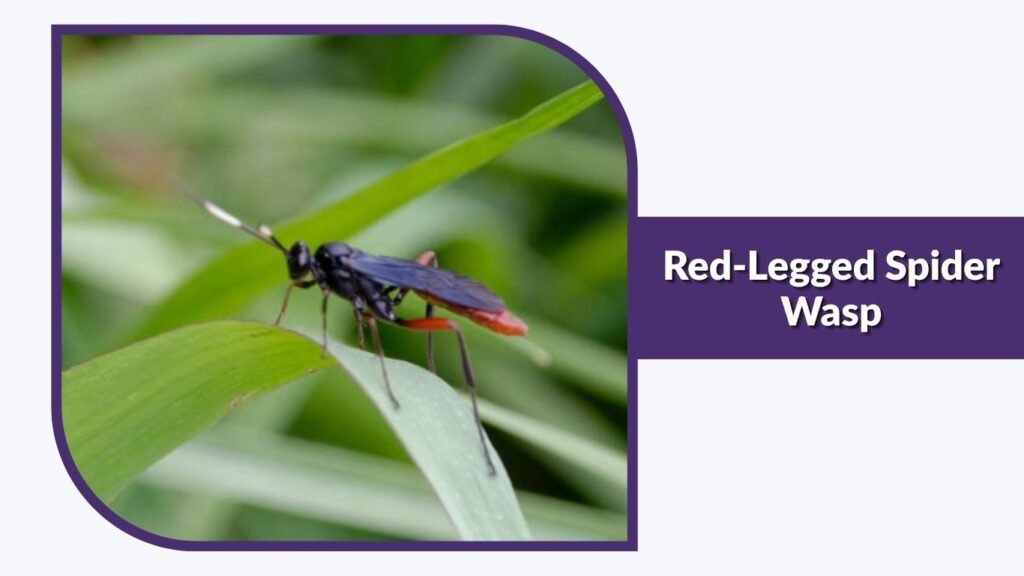
The Red-Legged Spider Wasp is named for the reddish or orange coloration visible on some or all of its legs. These solitary hunting wasps belong to the family Pompilidae and spend much of their time running over soil and vegetation while searching for spiders. Females use their sting primarily to immobilize prey for their offspring.
Identification
- Mostly black or dark body
- Red, orange, or rusty-colored legs
- Long legs with noticeable spines
- Slender abdomen
- Narrow waist
- Dark or translucent wings
- Long antennae
- Rapid movement across the ground
Habitat and Distribution
Red-Legged Spider Wasps can occur in dry grasslands, woodland edges, gardens, sandy areas, and scrub habitat. Open ground is especially useful because females need space to search for prey and, in many species, to excavate shallow nesting burrows.
Hunting and Reproduction
Females actively track spiders by searching beneath vegetation, around rocks, and across exposed ground. Once prey is located, the wasp stings and paralyzes it. The spider is then dragged or carried to a prepared nesting chamber, where the female lays an egg before sealing the entrance.
Diet and Importance
Adults depend largely on nectar and may regularly visit flowering plants. Their larvae feed on spiders. This predatory behavior helps naturally control spider populations and provides food for the next generation without requiring further parental care after the nest is closed.
9. Blue-Black Spider Wasp
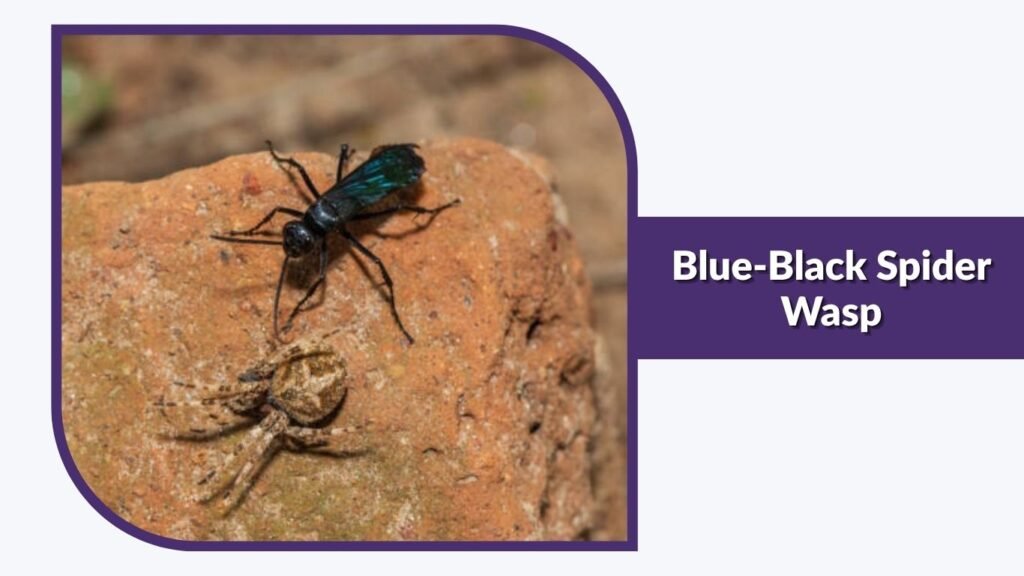
The Blue-Black Spider Wasp is recognized by its glossy dark body, which can appear metallic blue, violet, or nearly black depending on the light. These spider wasps are solitary hunters, and females search actively for spiders that can be paralyzed and stored as food for their larvae.
Identification
- Glossy blue-black or metallic body
- Dark wings, sometimes with bluish reflections
- Long, slender legs
- Narrow waist
- Elongated antennae
- Smooth or slightly shiny body surface
- Females have a stinger
- Often seen running rather than hovering
Habitat and Distribution
Blue-Black Spider Wasps may be found in gardens, forests, grasslands, open fields, coastal habitats, and scrubland. Their distribution depends on the particular species, but suitable environments generally contain plentiful spiders, flowering plants, and places where a female can establish a nest.
Hunting and Reproduction
The female locates spiders by exploring the ground and vegetation. After a short struggle, she uses her sting to immobilize the prey. The spider is moved to a burrow, crevice, or other protected location. A single egg is normally placed on the spider before the nest is closed.
Diet and Importance
Adults primarily feed on nectar, while larvae consume the stored spider. Blue-Black Spider Wasps are useful predators within terrestrial ecosystems because they help regulate spider numbers. Their flower-visiting behavior may also allow them to transfer pollen between plants.
10. Half-Belted Blue-Black Spider Wasp
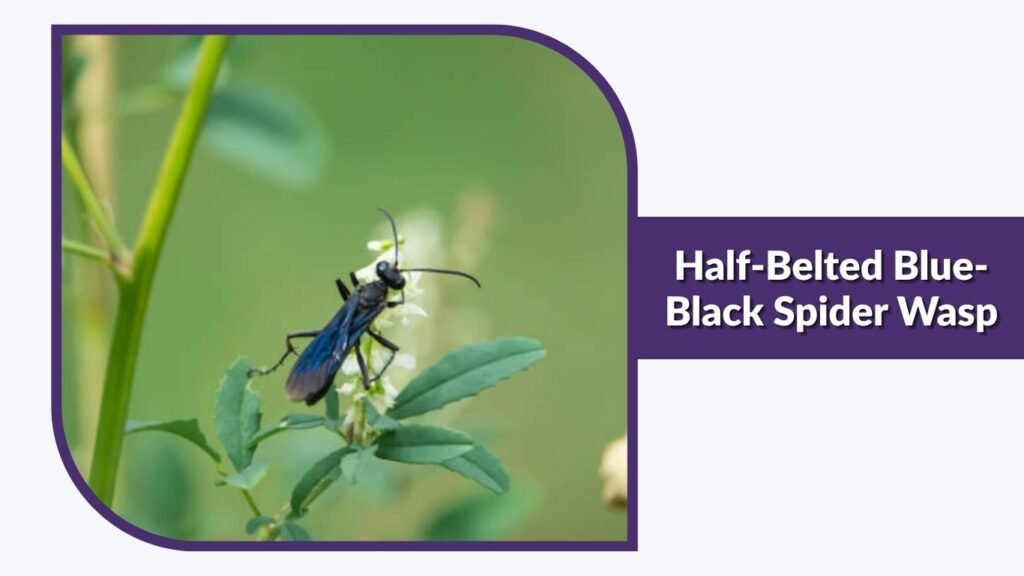
The Half-Belted Blue-Black Spider Wasp is a dark, solitary hunting wasp distinguished by pale or contrasting markings that can appear like a partial belt across the body. Its long legs and agile movements are typical of spider wasps. Females are specialized predators that capture spiders for their developing young.
Identification
- Dark blue-black or nearly black body
- Partial pale band or belt-like marking
- Long, slender legs
- Narrow waist
- Dark wings
- Long antennae
- Females equipped with a sting
- Slender, athletic appearance
Habitat and Distribution
Half-Belted Blue-Black Spider Wasps occur in habitats where ground-dwelling and web-building spiders are available. They may be encountered around grasslands, gardens, woodland edges, sandy clearings, and scrub. Adults often visit flowering vegetation when not hunting.
Hunting and Reproduction
A female searches carefully for a suitable spider and paralyzes it with a sting. She may drag the prey backward over the ground while searching for the nest entrance. After placing the spider inside the nesting chamber, she deposits an egg on its body and closes the nest.
Diet and Importance
Adult wasps obtain carbohydrates from nectar and similar sugary foods. Their larvae feed on the immobilized spiders stored within the nest. This highly specialized life cycle helps regulate spider populations while providing an efficient food supply for each developing wasp.
11. Common Black Spider-Wasp
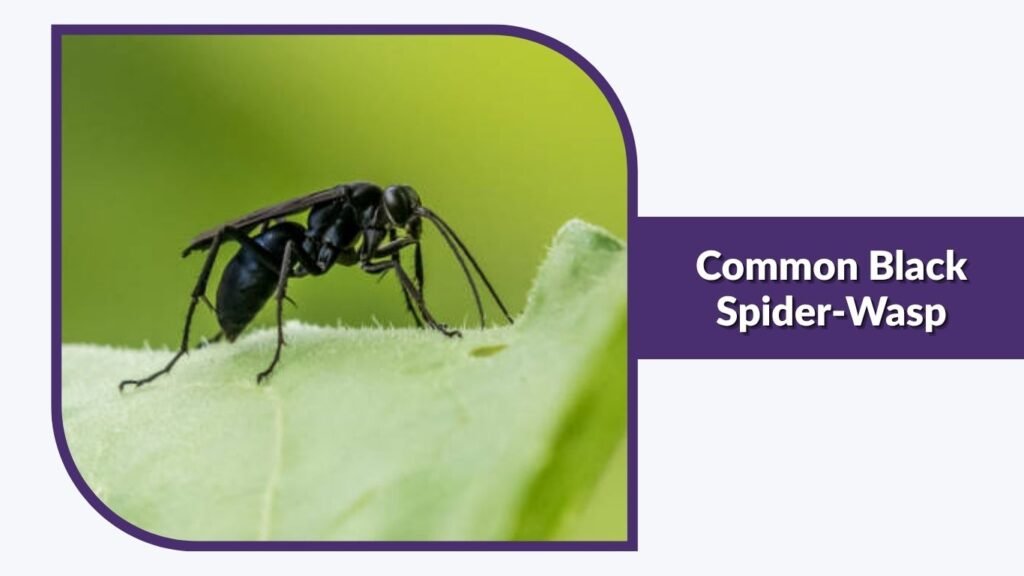
The Common Black Spider-Wasp is a solitary hunting wasp recognized by its mostly dark body and long, powerful legs. Like other spider wasps in the family Pompilidae, females actively search for spiders, paralyze them with a sting, and use them as food for their larvae. Adults are often seen running quickly over the ground rather than remaining around a permanent nest.
Identification
- Mostly black or very dark body
- Long, slender legs
- Narrow waist
- Dark or smoky wings
- Long antennae
- Females possess a functional sting
- Body usually slim and athletic
- Often runs rapidly across soil or vegetation
Habitat and Distribution
Common Black Spider-Wasps can occur in grasslands, woodland edges, gardens, open fields, sandy areas, and scrub. Different species with this general appearance occur in many regions of the world. Suitable habitat usually provides plenty of spiders, flowering plants, and loose soil or natural cavities for nesting.
Hunting and Reproduction
A female searches carefully for a spider and attacks it with a precisely delivered sting. Once paralyzed, the spider is dragged or carried to a burrow or other protected chamber. The female lays a single egg on the spider and closes the nest. The emerging larva then feeds on the immobilized prey.
Diet and Importance
Adults mainly feed on flower nectar and other sugary substances. Their larvae are carnivorous and depend on the spiders captured by females. These wasps are useful natural predators and help maintain balance among spider populations. They generally avoid humans unless directly handled or threatened.
12. Potter Spider-Wasp

The Potter Spider-Wasp is a solitary spider-hunting wasp associated with protected nesting chambers made or modified with soil or mud. It should not be confused with potter wasps of the subfamily Eumeninae. Spider wasps belong to the family Pompilidae and specialize in capturing spiders rather than caterpillars for their young.
Identification
- Slender, dark-colored body
- Long legs suited for handling spiders
- Narrow waist
- Black, brown, or reddish coloration
- Wings may be clear, smoky, or dark
- Long antennae
- Females possess a sting
- Often moves rapidly over the ground
Habitat and Distribution
Potter Spider-Wasps may occur in warm open habitats, sandy areas, woodland margins, gardens, and grasslands. They need an adequate population of spiders as well as protected sites where females can place prey and eggs. Loose soil and natural cavities can be especially useful for nesting.
Hunting and Reproduction
The female locates a spider, paralyzes it, and transports it to a nesting chamber. Some spider wasps dig their own burrows, while others make use of existing crevices or cavities. After laying one egg on the spider, the female closes the chamber and leaves the offspring to develop independently.
Diet and Importance
Adult Potter Spider-Wasps feed mainly on nectar. The larva consumes the paralyzed spider left inside its nest. Their predatory behavior naturally removes spiders from the environment and makes them an important link between flowering plants, insects, and arachnids in terrestrial food webs.
13. Golden Spider Wasp
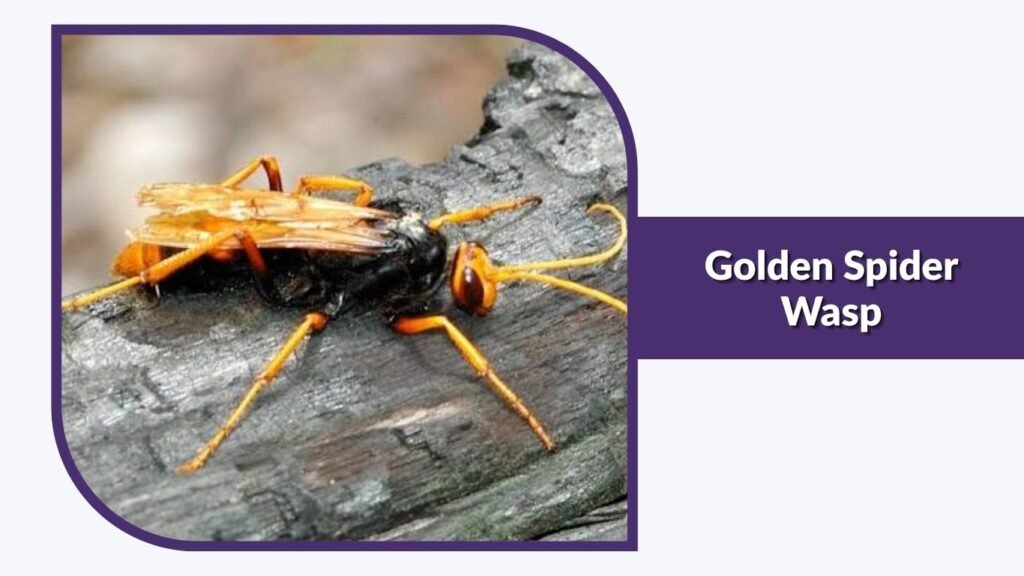
The Golden Spider Wasp is named for golden, yellowish, or orange coloration that may occur on the body, wings, or hairs. These solitary wasps can look striking in sunlight. Females are capable hunters and use their long legs, strong jaws, and sting to overpower spiders that will later serve as food for their offspring.
Identification
- Golden, yellow, or orange coloration
- Dark underlying body in many species
- Long, powerful legs
- Narrow waist
- Long antennae
- Clear to amber-colored wings
- Females possess a functional sting
- Slender body typical of spider wasps
Habitat and Distribution
Golden-colored spider wasps can occur in tropical, subtropical, and warm temperate habitats. They may be encountered in open woodland, scrubland, gardens, fields, and sandy environments. Flower-rich locations are especially attractive because adults regularly visit blossoms for nectar.
Hunting and Reproduction
A female searches for a spider of suitable size and attacks it using her sting. After immobilizing the prey, she transports it to a prepared or existing nest chamber. A single egg is usually laid on the spider, which remains available as fresh food for the larva after hatching.
Diet and Importance
Adults rely primarily on nectar and other sugary plant resources for energy. Their larvae consume spiders. Golden Spider Wasps contribute to natural spider control and may also participate in pollination as adults travel between flowers. Their solitary lifestyle makes defensive attacks on people uncommon.
14. Orange Spider Wasp
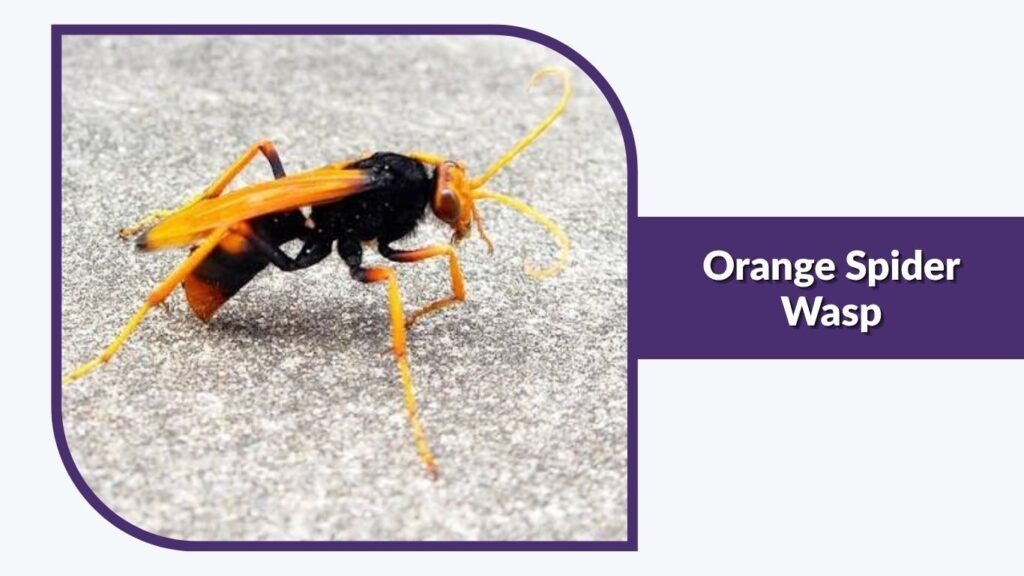
The Orange Spider Wasp is a colorful member of the spider-wasp group, typically showing orange or reddish coloration on the abdomen, thorax, legs, or wings. Many unrelated Pompilidae species can have this appearance. Females are solitary predators that hunt spiders and prepare individual nests for one developing offspring at a time.
Identification
- Orange, reddish, or rust-colored markings
- Dark black or brown areas on the body
- Long, slender legs
- Narrow waist
- Long antennae
- Wings may be orange, amber, or smoky
- Females can sting
- Often seen running quickly while hunting
Habitat and Distribution
Orange Spider Wasps are found in various warm habitats, including dry grasslands, forests, gardens, scrub, and open sandy areas. Their exact range depends on the species involved. Females are generally most abundant where spiders are common and suitable ground or cavities are available for nesting.
Hunting and Reproduction
Females actively explore the ground, vegetation, and spider retreats. When a suitable spider is found, the wasp paralyzes it with her sting. The prey is then dragged to a nesting chamber. After a single egg is deposited on the spider, the chamber is sealed and the female leaves.
Diet and Importance
Adults feed mostly on nectar, while developing larvae consume the paralyzed spiders provided by females. Their specialized predatory behavior contributes to the natural regulation of spider populations. Although females can sting people, they usually reserve the sting for prey and emergency self-defense.
15. Two-Colored Orange Spider Wasp

The Two-Colored Orange Spider Wasp is characterized by a noticeable combination of orange or reddish sections and darker black or brown areas. This contrasting pattern gives the wasp its two-toned appearance. Like other spider wasps, it is solitary, and females spend much of their active life searching for spiders to provision their nests.
Identification
- Two-tone orange and black coloration
- Orange or reddish abdomen or thorax
- Long, slender legs
- Narrow waist
- Long antennae
- Dark or amber-tinted wings
- Females possess a sting
- Streamlined body adapted for ground hunting
Habitat and Distribution
Two-colored spider wasps may inhabit gardens, grasslands, dry forests, scrub, woodland margins, and other open environments. They are especially likely to occur where abundant spider prey overlaps with warm, sunny nesting areas. Adults may also gather around flowering plants during nectar feeding.
Hunting and Reproduction
The female searches for a spider and delivers a sting that immobilizes it. She then pulls or carries the prey into a prepared nest chamber. A single egg is attached to the spider, and the nest is sealed. Once hatched, the larva gradually consumes the spider before pupating.
Diet and Importance
Adult Two-Colored Orange Spider Wasps mainly consume nectar. Their offspring rely completely on the spider stored in the nest. As specialized spider predators, they form an important part of natural food webs and help regulate arachnid populations without forming aggressive social colonies.
16. Orange-Collared Spider Wasp
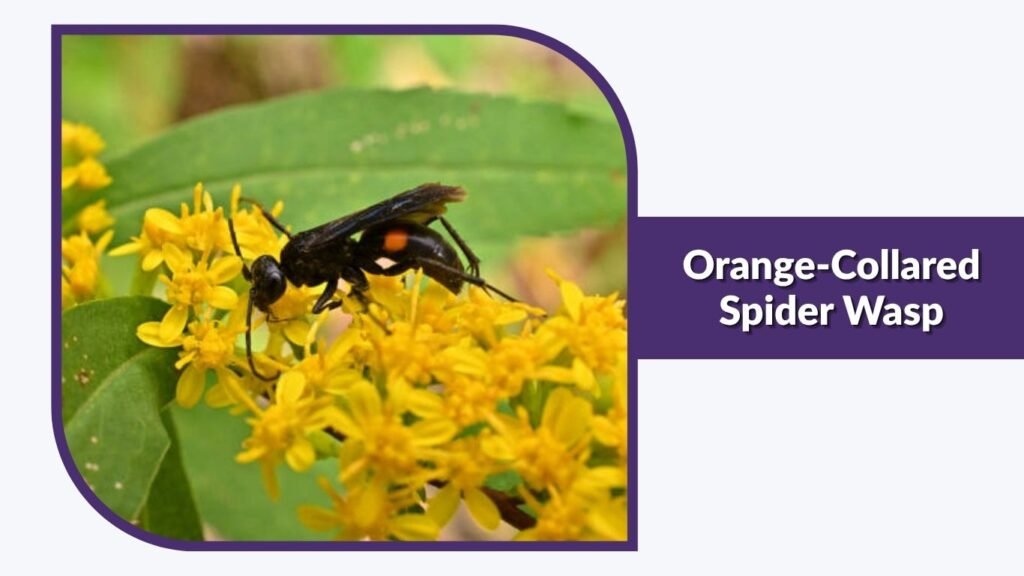
The Orange-Collared Spider Wasp (Ferreola handschini) is a striking Australian spider wasp named for the bright orange area around its prothorax or “collar.” The rest of the body is largely blue-black, creating a strong contrast. Like other members of the family Pompilidae, females are solitary hunters that capture spiders to provision their offspring.
Identification
- Scientific name: Ferreola handschini
- Family: Pompilidae
- Medium-sized spider wasp
- Blue-black body
- Distinctive orange collar behind the head
- Dark blue-black wings
- Long legs
- Slender waist
- Long antennae
Habitat and Distribution
Orange-Collared Spider Wasps occur in Australia, including Queensland and other suitable eastern regions. They may be encountered in open woodland, gardens, grasslands, and dry environments where spiders are plentiful. Adults can be noticed running across the ground while females search for potential prey or suitable nesting locations.
Hunting and Reproduction
The female searches for a suitable spider and subdues it with her sting. After preparing a nesting chamber in the ground, she transports the immobilized spider into it. An egg is laid with the prey, providing the developing larva with a food supply after it hatches.
Diet and Importance
Adult Orange-Collared Spider Wasps obtain energy from sugary food sources such as flower nectar, while their larvae depend on spider prey. Their hunting helps integrate spiders and wasps into the natural food web. Despite being equipped with a sting, these solitary wasps are primarily concerned with hunting and reproduction rather than defending colonies.
17. Blotchwing Spider Wasp
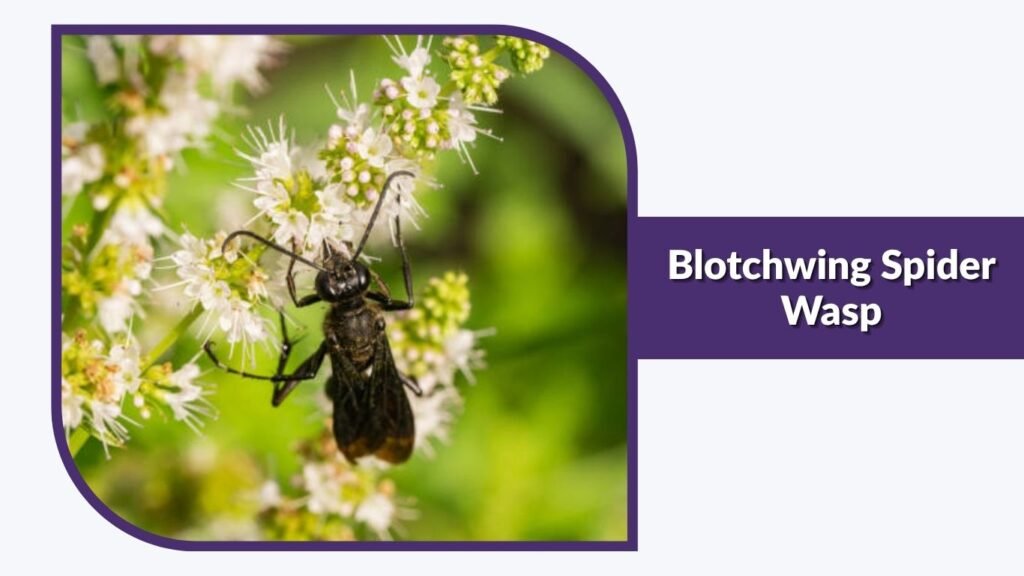
The Blotchwing Spider Wasp (Caliadurgus fasciatellus) is a small to medium-sized spider wasp recognized by the conspicuous dark patches and bands on its wings. Females have contrasting black and reddish coloration and specialize in hunting spiders. The species occurs in western Europe and has also been recorded in eastern North America.
Identification
- Scientific name: Caliadurgus fasciatellus
- Family: Pompilidae
- Females approximately 5.5–9 mm long
- Males approximately 5–7 mm long
- Female abdomen reddish with a dark tip
- Dark blotch near the tip of the forewing
- Additional dark band across the forewing
- Slender body
- Long legs typical of spider wasps
Habitat and Distribution
Blotchwing Spider Wasps occur across parts of western Europe and eastern North America. They may inhabit gardens, woodland margins, meadows, and other areas where suitable spiders are available. Their small size can make them easy to overlook unless their distinctive wing markings are noticed.
Hunting and Reproduction
Females specialize in capturing spiders, including orb-weaving spiders. A spider is attacked and immobilized before being transported to a nesting location. The female provides the prey for a single developing larva, following the characteristic reproductive strategy of spider wasps.
Diet and Importance
Adults obtain their own energy mainly from plant-derived sugary resources, while their offspring develop on captured spiders. By specializing on spiders, Blotchwing Spider Wasps contribute to predator-prey relationships within gardens and natural habitats and represent an important part of local insect diversity.
18. Spotted Cuckoo Spider Wasp
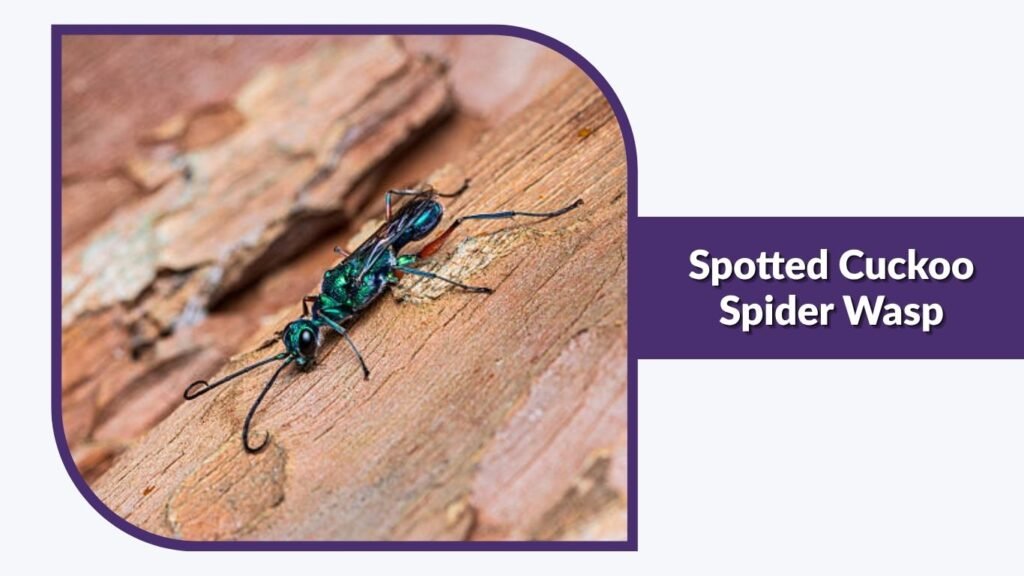
The Spotted Cuckoo Spider Wasp (Ceropales maculata) has one of the most unusual lifestyles among spider wasps. Instead of hunting and provisioning its own spider, the female steals the work of another spider wasp. She lays her egg on prey already captured by another Pompilidae species, making her a specialized kleptoparasite.
Identification
- Scientific name: Ceropales maculata
- Family: Pompilidae
- About 1 cm long
- Dark body with noticeable pale or yellow markings
- Spotted appearance
- Long antennae
- Slender legs
- Narrow waist
- Relatively small compared with tarantula hawks
Habitat and Distribution
Spotted Cuckoo Spider Wasps can be encountered in habitats where other spider wasps are active. Flower-rich meadows, woodland edges, gardens, and open areas provide feeding opportunities and increase the chance of encountering host species transporting captured spiders. Adults are sometimes noticed feeding on flowers.
Hunting and Reproduction
Unlike most spider wasps, the female does not need to capture her own prey. She watches another female spider wasp dragging a paralyzed spider toward its nest. When the owner temporarily leaves the spider unattended, Ceropales maculata quickly lays an egg on it. Its larva ultimately uses the stolen prey and can eliminate the host’s offspring.
Diet and Importance
Adults visit flowers for food, while the larvae exploit spiders captured by other spider wasps. This unusual reproductive strategy demonstrates the remarkable ecological diversity within Pompilidae. Rather than directly regulating spiders through hunting, the species affects interactions between other spider wasps and their prey.
19. Mud-Nesting Spider Wasp
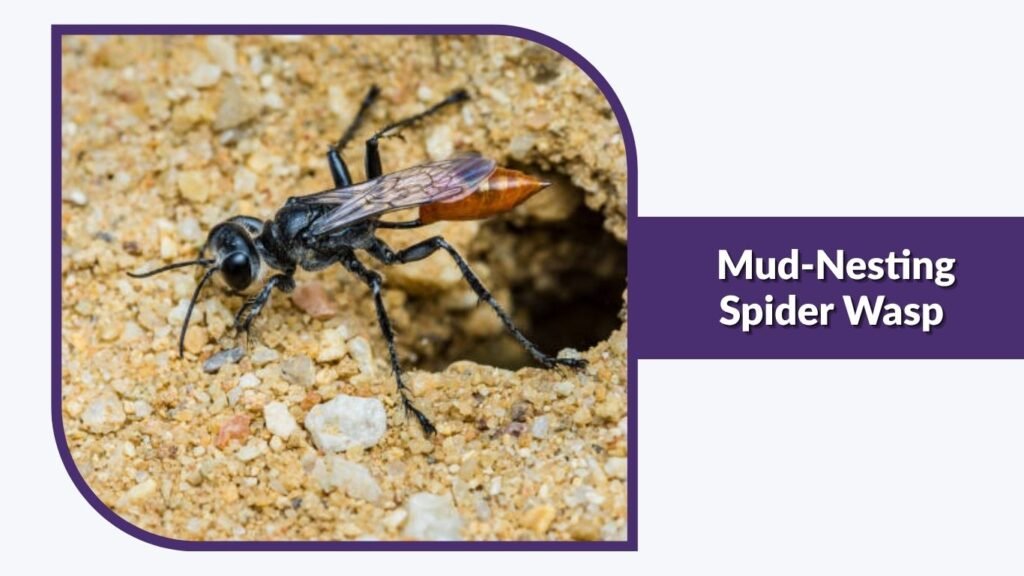
Mud-Nesting Spider Wasps include members of the tribe Ageniellini, a group of Pompilidae known for constructing mud cells or using protected cavities. One representative is Auplopus carbonarius. These wasps provision each brood chamber with a spider, and many members of the group remove some or all of the spider’s legs to make transportation easier.
Identification
- Family: Pompilidae
- Tribe: Ageniellini
- Representative species: Auplopus carbonarius
- Usually small to medium-sized
- Slender body
- Often predominantly black
- Narrow waist
- Long legs
- Females are specialized spider hunters
- Appearance varies among genera and species
Habitat and Distribution
Mud-nesting spider wasps occur widely, and different members of Ageniellini occupy many geographic regions. Auplopus species may occur in wooded areas as well as around old houses. Females can use cracks in foundations, old insect holes, spaces beneath bark, and other protected locations for their nests.
Nesting and Reproduction
Many Ageniellini construct distinctive thimble-shaped mud cells. Each brood cell typically contains one spider and one wasp egg. Some species remove the legs from captured spiders before carrying them to the nest, reducing the prey’s bulk and making transportation easier.
Diet and Importance
Adults obtain energy separately from the prey used for reproduction, while larvae consume the spider placed inside their brood cell. Mud-Nesting Spider Wasps are important natural spider predators and also demonstrate unusual nesting behaviors that distinguish them from many ground-burrowing members of Pompilidae.
20. Anoplius Spider Wasp
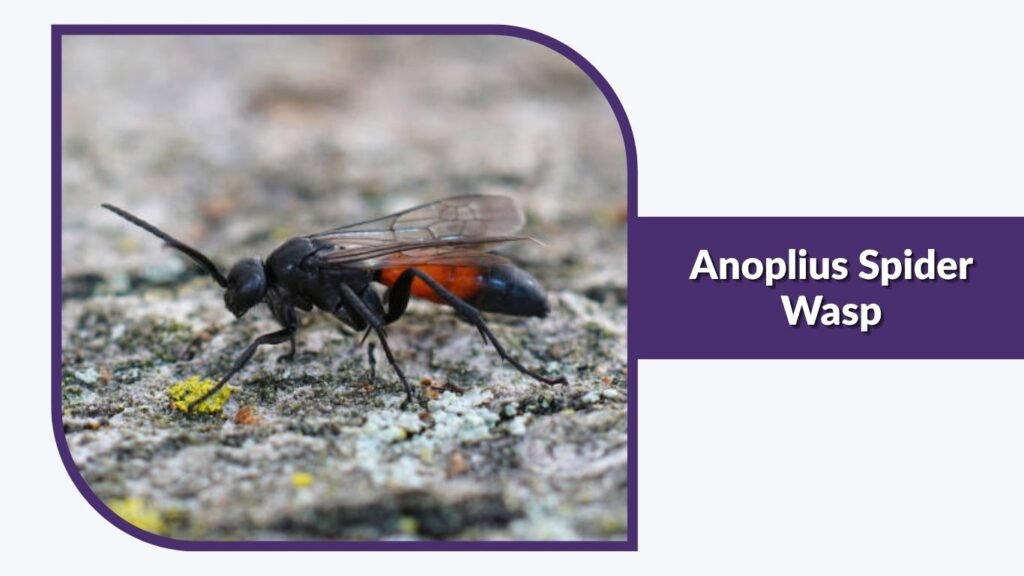
Anoplius Spider Wasps belong to a large genus of spider-hunting wasps in the family Pompilidae. They are often dark-colored, medium-sized, and highly active on the ground. The informal name Blue-Black Spider Wasp is also frequently applied to members of Anoplius, although experts note that this color-based name can also describe unrelated spider-wasp genera.
Identification
- Genus: Anoplius
- Family: Pompilidae
- Usually medium-sized
- Predominantly black or blue-black body
- Long, powerful legs
- Slender waist
- Dark wings in many species
- Long antennae
- Females possess a functional sting
- Exact markings vary considerably among species
Habitat and Distribution
Different Anoplius species occupy a wide variety of North American environments, including sandy areas, wetlands, coastal habitats, meadows, and open ground. They are often observed running quickly over soil while searching for spiders or investigating potential nesting locations.
Hunting and Reproduction
Females hunt spiders and immobilize them with a sting. The captured prey is transported to a nesting chamber, where the female lays an egg. After hatching, the larva feeds on the spider before pupating and eventually emerging as an adult. This spider-provisioning strategy is characteristic of the Pompilidae family.
Diet and Importance
Adult Anoplius wasps obtain energy independently of the spiders used for their offspring, while larvae rely on captured spider prey. Their specialized hunting makes them part of the natural system regulating spider populations. They are solitary rather than social, so they do not maintain large colonies that require collective defense.
FAQs
1. Are spider wasps dangerous to humans?
Spider wasps are generally not dangerous unless they are handled, trapped, or deliberately disturbed. Most species are solitary and do not defend large colonies. However, females can sting, and some tarantula hawks are famous for having extremely painful stings.
2. What do spider wasps eat?
Adult spider wasps mainly feed on nectar and other sugary plant sources. Their larvae eat spiders captured by females. The mother paralyzes a spider, places it in a nest or protected chamber, and lays an egg so the developing larva has a fresh food supply.
3. Why do spider wasps hunt spiders?
Female spider wasps hunt spiders to feed their offspring. The spider is usually paralyzed rather than killed immediately. After being moved to a nest, an egg is laid on or near it. The larva later hatches and consumes the immobilized spider while developing.
4. Where do spider wasps build their nests?
Many spider wasps dig burrows in sandy or loose soil, while others use natural cavities, cracks, hollow spaces, or mud cells. Nesting habits vary considerably among species. Some females prepare a nest before hunting, while others capture a spider first and then locate a suitable nesting site.
5. Do spider wasps kill tarantulas?
Some spider wasps, especially tarantula hawks, specialize in hunting tarantulas. The female usually paralyzes the spider with a carefully placed sting rather than killing it immediately. She then uses the tarantula as living food for a single developing larva.