

Mud daubers are solitary wasps best known for building nests from wet soil and clay. Most species have slender bodies, narrow waists, and long legs, while their colors range from black and yellow to metallic blue. Females hunt spiders, paralyze them, and store them inside mud brood cells as food for their developing larvae. These wasps are generally nonaggressive and can be beneficial around gardens and homes. Below are 20 types of mud daubers, along with their identification, habitat, nesting behavior, and diet.
1. Black and Yellow Mud Dauber
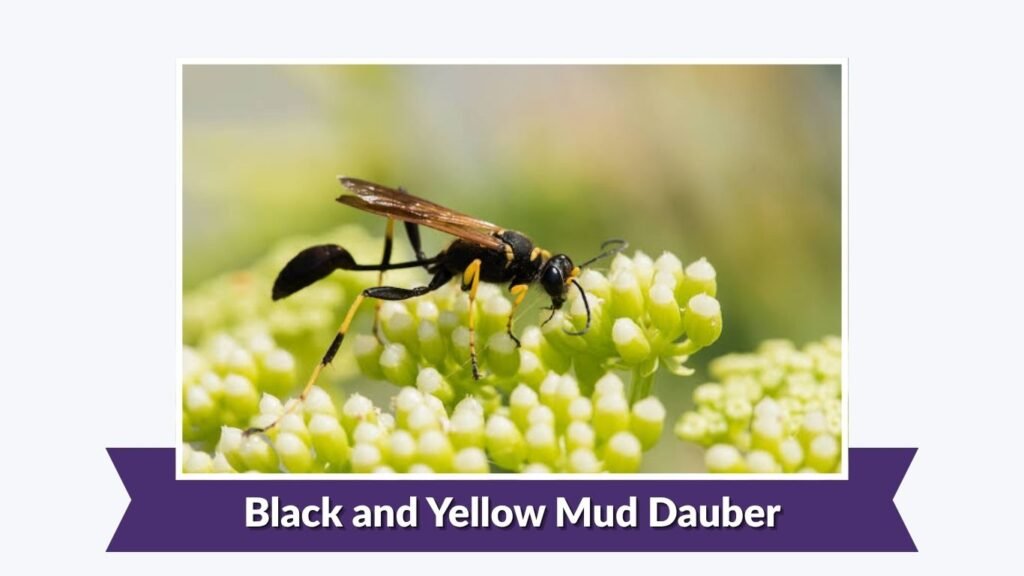
The Black and Yellow Mud Dauber (Sceliphron caementarium) is a large solitary wasp best known for building smooth mud nests on sheltered structures. Its extremely thin waist, black body, and bright yellow markings make it relatively easy to recognize. Unlike social wasps, each female works alone, gathering mud and hunting spiders to provide food for her developing larvae.
Identification
- Scientific name: Sceliphron caementarium
- Family: Sphecidae
- Mostly black body with variable yellow markings
- Long, extremely thin waist between the thorax and abdomen
- Legs prominently marked with yellow
- Wings usually amber or brownish
- Females are generally larger than males
- Adults commonly reach about 21–25 mm or slightly more in length
Habitat and Distribution
Black and Yellow Mud Daubers are widespread throughout much of North America and also occur in Central America and the Caribbean. They have additionally been introduced to several regions outside their native range. Around homes, they are often seen near gardens, flowers, puddles, ponds, barns, garages, porches, and other places that provide both wet mud and protected nesting surfaces.
Nesting Behavior
A female gathers small balls of wet mud and carries them to a sheltered site, often beneath an eave, bridge, porch, or similar overhang. She gradually constructs several cylindrical brood cells. Each cell is stocked with multiple spiders that have been paralyzed with her sting. She lays an egg inside before sealing the chamber with mud. Finished nests may contain numerous adjoining cells covered by an additional outer layer of mud.
Diet and Importance
Adult Black and Yellow Mud Daubers feed mainly on nectar from flowers. Their larvae, however, consume the spiders supplied by their mother. Females capture several types of spiders while provisioning nests, making these wasps important predators within local food webs. They are solitary and generally nonaggressive toward humans, so stings are uncommon unless a wasp is directly threatened or handled.
2. Blue Mud Dauber

The Blue Mud Dauber (Chalybion californicum) is a striking solitary wasp recognized by its metallic blue-black body. It differs from many other mud daubers because females often reuse existing mud nests rather than constructing an entirely new nest. This species is also well known for hunting spiders, including black widow spiders, to feed its developing larvae.
Identification
- Scientific name: Chalybion californicum
- Family: Sphecidae
- Metallic blue to blue-black body
- Adults about ¾–1 inch long
- Slender body with a narrow waist
- Wings can appear slightly iridescent
- Long, dark legs
- Lacks the bright yellow markings of the Black and Yellow Mud Dauber
Habitat and Distribution
Blue Mud Daubers are commonly found around gardens, fields, woodland edges, buildings, and other places where spiders and suitable nesting cavities occur. Females may nest in plant stems or buildings. They also carry water to dry soil, moistening it so mud can be collected and used during nest preparation.
Nesting Behavior
Instead of always starting from scratch, a female may occupy an abandoned mud-dauber nest. She uses water to soften and reshape the existing mud, repairs the cells, and then provisions them with spiders. Once an egg and sufficient prey are inside, the female seals the chamber to protect the developing larva.
Diet and Importance
Adults feed mainly on nectar, while larvae consume spiders captured by the female. Blue Mud Daubers are particularly interesting because they may prey on black widow spiders. They are solitary, do not form defensive colonies, and are generally nonaggressive; stings are considered uncommon.
3. Organ Pipe Mud Dauber

The Organ Pipe Mud Dauber (Trypoxylon politum) gets its common name from its extraordinary nest. Females build long, parallel mud tubes that resemble the pipes of an old-fashioned organ. This solitary spider-hunting wasp is native to eastern North America and often builds its nests beneath bridges, porches, overhangs, and other protected surfaces.
Identification
- Scientific name: Trypoxylon politum
- Family: Crabronidae
- Body primarily shiny black
- Wings often appear dark or bluish
- White or pale markings on the hind feet
- More robust waist than many Sceliphron mud daubers
- Long, relatively slender body
- Usually easily recognized when associated with its distinctive tubular nest
Habitat and Distribution
Organ Pipe Mud Daubers occur throughout much of eastern North America. They prefer locations with smooth vertical surfaces protected from heavy rain. Natural nesting sites include caves, hollow trees, and rock overhangs, while human structures such as garages, patios, attics, bridges, and sheds provide equally useful shelter.
Nesting Behavior
The female gathers wet mud and constructs long vertical tubes, sometimes exceeding six inches in length. Each tube is divided into individual brood cells. She captures spiders, paralyzes them with her sting, and stores them inside. A single egg is placed in each cell before it is sealed. Males may remain near the nest and guard it while females collect mud or hunt.
Diet and Importance
Developing larvae feed entirely on the spiders stored in their cells. Organ Pipe Mud Daubers frequently target medium-sized orb-weaver spiders. Adults rely mainly on sugary resources such as nectar. They are regarded as relatively docile wasps and rarely sting unless physically trapped or handled.
4. Asian Mud Dauber

The Asian Mud Dauber (Sceliphron curvatum) is a solitary mud-building wasp native to parts of Asia. It has successfully expanded into numerous areas outside its original range, particularly Europe. Females construct characteristic mud cells in sheltered locations and fill each one with paralyzed spiders that provide food for their developing larvae.
Identification
- Scientific name: Sceliphron curvatum
- Family: Sphecidae
- Slender, elongated body
- Very narrow waist
- Mostly dark coloration
- Yellow and reddish markings may be present
- Long legs
- Adults generally around 15–20 mm long
- Abdomen connected to the thorax by a long stalk-like segment
Habitat and Distribution
Asian Mud Daubers originated in Asia but have spread into many European countries. GBIF currently records the species as introduced in numerous countries and islands. They adapt particularly well to human environments and may be found around houses, garages, sheds, balconies, and other sheltered areas.
Nesting Behavior
Females create separate mud cells rather than a large social nest. Unusually, they may construct nests indoors on furniture, books, clothing, or other protected objects. Each chamber is stocked with several paralyzed spiders before an egg is deposited. The female then seals the nest, leaving the larva to complete its development independently.
Diet and Importance
Adults obtain energy primarily from nectar, while larvae depend on spiders supplied by their mother. This makes Asian Mud Daubers effective spider predators within their ecosystems. Although their appearance and indoor nesting habits can concern homeowners, they are solitary and generally show little aggression toward humans unless directly threatened.
5. Australian Mud Dauber

The name Australian Mud Dauber can refer broadly to native Australian Sceliphron wasps. One representative species is Sceliphron formosum, a mud-building wasp native to Australia and frequently found around human structures. Females build solid mud nests and provision their offspring with paralyzed spiders, making them important predators in both urban and natural habitats.
Identification
- Representative species: Sceliphron formosum
- Family: Sphecidae
- Long and slender body
- Very narrow, stalk-like waist
- Strong black and yellow coloration
- Long legs
- Narrow wings folded over the body at rest
- Similar to other Australian Sceliphron species, so exact identification may require close examination
Habitat and Distribution
Sceliphron formosum is native to Australia and is commonly associated with human-made structures. Australian mud daubers also occur in forests, woodlands, heathlands, and urban environments. Locations with accessible mud, sheltered nesting surfaces, and abundant spiders provide particularly favorable conditions.
Nesting Behavior
Females gather wet soil and form it into individual mud brood chambers. Several cells may be constructed together on walls or other protected surfaces. Each cell receives paralyzed spiders and a single egg before being sealed. The larva later consumes the stored prey and develops safely within the hardened mud structure.
Diet and Importance
Adult Australian mud daubers visit flowers for nectar, while females hunt spiders specifically for their offspring. Research on S. formosum confirms that spiders make up the prey stored inside its brood nests. These wasps therefore play a useful predatory role and, because they are solitary rather than social, usually do not aggressively defend their nests.
6. Yellow-Legged Mud Dauber

The Yellow-Legged Mud Dauber (Sceliphron caementarium) is a solitary spider-hunting wasp known for its exceptionally narrow waist and yellow-marked legs. It is another common name for the Black and Yellow Mud Dauber described earlier. Females build mud nests in sheltered locations and provision individual brood cells with paralyzed spiders.
Identification
- Scientific name: Sceliphron caementarium
- Family: Sphecidae
- Adult length typically about 24–28 mm
- Black body with variable yellow markings
- Hind legs have conspicuous yellow areas
- Extremely long, narrow waist
- Long legs and slender body
- Brownish to amber wings
Habitat and Distribution
Yellow-Legged Mud Daubers are widespread in North America and have also become established in other regions. They adapt readily to areas around people, including gardens, barns, garages, bridges, sheds, and porches. Suitable habitat generally combines spider-rich vegetation, a source of wet soil, and protected surfaces for attaching mud nests.
Nesting Behavior
A female collects small portions of wet mud and carries them to her chosen nesting location. She gradually creates elongated brood cells, places several paralyzed spiders inside each chamber, lays an egg, and seals the entrance. Several completed cells may be grouped together and covered with additional mud.
Diet and Importance
Adults primarily use nectar for energy, while their larvae eat spiders stored inside the nest. Their spider-hunting behavior makes them important predators within local food webs. Although females possess a sting, these solitary wasps normally concentrate on nesting and hunting rather than aggressively defending their nests.
7. Steel-Blue Mud Dauber

The Steel-Blue Mud Dauber (Chalybion californicum) is a metallic blue solitary wasp native to North America. “Steel-blue” is one of the names sometimes applied to this distinctive mud dauber, although Blue Mud Dauber is more widely used. Females are especially interesting because they frequently renovate old mud nests instead of constructing completely new ones.
Identification
- Scientific name: Chalybion californicum
- Family: Sphecidae
- Metallic blue to blue-black body
- Strong iridescent sheen in sunlight
- Long, slender legs
- Narrow waist
- Dark wings with bluish reflections
- No yellow abdominal bands
- Sleek appearance compared with many other wasps
Habitat and Distribution
Steel-Blue Mud Daubers occur widely across North America. They can be encountered in gardens, open woodland, fields, parks, and around buildings. Locations already containing abandoned mud-dauber nests can be especially attractive to females because these nests provide ready-made structures that can be softened, repaired, and reused.
Nesting Behavior
Females commonly occupy nests previously constructed by other mud daubers. They bring water to the dry mud, soften the material, and remodel the existing chambers. Spiders are captured and paralyzed before being placed inside each brood cell. Once an egg and enough prey are present, the chamber is sealed.
Diet and Importance
Adults obtain carbohydrates from flower nectar, whereas the larvae consume spiders. This species is especially well known for capturing widow spiders, including black widows. Despite its ability to sting prey, it is solitary and generally avoids confrontations with people.
8. Metallic Blue Mud Dauber

The Metallic Blue Mud Dauber (Chalybion californicum) is named for the brilliant blue, violet, or blue-black sheen covering its body. This is another common name for the Blue Mud Dauber rather than a separate species. Its striking coloration, spider-hunting behavior, and habit of reusing older mud nests make it one of the most recognizable mud daubers.
Identification
- Scientific name: Chalybion californicum
- Family: Sphecidae
- Bright metallic blue body
- Color may appear violet or blue-black depending on light
- Long, slender legs
- Narrow waist
- Dark iridescent wings
- Smooth, shiny appearance
- Lacks the yellow markings found on many Sceliphron species
Habitat and Distribution
Metallic Blue Mud Daubers occur across much of North America. They are frequently associated with flower gardens, woodland margins, fields, fences, barns, garages, and other structures. Their presence often overlaps with other mud daubers because females can benefit from abandoned mud nests available for reuse.
Nesting Behavior
A female may locate an old mud nest, soften it with water, remove unwanted material, and prepare the chambers for her own offspring. She then hunts spiders and immobilizes them with her sting. The prey is packed into the brood cell, an egg is deposited, and the chamber is closed.
Diet and Importance
Adults visit flowers for nectar, but the larvae are supplied with spiders. The Metallic Blue Mud Dauber is particularly notable as a predator of black widow spiders. This hunting behavior makes it an interesting component of natural predator communities.
9. Common Mud Dauber

The Common Mud Dauber (Sceliphron laetum) is a large Australian mud-building wasp with a black-and-yellow body and extremely thin waist. Females construct covered rows of mud cells on protected surfaces and hunt spiders to feed their larvae. It is frequently encountered around buildings as well as in natural Australian habitats.
Identification
- Scientific name: Sceliphron laetum
- Family: Sphecidae
- Body may reach about 3 cm long
- Primarily black with yellow to orange markings
- Very long and thin waist
- Long legs
- Narrow wings
- Large, slender appearance
- Easily associated with substantial mud nests
Habitat and Distribution
Common Mud Daubers occur across mainland Australia and are particularly noticeable in urban areas. They may forage in gardens and construct nests on houses, sheds, walls, rock surfaces, and other sheltered structures. Their range includes both eastern and western mainland Australia.
Nesting Behavior
The female repeatedly transports wet mud to a protected surface and constructs rows of cylindrical brood cells. Once a chamber is ready, she hunts spiders and paralyzes them before carrying them back to the nest. An egg is placed with the stored prey, and completed cells are eventually covered with mud.
Diet and Importance
Adult Common Mud Daubers mainly feed on nectar. Their larvae consume the spiders that females place inside the nest. This division between nectar-feeding adults and predatory larvae is typical of many mud daubers. The species can therefore help regulate spider populations while also visiting flowering plants.
10. Black Mud Dauber

The term Black Mud Dauber is commonly applied to wasps in the genus Sceliphron rather than to one universally recognized species. These solitary wasps usually have dark bodies, extremely narrow waists, and long legs. Females are skilled mud builders that construct individual brood chambers and provision them with spiders.
Identification
- Genus: Sceliphron
- Family: Sphecidae
- Predominantly black or dark body
- Many species have yellow, orange, or reddish markings
- Extremely long, thread-like waist
- Long legs
- Slender abdomen
- Narrow wings
- Exact coloration depends on species
Habitat and Distribution
Sceliphron mud daubers occur across many warm and temperate parts of the world. Different species inhabit North America, South America, Europe, Africa, Asia, and Australia. They commonly use natural overhangs as well as houses, bridges, barns, garages, sheds, and similar structures that protect mud nests from heavy rain.
Nesting Behavior
Females collect wet soil and shape it into cylindrical or rounded brood chambers. After completing a cell, the female hunts spiders, paralyzes them, and carries them back to the nest. She deposits an egg with the prey before sealing the chamber. Several cells may eventually form one large mud structure.
Diet and Importance
Adult Black Mud Daubers generally feed on nectar and other sugary resources. Their larvae rely on the spiders stored by females. Because they are solitary, there is no worker colony defending the nest. They usually avoid people and focus their activity on flowers, mud collection, spider hunting, and nest construction.
11. Yellow Mud Dauber

The name Yellow Mud Dauber is sometimes used descriptively for Sceliphron species with prominent yellow markings. One suitable representative is Sceliphron spirifex, a solitary mud-building wasp found mainly in Africa and southern Europe. It has the characteristically long waist of the genus and constructs mud chambers provisioned with spiders for its offspring.
Identification
- Representative species: Sceliphron spirifex
- Family: Sphecidae
- Adult length roughly 17–27 mm
- Body mainly dull black
- Long yellow petiole or waist
- Black legs with yellow markings
- Clear to lightly tinted wings
- Extremely slender body shape
Habitat and Distribution
Sceliphron spirifex occurs across parts of Africa and southern Europe. It can live in a variety of warm habitats but is often associated with human structures. Buildings, bridges, rock faces, walls, and other sheltered locations provide suitable surfaces for its mud nests.
Nesting Behavior
Females construct clusters of mud brood cells on sheltered surfaces. After completing a chamber, the female hunts spiders, paralyzes them, and carries them back to the nest. Several spiders may be stored in each cell before an egg is laid and the entrance is sealed with additional mud.
Diet and Importance
Adult mud daubers obtain much of their energy from sugary resources such as nectar, while their larvae are supplied with spiders. Because each female nests alone, these wasps do not form large defensive colonies. Their spider-hunting behavior makes them important predators within the habitats they occupy.
12. Red Mud Dauber

Red Mud Dauber is not a standardized common name for one single species, but it can describe mud daubers with reddish markings. A representative is Sceliphron rufopictum, a recognized species in the mud-dauber genus Sceliphron. Like its relatives, it belongs to a group of solitary wasps known for constructing mud brood cells.
Identification
- Representative species: Sceliphron rufopictum
- Family: Sphecidae
- Long, slender mud-dauber form
- Narrow stalk connecting thorax and abdomen
- Dark underlying body coloration
- Reddish or lighter markings may be present
- Long legs
- Narrow wings
- Exact identification requires close examination
Habitat and Distribution
Sceliphron rufopictum is associated with East Asia. Like other members of its genus, it belongs to a widespread group whose species occur across tropical and temperate regions. Suitable environments provide spiders, wet soil, flowers, and sheltered surfaces for attaching mud nests.
Nesting Behavior
Members of Sceliphron typically gather wet soil and form it into elongated or cylindrical brood chambers. Females provision individual cells with spiders and lay one egg with the stored prey. The chamber is then closed with mud, allowing the larva to develop inside a protected enclosure.
Diet and Importance
Adults commonly visit flowers, while the larvae depend on spiders captured by females. Mud daubers therefore differ greatly in diet between the adult and immature stages. Their solitary nature also means they normally have little reason to defend a large area around their nests.
13. Golden Mud Dauber

The name Golden Mud Dauber is another descriptive rather than standardized species name. Sceliphron formosum is a useful representative because it is an Australian mud dauber with conspicuous yellow markings. Research confirms that this species commonly nests around urban environments and provisions its mud chambers with spiders.
Identification
- Representative species: Sceliphron formosum
- Family: Sphecidae
- Slender body
- Dark base coloration
- Prominent yellow markings
- Long petiole or waist
- Long legs
- Narrow wings
- Similar to other Australian Sceliphron species
Habitat and Distribution
Sceliphron formosum is native to Australia and occurs in both natural and human-modified environments. It is particularly capable of using buildings and other urban structures as nesting sites when suitable sheltered surfaces are available.
Nesting Behavior
Females build brood chambers from mud collected from the surrounding environment. Research on this species has found large numbers of spiders stored within its nests. Each chamber provides both shelter and a food supply for the developing larva until it reaches the pupal stage.
Diet and Importance
Adult wasps visit flowers for energy, whereas females capture spiders to provision their nests. Studies of S. formosum have recorded several spider families among its prey, with jumping spiders particularly well represented in examined nests. This makes the wasp an active predator within Australian urban and natural ecosystems.
14. Slender Mud Dauber

The Slender Mud Dauber name is commonly descriptive of wasps in the genus Sceliphron. A representative species is Sceliphron laetum, an Australian and Southeast Asian mud dauber distinguished by its extremely narrow petiole and black-and-yellow coloration. Females construct mud cells and provision them with paralyzed spiders.
Identification
- Representative species: Sceliphron laetum
- Family: Sphecidae
- Adult length roughly 17–26 mm
- Mainly black body
- Strong yellow markings
- Extremely long, slender petiole
- Long yellow-and-black legs
- Narrow membranous wings
- Yellow hairs may be visible on the head
Habitat and Distribution
Sceliphron laetum is native to Australia and parts of Southeast Asia, including Papua New Guinea. It can occur in natural vegetation as well as around homes and other structures where females find protected surfaces suitable for mud-nest construction.
Nesting Behavior
Females construct cylindrical cells from mud and cluster several chambers together. Each cell receives multiple paralyzed spiders and a single egg before being sealed. Once several cells have been completed, additional mud may be applied across the exterior of the nest.
Diet and Importance
The larvae consume the spiders stored inside their brood chamber. Research on this species has found that females often collect orb-weaving spiders and adjust the amount of prey placed in a cell. Adults have a much less predatory diet and primarily seek energy from flowers.
15. Long-Waisted Mud Dauber
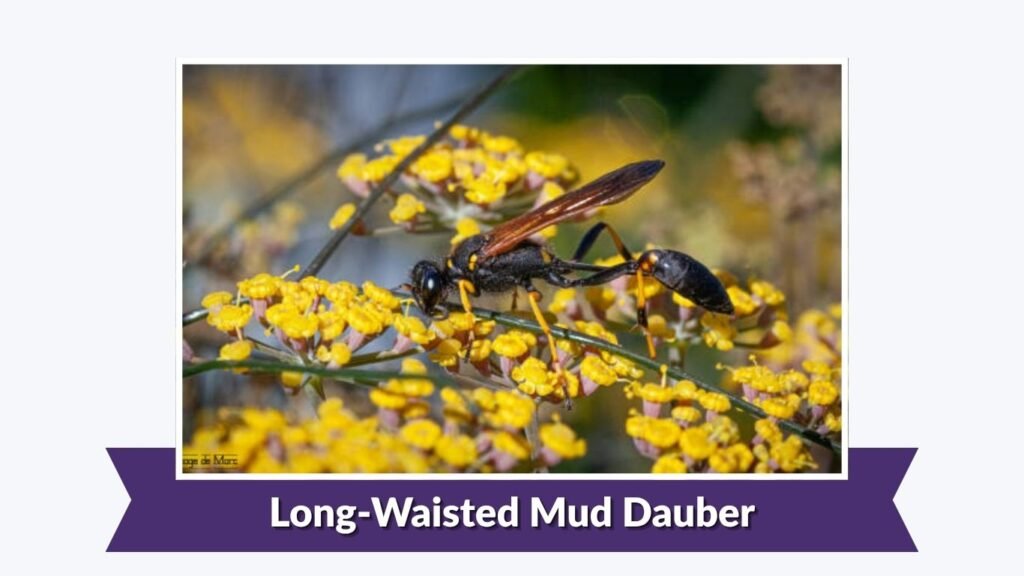
Long-Waisted Mud Dauber is a descriptive name that fits many species of Sceliphron. These wasps are immediately noticeable for the extraordinarily thin petiole joining the thorax to the abdomen. The genus includes dozens of valid species occurring around the world, all sharing broadly similar solitary nesting and spider-hunting behavior.
Identification
- Genus: Sceliphron
- Family: Sphecidae
- Extremely long and narrow waist
- Slender abdomen
- Long legs
- Mostly dark body
- Yellow, orange, or reddish markings depending on species
- Narrow wings
- Many species approach roughly 2–3 cm in length
Habitat and Distribution
Sceliphron mud daubers occur worldwide, with different species living in North America, South America, Africa, Europe, Asia, and Australia. They frequently use sheltered natural surfaces and human structures because their mud chambers require protection from heavy rain and physical disturbance.
Nesting Behavior
A female collects mud repeatedly and shapes it with her jaws into one or more brood cells. She then hunts spiders and carries the immobilized prey back to the nest. Each completed chamber normally contains an egg together with several spiders before the female closes it with mud.
Diet and Importance
Adult long-waisted mud daubers obtain energy mainly from flowers and other sugary sources. Their larvae are predators that consume the spider supply provided by their mother. Despite their conspicuous appearance, these wasps are solitary and are generally far less defensive than colony-forming social wasps.
16. White-Banded Mud Dauber

The White-Banded Mud Dauber is a descriptive name sometimes applied to slender mud-building wasps that show pale or whitish markings on an otherwise dark body. It is not a universally standardized common name for one species. Like other mud daubers, these solitary wasps construct or reuse protected brood cells and provision them with spiders for their developing larvae.
Identification
- Mostly dark or black body
- Pale white or cream-colored markings
- Long, slender abdomen
- Narrow waist
- Long legs
- Narrow wings
- Color pattern varies among species
- Usually solitary rather than colony-forming
Habitat and Distribution
White-banded mud daubers may occur in warm and temperate habitats where suitable species are present. Gardens, woodland edges, fields, sheds, porches, barns, bridges, and rock overhangs can all provide useful nesting locations. Females also need nearby wet soil or existing mud nests as well as healthy spider populations.
Nesting Behavior
Females work alone and construct brood chambers from wet soil or modify an existing nest. After preparing a cell, the female captures spiders and paralyzes them with her sting. These spiders are placed inside as a food supply before an egg is laid and the cell entrance is sealed.
Diet and Importance
Adults primarily rely on nectar and other sugary plant resources. The larvae feed on the spiders stored within their brood cells. By hunting spiders, these mud daubers form part of natural food webs. Their solitary lifestyle also means they generally do not aggressively defend their nests.
17. Tropical Mud Dauber

The name Tropical Mud Dauber broadly describes mud-building wasps that thrive in warm tropical environments. Numerous Sceliphron and related species occur across Africa, Asia, Australia, Central America, and other tropical regions. Their warm-climate habitats provide abundant spiders, moist soil, flowers, and sheltered surfaces suitable for constructing mud nests.
Identification
- Long, slender body
- Extremely narrow waist in many species
- Mostly black or dark coloration
- Yellow, orange, or reddish markings may occur
- Long legs
- Narrow wings
- Adults often around 15–30 mm long
- Exact appearance varies by species
Habitat and Distribution
Tropical mud daubers inhabit forests, savannas, gardens, agricultural areas, villages, and cities. They often adapt particularly well to buildings because roofs, balconies, sheds, and walls provide dry surfaces protected from heavy tropical rainfall. Mud is commonly gathered from puddles, riverbanks, irrigation areas, and damp soil.
Nesting Behavior
Females repeatedly carry small amounts of wet soil to the nest site. The mud is shaped into elongated or rounded chambers that harden after drying. Each chamber is supplied with immobilized spiders before an egg is laid. Several brood cells may eventually be combined into a larger mud mass.
Diet and Importance
Adult tropical mud daubers frequently visit flowers for nectar. Their larvae are carnivorous and depend on spiders captured by their mothers. These wasps help regulate local arthropod populations and serve as both predators and prey within tropical ecosystems. They are generally nonaggressive when left undisturbed.
18. Oriental Mud Dauber

The Oriental Mud Dauber is a broad common name used for several mud-dauber species occurring across Asia. A representative example is Sceliphron deforme, a slender spider-hunting wasp native to parts of eastern and southeastern Asia. Females construct hard mud brood cells in sheltered locations and provision them with paralyzed spiders.
Identification
- Representative species: Sceliphron deforme
- Family: Sphecidae
- Slender black body
- Yellow markings on portions of the body and legs
- Extremely narrow waist
- Long legs
- Narrow, slightly smoky wings
- Typical elongated Sceliphron appearance
Habitat and Distribution
Oriental mud daubers occur throughout many regions of Asia, including warm temperate and subtropical environments. They may be found around woodland, agricultural areas, gardens, villages, and urban buildings. Human structures often provide excellent protected surfaces where mud nests can remain dry and undisturbed.
Nesting Behavior
Females gather moist soil and build individual brood chambers against walls, ceilings, rocks, or other firm surfaces. Spiders are hunted, stung, and transported to the nest. Once enough prey has been stored, the female deposits an egg and seals the chamber with additional mud.
Diet and Importance
Adults mainly consume nectar, while their larvae feed exclusively on the spiders provided inside the nest. Their hunting behavior places Oriental Mud Daubers among the important small predators in their ecosystems. They rarely show aggressive behavior toward people because they do not maintain social colonies.
19. Pipe-Organ Mud Dauber

The Pipe-Organ Mud Dauber is another common name for the Organ Pipe Mud Dauber (Trypoxylon politum). It is named after the long, parallel mud tubes constructed by females. These nests often resemble rows of organ pipes and may be found beneath bridges, roof overhangs, porches, rock shelters, and other protected surfaces.
Identification
- Scientific name: Trypoxylon politum
- Family: Crabronidae
- Shiny black body
- Long, slender form
- Dark or bluish wings
- Pale markings may occur on the hind feet
- Waist less thread-like than in Sceliphron
- Commonly associated with tubular mud nests
- Adults are relatively large solitary wasps
Habitat and Distribution
Pipe-Organ Mud Daubers are widespread in eastern North America. They favor locations offering both abundant spiders and sheltered vertical surfaces. Bridges, garages, barns, caves, abandoned buildings, cliffs, and house eaves are frequently selected for nesting.
Nesting Behavior
Females construct long mud tubes divided internally into several brood chambers. Each chamber receives a supply of paralyzed spiders and a single egg. Males may remain close to a nesting female and sometimes guard the entrance while she leaves to collect mud or capture additional prey.
Diet and Importance
Adult Pipe-Organ Mud Daubers obtain energy mainly from nectar. Their larvae consume spiders stored inside the mud tubes, particularly orb-weaving species. These wasps are generally docile and rarely sting people. Their distinctive nests also make them one of the easiest mud-dauber groups to recognize.
20. Blue-Winged Mud Dauber

The name Blue-Winged Mud Dauber can be used descriptively for dark mud daubers whose wings show a blue or violet iridescent sheen. It is not consistently tied to one recognized species. Metallic members of genera such as Chalybion can appear strongly blue-winged when sunlight reflects from their wings and body.
Identification
- Metallic blue, blue-black, or dark body
- Wings may show blue or violet reflections
- Slender body
- Narrow waist
- Long legs
- Smooth, glossy appearance
- Usually lacks bold yellow abdominal bands
- Exact size and markings depend on species
Habitat and Distribution
Blue-winged mud daubers can occur in gardens, open woodland, grasslands, fields, and around houses or outbuildings. They are frequently associated with places where other mud daubers nest because some species reuse abandoned mud cells instead of constructing an entirely new structure.
Nesting Behavior
A female may renovate an old mud nest by carrying water to soften the hardened clay. She removes debris, reshapes the chamber, and then fills it with paralyzed spiders. After laying an egg, she seals the brood cell so the larva can develop safely inside.
Diet and Importance
Adults visit flowers and feed primarily on nectar. Their larvae consume the spiders stored by the female. Some metallic blue mud daubers are particularly effective hunters of widow spiders. They are solitary and usually avoid people, making them far less defensive than social yellowjackets or hornets.
FAQs
1. Are mud daubers dangerous to humans?
Mud daubers are generally not dangerous to people. They are solitary wasps and do not aggressively defend large colonies. Females can sting if they are trapped, handled, or strongly threatened, but stings are uncommon because these wasps usually prefer to escape rather than attack.
2. Do mud daubers sting?
Yes, female mud daubers can sting, but they mainly use their stinger to paralyze spiders for their larvae. They are far less aggressive than yellowjackets or hornets. Most people can safely observe mud daubers around buildings and gardens without being stung.
3. What do mud daubers eat?
Adult mud daubers mainly feed on flower nectar and other sugary substances. Their larvae eat spiders captured and paralyzed by the female. Different species may prefer different spider groups, and some blue mud daubers are especially well known for hunting widow spiders.
4. Where do mud daubers build their nests?
Mud daubers often build nests under roof eaves, porches, bridges, garages, sheds, barns, rock overhangs, and other sheltered places. Females collect wet soil and shape it into brood cells. Some species also reuse abandoned mud nests made by other wasps.
5. Are mud daubers beneficial?
Yes. Mud daubers are beneficial predators because they capture many spiders to feed their offspring. They also visit flowers for nectar and may contribute to pollination. Since they are generally nonaggressive, their nests can often be left undisturbed when they are not causing a problem.