
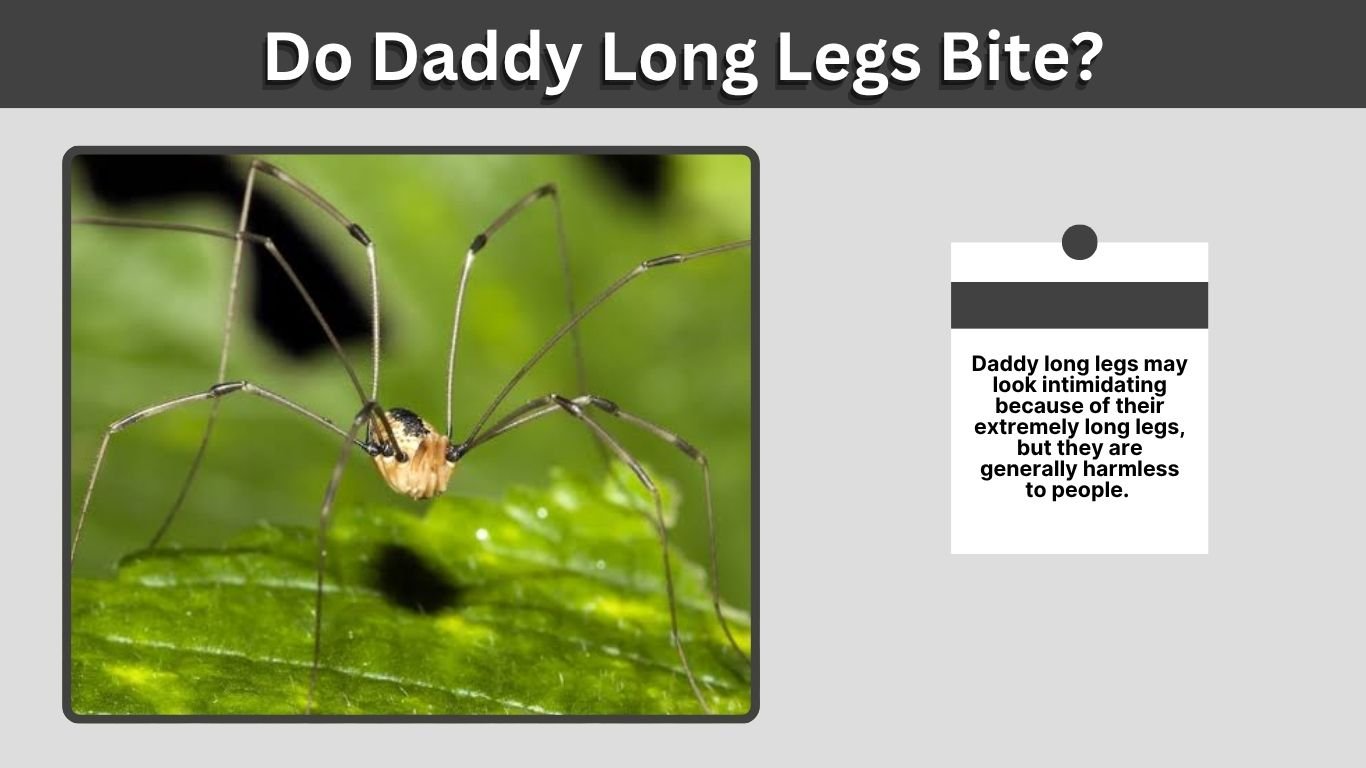
Daddy long legs may look intimidating because of their extremely long legs, but they are generally harmless to people. The answer to “do daddy long legs bite?” depends on which animal you mean. The name can describe harvestmen, cellar spiders, or even crane flies in some regions. Harvestmen cannot deliver a venomous bite, crane flies do not bite people, and cellar spiders are not considered dangerous to humans. Understanding the differences can clear up the long-standing myths surrounding these unusual long-legged creatures.
What Exactly Is a Daddy Long Legs?
“Daddy long legs” is a common name rather than a precise scientific name. Depending on where you live, people may use it for three very different animals. Knowing which one you have seen is important because their bodies, feeding habits, and ability to bite are not the same. Only one of the three is actually a true spider.
Three Animals Called Daddy Long Legs
- Harvestmen: Arachnids in the order Opiliones; they are not true spiders.
- Cellar spiders: True spiders in the family Pholcidae, commonly found in basements and corners.
- Crane flies: Winged insects that resemble oversized mosquitoes.
Harvestmen have a rounded, apparently single-section body and do not produce silk or venom. Cellar spiders have two main body sections and make irregular webs. Crane flies are easily recognized because they have wings and six legs rather than eight.
Do Daddy Long Legs Bite Humans?
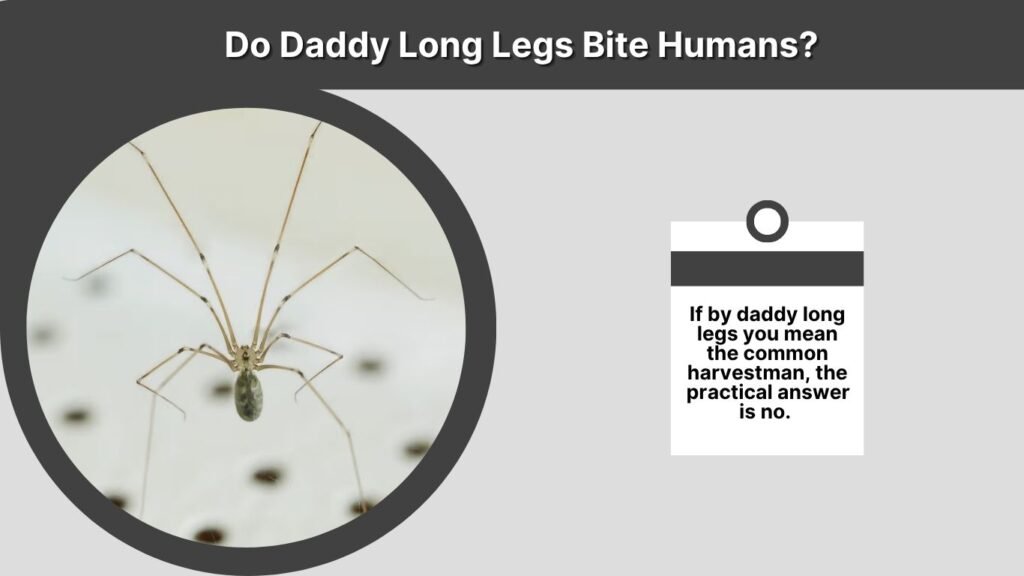
If by daddy long legs you mean the common harvestman, the practical answer is no. Harvestmen have small grasping mouthparts called chelicerae rather than venom-delivering spider fangs. University extension sources describe them as harmless to people, without venom glands, and unable to puncture human skin.
Can Daddy Long Legs Bite You?
A harvestman may use its mouthparts to tear apart small prey or decomposing material, but those structures are not designed to inject venom into people. There is therefore no normal harvestman “bite” comparable with a spider bite.
Cellar spiders are different because they are true spiders and possess fangs and venom for subduing small prey. However, there is no evidence supporting the popular claim that their venom is exceptionally dangerous. Utah State University describes cellar spiders as not known to be a health hazard.
Does a Daddy Long Legs Bite Hurt?
For a true harvestman, there should be no painful venomous bite because it lacks venom glands and cannot normally pierce human skin. If someone develops pain, swelling, or a visible skin lesion after seeing a long-legged arachnid nearby, that does not prove the animal caused it. Many skin reactions can resemble arthropod bites.
What About Cellar Spider Bites?
Cellar spiders technically possess the structures needed to bite prey, but they are not regarded as dangerous to people. The famous story that their venom is extremely powerful but their fangs are “too short” to penetrate human skin is unsupported. Research summarized by the University of California, Riverside rejects the idea that daddy-longlegs spiders possess extraordinarily toxic venom.
Do Daddy Long Legs With Wings Bite?
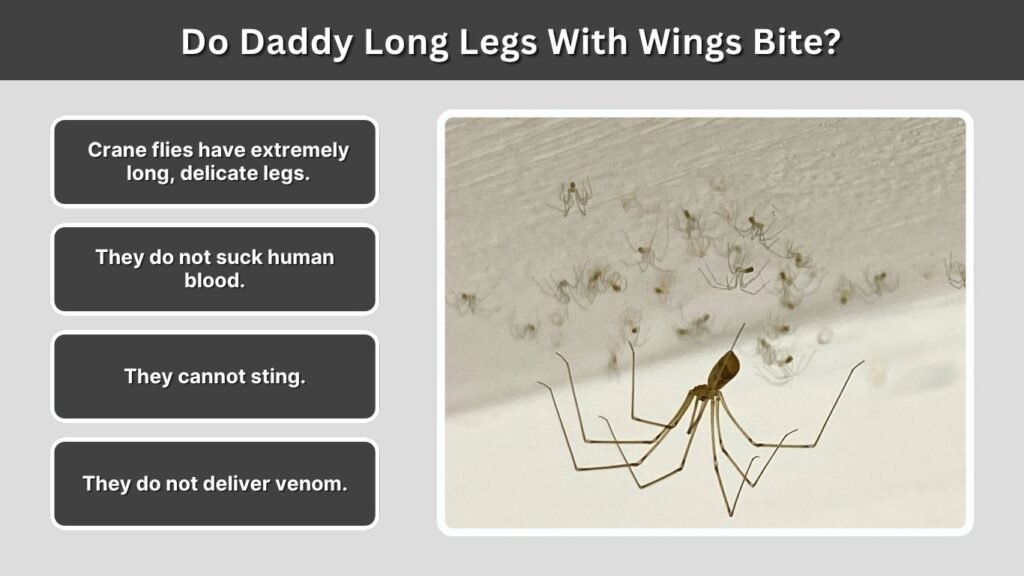
The winged creature commonly called a daddy long legs, particularly in the UK, is usually a crane fly. Crane flies are insects rather than spiders or harvestmen. Their mosquito-like shape often causes unnecessary concern, but they do not feed on human blood and their mouthparts cannot pierce human skin.
Crane Flies vs. Mosquitoes
Crane flies may look like giant mosquitoes, but their behavior is very different.
- Crane flies have extremely long, delicate legs.
- They do not suck human blood.
- They cannot sting.
- They do not deliver venom.
- Adults are often seen around lights, windows, lawns, and vegetation.
The University of Minnesota Extension classifies crane flies as harmless to people and property.
Do Daddy Long Legs Bite Dogs or Cats?
Harvestmen are not considered a biting threat to dogs or cats for the same basic reason they are harmless to humans: they lack venom glands and do not have spider-like venom-delivering fangs. Crane flies also lack the ability to bite people and are not blood-feeding insects.
What If a Pet Plays With One?
A curious dog or cat may paw at or attempt to eat a daddy long legs. In most ordinary encounters, there is little reason for concern. It is still sensible to prevent pets from deliberately eating unknown arthropods because identification can sometimes be wrong.
If a pet develops unusual swelling, repeated vomiting, breathing problems, marked lethargy, or another significant reaction after interacting with an unidentified animal, contact a veterinarian rather than assuming it was a harmless daddy long legs.
Are Daddy Long Legs Really the Most Venomous Spiders?
No. This is one of the most persistent myths about daddy long legs. Harvestmen have no venom glands at all, so they cannot possibly be the “most venomous spider.” They are not even true spiders. Cellar spiders do have venom, but there is no evidence that their venom is unusually dangerous to humans.
Why the Venom Myth Is Wrong
The myth usually makes two claims:
- Daddy long legs have extremely potent venom.
- Their fangs are too small to penetrate human skin.
For harvestmen, both claims fail because they have neither venom glands nor true spider fangs. For cellar spiders, the “deadly venom” part is unsupported. Crane flies have no venom and cannot bite people either.
Are Baby or Female Daddy Long Legs Dangerous?
Baby, female, and large adult harvestmen do not suddenly become venomous. The basic anatomy remains the same: harvestmen lack venom glands and are considered harmless to humans. Therefore, searches such as “do baby daddy long legs bite,” “do female daddy long legs bite,” and “do big daddy long legs bite” have essentially the same answer when referring to harvestmen.
Should You Remove Them?
Daddy long legs generally do not need to be killed. Harvestmen can act as scavengers and predators, feeding on small arthropods and decaying organic material. Cellar spiders also consume insects and other arachnids. If one is somewhere inconvenient, gently relocating it outdoors is usually enough.
What Should You Do If You Think You Were Bitten?
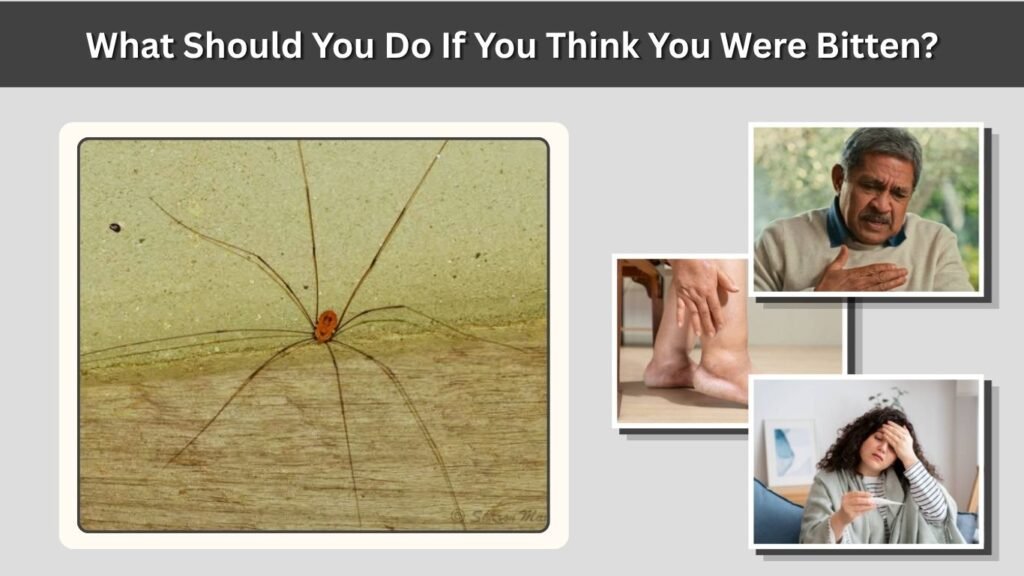
Because genuine spider bites can be difficult to identify from skin symptoms alone, avoid diagnosing a bite solely because a spider or daddy long legs happened to be nearby. Utah State University notes that confirming a spider bite generally requires identifying the actual spider involved.
When to Seek Medical Help
Consider medical attention if you experience:
- Severe or rapidly increasing pain
- Significant swelling
- Difficulty breathing
- Widespread rash or allergic symptoms
- Fever or other systemic symptoms
- A skin injury that continues to worsen
These symptoms do not specifically indicate a daddy long legs bite, but they deserve appropriate evaluation.
FAQs
1. Do daddy long legs bite people?
Common harvestmen do not deliver venomous bites to people. Their mouthparts are not venom-injecting fangs, and they are considered harmless to humans.
2. Do daddy long legs spiders bite humans?
Cellar spiders are true spiders and have fangs, but they are not considered dangerous to humans. The claim that they have extremely deadly venom is a myth.
3. Do daddy long legs bite or sting?
Harvestmen neither deliver venomous bites nor sting. Crane flies also do not bite or sting people.
4. Why don’t daddy long legs bite humans?
Harvestmen lack venom glands and do not possess the venom-delivering fangs found in true spiders. Their small mouthparts are primarily used for feeding.
5. Are daddy long legs dangerous?
Generally, no. Harvestmen are harmless, crane flies cannot bite humans, and cellar spiders are not regarded as a significant human health hazard. The frightening reputation of daddy long legs comes mainly from a long-running venom myth rather than documented danger.
