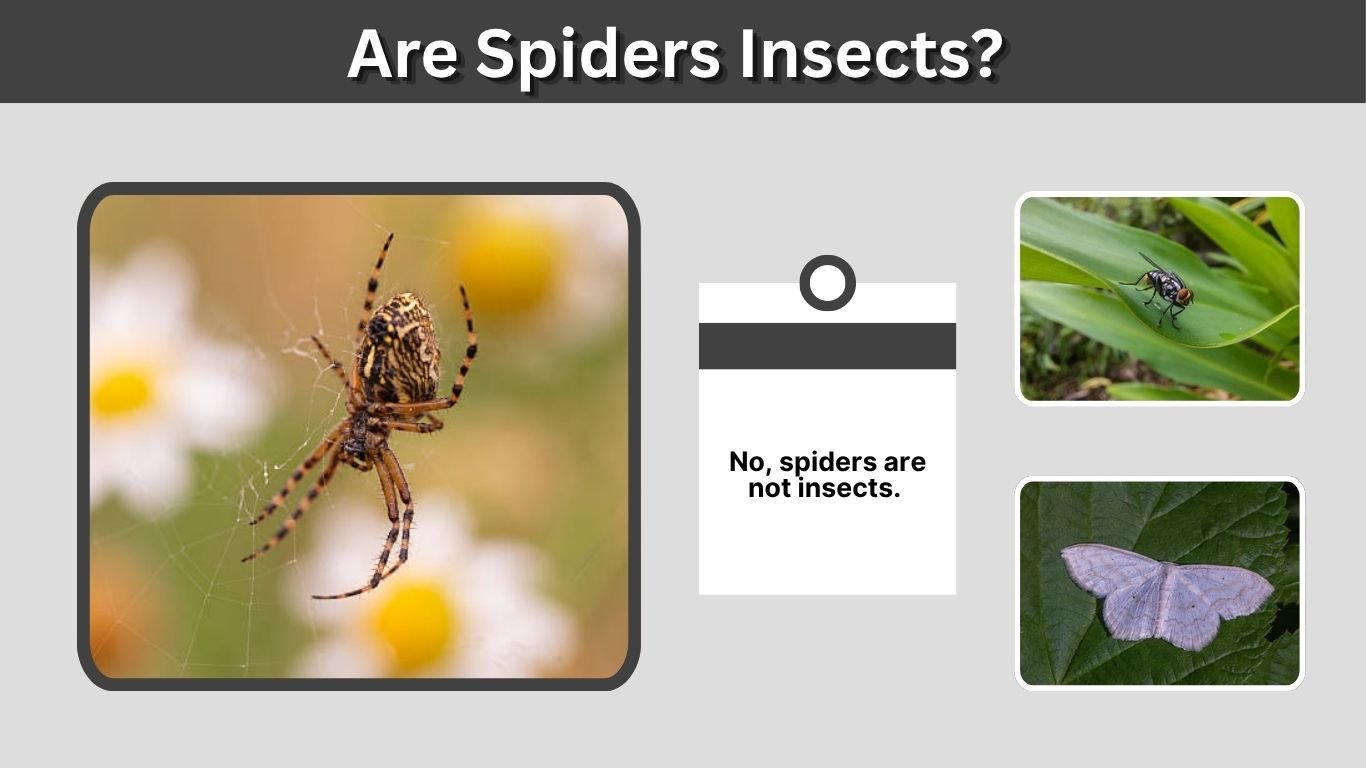
Are spiders insects, or do they belong to a completely different animal group? Although spiders and insects share several characteristics, they are not the same. Spiders are arachnids, while insects belong to a separate scientific class. Their number of legs, body structure, eyes, and feeding habits reveal important differences. Both groups are arthropods and play essential roles in nature. This guide explains why spiders are not insects, how to identify them, their scientific classification, and how they compare with other creatures such as ticks, scorpions, and daddy longlegs.
Are Spiders Insects or Arachnids?
No, spiders are not insects. They belong to the class Arachnida, while insects belong to the class Insecta. Both groups are classified within the phylum Arthropoda, which includes animals with jointed legs and external skeletons. However, spiders have eight legs and two main body sections, while adult insects have six legs and three distinct body regions.
Scientific Classification of Spiders
The scientific classification of spiders helps explain their relationship with other animals.
- Kingdom: Animalia
- Phylum: Arthropoda
- Subphylum: Chelicerata
- Class: Arachnida
- Order: Araneae
Spiders share the arachnid class with scorpions, ticks, mites, and harvestmen. However, these animals belong to different orders.
Why Are Spiders Not Considered Insects?
Spiders are not classified as insects because their anatomy differs significantly.
Unlike insects, spiders lack antennae, possess four pairs of walking legs, and have specialized mouthparts called chelicerae.
They also produce silk through structures called spinnerets, a distinctive feature of true spiders.
How Are Spiders Different From Insects?
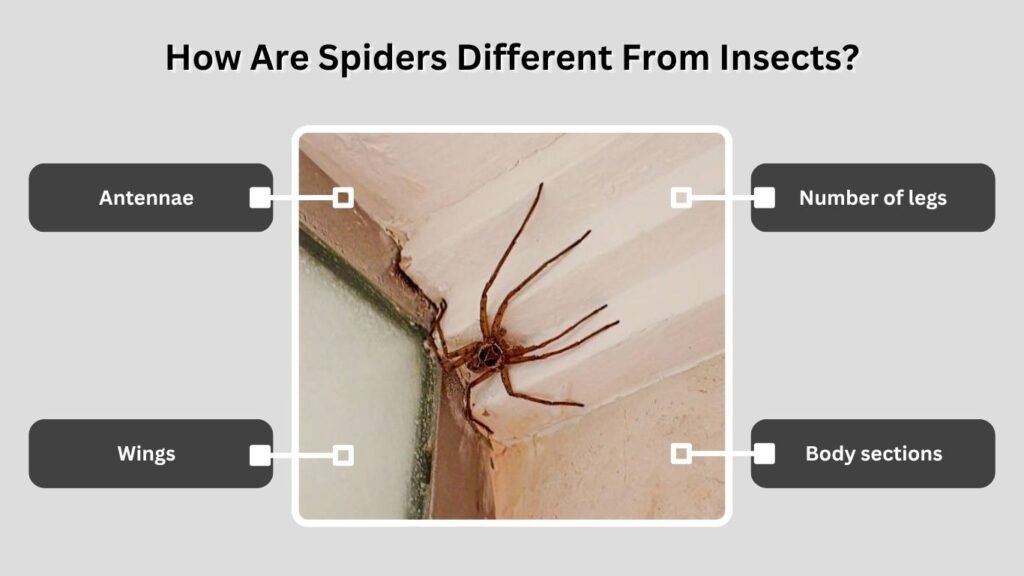
Spiders and insects may appear similar because both are small invertebrates with jointed legs and protective exoskeletons. However, several anatomical characteristics distinguish them. The easiest differences involve their number of legs, body divisions, and antennae. Examining these features helps identify whether an unfamiliar animal belongs to the arachnid class or the insect class.
Main Differences Between Spiders and Insects
The following characteristics help distinguish spiders from insects.
- Number of legs: Spiders have eight legs, while adult insects have six.
- Body sections: Spiders have two main body regions; insects have three.
- Antennae: Insects have one pair, while spiders have none.
- Wings: Spiders never have wings, but many adult insects do.
- Eyes: Spiders typically have simple eyes, while insects commonly possess compound eyes.
- Mouthparts: Spiders use chelicerae and fangs, while insects have various specialized mouthparts.
- Silk production: All spiders can produce silk, although not all build prey-catching webs.
Spider vs. Insect Comparison Chart
| Feature | Spiders | Insects |
| Scientific class | Arachnida | Insecta |
| Legs | 8 | 6 |
| Main body regions | 2 | 3 |
| Antennae | Absent | Present |
| Wings | Absent | Present in many adults |
| Eyes | Usually simple | Usually compound |
| Examples | Wolf spiders, tarantulas | Ants, bees, beetles |
Do All Spiders Have Eight Legs?
Healthy adult spiders normally possess eight walking legs arranged in four pairs.
However, some individuals lose legs through injury or encounters with predators. Younger spiders may sometimes regenerate missing limbs during subsequent molts.
Even when a spider has fewer than eight visible legs, its scientific classification remains unchanged.
How Are Spiders and Insects Alike?
Although spiders and insects belong to different scientific classes, they share several important characteristics. Both are arthropods, meaning they have segmented bodies, jointed appendages, and external skeletons. Their evolutionary history connects them within the broader animal kingdom. These similarities explain why people frequently group spiders, insects, and other small crawling animals together in everyday conversation.
Similarities Between Spiders and Insects
Spiders and insects share several biological features.
- Exoskeleton: Both possess a protective outer covering made primarily from chitin.
- Jointed legs: Their appendages contain movable joints.
- Invertebrate bodies: Neither group has a backbone.
- Molting: Both shed their exoskeletons during development.
- Egg reproduction: Most spiders and insects reproduce by laying eggs.
- Ecological importance: Both contribute to food webs and natural ecosystems.
How Are Spiders Related to Insects?
Spiders and insects share distant evolutionary ancestors within the phylum Arthropoda.
However, they belong to different evolutionary branches. Spiders are chelicerates, while insects are hexapods within the larger pancrustacean lineage.
This means spiders are related to insects, but they are not simply insects with additional legs.
Are Spiders Animals, Insects, or Bugs?
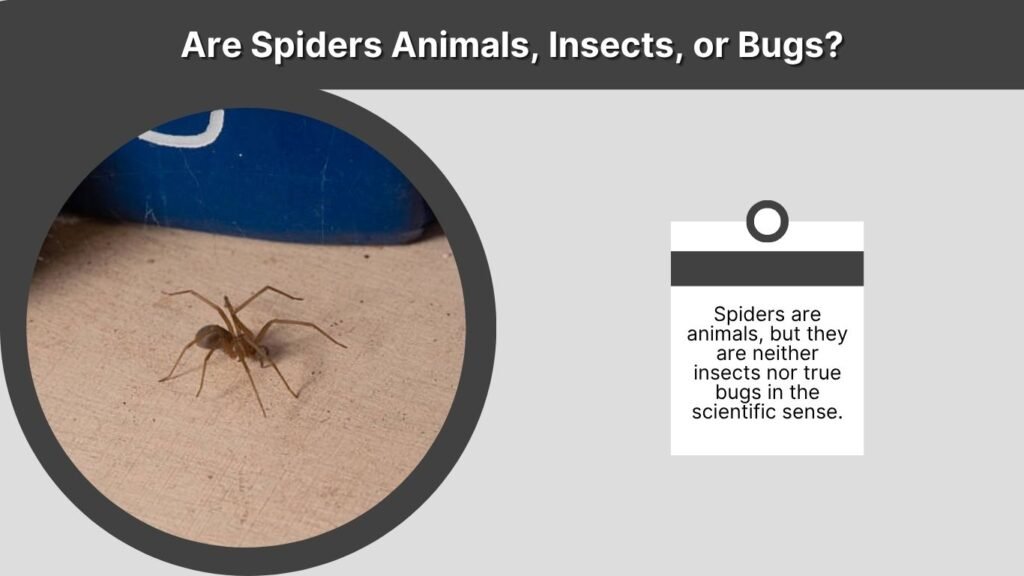
Spiders are animals, but they are neither insects nor true bugs in the scientific sense. The confusion occurs because everyday language frequently describes many small crawling creatures as bugs. Biologists use more specific classifications based on anatomy and evolutionary relationships. Understanding these categories makes it easier to distinguish spiders from insects, mites, scorpions, and other arthropods.
Are Spiders Considered Animals?
Yes. Every spider belongs to the animal kingdom, Animalia.
Spiders are multicellular organisms that consume other organisms for energy. They lack backbones and are classified as invertebrate animals.
They are not mammals, reptiles, or amphibians because those groups have entirely different biological characteristics.
Are Spiders Bugs or Insects?
In everyday conversation, people sometimes call spiders bugs. However, the word “true bug” has a specific scientific meaning.
True bugs belong to the insect order Hemiptera, which includes stink bugs, bed bugs, and water striders.
Since spiders belong to Araneae rather than Hemiptera, they are not scientifically classified as true bugs.
Are Spiders and Insects Invertebrates?
Yes. Both groups are invertebrates because they lack a vertebral column.
Their exoskeletons provide structural support and protection instead of an internal backbone.
Other invertebrates include worms, jellyfish, snails, and numerous marine animals.
Are Daddy Longlegs, Ticks, and Scorpions Insects?
Several eight-legged animals resemble spiders but belong to different groups within Arachnida. Daddy longlegs, ticks, mites, and scorpions are commonly mistaken for insects or true spiders. Although they share certain anatomical features, they have different feeding habits, body structures, and evolutionary relationships. Recognizing these differences helps explain why having eight legs does not automatically make an animal a spider.
Are Daddy Longlegs Spiders or Insects?
The name daddy longlegs commonly refers to harvestmen or cellar spiders, depending on the region.
Harvestmen belong to the arachnid order Opiliones. They have broadly joined body regions and do not produce silk.
Cellar spiders belong to Araneae and are true spiders. Neither group is classified as insects.
Are Ticks and Scorpions Spiders?
Ticks and scorpions belong to Arachnida, but neither is a true spider.
Ticks are parasitic arachnids that feed on the blood of vertebrate hosts during their parasitic life stages.
Scorpions are predators recognized by their pincers and segmented tails bearing a venomous stinger.
Other Arthropods That Are Not Insects
Several familiar animals belong to arthropod groups outside Insecta.
- Spiders: Arachnids belonging to Araneae.
- Ticks: Arachnids commonly classified within Acari.
- Scorpions: Arachnids belonging to Scorpiones.
- Harvestmen: Arachnids belonging to Opiliones.
- Centipedes: Myriapods belonging to Chilopoda.
- Millipedes: Myriapods belonging to Diplopoda.
- Crabs and lobsters: Crustacean arthropods.
Why Are Spiders Important to the Environment?
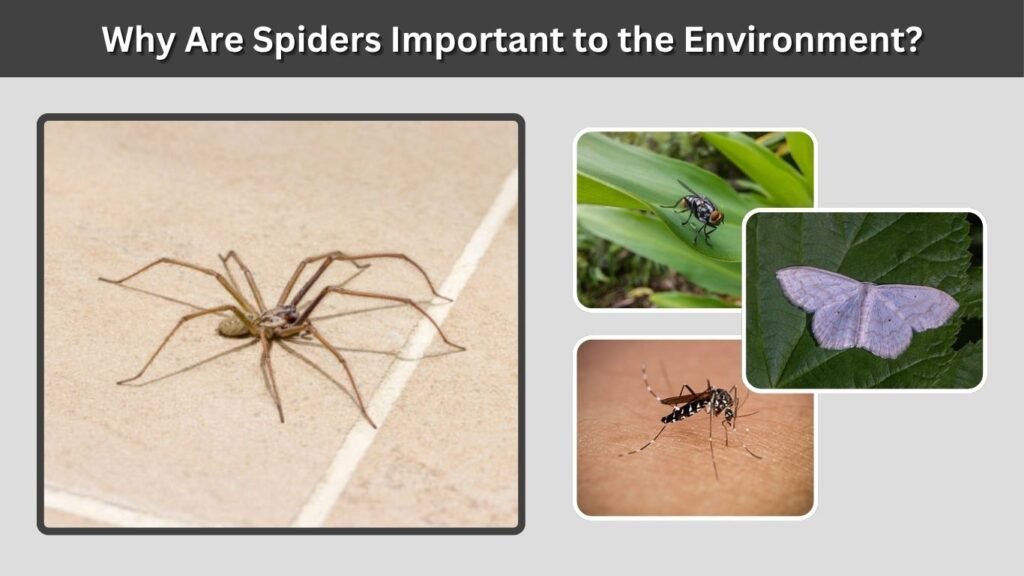
Spiders perform essential ecological functions by controlling populations of insects and other small animals. They inhabit forests, grasslands, gardens, agricultural fields, and buildings. Although some people fear spiders, most species pose little threat to humans. Their feeding activity supports natural pest regulation, while their presence also provides food for birds and other predators.
Do Spiders Eat Insects?
Yes. Most spiders are predators that consume insects and other small arthropods.
Orb-weaving spiders capture flying insects in silk webs, while jumping spiders actively stalk their prey.
Wolf spiders typically hunt on the ground rather than relying on prey-catching webs.
Are Spiders Beneficial?
Spiders help regulate populations of flies, mosquitoes, moths, and numerous other arthropods.
They also serve as prey for birds, reptiles, amphibians, and predatory insects.
Maintaining healthy spider populations contributes to biodiversity and balanced ecosystems.
FAQs
Spiders are often confused with insects because both groups have relatively small bodies, jointed legs, and similar habitats. However, their biological classification reveals important distinctions. The following frequently asked questions address common misconceptions about spider anatomy, evolutionary relationships, and other arachnids. These answers provide a straightforward explanation for readers learning about arthropod identification.
1. Are Spiders Insects, Yes or No?
No. Spiders are arachnids belonging to the class Arachnida, while insects belong to Insecta. Both groups are arthropods.
2. Why Are Spiders Not Classified as Insects?
Spiders have eight legs, two main body sections, and no antennae. Adult insects have six legs, three main body regions, and one pair of antennae.
3. Are Jumping Spiders Insects?
No. Jumping spiders are true spiders belonging to the family Salticidae. Their distinctive eyes and active hunting behavior make them recognizable arachnids.
4. Are All Eight-Legged Animals Spiders?
No. Scorpions, ticks, mites, and harvestmen are examples of other arachnids that typically have eight legs as adults.
5. Are Spiders Related to Crabs and Lobsters?
Yes. Spiders, crabs, and lobsters all belong to Arthropoda. However, spiders are chelicerates, while crabs and lobsters are crustaceans.
