
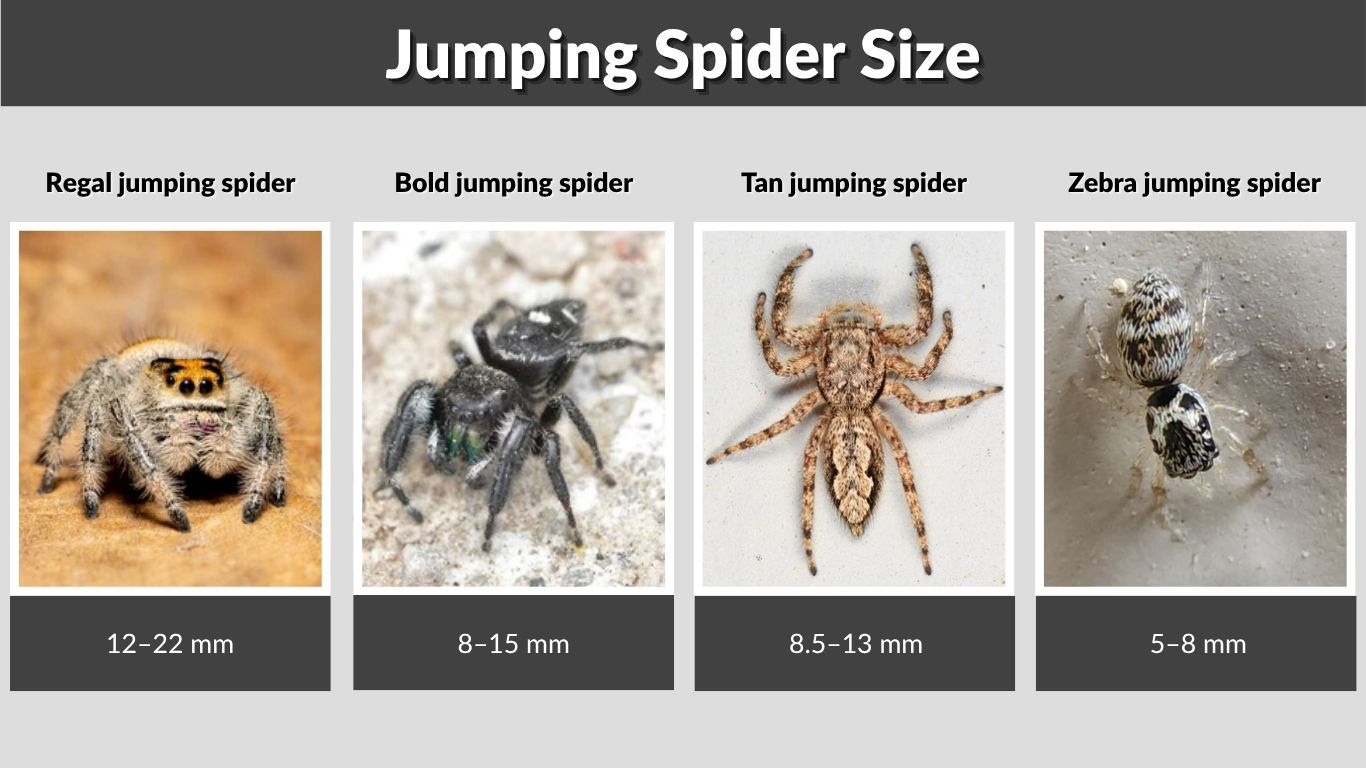
Jumping spiders are small, compact spiders with big eyes, strong legs, and curious hunting behavior. Most adults are only a few millimeters long, but their size depends on species, sex, age, and feeding condition. Some tiny species look like moving dots, while large regal or bold jumping spiders can look as big as a fingernail.
How Big Are Jumping Spiders?
Jumping spiders are usually small compared with wolf spiders, orb-weavers, and house spiders. Most common species measure about 4–18 mm in body length, not including the full spread of the legs. Their compact body, furry appearance, and active movement can make them look larger than they really are.
In general, adult jumping spiders are about the size of a sesame seed, pea, fingernail, or small button, depending on the species. Females are often larger and heavier than males. Males may look slimmer, with longer front legs or more noticeable face markings.
Common size points:
- Small jumping spiders: around 3–6 mm
- Medium jumping spiders: around 7–12 mm
- Large jumping spiders: around 13–18 mm
- Very large individuals: sometimes close to 20 mm in body length
- Spiderlings: often only 1–3 mm after leaving the egg sac
A jumping spider’s abdomen size can also change. A well-fed spider may have a round, full abdomen, while a hungry or dehydrated spider may look slimmer. This does not always mean the spider is a different species or a different age.
Jumping Spider Size Chart
Different jumping spiders vary widely in size. Some house and wall species stay tiny, while larger Phidippus species are popular among keepers because they are easier to see, observe, and feed.
| Jumping Spider Type | Adult Body Size | Common Size Impression |
| Regal jumping spider | 12–22 mm | Large, fingernail-sized |
| Bold jumping spider | 8–15 mm | Medium to large |
| Tan jumping spider | 8.5–13 mm | Medium, flattened body |
| Zebra jumping spider | 5–8 mm | Small, wall-dwelling |
| Bronze jumping spider | 4.7–8 mm | Small to medium |
| Emerald jumping spider | around 6–10 mm | Medium, colorful |
| Twin-flagged jumping spider | around 3–5 mm | Very small |
| Peacock jumping spider | around 3–6 mm | Tiny and colorful |
These numbers refer mainly to body length. If you include the legs, the spider may appear larger. This is why a spider listed as 10 mm can look closer to the size of a small coin when it is standing with legs spread.
Bold Jumping Spider Size
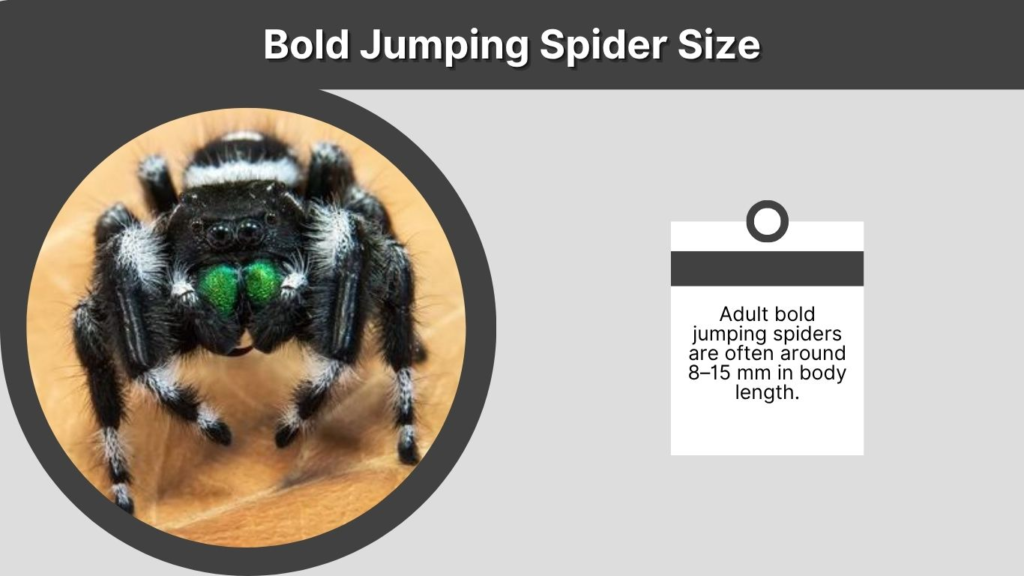
The bold jumping spider, also called the daring jumping spider, is one of the most familiar species in North America. It is usually black with white, yellow, or orange abdominal spots and shiny green or blue mouthparts.
Adult bold jumping spiders are often around 8–15 mm in body length. Females are usually larger and rounder, while males may look slimmer with longer front legs. Young bold jumpers may start with orange markings that become white as they mature.
Important size details:
- Females are commonly larger than males.
- Full-grown adults are often about the size of a small fingernail.
- Large females may look bulky because of a rounded abdomen.
- Young spiders can be much smaller and may be mistaken for another species.
- Feeding condition affects abdomen width more than true body length.
Bold jumpers are often confused with regal jumping spiders because both can have dark bodies, pale spots, and bright chelicerae. Size can help, but location, markings, and body shape are also important.
Regal Jumping Spider Size
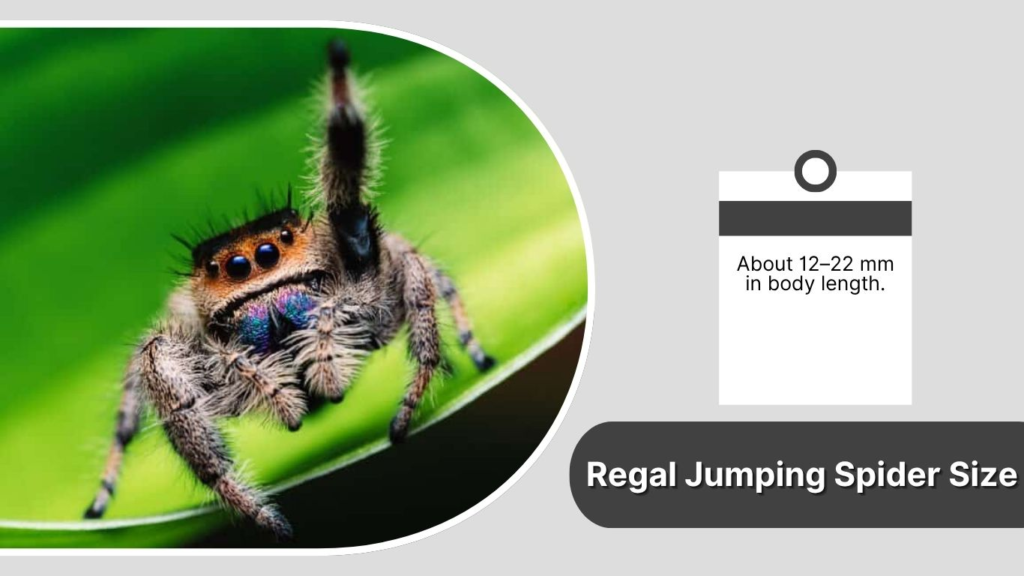
The regal jumping spider is one of the largest and most popular jumping spiders. It is especially common in Florida and nearby regions. Because of its size, color, and bold personality, it is also one of the most common pet jumping spiders.
Adult female regal jumping spiders can reach about 12–22 mm in body length. Males are usually smaller, often around 6–13 mm. This difference between male and female size is one reason young regal spiders can be hard to sex before maturity.
Regal jumping spiders often look bigger than bold jumpers because large females have a heavy body and thick legs. Females may be gray, orange, tan, or white, while males are often black and white with bright green or blue mouthparts.
For keepers, regal jumping spider size matters because larger individuals need more room to climb, hunt, and build silk retreats. A tiny sling does not need a large enclosure right away, but an adult female should have enough vertical space to explore safely.
Zebra, Tan, and Other Common Species
Not all jumping spiders are large. Many common species are small enough to live on walls, fences, bark, windows, garden plants, and outdoor furniture. Their size helps them hide, stalk tiny insects, and move quickly across rough surfaces.
Zebra jumping spiders are usually about 5–8 mm long. They are black and white, active in sunlight, and often seen on walls or window frames. Their small size makes them easy to overlook unless they move.
Tan jumping spiders are usually larger than zebra jumpers. Females may reach about 10–13 mm, while males are often around 8.5–9.5 mm. Their flattened body helps them hide on bark, fences, and walls.
Other species can be smaller or larger:
- Twin-flagged jumping spiders are tiny and often only a few millimeters long.
- Bronze jumping spiders are usually small to medium-sized.
- Emerald jumping spiders are colorful and medium-sized.
- Gray wall jumpers are often medium-sized and commonly found on buildings.
- Peacock jumping spiders are famous for color, not large size.
When identifying a jumping spider, size is helpful but not enough. Color pattern, eye arrangement, location, body shape, and behavior should also be considered.
Baby and Juvenile Jumping Spider Size
Baby jumping spiders are called spiderlings. They hatch from an egg sac and remain very small during their early life. Many newly emerged spiderlings are only about 1–2 mm long, depending on species.
As they grow, they pass through stages called instars. Each instar happens after a molt, when the spider sheds its old outer skin. Keepers often use terms like i4, i5, i6, or i7 to describe juvenile stages.
General growth stages:
- New spiderlings: tiny, delicate, and hard to see
- Early instars: usually 1–3 mm
- Middle instars: more visible, often 3–7 mm
- Later instars: stronger body shape and clearer markings
- Subadult stage: nearly adult size but not fully mature
- Adult stage: final size after the last molt
A jumping spider does not grow slowly like a mammal. It grows in steps. After each molt, the body becomes slightly larger, softer for a short time, and then hardens again.
Feeding also affects appearance. A young spider with a full abdomen may look bigger than a slightly older spider that has not eaten recently. For this reason, abdomen size should not be used alone to judge age.
Full-Grown Jumping Spider Size Comparison
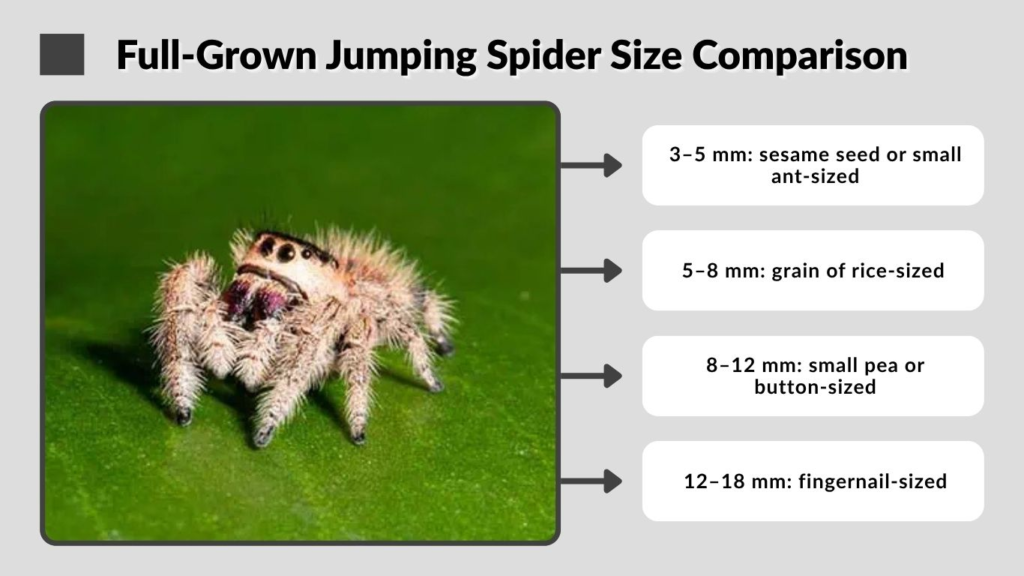
A full-grown jumping spider can be compared with everyday objects. This helps readers understand real size better than numbers alone.
A small zebra jumper may be about the size of a grain of rice. A medium tan jumper may look like a small button. A large regal female may look close to the size of a fingernail or small coin when the legs are spread.
Simple comparisons:
- 3–5 mm: sesame seed or small ant-sized
- 5–8 mm: grain of rice-sized
- 8–12 mm: small pea or button-sized
- 12–18 mm: fingernail-sized
- 18–22 mm: large fingernail or small coin impression
The phrase “dog-sized jumping spider” is not realistic. Jumping spiders are small arachnids. Even the largest common pet species remain tiny compared with tarantulas, wolf spiders, or large orb-weavers.
Jumping Spider Enclosure Size
Enclosure size depends on the spider’s body size, age, and species. Jumping spiders are active hunters and prefer vertical space because they climb, watch prey, and build silk retreats near the top.
A small spiderling should not be placed in a huge enclosure. It may struggle to find food, and the keeper may struggle to monitor it. A larger adult needs more room but still does not need a giant tank.
Good enclosure guidelines:
- Tiny spiderlings: small deli cup or sling enclosure
- Juveniles: compact enclosure with safe climbing surfaces
- Adult small species: around 2 x 2 x 3 inches or similar
- Adult medium species: around 4 x 4 x 6 inches
- Adult large females: around 6 x 6 x 8 inches or similar
- Always choose more height than floor space
The enclosure should have ventilation, secure openings, anchor points, and a safe top area for web retreats. Avoid large gaps because small spiders can escape easily. Also avoid sharp decorations, sticky traps, and deep open water dishes.
Does Size Affect Feeding?
Jumping spider size directly affects feeding. A small spider needs tiny prey, while a large adult can handle larger insects. Prey should never be much bigger than the spider’s body, especially for young or freshly molted spiders.
Good feeding rules:
- Offer prey close to the spider’s body size or smaller.
- Use fruit flies for tiny spiderlings.
- Use small flies, pinhead crickets, or tiny roaches for juveniles.
- Use house flies, small crickets, or small roaches for adults.
- Remove uneaten prey if the spider is not interested.
- Do not feed during or right after molting.
A spider with a very round abdomen may not need food right away. A spider with a thin, shrunken abdomen may need hydration and a suitable meal. Size, age, and abdomen shape should be considered together.
Male vs Female Jumping Spider Size
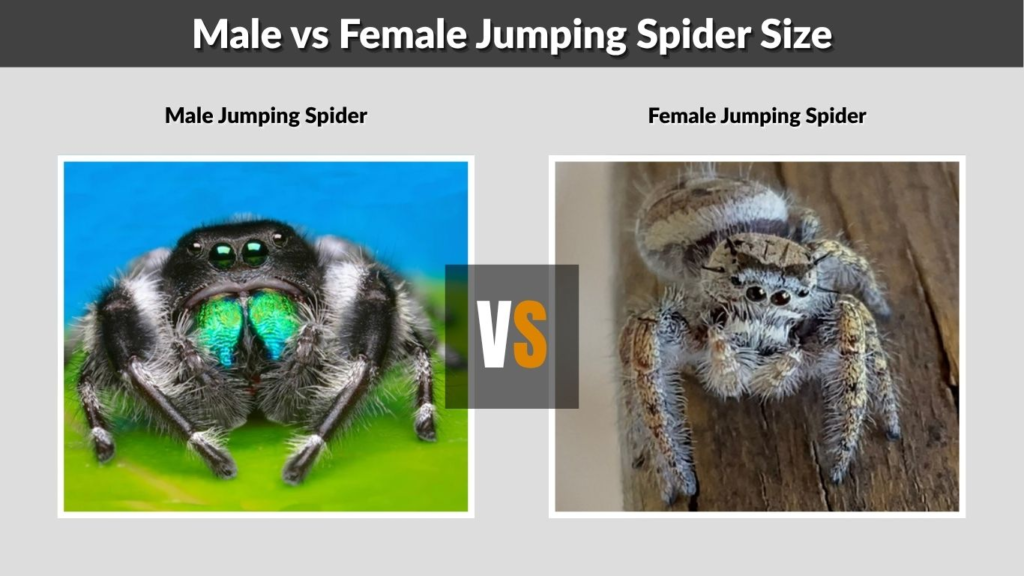
Female jumping spiders are often larger, heavier, and rounder than males. This is especially noticeable in regal jumping spiders, where mature females can be much larger than mature males.
Males may be smaller but more active. They often wander more because they search for females. Their front legs may look longer, and their body may appear slimmer. In some species, males also have stronger color contrast or more dramatic facial features.
Females may:
- Have a larger abdomen
- Look heavier after feeding
- Grow larger before maturity
- Live longer in captivity
- Spend more time near retreats
Males may:
- Be slimmer
- Move more often
- Mature at a smaller size
- Have longer-looking front legs
- Show stronger courtship behavior
Size alone does not always confirm sex. A young female may look like a male, and a well-fed male may look larger than expected. Mature body features are more reliable.
Why Jumping Spider Size Can Look Different
The same jumping spider may appear different in size from one day to another. This usually happens because of posture, feeding, lighting, and the way the spider holds its legs.
A spider with spread legs looks larger than one sitting compactly. A spider on a fingertip may look huge in a close-up photo, but the same spider may look tiny on a wall. Camera zoom can make size confusing.
Common reasons size looks different:
- The abdomen becomes round after feeding.
- The abdomen shrinks before the next meal.
- Females may swell before laying eggs.
- Young spiders look bigger after each molt.
- Close-up photos exaggerate body size.
- Leg spread makes the total size look larger than body length.
For accurate measurement, use body length from the front of the cephalothorax to the end of the abdomen. Do not include the legs unless you clearly say “leg span.”
FAQs
How big do jumping spiders get?
Most jumping spiders stay between 4 and 18 mm in body length. Some large species, especially female regal jumping spiders, can reach around 20 mm or slightly more. Smaller species may be only a few millimeters long, even as adults.
What is the average jumping spider size?
The average jumping spider is usually around 6–12 mm long. Small wall-dwelling species may be closer to 5 mm, while larger Phidippus species are often over 10 mm. Females usually appear larger because they have wider, rounder bodies.
How big is a full-grown regal jumping spider?
A full-grown female regal jumping spider can reach about 12–22 mm in body length. Adult males are usually smaller, often around 6–13 mm. Large females may look close to fingernail-sized, especially when their legs are spread.
What size enclosure does a jumping spider need?
A small sling needs a small enclosure so it can find food easily. Adult jumping spiders usually do well in vertical enclosures around 4 x 4 x 6 inches, while large females may use something closer to 6 x 6 x 8 inches.
Are bigger jumping spiders dangerous?
Bigger jumping spiders are not considered dangerous to people. They may bite if squeezed or handled roughly, but most bites are mild. Their size mainly affects prey choice, enclosure size, and visibility, not serious risk to humans.
