
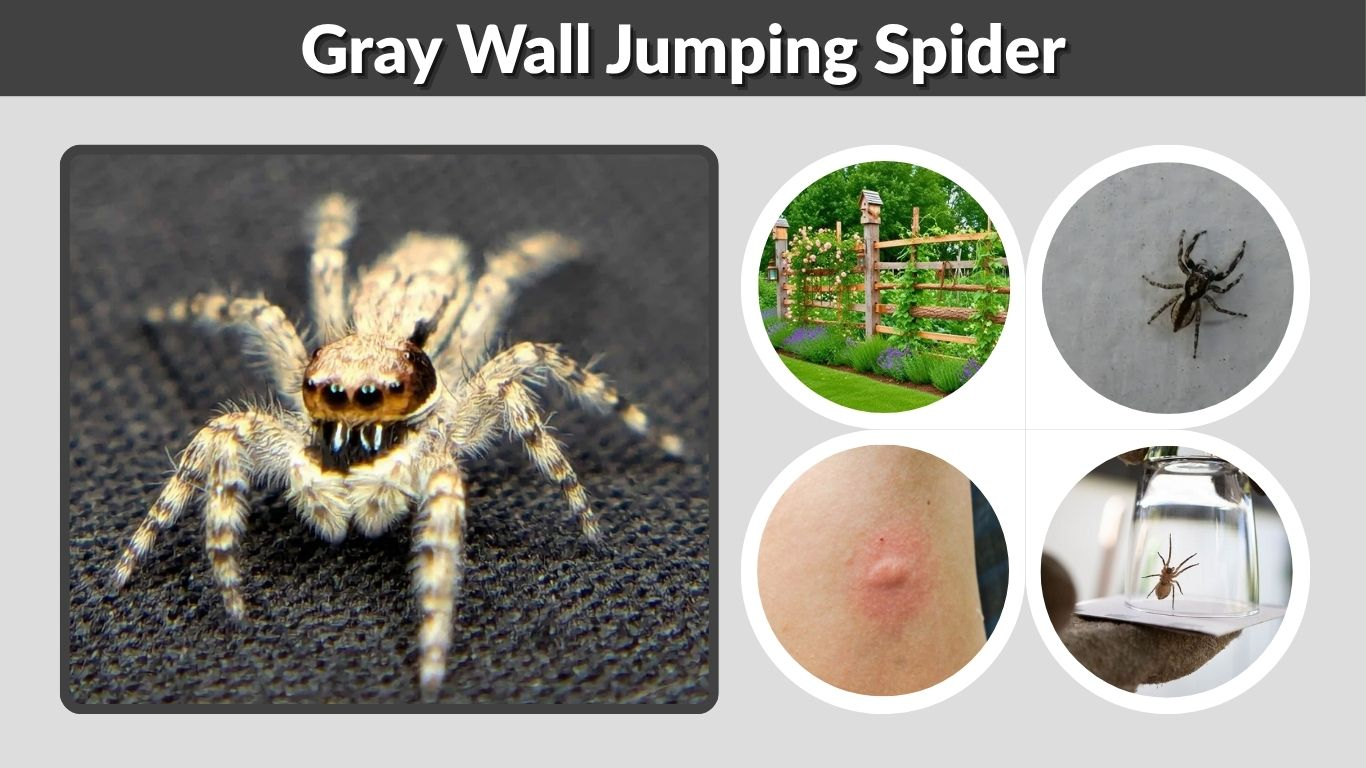
The gray wall jumping spider is a small, fast, and alert spider often seen on walls, fences, windows, and outdoor buildings. Also called the gray wall jumper, this spider is not dangerous to humans and usually helps control small insects. Its flat body, gray color, quick jumps, and large front eyes make it one of the easiest jumping spiders to recognize.
What Is a Gray Wall Jumping Spider?
The gray wall jumping spider is a member of the jumping spider family, Salticidae. Its scientific name is Menemerus bivittatus. This species is commonly seen in warm areas and often lives close to people, especially around houses, walls, patios, fences, and garden structures.
Unlike web-building spiders, the gray wall jumper does not sit in a large web waiting for prey. It actively hunts. It watches insects with excellent vision, slowly moves closer, and then jumps quickly to catch them. This hunting style makes it useful around homes because it feeds on flies, mosquitoes, moths, and other small insects.
Quick Facts About Gray Wall Jumping Spider
| Feature | Details |
| Common name | Gray wall jumping spider, gray wall jumper |
| Scientific name | Menemerus bivittatus |
| Family | Salticidae |
| Average size | Around 8–12 mm |
| Color | Gray, white, brown, black, or striped |
| Habitat | Walls, fences, tree trunks, buildings, windows |
| Diet | Small flies, moths, mosquitoes, and other insects |
| Danger level | Not dangerous to humans |
| Web use | Does not build a prey-catching web |
| Activity | Active hunter during the day |
Why It Is Called a Wall Jumper
This spider gets its common name because it is often found moving across walls. Its flattened body helps it stay close to flat surfaces, while its strong legs allow it to jump from one spot to another. You may see it pause, turn its body, watch movement, and then leap suddenly toward prey.
It is especially common near outdoor lights because insects gather there at night. The spider uses those insect-rich areas as hunting grounds.
Gray Wall Jumping Spider Identification
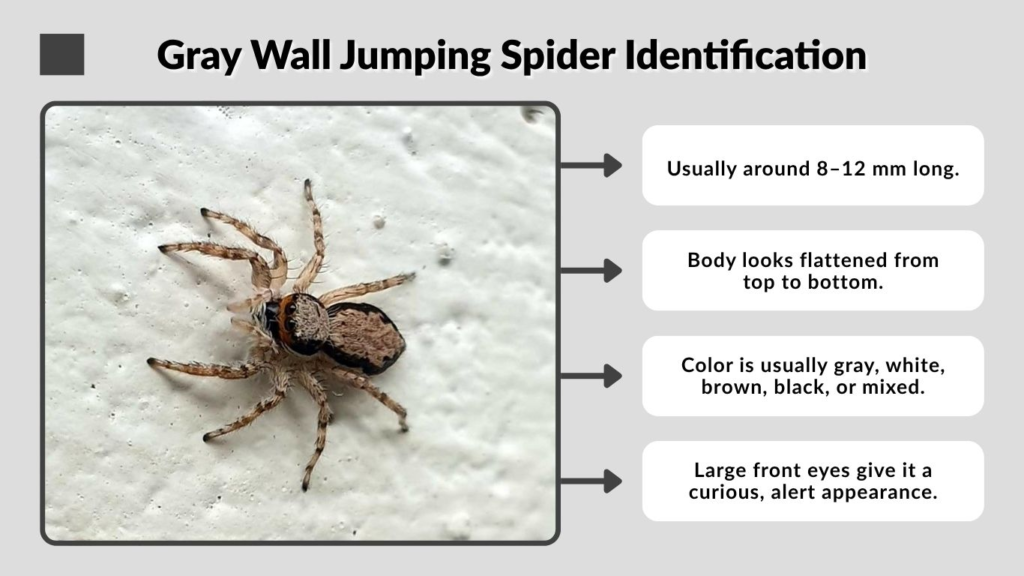
Identifying a gray wall jumping spider is easier if you look at its body shape, eye pattern, color, and movement. It looks compact, flat, and hairy, with large forward-facing eyes. Its quick stop-and-go walking style is also a strong clue.
Identification
- Small to medium-sized jumping spider, usually around 8–12 mm long.
- Body looks flattened from top to bottom.
- Color is usually gray, white, brown, black, or mixed.
- Large front eyes give it a curious, alert appearance.
- Legs may show light and dark banding.
- Moves in short bursts instead of crawling smoothly.
- Often turns to look directly at movement.
- Commonly seen on walls, fences, windows, and tree trunks.
- Does not make a large web to catch prey.
- Usually active during daylight.
Male Appearance
Male gray wall jumpers are usually darker and more strongly patterned than females. They often have a dark stripe running along the body, with pale or whitish stripes on the sides. The male may also look slightly slimmer.
The dark-and-light contrast can make males look sharper and more dramatic. Their face area may appear darker, and the legs often show stronger banding. If you see a small, flat spider with bold markings on a wall, it may be a male gray wall jumper.
Female Appearance
Female gray wall jumping spiders are usually paler and more brownish-gray than males. Their bodies may look broader, especially around the abdomen. The pattern is often softer, with less contrast than the male.
Females may have light edging on the body and darker side markings. Young spiders often look more like females, so it can be difficult to separate immature spiders from adult females without close observation.
Gray Wall Jumping Spider Male vs Female
Male and female gray wall jumpers can look different in color, body size, and pattern. These differences are useful for identification, but lighting, age, and body condition can also affect how the spider appears.
Main Differences
- Males are often slightly smaller than females.
- Males usually have stronger black-and-white contrast.
- Females are often paler, brownish, or grayish.
- Females may have a fuller abdomen.
- Males may look slimmer and more sharply marked.
- Young spiders often resemble females.
- Females may be seen guarding egg sacs in hidden cracks.
- Males may move more actively while searching for mates.
Size Difference
The gray wall jumping spider is not large. Most adults are less than half an inch long. Females are often a little larger and fuller-bodied, while males are usually slightly smaller and slimmer.
Because they are small, people may confuse them with baby spiders or other wall spiders. However, the large front eyes, quick jumps, and flat body help separate them from many common house spiders.
Color and Pattern Difference
Male gray wall jumpers usually show darker markings. Their bodies may have black, white, gray, and brown patterns that form stripes or bands. Females are usually lighter and less bold.
This color difference is one reason people sometimes think they are seeing two different spider species. In reality, the male and female of the same species can look noticeably different.
Gray Wall Jumping Spider Bite
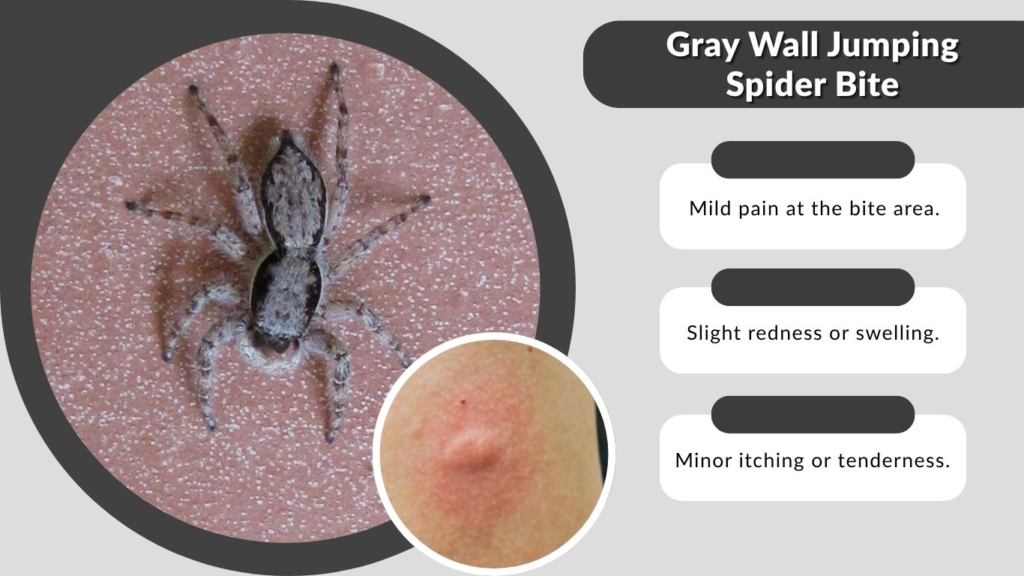
The gray wall jumping spider can bite, but bites are rare. It is not aggressive toward humans and usually tries to escape when disturbed. Most bites happen only when the spider is trapped against the skin, squeezed, or roughly handled.
Is the Bite Dangerous?
A gray wall jumping spider bite is not considered dangerous to healthy adults. Like most spiders, it has venom for catching prey, but its venom is not medically significant to humans. A bite may feel like a small pinch or mild bee-sting-like irritation.
Possible bite reactions may include:
- Mild pain at the bite area.
- Slight redness or swelling.
- Minor itching or tenderness.
- A small raised bump.
- Temporary irritation that improves naturally.
Serious reactions are unusual. However, anyone who develops strong swelling, spreading redness, fever, dizziness, breathing trouble, or signs of infection should contact a medical professional.
Why Bites Happen
This spider does not chase people or bite without reason. It depends on speed, vision, and jumping ability to hunt insects, not people. Bites are usually defensive.
A bite may happen if someone presses the spider between fingers, clothing, towels, shoes, or bedding. The best approach is to gently move the spider outside using a cup and paper instead of touching it directly.
What to Do After a Bite
If a bite happens, wash the area with soap and water. Apply a cold compress to reduce mild swelling. Avoid scratching the bite, because scratching can irritate the skin and increase the chance of infection.
Most mild bites improve without special treatment. If symptoms become severe or do not improve, seek medical advice.
Is the Gray Wall Jumping Spider Poisonous?
Many people use the word “poisonous” when asking about spiders, but “venomous” is the more accurate word. Spiders use venom to subdue prey through a bite. Poison is usually harmful when eaten or touched.
The gray wall jumping spider is venomous in the basic spider sense, but it is not dangerous to people. Its venom is meant for tiny insects, not humans. It should not be treated like a harmful house pest.
Safe Around Homes
Gray wall jumpers are usually beneficial. They eat small insects that land on walls, windows, and lights. Instead of destroying them, many homeowners simply leave them alone or move them outside.
They do not damage wood, clothing, food, or furniture. They also do not create messy web networks like some cobweb spiders. Their presence usually means there are small insects nearby.
Safe Around Pets
A gray wall jumping spider is unlikely to harm cats or dogs. Most pets ignore them, though curious pets may try to paw at or eat them. If a pet shows unusual swelling, drooling, vomiting, or discomfort after contact with any spider, it is safer to call a vet.
For normal household encounters, this spider is not a major pet danger.
Gray Wall Jumping Spider Habitat and Distribution
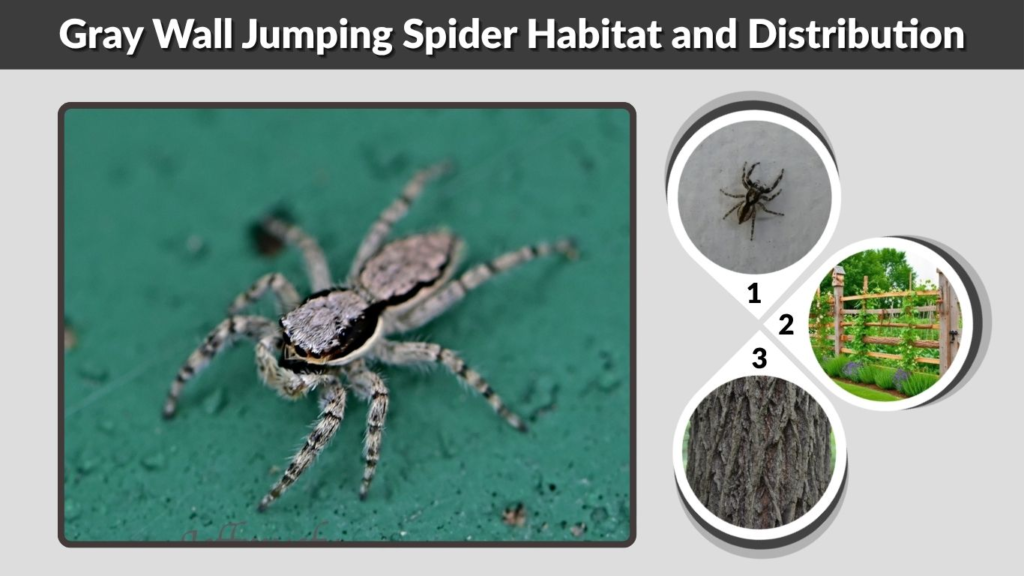
The gray wall jumping spider prefers warm places and is often connected with human-made structures. It is commonly found on outside walls, fences, window frames, garden walls, and tree trunks. It likes flat surfaces where it can run, watch insects, and jump quickly.
Where It Lives
This spider often appears in:
- House walls and exterior siding.
- Garden fences and wooden posts.
- Window frames and door frames.
- Tree trunks and rough bark.
- Stone walls and brick surfaces.
- Patios, garages, sheds, and porches.
- Areas near outdoor lights.
- Warm urban and suburban environments.
In the United States, it is often reported in warmer southern regions, including places such as Florida and Texas. It is also found in many tropical and subtropical parts of the world.
Why It Likes Buildings
Buildings attract insects, especially around porch lights, windows, and warm surfaces. The gray wall jumper follows that food source. Walls also provide good hunting space because insects are easier to see and catch on flat surfaces.
Cracks and gaps in walls, bark, and outdoor structures also give females hidden places to make egg sacs.
Gray Wall Jumping Spider Behavior and Diet
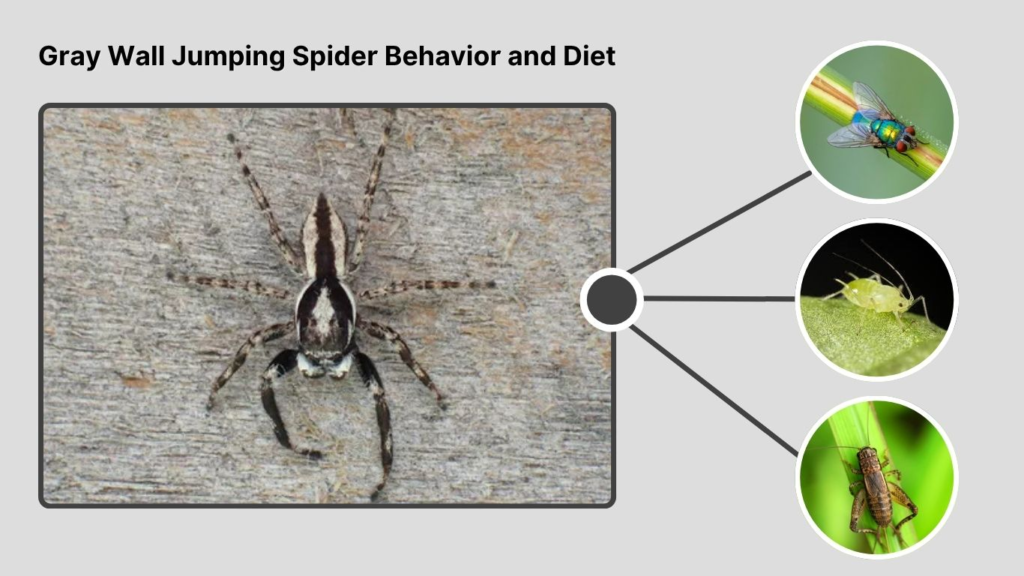
The gray wall jumping spider is a daytime hunter with excellent eyesight. Instead of using a web to trap food, it relies on stalking, aiming, and jumping. Its behavior can look intelligent because it often watches objects and changes direction carefully.
Hunting Style
When hunting, the spider usually pauses and studies its target. Then it slowly moves closer. Once it is within range, it jumps and grabs the prey. Before jumping, it may attach a silk safety line to the surface. This helps protect it if the jump fails.
This spider can catch small flying insects that land on walls. It may also hunt insects near lights, windows, and doorways.
Common Food
The gray wall jumping spider eats small arthropods, especially insects. Its diet may include flies, mosquitoes, moths, small beetles, gnats, and other tiny insects. It is not a plant pest and does not feed on household materials.
Because it feeds on insects, it can be considered a natural pest helper around homes and gardens.
Gray Wall Jumping Spider Life Cycle and Reproduction
Like other spiders, the gray wall jumping spider starts life as an egg, hatches as a tiny spiderling, grows through molts, and becomes an adult. Its life cycle depends on temperature, food, shelter, and season.
Egg Sac and Spiderlings
Female gray wall jumpers place egg sacs in protected areas such as cracks, crevices, or hidden corners. The sac is made of silk and keeps the eggs safer from weather and predators.
After hatching, spiderlings remain small and vulnerable. They eventually disperse to find food and shelter. Young spiders look similar to females but are much smaller and less developed.
Growth and Molting
As spiderlings grow, they shed their outer skin several times. This process is called molting. After each molt, the spider becomes larger and more developed. Once mature, males and females begin searching for mates.
Jumping spiders depend heavily on vision during mating. Males may use body movements, leg signals, or display behavior to approach females.
Gray Wall Jumper in Florida, Texas, and South Africa
The keyword “gray wall jumping spider” is often searched with locations such as Florida, Texas, and South Africa. This makes sense because the spider prefers warmer regions and is commonly seen around buildings in tropical or subtropical climates.
Florida
In Florida, gray wall jumpers are often seen on houses, walls, screens, and outdoor structures. Warm weather, insects, and lights make many Florida homes suitable for them. They may be noticed more often in spring, summer, and warm rainy periods.
Texas
In Texas, this spider may appear around walls, patios, garages, fences, and garden structures. It is more likely to be noticed in warm areas where insects gather. A Texas gray wall jumping spider is not a separate species; it is the same general gray wall jumper.
South Africa
The gray wall jumper is also associated with warm regions outside the United States, including parts of Africa. In South Africa, it may be found around buildings, walls, and tree trunks. Its habit of living near human structures makes it easy to notice.
How to Remove Gray Wall Jumping Spiders Safely
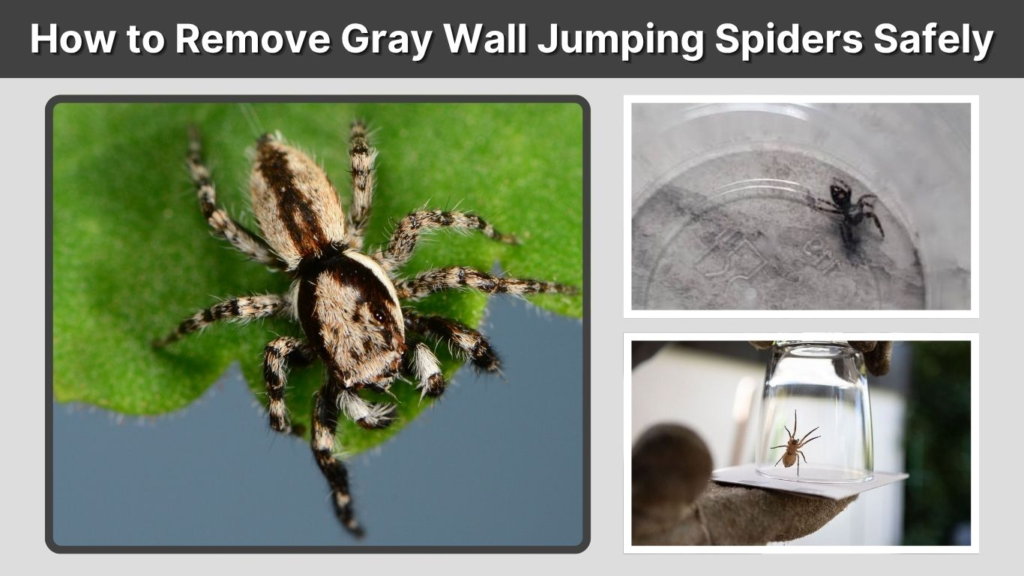
Most gray wall jumpers do not need to be killed. They are harmless, clean, and useful insect hunters. Still, some people prefer to remove spiders from indoor spaces.
Safe Removal Steps
- Place a cup or small container over the spider.
- Slide a piece of paper under the cup.
- Carry the spider outside.
- Release it on a wall, fence, shrub, or tree trunk.
- Avoid grabbing it with bare hands.
- Seal cracks if spiders keep entering rooms.
- Reduce insects around lights to make the area less attractive.
- Keep windows and door screens repaired.
Preventing Indoor Encounters
If gray wall jumpers keep coming indoors, check window gaps, door sweeps, screen holes, and wall cracks. Reducing indoor insects also helps, because spiders follow their food.
Outdoor lights can attract flying insects, which then attract spiders. Switching off unnecessary lights or using less insect-attractive bulbs may reduce activity near doors and windows.
FAQs
Are gray wall jumping spiders dangerous?
No, gray wall jumping spiders are not dangerous to humans. They are small hunting spiders that prefer insects, not people. A bite is possible if one is squeezed or handled roughly, but serious effects are very uncommon. Most encounters are harmless.
What does a gray wall jumping spider bite look like?
A bite may look like a tiny red bump with mild swelling or irritation. Some people may feel a small pinch or short-lasting soreness. If redness spreads, pain becomes severe, or infection signs appear, it is best to seek medical advice.
Are gray wall jumping spiders good to have around?
Yes, they can be helpful because they eat flies, mosquitoes, gnats, moths, and other small insects. They do not damage homes or build large messy webs. Many people leave them alone unless they move indoors.
How big is a gray wall jumping spider?
Most adult gray wall jumping spiders are around 8–12 mm long. Females are often slightly larger and fuller-bodied than males. Their flat shape and large front eyes can make them look more noticeable than their actual size.
How can I tell a male from a female gray wall jumper?
Males are usually darker, slimmer, and more strongly patterned with black-and-white contrast. Females are often paler, broader, and more brownish-gray. Young spiders may resemble females, so small or immature spiders can be harder to identify.
