
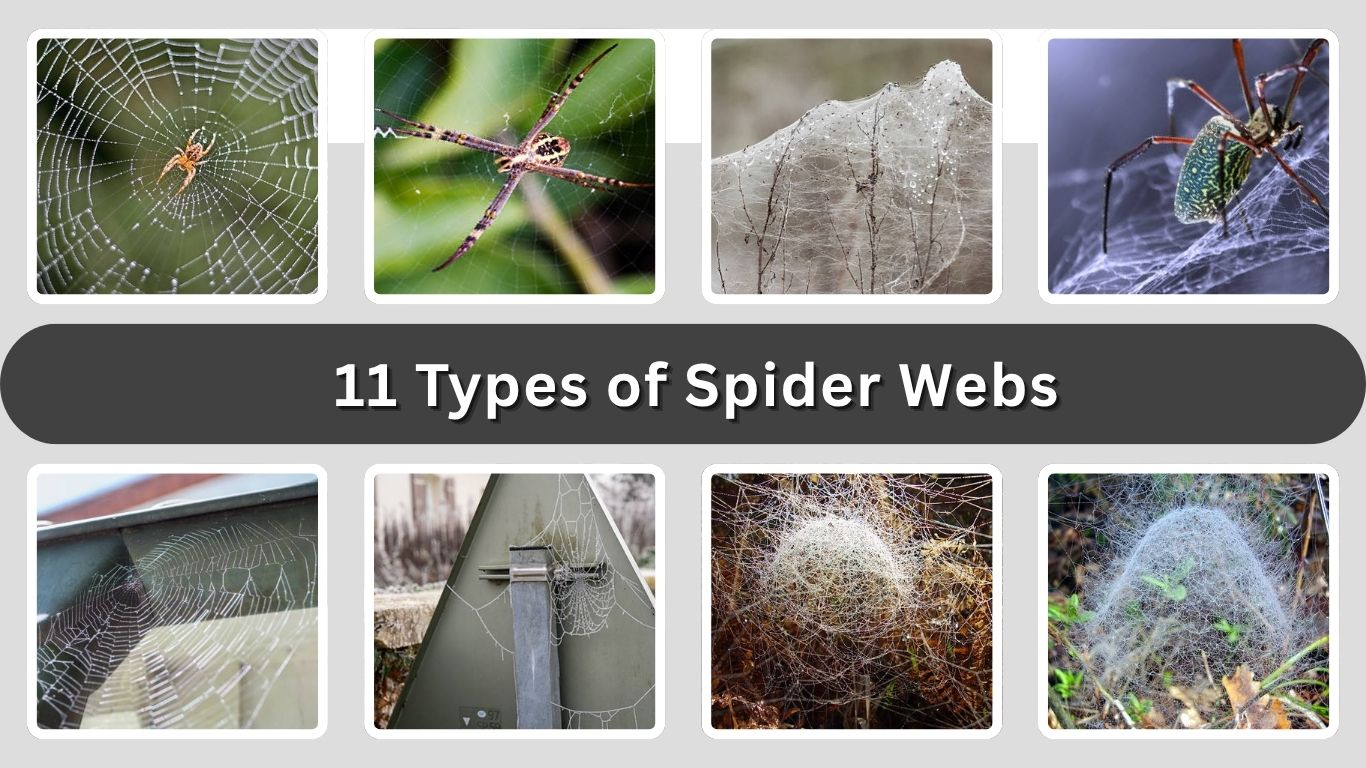
Spider webs are incredible examples of natural engineering, each designed for a specific purpose and hunting style. From the classic circular orb web to unique structures like the bolas and funnel web, spiders use silk in many creative ways to capture prey and survive. These webs vary in shape, complexity, and function depending on the species and environment. In this guide, you’ll explore 11 different types of spider webs and understand how each one works in nature.
1. Orb Web

The orb web is one of the most recognizable and commonly seen types of spider webs in the world. It is the classic circular web that people often associate with spiders, especially in gardens, forests, and open spaces. Built mainly by orb-weaver spiders, this web is a highly efficient structure designed to catch flying insects. Its symmetrical design not only looks beautiful but also plays a crucial role in the spider’s survival.
Structure
An orb web is shaped like a wheel, with spokes radiating outward from the center and spiral threads connecting them. The outer frame provides support, while the radial lines act as the foundation. The spiral threads are coated with sticky silk, which helps trap insects when they collide with the web. The center, known as the hub, is where the spider typically waits or monitors vibrations.
Function
The primary purpose of the orb web is to catch flying prey such as flies, mosquitoes, and moths. When an insect hits the sticky spiral threads, it becomes entangled. The spider quickly senses the vibrations and moves toward the prey to immobilize it with silk before feeding. This design allows the spider to capture prey efficiently with minimal energy use.
Behavior
Orb-weaver spiders often rebuild their webs daily, especially if the web becomes damaged or loses its stickiness. Many species construct their webs at night and take them down in the morning to avoid predators and conserve silk. Others remain in the center of the web or hide nearby, connected by a signal thread.
Importance
Orb webs play an important role in ecosystems by helping control insect populations. They are also considered a marvel of natural engineering due to their strength, flexibility, and intricate design. Despite their delicate appearance, these webs are highly effective tools for survival.
2. Sheet Web

The sheet web is a flat, horizontal web commonly built by small spiders in grasslands, gardens, and low vegetation. Unlike the circular orb web, this type of web forms a dense, sheet-like platform that helps spiders capture insects moving above or within the vegetation. It may look simple at first glance, but it is an effective and strategic trap designed for ground-level hunting.
Identification
- Flat, horizontal sheet of silk
- Often slightly curved or bowl-shaped
- Fine, dense weaving
- Supported by multiple anchor threads
- May have tangled threads above the sheet
Structure
A sheet web typically consists of a tightly woven horizontal layer of silk that acts as the main catching surface. Above this sheet, many species build a loose tangle of threads. These upper threads help disrupt flying or jumping insects, causing them to fall onto the sheet below. The spider usually stays underneath the sheet, hidden from view.
Function
The web works by intercepting insects that either fall from above or jump into it. When an insect lands on the sheet, it becomes trapped or slowed down, allowing the spider to quickly attack from below. This method is especially effective for catching small flying insects and those that move through grass.
Behavior
Sheet web spiders are generally passive hunters. They remain under the web and wait for vibrations that signal trapped prey. Once detected, the spider rushes upward or bites through the silk from below to capture its meal. These spiders often remain in the same web for extended periods if it continues to be effective.
Importance
Sheet webs play a key role in controlling insect populations in grassy and garden environments. They are especially valuable in ecosystems where small flying insects are abundant, helping maintain a natural balance without posing any risk to humans.
3. Funnel Web

The funnel web is a distinctive type of spider web known for its tunnel-like structure that leads into a hidden retreat. It is commonly built by ground-dwelling spiders in moist environments such as gardens, forests, and grassy areas. This web is designed more for sensing and ambushing prey rather than trapping it with sticky silk.
Identification
- Funnel-shaped entrance leading into a silk tube
- Flat sheet of silk extending outward
- Non-sticky silk structure
- Often built close to the ground
- Connected to a hidden burrow or retreat
Structure
A funnel web consists of a wide, flat sheet that narrows into a tubular funnel. The funnel leads into a silk-lined burrow or crevice where the spider stays hidden. The sheet acts as a detection surface, transmitting vibrations when prey walks across it.
Function
Unlike sticky webs, the funnel web relies on speed and sensitivity. When an insect walks over the silk sheet, vibrations alert the spider. It quickly rushes out from the funnel, captures the prey, and drags it back inside its retreat. This method allows efficient hunting without the need for sticky threads.
Behavior
Funnel web spiders are ambush predators. They spend most of their time inside the funnel, waiting for prey. These spiders rarely leave their web unless disturbed. The web is usually maintained and repaired regularly to ensure effective vibration detection.
Importance
Funnel webs are highly effective for catching ground-dwelling insects and play an important role in pest control. Although some species associated with this web type can be dangerous, the web itself is a remarkable example of adaptation for stealth and rapid attack.
4. Tangle Web

The tangle web, also known as a cobweb, is an irregular and messy-looking web commonly found in corners of buildings, under furniture, and in sheltered outdoor spaces. Despite its chaotic appearance, it is a highly effective trap used by many small spiders, especially those in the comb-footed spider family.
Identification
- Irregular, tangled silk threads
- No clear pattern or symmetry
- Sticky strands in multiple directions
- Often found in corners or hidden spaces
- Appears messy or disorganized
Structure
A tangle web is made up of randomly arranged silk threads that form a three-dimensional network. It usually includes sticky vertical strands that extend downward. These threads are designed to snag insects as they move through the area. The spider typically stays hidden in a small retreat within the web.
Function
The web works by trapping insects that accidentally walk into or brush against the sticky threads. Some strands are designed to break easily, causing the insect to become entangled and suspended. The spider then approaches and wraps the prey in silk before feeding.
Behavior
Spiders that build tangle webs are usually stationary and rely on their web rather than active hunting. They remain in their retreat and respond quickly to vibrations caused by trapped prey. These spiders often maintain and expand their webs over time instead of rebuilding them completely.
Importance
Tangle webs are highly effective in indoor and sheltered environments, helping control insects such as flies and ants. Although they may look untidy, they are a natural and useful method of pest control.
5. Tube Web

The tube web is a specialized web structure built by certain spiders that prefer to live within narrow shelters. This web is designed more as a protective retreat than a traditional trapping system, allowing the spider to remain hidden while still being able to detect and capture nearby prey. It is commonly found in cracks, crevices, tree bark, and even walls of buildings.
Identification
- Silk-lined tube or tunnel structure
- Built inside cracks, holes, or crevices
- Non-sticky silk
- Often partially hidden from view
- May have radiating signal threads outside
Structure
A tube web consists of a cylindrical silk retreat where the spider lives. The inside of the tube is smooth and lined with silk, while the outer part may connect to surrounding surfaces with fine threads. Some species extend signal lines from the tube to detect movement outside.
Function
The primary purpose of the tube web is protection and ambush. The spider remains safely inside the tube and waits for vibrations from passing prey. When an insect touches nearby threads or moves close to the entrance, the spider quickly emerges to capture it and retreat back inside.
Behavior
Tube web spiders are mostly nocturnal and prefer to stay hidden during the day. They rely on stealth rather than speed or sticky silk. These spiders rarely leave their tube unless necessary, making them difficult to spot.
Importance
Tube webs provide both shelter and an effective hunting strategy. They help spiders survive in exposed environments while still allowing them to catch prey efficiently. These webs also contribute to natural insect control in both urban and natural habitats.
6. Triangle Web

The triangle web is a unique and less common type of spider web known for its distinctive triangular shape. It is built by a small group of spiders that use a clever hunting technique involving tension and release. This web may appear simple, but it is highly effective for capturing fast-moving insects.
Identification
- Triangular-shaped web
- Three main anchor points
- Few radial threads
- Non-sticky or lightly sticky silk
- Often held under tension by the spider
Structure
The triangle web is formed by connecting silk threads between three نقاط, creating a flat triangular frame. Unlike orb webs, it has very few strands and lacks a spiral pattern. The spider usually holds one corner of the web, keeping it under tension like a stretched net.
Function
Instead of relying on sticky silk, the triangle web works through tension. When an insect touches the web, the spider releases the tension, causing the web to snap forward and entangle the prey. This sudden movement helps trap insects that might otherwise escape from a traditional web.
Behavior
Triangle web spiders actively control their web rather than passively waiting. They remain attached to one corner and adjust the tension as needed. When prey is detected, they quickly release and then secure the insect with silk. This method allows efficient hunting with minimal silk use.
Importance
Triangle webs demonstrate an advanced hunting strategy that combines simplicity with effectiveness. They help control small flying insects and highlight the diversity of spider web designs in nature.
7. Dome Web

The dome web is a three-dimensional web structure shaped like a dome or canopy. It is commonly found in low vegetation, shrubs, and grassy areas. This web provides both a trapping surface and a protective shelter for the spider, making it an effective design for survival in open environments.
Identification
- Dome or canopy-shaped web
- Curved, tent-like structure
- Fine, closely woven silk
- Often built above a sheet-like base
- Spider usually found beneath the dome
Structure
A dome web consists of a curved upper layer of silk forming a canopy, often paired with a flat sheet below. The dome acts as a barrier that intercepts insects, while the sheet provides a surface where prey may fall. The spider typically stays underneath the structure, protected and hidden.
Function
The web works by catching insects that fly or jump into the dome. When they hit the upper threads, they are deflected downward onto the sheet below. The spider senses vibrations and quickly moves to capture the prey. This dual-layer design increases the chances of trapping insects.
Behavior
Dome web spiders are mostly passive hunters. They remain under the dome, waiting for prey to land on the web. They rely on vibrations to detect movement and respond quickly. These spiders may repair their webs regularly to maintain effectiveness.
Importance
Dome webs are highly efficient in catching small flying insects and provide excellent protection for the spider. They play an important role in maintaining ecological balance by reducing insect populations in grassy and garden environments.
8. Mesh Web

The mesh web is an irregular, net-like structure built by certain spiders to trap insects in a loose but effective silk network. It is commonly found in vegetation, tree branches, and sometimes around buildings. Although it may appear unorganized, this web is designed to intercept insects from multiple directions.
Identification
- Irregular, net-like pattern
- No clear central hub
- Threads spread in multiple directions
- Moderate density of silk
- Often stretched between plants or structures
Structure
A mesh web consists of interconnected silk strands forming a loose network. Unlike orb webs, it does not have a symmetrical shape. The web may vary in size and density depending on the environment and the spider species. The spider usually stays hidden nearby rather than in the center.
Function
The web works by creating a barrier that insects accidentally fly or crawl into. Once trapped or slowed by the silk, the spider detects vibrations and moves in to secure the prey. The design allows for trapping insects without the need for a highly structured web.
Behavior
Mesh web spiders are generally passive hunters. They rely on their web to catch prey and often remain concealed nearby. These spiders may repair or adjust parts of the web rather than rebuilding it entirely.
Importance
Mesh webs help control a wide range of insects, especially in natural environments. Their flexible design allows spiders to adapt to different spaces, making them effective predators in both wild and urban settings.
9. Dome Web

The retreat web is a protective silk structure built primarily as a shelter rather than a prey-catching device. Many spiders use this type of web as a safe hiding place where they can rest, molt, or guard their eggs. It is often connected to other web types or nearby hunting areas.
Identification
- Dense silk retreat or hiding chamber
- Usually tucked in corners, leaves, or crevices
- Non-sticky silk
- Often connected to nearby threads or webs
- Small and well-hidden structure
Structure
A retreat web is typically a compact, tube-like or irregular silk shelter. It may be built within leaves, under bark, or in cracks and corners. While it does not function as a primary trap, it is often connected to signal threads or nearby web structures that help the spider detect prey.
Function
The main function of a retreat web is protection. It provides a safe place for the spider to stay hidden from predators and environmental threats. Some spiders also use it as a base, venturing out to hunt and returning to the retreat afterward.
Behavior
Spiders using retreat webs are usually cautious and secretive. They spend most of their time inside the shelter and only come out when necessary, such as to hunt or repair nearby silk lines. The retreat also serves as a secure place for laying eggs.
Importance
Retreat webs play a vital role in spider survival by offering safety and stability. While not directly used for capturing prey, they support hunting strategies and help spiders thrive in both natural and human-made environments.
10. Cobweb

The cobweb is a type of irregular, tangled web commonly found in homes, corners, and sheltered outdoor areas. It is often associated with abandoned or dusty spaces, but in reality, many cobwebs are active traps built by spiders to catch prey efficiently. This web is especially common among house-dwelling spiders.
Identification
- Messy, tangled appearance
- No defined shape or symmetry
- Sticky silk strands
- Found in corners, ceilings, and undisturbed areas
- Often dusty when old or unused
Structure
Cobwebs consist of loosely arranged silk threads forming a three-dimensional network. Some strands are sticky and extend downward, designed to catch insects moving along surfaces. The spider usually stays hidden in a corner or within a small retreat connected to the web.
Function
The web works by trapping insects that come into contact with the sticky threads. Some strands may break easily, causing the insect to become entangled and suspended. The spider senses vibrations and quickly approaches to wrap and immobilize the prey.
Behavior
Cobweb-building spiders are generally passive hunters. They remain near or within their web and wait for prey to become trapped. These spiders may maintain the same web for long periods, repairing and expanding it as needed rather than rebuilding it entirely.
Importance
Cobwebs play an important role in controlling indoor insect populations such as flies, mosquitoes, and ants. While they may appear untidy, they are a natural and effective method of pest control in both homes and outdoor environments.
11. Bolas Web

The bolas web is a highly specialized and unusual type of web used by certain spiders that hunt in a very different way compared to typical web-builders. Instead of constructing a full web, these spiders create a single silk line with a sticky droplet at the end, resembling a “bola” (a hunting tool made of weights on cords). This unique method allows them to target specific prey with precision.
Identification
- Single silk thread with a sticky droplet
- No full web structure
- Sticky “ball” at the end of the thread
- Often used at night
- Spider holds the silk line while hunting
Structure
The bolas web is extremely simple compared to other webs. It consists of a single strand of silk with one or more sticky droplets at the end. The spider holds this thread with its legs, ready to swing it toward prey.
Function
Rather than trapping insects in a web, the spider swings the sticky droplet toward flying insects, especially moths. When the droplet makes contact, the prey becomes stuck, allowing the spider to reel it in and capture it. Some species even release chemicals that mimic moth pheromones to attract their targets.
Behavior
Bolas spiders are active hunters and typically operate at night. They remain still while waiting for prey to come close, then skillfully swing their silk line to capture it. This method requires precision and timing rather than relying on a stationary trap.
Importance
The bolas web is a remarkable example of adaptation and specialization. It allows spiders to target specific prey efficiently and demonstrates the incredible diversity of hunting strategies in the spider world.
