
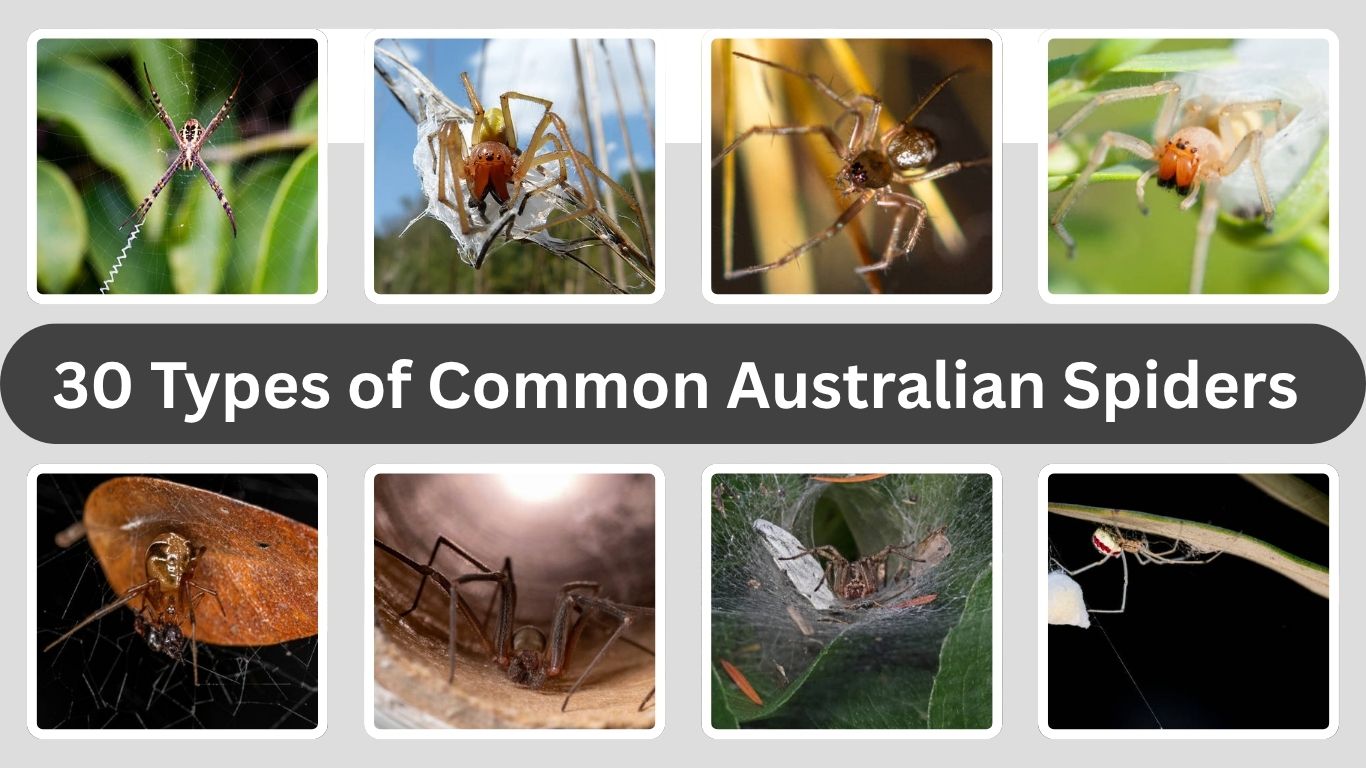
Australia is home to a fascinating diversity of spiders, ranging from tiny, harmless species to some of the most well-known venomous spiders in the world. These spiders can be found in a wide variety of environments, including forests, gardens, deserts, and even inside homes. While many may appear intimidating, most play an important role in controlling insect populations. In this guide, you’ll discover 30 common Australian spiders, along with their key features, habitats, and behaviors.
1. Sydney Funnel-web Spider

The Sydney Funnel-web Spider is one of Australia’s most well-known and dangerous spiders, commonly found in eastern regions. It prefers moist environments and is often encountered in gardens, forests, and even suburban areas.
Identification
- Glossy black or dark brown body
- Large, robust build
- Body length around 1–5 cm
- Long, strong fangs
- Spinnerets visible at the rear
Habitat
This spider typically lives in burrows with a silk-lined funnel entrance. It prefers damp, sheltered areas such as under rocks, logs, and garden debris, and is often found in coastal regions around Sydney.
Behavior
Sydney Funnel-web Spiders are mostly nocturnal and highly defensive when threatened. Males tend to wander during warmer months, increasing the likelihood of human encounters.
Danger to Humans
This species is considered highly venomous and can pose a serious threat to humans. Bites require immediate medical attention, though effective antivenom has significantly reduced fatalities.
2. Redback Spider

The Redback Spider is one of Australia’s most recognizable spiders, famous for its distinctive red stripe and potent venom. It belongs to the widow spider family and is commonly found in both urban and rural environments. Despite its dangerous reputation, serious incidents are relatively rare due to effective medical treatment.
Identification
- Small, black body with a glossy appearance
- Distinct red or orange stripe on the upper abdomen
- Females are larger (about 1 cm), males much smaller
- Round abdomen with long, slender legs
- Juveniles may show white markings
Habitat
Redback Spiders prefer dry, sheltered locations close to human activity. They are often found in sheds, garages, under outdoor furniture, inside mailboxes, and around garden equipment. Their messy, irregular webs are usually built low to the ground in hidden corners.
Behavior
These spiders are generally shy and non-aggressive. Females stay in their webs, while males roam in search of mates. The web is designed to trap crawling insects, and the spider quickly immobilizes prey with silk before delivering a bite.
Danger to Humans
The Redback Spider is highly venomous, and bites can cause significant pain, sweating, and nausea. However, fatalities are extremely rare thanks to the availability of antivenom. Medical attention is recommended if a bite occurs, especially for children or vulnerable individuals.
3. Huntsman Spider

The Huntsman Spider is a large and fast-moving spider commonly found across Australia. Known for its impressive size and crab-like appearance, it often startles people but is generally harmless. These spiders are beneficial as they help control insect populations in homes and gardens.
Identification
- Large, flat body with long legs
- Leg span can reach up to 15 cm
- Brown, grey, or mottled coloration
- Crab-like sideways leg movement
- Hairy legs and body
Habitat
Huntsman Spiders prefer sheltered spaces such as under bark, in tree crevices, and inside homes. They are frequently found on walls, ceilings, and even inside cars, especially during warm weather.
Behavior
These spiders do not build webs to catch prey. Instead, they actively hunt insects at night using speed and agility. They are generally shy and will try to escape rather than bite when disturbed.
Danger to Humans
Huntsman Spiders are not considered dangerous. Their bite may cause mild pain or irritation, but serious reactions are rare. They are often regarded as harmless and even helpful household visitors.
4. Wolf Spider

Wolf Spiders are robust ground-dwelling spiders known for their excellent hunting skills and keen eyesight. Unlike many spiders, they do not rely on webs to catch prey, making them active and efficient predators in natural and urban environments.
Identification
- Medium to large size with a sturdy body
- Brown, grey, or black with striped patterns
- Hairy body and legs
- Eight eyes arranged in three rows
- Females carry egg sacs attached to their abdomen
Habitat
Wolf Spiders are commonly found on the ground in grasslands, gardens, forests, and even inside homes. They prefer burrows or hidden spots under rocks, logs, and leaf litter.
Behavior
These spiders are active hunters, especially at night. They chase down prey rather than using webs. Female wolf spiders are notable for carrying their young on their backs after they hatch.
Danger to Humans
Wolf Spiders are not highly dangerous. Their bite can be painful but is generally not medically significant. Symptoms are usually mild and short-lived, making them low-risk to humans.
5. Trapdoor Spider

The Trapdoor Spider is a secretive and fascinating species known for its unique burrow with a hidden “trapdoor.” These spiders are rarely seen because they spend most of their lives underground, waiting for prey to pass by.
Identification
- Thick, robust body
- Dark brown to black coloration
- Strong legs adapted for digging
- Large downward-pointing fangs
- Compact, heavy appearance
Habitat
Trapdoor Spiders live in burrows in soil, often in forests, gardens, or grassy areas. The entrance is covered with a camouflaged lid made of silk, soil, and debris, making it nearly invisible.
Behavior
These spiders are ambush predators. They stay inside their burrow with the trapdoor closed and quickly lunge out when they detect vibrations from passing prey. They are generally slow-moving and prefer to remain hidden.
Danger to Humans
Trapdoor Spiders are not considered dangerous. While they can bite if handled, their venom is not harmful to humans, and bites usually result in only mild discomfort.
6. Mouse Spider

The Mouse Spider is a burrowing species often confused with the more dangerous funnel-web spiders due to its similar appearance. It is found across much of Australia and is known for its strong build and striking features.
Identification
- Medium to large, stout body
- Glossy black or dark coloration
- Males may have bright red or blue markings
- Short, thick legs
- Large fangs
Habitat
Mouse Spiders typically live in deep burrows in soil, often near water or in open ground. They can also be found in suburban gardens, especially after rain when they may wander above ground.
Behavior
These spiders are mostly ground-dwelling and spend much of their time in burrows. Males are more likely to roam during mating season, which increases the chance of encounters with humans.
Danger to Humans
Mouse Spiders possess venom similar to funnel-web spiders, but serious bites are rare. They are considered potentially dangerous, and medical attention should be sought if bitten, although effective treatment is available.
7. White-tailed Spider

The White-tailed Spider is a common household spider in Australia, often recognized by the pale tip at the end of its abdomen. It frequently enters homes in search of prey, especially other spiders.
Identification
- Slender, elongated body
- Dark grey to black coloration
- Distinct white or pale spot at the tip of the abdomen
- Long, thin legs
- Body length around 1–2 cm
Habitat
White-tailed Spiders are often found indoors, particularly in bedding, clothing, and dark corners. Outdoors, they live under bark, logs, and leaf litter, where they hunt other spiders.
Behavior
These spiders are active hunters and do not build webs to catch prey. They roam at night in search of other spiders, making them beneficial in controlling spider populations indoors.
Danger to Humans
White-tailed Spider bites can cause irritation, redness, and swelling. While they have a reputation for causing severe skin damage, most bites result in only mild symptoms and heal without complications.
8. Garden Orb-weaver

The Garden Orb-weaver is a large and harmless spider commonly seen in Australian gardens. It is known for building beautiful circular webs, especially in the evening.
Identification
- Large, rounded abdomen
- Brown, orange, or grey coloration with patterns
- Long legs, often banded
- Body length up to 2–3 cm
- Females larger than males
Habitat
These spiders are commonly found in gardens, parks, and bushland. They build large orb-shaped webs between trees, shrubs, and structures, often rebuilding them daily.
Behavior
Garden Orb-weavers are nocturnal and typically rebuild their webs at dusk. They remain in the center of the web waiting for flying insects to become trapped. During the day, they often hide nearby.
Danger to Humans
Garden Orb-weavers are not dangerous to humans. Their bite may cause mild discomfort, but they are generally harmless and play an important role in controlling insect populations.
9. Golden Orb-weaver

The Golden Orb-weaver is a striking spider known for its large size and golden-colored webs. It is commonly found in warm regions of Australia and is easily recognized by its impressive web structures.
Identification
- Large body with long, slender legs
- Females much larger than males
- Yellow, black, or greenish coloration
- Distinct elongated abdomen
- Often seen sitting in large golden webs
Habitat
Golden Orb-weavers are typically found in forests, gardens, and coastal areas. They build large, strong webs between trees and shrubs, often in sunny locations where insects are abundant.
Behavior
These spiders are web-builders and remain in the center of their webs waiting for prey. Their silk is extremely strong and can trap large insects. Males are much smaller and often stay near the female’s web.
Danger to Humans
Golden Orb-weavers are not dangerous to humans. Their bite may cause mild discomfort, but they are generally harmless and rarely aggressive.
10. Black House Spider

The Black House Spider is a common species found around human dwellings in Australia. It is known for its messy, lace-like webs and preference for sheltered areas.
Identification
- Dark brown to black velvety body
- Medium size with sturdy legs
- Females larger than males
- Irregular, messy web structure
- Body length around 1–1.5 cm
Habitat
Black House Spiders are often found around windows, door frames, walls, and under eaves. They prefer dry, sheltered locations where they can build their webs undisturbed.
Behavior
These spiders stay in their webs and wait for insects to become trapped. They are generally sedentary and may remain in the same web for long periods if food is available.
Danger to Humans
Black House Spiders are not considered dangerous. Their bite can cause mild pain or swelling, but serious reactions are rare. They are typically shy and avoid human contact.
11. Brown Recluse Spider
The Brown Recluse Spider is a shy and reclusive species known for its preference for undisturbed areas. Although more commonly associated with other regions, similar recluse-type spiders are occasionally noted in Australia. It avoids human contact and is rarely seen.
Identification
- Light to dark brown body
- Distinct violin-shaped marking on the cephalothorax
- Long, thin legs
- Small to medium size
- Six eyes arranged in pairs
Habitat
Brown Recluse Spiders prefer dark, quiet places such as storage boxes, closets, woodpiles, and sheds. They thrive in dry environments where there is minimal disturbance.
Behavior
These spiders are nocturnal and tend to hide during the day. They hunt at night rather than using webs to catch prey. True to their name, they avoid confrontation and will only bite if threatened.
Danger to Humans
The bite of a Brown Recluse Spider can be medically significant, potentially causing tissue damage in rare cases. However, bites are uncommon, and serious outcomes are rare with proper medical care.
12. St Andrew’s Cross Spider

The St Andrew’s Cross Spider is a distinctive orb-weaving spider named after the cross-shaped pattern it creates in its web. It is commonly seen in gardens and bushland across Australia.
Identification
- Bright yellow and black striped body
- Medium size with long legs
- Often sits in a cross-shaped web pattern
- Slender body with bold markings
- Legs often held in pairs forming an “X” shape
Habitat
This spider is found in gardens, shrubs, and open bushland. It builds its web in sunny, open areas where flying insects are plentiful.
Behavior
St Andrew’s Cross Spiders remain in the center of their web during the day. The cross-shaped silk structure may help attract prey or deter predators. They rebuild or repair their webs regularly.
Danger to Humans
These spiders are not dangerous. Their bite is mild and rarely causes more than slight irritation. They are generally harmless and beneficial for controlling insect populations.
13. Peacock Spider

The Peacock Spider is a small but incredibly colorful spider famous for its vibrant patterns and unique courtship dances. Found mainly in Australia, it has gained global attention due to its striking appearance and fascinating behavior.
Identification
- Very small size (usually under 5 mm)
- Bright, iridescent colors (blue, red, orange, green)
- Males have fan-like abdominal flaps
- Compact body with short legs
- Large forward-facing eyes
Habitat
Peacock Spiders are typically found in leaf litter, grasslands, and low vegetation. They prefer sunny environments where they can easily hunt and perform mating displays.
Behavior
These spiders are active hunters and rely on their excellent vision rather than webs. Males are known for their elaborate courtship dances, raising their colorful abdomen and waving their legs to attract females.
Danger to Humans
Peacock Spiders are harmless to humans. Due to their tiny size, they pose no threat and are considered completely safe.
14. Jumping Spider

Jumping Spiders are among the most intelligent and curious spiders, known for their excellent vision and agile movements. They are commonly found in many parts of Australia, both indoors and outdoors.
Identification
- Small to medium size
- Compact, hairy body
- Large front-facing eyes
- Short, strong legs for jumping
- Often dark with subtle patterns
Habitat
Jumping Spiders live in a wide range of environments, including gardens, walls, windowsills, and tree trunks. They prefer areas with plenty of light where they can spot prey easily.
Behavior
These spiders do not use webs to catch prey. Instead, they stalk and leap onto their targets with precision. They are active during the day and are known for their curious nature, often turning to observe movement.
Danger to Humans
Jumping Spiders are not dangerous. Their bite is rare and usually harmless, causing little to no discomfort. They are considered beneficial due to their role in controlling insect populations.
15. Daddy Long-legs Spider

The Daddy Long-legs Spider, also known as the cellar spider, is a delicate and long-legged species commonly found in homes across Australia. It is well known for its thin body and ability to thrive in quiet indoor spaces.
Identification
- Very long, thin legs
- Small, oval-shaped body
- Pale brown or grey coloration
- Fragile appearance
- Often hangs upside down in webs
Habitat
These spiders are commonly found indoors in corners of ceilings, basements, garages, and sheds. They prefer undisturbed, dimly lit areas where they can build their loose webs.
Behavior
Daddy Long-legs Spiders build irregular, tangled webs and hang upside down. They feed on small insects and even other spiders. When disturbed, they vibrate rapidly in their web to confuse predators.
Danger to Humans
They are harmless to humans. Despite common myths, their venom is not dangerous, and they rarely bite. They are considered beneficial for controlling pests indoors.
16. Green Lynx Spider

The Green Lynx Spider is a bright green, agile hunter known for its excellent camouflage among plants. It is commonly found in vegetation and is an active daytime predator.
Identification
- Bright green body
- Slender shape with long legs
- Spiny legs for gripping prey
- Red or yellow markings may be present
- Medium size
Habitat
Green Lynx Spiders live in shrubs, grasses, and garden plants. They prefer areas with dense vegetation where they can blend in and hunt effectively.
Behavior
These spiders do not build webs to catch prey. Instead, they actively stalk and pounce on insects during the day. They rely heavily on camouflage to ambush their targets.
Danger to Humans
Green Lynx Spiders are not dangerous. Their bite is rare and may cause mild irritation, but they pose no serious threat to humans.
17. Spiny Orb-weaver

The Spiny Orb-weaver is a uniquely shaped spider known for its bright colors and spiked abdomen. It is commonly found in gardens and forests across Australia, where it builds distinctive orb-shaped webs.
Identification
- Small, flattened body
- Hard, spiny abdomen with sharp projections
- Bright colors such as white, yellow, red, or black
- Short legs compared to body size
- Crab-like appearance
Habitat
Spiny Orb-weavers are typically found in gardens, woodlands, and forest edges. They build circular webs between branches, shrubs, or structures, usually in open areas with good airflow.
Behavior
These spiders are web-builders and remain stationary in the center of their webs, waiting for flying insects to become trapped. Their bright colors may help deter predators.
Danger to Humans
Spiny Orb-weavers are harmless to humans. They are not aggressive, and their bite, if it occurs, is mild and not medically significant.
18. Net-casting Spider

The Net-casting Spider, also known as the ogre-faced spider, is famous for its unusual hunting technique using a small web “net.” It has a distinctive appearance and is mostly active at night.
Identification
- Elongated body with long legs
- Large forward-facing eyes
- Brown or grey coloration
- Slender, stick-like appearance
- Often seen hanging upside down
Habitat
Net-casting Spiders are found in forests, gardens, and bushland. They prefer areas with vegetation where they can hang quietly while waiting for prey.
Behavior
Unlike typical spiders, they do not spin large webs. Instead, they hold a small rectangular net of silk between their front legs and stretch it over passing prey. Their large eyes help them see well in low light.
Danger to Humans
Net-casting Spiders are not dangerous. They are shy and rarely interact with humans. Bites are extremely uncommon and not considered harmful.
19. Wishbone Spider

The Wishbone Spider is a burrowing species named after the unique shape of its underground tunnel. It is a secretive spider that spends most of its life hidden beneath the soil, making sightings relatively uncommon.
Identification
- Medium-sized, robust body
- Dark brown to black coloration
- Strong legs adapted for digging
- Large fangs
- Stocky and compact appearance
Habitat
Wishbone Spiders live in underground burrows shaped like a “Y” or wishbone. They are typically found in forests, grasslands, and gardens, especially in areas with loose soil suitable for digging.
Behavior
These spiders are ambush predators. They remain inside their burrow and wait for vibrations from nearby prey. Once detected, they quickly emerge to capture insects before retreating back inside.
Danger to Humans
Wishbone Spiders are not considered dangerous. They are shy and rarely bite. If a bite does occur, it usually results in only mild irritation.
20. Badge Huntsman Spider

The Badge Huntsman Spider is a member of the huntsman family, known for its speed and distinctive markings. It is commonly found in Australia and often encountered in both natural and urban environments.
Identification
- Large, flat body with long legs
- Brown or grey coloration
- Distinct “badge-like” marking on the underside
- Hairy legs and body
- Leg span can be quite wide
Habitat
Badge Huntsman Spiders are found under bark, in tree crevices, and inside homes. They prefer warm, sheltered environments and are often seen on walls or ceilings.
Behavior
Like other huntsman spiders, they are active hunters and do not rely on webs. They move quickly and hunt insects at night. During the day, they hide in cracks or behind surfaces.
Danger to Humans
These spiders are not dangerous. Although they may appear intimidating due to their size, their bite is mild and not considered medically significant.
21. Bark Huntsman Spider

The Bark Huntsman Spider is a fast and well-camouflaged species commonly found on tree trunks. Its flattened body allows it to blend seamlessly with bark, making it difficult to spot in natural environments.
Identification
- Flat body adapted to tree surfaces
- Brown, grey, or mottled coloration
- Long legs spread sideways
- Excellent camouflage resembling tree bark
- Medium to large size
Habitat
Bark Huntsman Spiders are typically found on tree trunks, under loose bark, and in wooded areas. They prefer forests, parks, and gardens with plenty of trees.
Behavior
These spiders are nocturnal hunters and rely on speed rather than webs. During the day, they remain motionless against tree bark to avoid detection. At night, they actively search for insects.
Danger to Humans
Bark Huntsman Spiders are not dangerous. Their bite may cause mild discomfort, but they are generally harmless and avoid human contact.
22. Giant Crab Spider

The Giant Crab Spider is known for its wide leg span and crab-like movement. It is a powerful ambush predator that relies on stealth rather than webs to capture prey.
Identification
- Large body with very long legs
- Legs extend sideways like a crab
- Brown, grey, or mottled coloration
- Flattened body shape
- Strong front legs for grabbing prey
Habitat
These spiders are found in forests, grasslands, and gardens. They often hide on plants, tree trunks, or among leaves where they can blend into their surroundings.
Behavior
Giant Crab Spiders do not build webs. Instead, they wait motionless for prey and quickly grab it using their strong front legs. Their sideways movement gives them a crab-like appearance.
Danger to Humans
They are not considered dangerous. Bites are rare and usually result in mild pain or irritation. They are generally shy and prefer to avoid humans.
23. Flower Spider

The Flower Spider is a small, well-camouflaged spider often found on blossoms, where it waits to ambush pollinating insects. Its ability to blend into flowers makes it an effective and stealthy predator.
Identification
- Small, compact body
- White, yellow, or pink coloration
- Can change color to match flowers
- Short, strong front legs
- Crab-like stance
Habitat
Flower Spiders are commonly found on flowers in gardens, meadows, and bushland. They prefer areas rich in flowering plants where insects frequently visit.
Behavior
These spiders are ambush hunters and do not build webs. They remain motionless on flowers, waiting for insects such as bees or butterflies to land before quickly capturing them.
Danger to Humans
Flower Spiders are harmless to humans. Their bite is extremely rare and not considered medically significant.
24. Lace Web Spider

The Lace Web Spider is a common species found around homes, known for its dense, lace-like web structure. It is often seen in sheltered areas where it can build its distinctive web undisturbed.
Identification
- Medium-sized, dark brown body
- Slightly hairy appearance
- Sturdy legs
- Dense, tangled web resembling lace
- Females larger than males
Habitat
Lace Web Spiders are typically found around window frames, walls, fences, and under eaves. They prefer dry, sheltered environments close to human structures.
Behavior
These spiders remain in their webs and wait for insects to become trapped. They are mostly inactive during the day and become more active at night when prey is abundant.
Danger to Humans
Lace Web Spiders are not dangerous. Their bite may cause mild discomfort, but serious reactions are rare. They generally avoid human interaction.
25. Swift Spider

The Swift Spider is a fast-moving ground spider known for its agility and hunting ability. It is commonly found in open areas where it can quickly chase down prey rather than relying on webs.
Identification
- Small to medium size
- Slender body with long legs
- Brown or grey coloration
- Smooth, streamlined appearance
- Adapted for speed
Habitat
Swift Spiders are typically found in grasslands, gardens, and open ground. They prefer dry environments where they can move freely and hunt effectively.
Behavior
These spiders are active hunters and do not build webs to catch prey. They rely on speed and quick reflexes to chase and capture insects, especially during warmer parts of the day.
Danger to Humans
Swift Spiders are harmless to humans. Bites are rare and usually cause only mild irritation, making them low-risk and generally unnoticed.
26. Ground Spider

The Ground Spider is a common and widespread species that lives close to the soil surface. It is a nocturnal hunter and plays an important role in controlling insect populations.
Identification
- Small to medium size
- Dark brown, grey, or black body
- Cylindrical abdomen
- Short, sturdy legs
- Often has visible spinnerets
Habitat
Ground Spiders are found in leaf litter, under rocks, logs, and in soil crevices. They are common in gardens, forests, and natural landscapes across Australia.
Behavior
These spiders are nocturnal and hunt actively at night. They do not build webs for catching prey but may create silk shelters for resting during the day.
Danger to Humans
Ground Spiders are not dangerous. Their bite is uncommon and typically results in only minor discomfort, posing no serious threat to humans.
27. Comb-footed Spider

The Comb-footed Spider belongs to a group known for their unique leg structures and irregular webs. Many species in this family are found in Australia, including some well-known house-dwelling spiders.
Identification
- Small to medium size
- Rounded abdomen
- Thin, relatively long legs
- Comb-like bristles on hind legs
- Often dark brown or black
Habitat
Comb-footed Spiders are commonly found in homes, sheds, and sheltered outdoor areas. They build messy, tangled webs in corners, under furniture, and around structures.
Behavior
These spiders use their comb-like hind legs to throw sticky silk over prey caught in their web. They are generally sedentary and remain close to their web, waiting for insects to become trapped.
Danger to Humans
Most Comb-footed Spiders are not dangerous. While some relatives (like the Redback) are venomous, many species cause only mild effects if they bite.
28. Tube Web Spider

The Tube Web Spider is a distinctive species known for its silk-lined tubular retreat. It is often found around homes and can sometimes be mistaken for more dangerous spiders due to its appearance.
Identification
- Medium-sized, dark brown or black body
- Long legs with a slightly hairy texture
- Glossy appearance
- Strong fangs
- Compact, sturdy build
Habitat
Tube Web Spiders are commonly found in cracks, walls, and crevices around buildings. They create silk-lined tubes in sheltered areas such as brickwork, rocks, or tree bark.
Behavior
These spiders remain inside their tube-like retreat and wait for vibrations from nearby prey. When prey approaches, they quickly emerge to capture it before retreating back inside.
Danger to Humans
Tube Web Spiders can bite if disturbed, and their bite may be painful. While not considered highly dangerous, medical attention may be needed if symptoms persist.
29. Sac Spider

The Sac Spider is a small, nocturnal hunter known for creating silk “sacs” where it rests during the day. It is commonly found in homes and gardens across Australia.
Identification
- Small, pale yellow or light green body
- Slender legs
- Smooth, soft appearance
- Oval-shaped abdomen
- Often slightly translucent
Habitat
Sac Spiders are found on walls, ceilings, and plant leaves. They build small silk sacs in corners, under leaves, or along surfaces where they can hide during daylight hours.
Behavior
These spiders are active at night and do not rely on webs to catch prey. Instead, they wander in search of insects. During the day, they stay hidden inside their silk retreat.
Danger to Humans
Sac Spiders are not highly dangerous, but their bite can cause mild pain, redness, or irritation. In most cases, symptoms are minor and resolve quickly.
30. Sheet Web Spider

The Sheet Web Spider is a small spider known for its flat, sheet-like web structure. It is commonly found in grassy areas and gardens where it builds low, horizontal webs.
Identification
- Small body size
- Brown or grey coloration
- Slender legs
- Rounded abdomen
- Builds flat, sheet-like webs
Habitat
Sheet Web Spiders are typically found in grass, low vegetation, and gardens. Their webs are often built close to the ground, stretched between plants or across small gaps.
Behavior
These spiders stay beneath or near their sheet web, waiting for insects to fall onto it. Once prey is detected, they quickly move to capture it from below the web surface.
Danger to Humans
Sheet Web Spiders are harmless to humans. Their bite is rare and not medically significant, making them safe and beneficial in natural environments.
