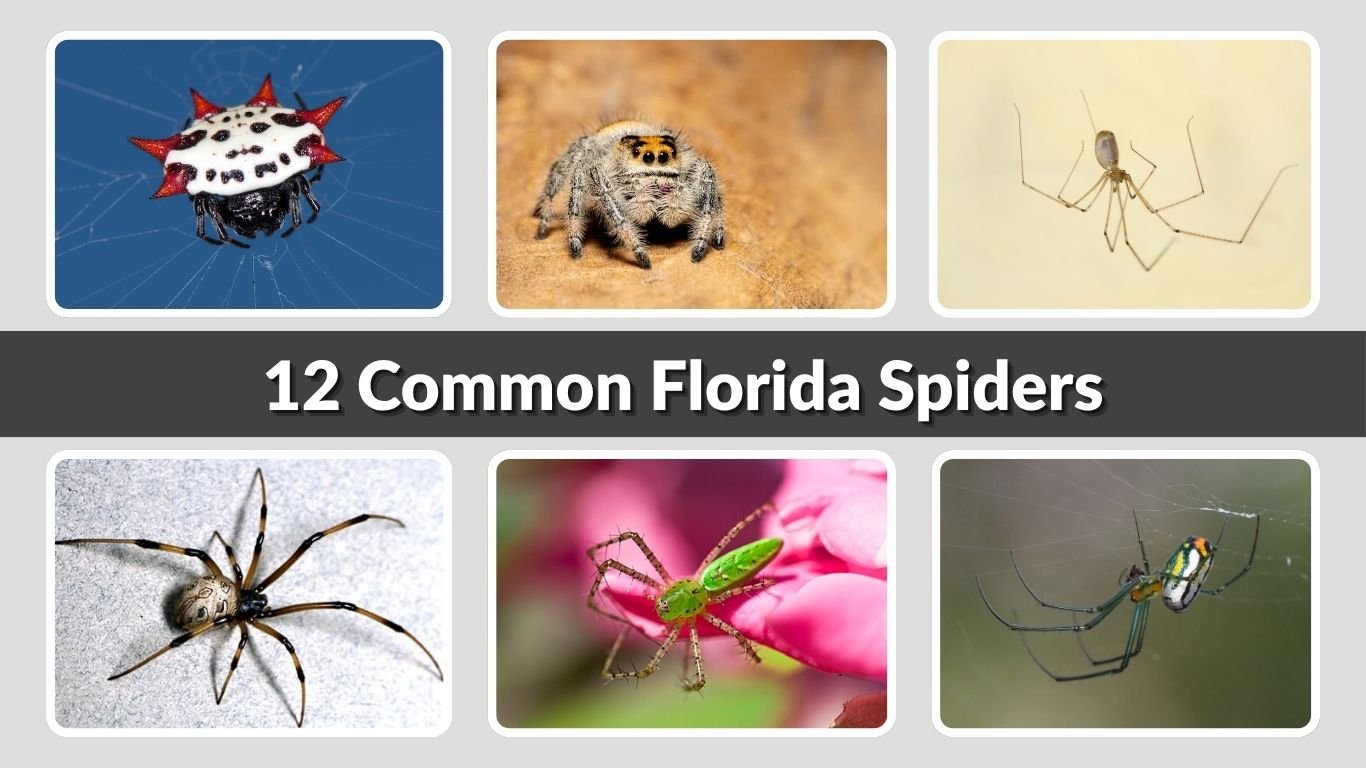
Florida is home to hundreds of spider species, ranging from tiny jumping spiders to large orb-weavers that build impressive webs. Many common Florida spiders live in gardens, garages, patios, and even inside homes. Although their appearance can be frightening, most are harmless to humans and help control insect populations. Identifying these spiders becomes easier when you understand their colors, body shapes, habitats, and behaviors. This guide explores 12 common spiders found in Florida, including house spiders, outdoor species, and those requiring extra caution.
Common House Spiders in Florida
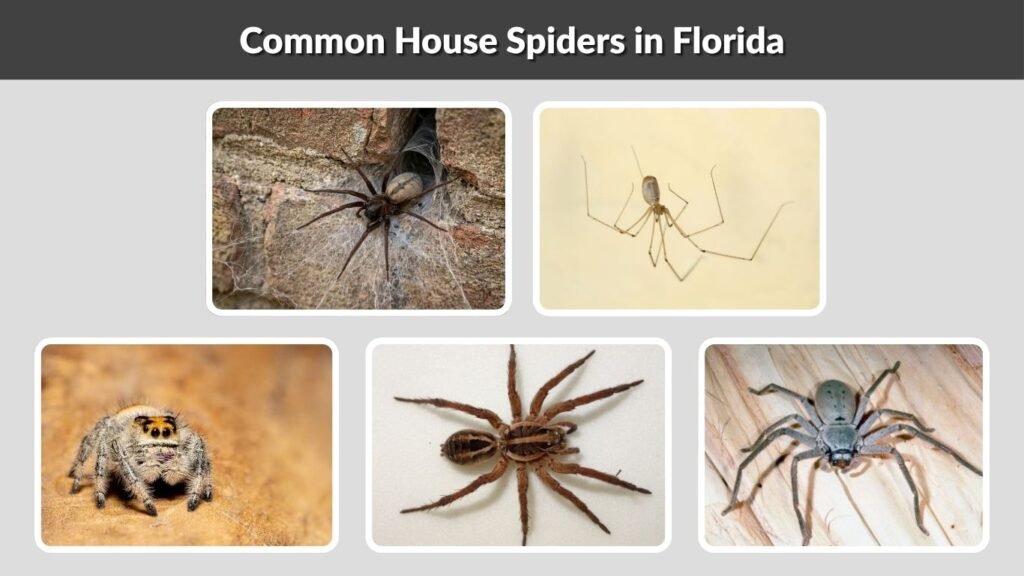
Florida’s warm climate allows many spiders to remain active throughout the year. Some prefer sheltered indoor spaces, while others enter houses accidentally while searching for insects. The following species are among the spiders homeowners may encounter in garages, bedrooms, bathrooms, and other areas.
1. Southern House Spider
The southern house spider (Kukulcania hibernalis) is one of the most recognizable common brown house spiders in Florida. Females have dark, velvety bodies, while males are lighter brown with unusually long legs.
These spiders often live around windows, shutters, wall crevices, and building exteriors. Females construct irregular, tangled webs near their hiding places.
Male southern house spiders are sometimes confused with brown recluses because of their similar appearance. However, southern house spiders are not considered medically dangerous.
2. Cellar Spider
Cellar spiders, commonly called daddy longlegs spiders, have tiny bodies and extremely long, thin legs. Their light brown or gray coloration makes them difficult to notice against walls.
They commonly occupy ceiling corners, bathrooms, basements, sheds, and garages. Their loose, irregular webs capture flies, mosquitoes, and other small insects.
Cellar spiders frequently vibrate their webs when disturbed, making their bodies appear blurred. Despite their unusual appearance, they pose little danger to people.
3. Regal Jumping Spider
The regal jumping spider (Phidippus regius) is one of Florida’s most distinctive jumping spiders. It has a compact, hairy body, large forward-facing eyes, and strong jumping abilities.
Males are generally black with white markings, while females may appear gray, brown, or orange.
These spiders are commonly found on windows, exterior walls, fences, and plants. Instead of constructing prey-catching webs, they actively hunt insects using excellent vision. They are generally harmless unless handled roughly.
4. Wolf Spider
Wolf spiders belong to the family Lycosidae and are among the common large brown spiders in Florida. They have sturdy bodies, hairy legs, and brown or gray patterns that provide camouflage.
Unlike orb-weavers, wolf spiders actively chase insects rather than catching them in webs.
They frequently inhabit lawns, gardens, garages, and ground-level hiding places. Some wander indoors accidentally. Female wolf spiders are especially recognizable because they carry their egg sacs behind them and later transport their spiderlings on their backs.
5. Huntsman Spider
The pantropical huntsman spider (Heteropoda venatoria) is a large, fast-moving brown spider found particularly in warmer parts of Florida.
Its flattened body and sideways-spreading legs give it a crab-like appearance. Some individuals have leg spans reaching several inches.
Huntsman spiders often hide behind furniture, inside garages, beneath cabinets, and around building materials. They hunt cockroaches and other insects without constructing capture webs.
Although their size can be alarming, they are not considered dangerous to humans.
Common Outdoor and Garden Spiders in Florida
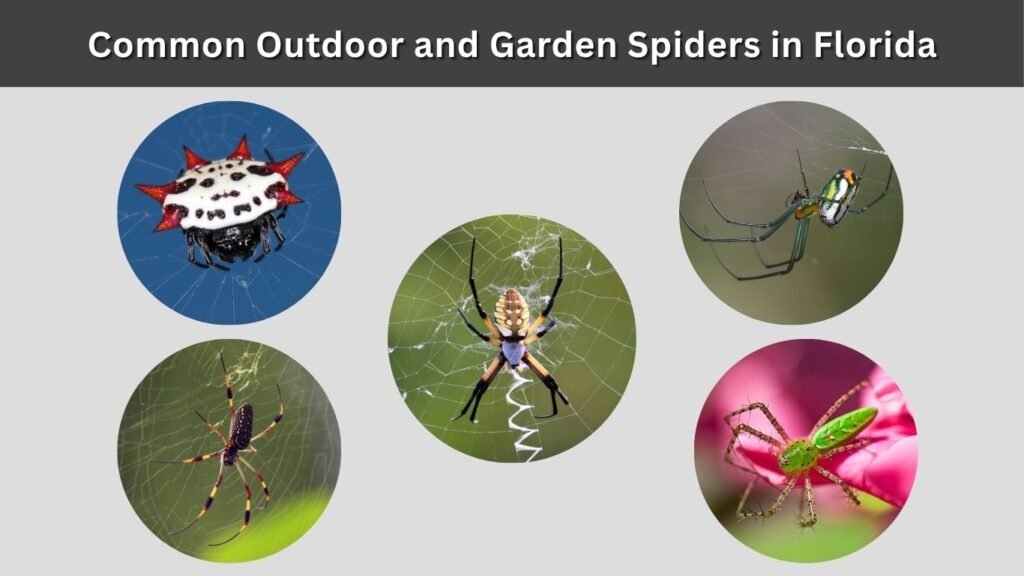
Florida gardens, backyards, wooded areas, and agricultural landscapes support numerous spider species. Many construct elaborate webs between plants, while others hunt directly among leaves and flowers. These outdoor spiders play important ecological roles by feeding on flies, moths, mosquitoes, and agricultural pests.
6. Spiny-Backed Orb-Weaver
The spiny-backed orb-weaver (Gasteracantha cancriformis) is a small, colorful spider with a distinctive flattened abdomen surrounded by pointed spines.
Females often have white or yellow abdomens decorated with black spots and contrasting spines.
These spiders build circular webs between shrubs, trees, and garden plants. Their unusual body shape sometimes causes people to mistake them for tiny crabs.
Despite their sharp-looking spines, spiny-backed orb-weavers are not dangerous to humans.
7. Golden Silk Orb-Weaver
The golden silk orb-weaver (Trichonephila clavipes) is among Florida’s largest web-building spiders. It is sometimes called the banana spider.
Females have elongated bodies, yellow and brown coloration, and long legs with noticeable hair tufts.
They create enormous webs containing golden-colored silk, often between trees or along woodland trails.
Although the webs can appear intimidating, these spiders rarely bite unless trapped or handled. Their bites are not generally medically significant.
8. Yellow Garden Spider
The yellow garden spider (Argiope aurantia) is a striking species with bright yellow and black abdominal markings.
Females create large, circular webs, often decorated with a distinctive zigzag pattern of thick white silk near the center.
These spiders are frequently found in flower gardens, grassy areas, and vegetation surrounding homes.
Yellow garden spiders remain relatively stationary while waiting for flying insects to become trapped. They are beneficial predators and typically avoid human contact.
9. Orchard Orb-Weaver
Orchard orb-weavers (Leucauge species) are small spiders recognized by their metallic green, silver, and yellow coloring.
Their slender bodies and long legs distinguish them from many common brown Florida spiders.
They construct delicate, horizontal or angled webs among shrubs, gardens, and shaded vegetation.
Orchard orb-weavers often hang beneath their webs while waiting for insects. Their bright abdominal markings occasionally lead to confusion with young widow spiders, although they are not considered dangerous.
10. Green Lynx Spider
The green lynx spider (Peucetia viridans) is a bright green hunting spider commonly encountered on Florida vegetation.
Its long legs feature prominent black spines, while reddish markings may appear around its eyes and body.
Unlike web-building spiders, green lynx spiders wait on plants and ambush nearby insects.
They frequently inhabit gardens, shrubs, and flowering plants. Although capable of biting when threatened, they rarely cause significant problems for humans.
Common Venomous Spiders in Florida
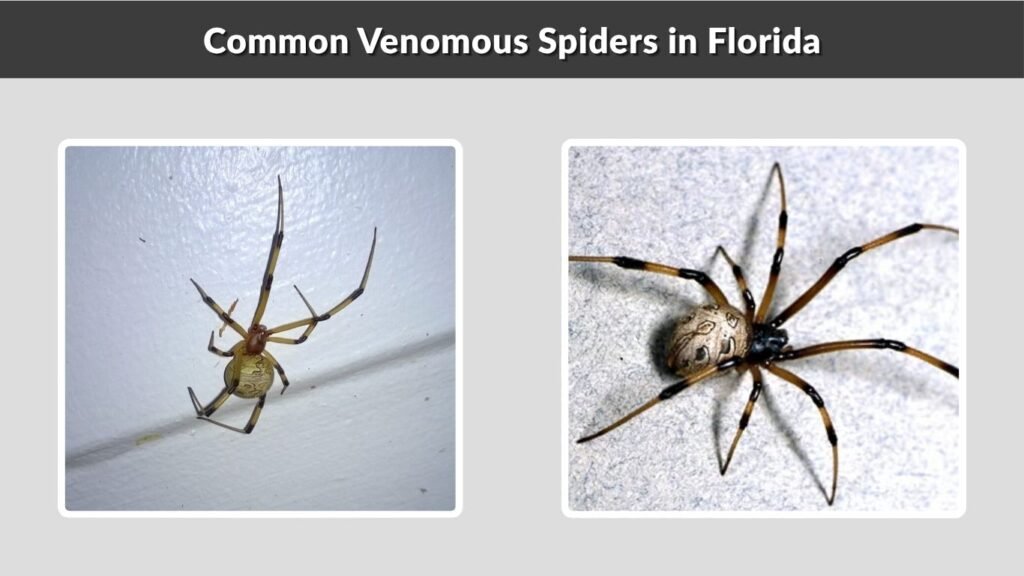
Most Florida spiders possess venom used to capture prey, but only a small number are medically significant to humans. Widow spiders deserve particular attention because their bites can cause substantial pain and other symptoms.
11. Southern Black Widow
The southern black widow (Latrodectus mactans) is one of Florida’s best-known venomous spiders.
Adult females have shiny black bodies and typically display a red hourglass-shaped marking underneath their rounded abdomens.
They prefer sheltered locations such as woodpiles, sheds, garages, and cluttered outdoor structures.
Black widows generally avoid confrontation, but accidental contact can result in a medically significant bite. Symptoms may include severe pain, sweating, and muscle cramping. Suspected bites require prompt medical advice.
12. Brown Widow Spider
The brown widow (Latrodectus geometricus) is another medically important spider commonly encountered around Florida homes.
Its body ranges from tan to dark brown, often displaying geometric abdominal markings and banded legs.
Brown widows have an orange or reddish hourglass underneath the abdomen. Their distinctive egg sacs are round with pointed projections.
They frequently occupy patio furniture, mailboxes, garages, and other sheltered areas.
Although brown widow bites are generally less severe than black widow bites, medical assessment may still be necessary.
Common Florida Spiders Identification Chart
Identifying a Florida spider involves examining its overall shape, color, web structure, and location. The following chart highlights recognizable characteristics of the 12 spiders discussed above. Color alone is not always reliable because juveniles and adults can look different.
| Spider | Main identifying feature | Typical habitat |
| Southern House Spider | Velvety brown body | Window crevices |
| Cellar Spider | Extremely long legs | Ceiling corners |
| Regal Jumping Spider | Large forward-facing eyes | Walls and fences |
| Wolf Spider | Hairy, patterned body | Lawns and garages |
| Huntsman Spider | Flat body, sideways legs | Houses and sheds |
| Spiny-Backed Orb-Weaver | Spiny abdomen | Garden webs |
| Golden Silk Orb-Weaver | Long legs, golden web | Trees and trails |
| Yellow Garden Spider | Yellow-black markings | Gardens |
| Orchard Orb-Weaver | Metallic green abdomen | Shrubs |
| Green Lynx Spider | Green body, spiny legs | Vegetation |
| Southern Black Widow | Black body, red hourglass | Sheltered clutter |
| Brown Widow | Brown body, spiky egg sacs | Patios and garages |
Are Brown Recluse Spiders Common in Florida?
Brown recluse spiders are not considered common or established throughout Florida. Although occasional specimens have been documented, many suspected sightings involve other brown spider species.
Male southern house spiders are particularly common sources of misidentification.
Brown recluses have six eyes arranged in three pairs, unlike the eight eyes found in many other spiders. However, identifying a spider based only on a photograph or brown coloration is unreliable.
If a suspicious spider appears indoors, avoid handling it directly and consult a qualified identification service.
How to Keep Common Florida Spiders Out of Your House
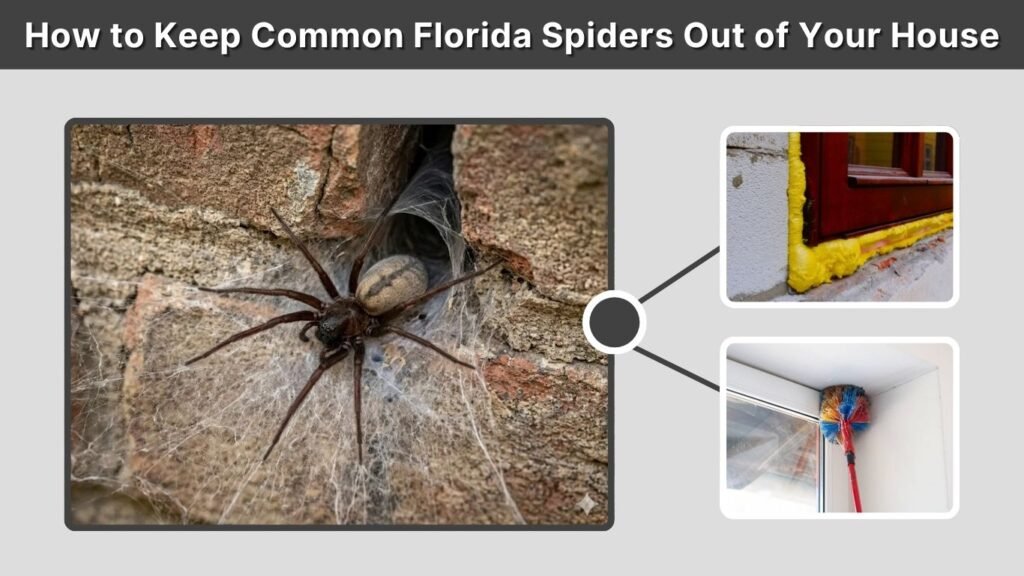
Most spiders enter buildings while searching for shelter, prey, or suitable hiding places. Reducing entry points and insect populations can help discourage them from settling indoors.
Seal Entry Points
Inspect door frames, window screens, utility openings, and gaps around exterior walls. Repair damaged screens and seal cracks to prevent spiders and insects from entering.
Reduce Indoor Insects
Spiders gather where food is available. Vacuum regularly, remove unnecessary clutter, store food properly, and address other household insect problems.
Remove Unnecessary Webs
Regularly remove abandoned webs from corners, garages, and storage spaces. Wear gloves when moving stored materials, particularly in locations where widow spiders could be hiding.
FAQs
What Is the Most Common House Spider in Florida?
Southern house spiders, cellar spiders, jumping spiders, and various small cobweb spiders are frequently encountered indoors. Their abundance varies by location and household conditions.
Are Wolf Spiders Common in Florida?
Yes. Wolf spiders are widespread throughout Florida and commonly inhabit lawns, gardens, wooded areas, and occasionally homes.
Are Black Widow Spiders Common in Florida?
Black widows occur in Florida, especially in sheltered outdoor locations. However, they are not necessarily the spiders most frequently encountered inside homes.
What Are the Common Large Spiders in Florida?
Wolf spiders, huntsman spiders, golden silk orb-weavers, and large garden orb-weavers are among the more noticeable large spiders in Florida.
Are Common Florida Spiders Dangerous?
Most are not dangerous to humans. Widow spiders are important exceptions because their venom can cause medically significant symptoms.
