

The giant Joro spider (Trichonephila clavata) is a brightly colored golden orb-weaver native to East Asia. It is now established in parts of the southeastern United States and continues to spread. Adult females can appear palm-sized when their long legs are extended, but alarming descriptions such as “giant flying venomous spider” exaggerate the danger. Joro spiders are shy, remain outdoors, and rarely bite people.
Giant Joro Spider Quick Facts
Female Joro spiders are much larger and more colorful than males. They build expansive golden webs among trees, shrubs, utility structures, and buildings.
| Feature | Description |
| Scientific name | Trichonephila clavata |
| Spider group | Golden orb-weaver |
| Female body length | More than 1 inch |
| Total leg span | About 3–4 inches |
| Male size | Around 1 inch including legs |
| Web color | Yellow or golden |
| Native range | East Asia |
| U.S. discovery | Georgia in 2014 |
| Danger to people | Low; bites are rare |
The female’s body can exceed one inch, while her outstretched legs may create a total span of three inches or more. Some University of Georgia sources describe exceptionally large females approaching a four-inch leg span. Males are considerably smaller, slender, and less colorful.
What Does a Giant Joro Spider Look Like?
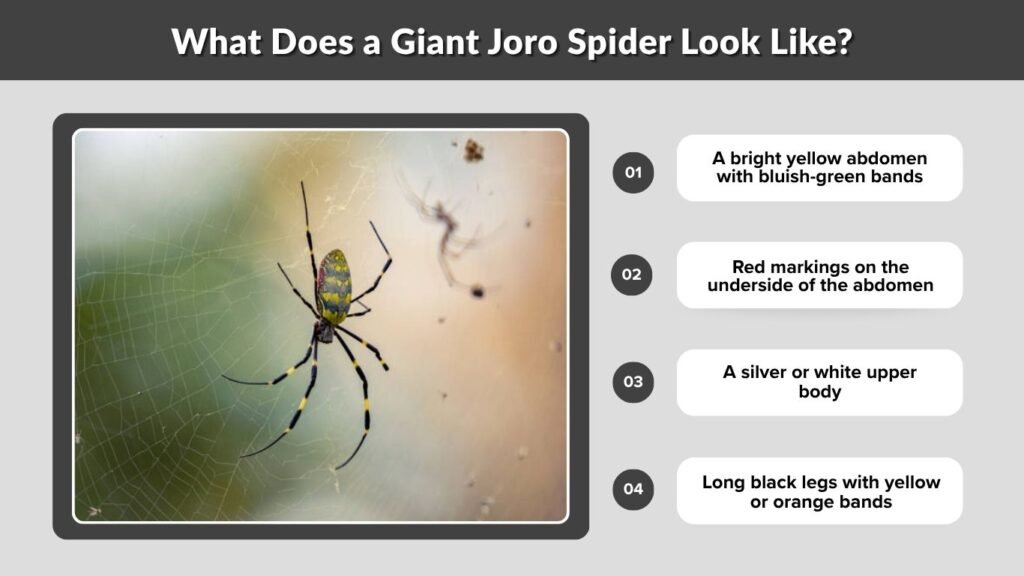
Mature females are easy to recognize by late summer and fall. Their vivid colors, long banded legs, and enormous golden webs distinguish them from most other North American spiders.
Identification Features
A female Joro spider typically has:
- A bright yellow abdomen with bluish-green bands
- Red markings on the underside of the abdomen
- A silver or white upper body
- Long black legs with yellow or orange bands
- A body measuring more than one inch
- A leg span reaching approximately three to four inches
- A large, layered web made from golden silk
Males have smaller brown, yellow, and black bodies. Several males may gather near a mature female’s web, making them look like young spiders even though they are adults.
Giant Joro Spider vs Banana Spider
Joro spiders are sometimes confused with native golden silk orb-weavers, commonly called banana spiders. Both produce yellow silk and have long legs, but mature female Joros have prominent black-and-yellow leg bands and blue-green bands across a bright yellow abdomen.
Because juvenile Joros resemble several native orb-weavers, location and photographs of the upper and lower body can help with identification. Verified sightings can be submitted through Joro Watch or EDDMapS.
How Big Is a Giant Joro Spider?
The spider’s body is much smaller than its full leg span. An adult female’s body may exceed one inch, but her long legs make her appear three to four inches wide. That is approximately the width of an adult human palm.
The term “giant” is therefore understandable, although headlines sometimes confuse body length with total size. Claims that Joro spiders have bodies measuring several inches are generally inaccurate.
Can Giant Joro Spiders Fly?
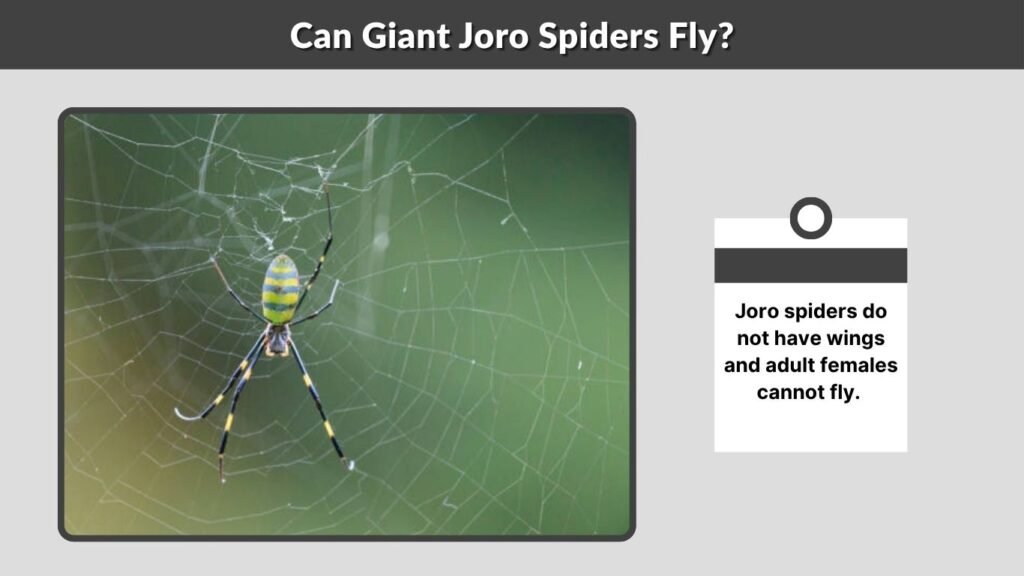
Joro spiders do not have wings and adult females cannot fly. The “flying Joro spider” description refers to ballooning, a dispersal behavior performed by tiny spiderlings.
How Joro Spiders Parachute
After hatching, a spiderling climbs to an exposed location and releases fine silk strands. Air currents catch the silk and carry the lightweight spider away. This behavior resembles parachuting and is common among many spider species.
Only tiny young Joros travel this way. Palm-sized adult females do not parachute through the sky or fly toward people. Their spread may also be assisted by vehicles, cargo, and transported materials, although the species’ original arrival route remains uncertain.
How Large Is a Giant Joro Spider Web?
A mature female creates a large, three-dimensional orb web from strong, sticky, golden silk. The organized central orb may measure around two feet across, while the surrounding structural lines extend much farther.
University of Georgia Extension reports that complete webs may span 10 feet or more. Long supporting strands can extend 20 feet between trees, porch columns, utility structures, or other attachment points.
Why Is the Web Golden?
Mature females produce naturally yellow or golden silk. The color becomes more noticeable as the spider grows and its silk becomes thicker. Juveniles generally produce clearer silk that resembles the webs of other orb-weavers.
Several individual webs may overlap in areas with many Joros. This can create what appears to be one enormous communal structure, although each female normally occupies her own central orb.
Is the Giant Joro Spider Poisonous?
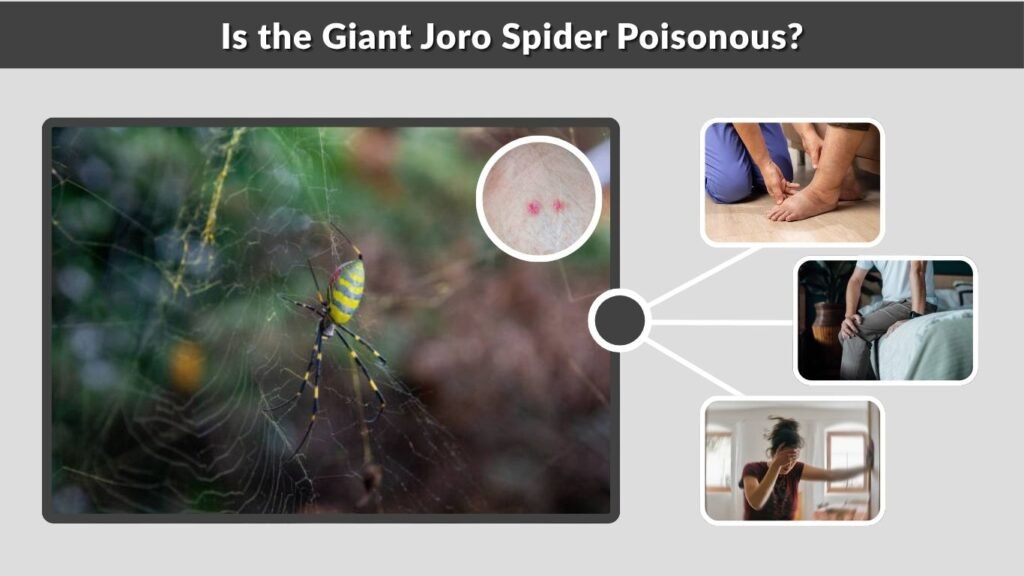
Joro spiders are venomous, not poisonous. They use venom to immobilize the insects captured in their webs. However, current extension guidance considers them a very low risk to people and pets.
“Poisonous” describes something harmful when eaten or touched, while “venomous” describes an animal that delivers venom through a bite or sting.
Does a Giant Joro Spider Bite?
A Joro spider can theoretically bite, but bites are unusual. The spider normally runs, hides, or remains motionless when disturbed rather than attacking. Research comparing its response with other spiders found that Joros may remain frozen for more than an hour after a harmless disturbance.
A bite is most likely when the spider is trapped against the skin or handled. Reported effects are generally expected to be minor and localized, although any bite could cause a stronger response in a sensitive person. Seek medical advice for spreading swelling, severe pain, breathing difficulty, dizziness, or other serious symptoms.
Giant Joro Spiders in the United States
Joro spiders were first formally documented in northeastern Georgia in 2014. They have since become common across parts of Georgia, South Carolina, North Carolina, and Tennessee, with verified reports expanding into additional areas.
Maryland has also documented the species, including a confirmed observation in Howard County in 2024. Researchers expect continued expansion because the spider’s native range includes areas with climates similar to much of the eastern United States.
Reports mentioning New York, Ohio, Massachusetts, or other northern states should be checked against a current verified map. A transported individual does not automatically prove that a breeding population is established. EDDMapS and Joro Watch maintain updated observation records.
Are Joro Spiders Invasive?
Joro spiders are introduced and non-native in the United States. Whether they are causing substantial ecological damage is still being studied. University of Georgia researchers have not yet identified major environmental or economic harm, although their abundance and large webs can create a considerable nuisance.
They catch many flying insects, including some agricultural pests. However, scientists continue investigating their effects on native spiders, pollinators, food webs, and local insect populations.
How to Remove Giant Joro Spiders
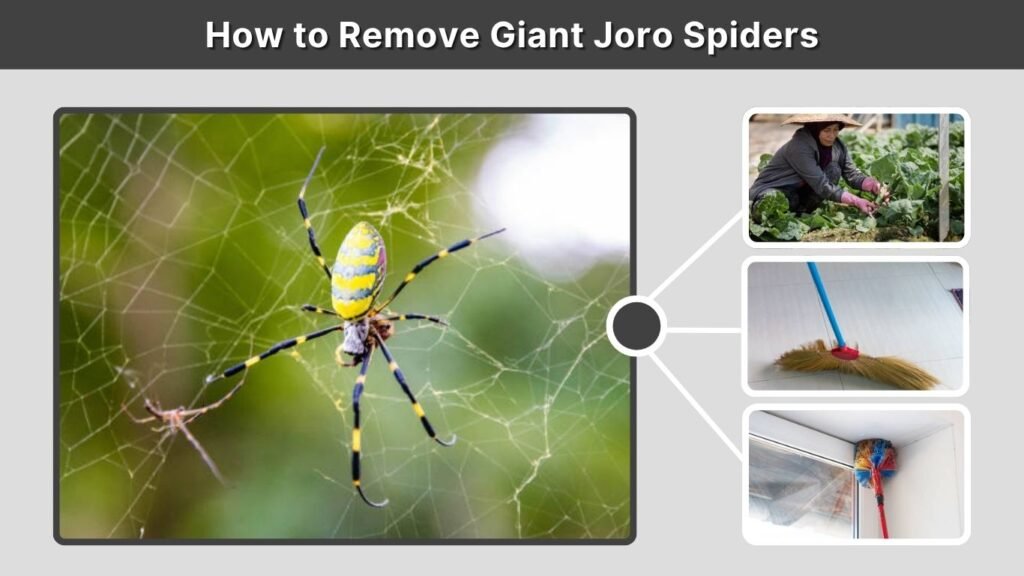
A web located away from doors, walkways, playgrounds, or frequently used spaces can usually be left alone. Joros remain outdoors and help capture flying insects.
For an inconvenient web:
- Wear gloves and long sleeves.
- Use a long-handled broom or stick.
- Remove the spider and web without touching them directly.
- Clear supporting strands from doors and walkways.
- Repeat the removal if the spider rebuilds.
- Report unusual sightings outside the known range.
Repeatedly disrupting a web may encourage the spider to relocate. Broad pesticide treatment is rarely necessary for an isolated outdoor Joro and may harm other spiders, insects, and pollinators.
FAQs
Are giant Joro spiders dangerous to dogs?
Joro spiders are not considered a significant threat to dogs or other pets. They are reluctant to bite and usually escape when disturbed. Prevent pets from eating or repeatedly pawing at any large spider.
When are giant Joro spiders most visible?
They hatch in spring and grow through summer. Large, brightly colored females and their golden webs become most noticeable from late summer through fall. Adults generally die after freezing weather, while egg sacs survive until spring.
How many eggs does a Joro spider lay?
A female typically deposits an egg mass containing approximately 400–500 eggs before winter. The eggs are protected within a silk-covered sac, and surviving spiderlings emerge during spring.
Can a Joro spider web trap a bird?
The web is designed to catch insects. A small bird might become temporarily tangled, but birds are not normal Joro prey and are generally strong enough to break the silk.
Should giant Joro spiders be killed?
Removing spiders from high-traffic areas is reasonable, but widespread killing is not generally necessary. Their ecological effects remain under study, and physical removal is usually enough when a web becomes a nuisance.
