
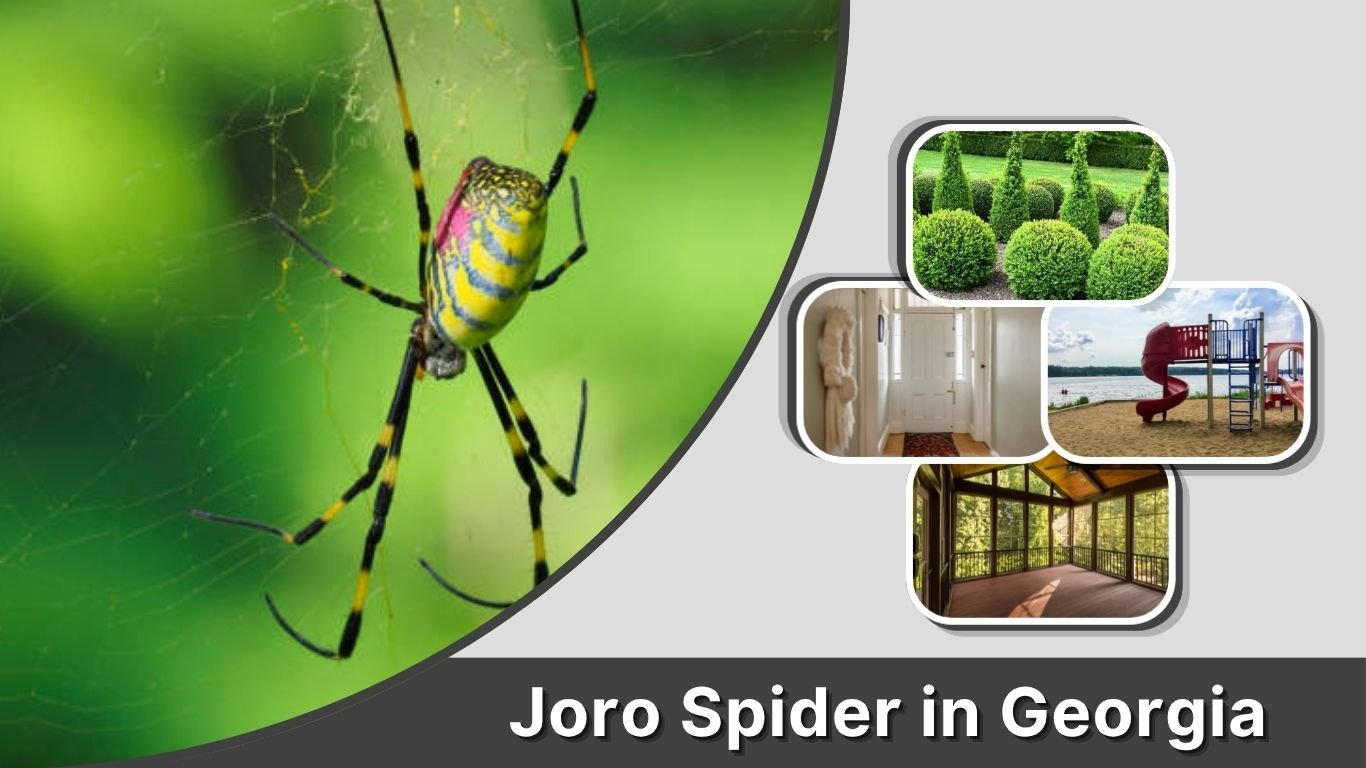
The Joro spider (Trichonephila clavata) is a large, brightly colored orb-weaver now established across Georgia. Native to East Asia, it was first officially detected in northeast Georgia in 2014 and has since spread into neighboring southeastern states. Joro spiders are most noticeable from late summer through fall, when mature females build large golden webs between trees, buildings, power lines, and landscape plants. Despite their intimidating appearance, they are timid and rarely bite people.
Joro Spider Facts at a Glance
| Feature | Description |
| Scientific name | Trichonephila clavata |
| Native range | East Asia |
| First confirmed in Georgia | 2014 |
| Georgia status | Established non-native species |
| Peak viewing season | September and October |
| Female body length | About 0.67–1.2 inches |
| Web | Large, strong, golden orb web |
| Danger to people | Low; bites are uncommon |
| Main food | Flying insects caught in the web |
The female is much larger and more colorful than the male. A mature female has a yellow abdomen crossed by broad bluish-green bands, red markings underneath, and long black legs with yellow-orange bands.
How Did the Joro Spider Get to Georgia?
Researchers cannot identify the exact shipment or event that introduced the species. However, Joro spiders or their egg sacs most likely arrived accidentally in imported goods, shipping materials, cargo containers, or vehicles from Asia.
They were first documented in northeast Georgia, where they became well established before spreading naturally and through human transportation. Small juvenile spiders can also disperse by releasing silk that catches the wind, a behavior called ballooning.
Where Are Joro Spiders Found in Georgia?
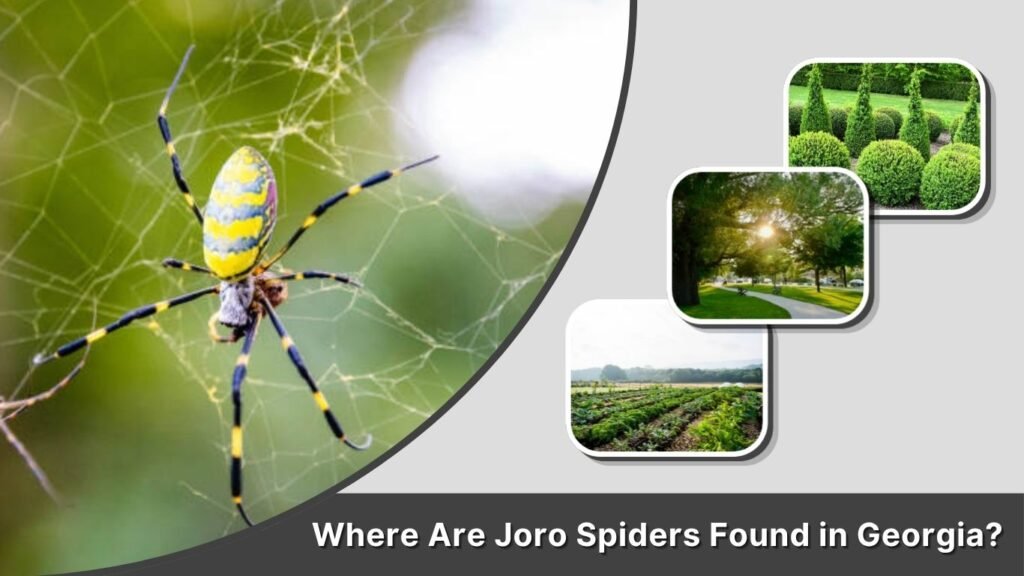
Joro spiders are established in Georgia and are especially familiar in northern and central parts of the state. They have also expanded into North Carolina, South Carolina, Tennessee, and Alabama, with isolated populations recorded farther north.
Common Places to Find Them
Joro spiders commonly build webs:
- Between trees and shrubs
- Along woodland and park edges
- Around porches and decks
- Between utility lines
- Near streetlights
- Across driveways and walkways
- Around sheds, fences, and outbuildings
- In gardens and landscaped areas
Their webs can extend across broad spaces because strong supporting strands connect the central orb to distant trees, structures, or utility lines.
Joro Spider Map and Reporting
The known range changes as new sightings are confirmed. The University of Georgia’s Joro Watch program and EDDMapS maintain updated distribution information using reports from researchers and the public. Residents can submit photographs, locations, and spider counts throughout the year.
When Is Joro Spider Season in Georgia?
Small spiderlings may begin appearing as early as May, but they are difficult to recognize. More mature spiders become easier to detect during late July and August.
Sightings rise sharply in September and typically peak in October. Adult females become sexually mature around September or early October, while egg sacs are generally produced from mid-October through November.
| Time of year | Joro spider activity |
| Winter | Eggs remain protected inside sacs |
| Spring | Spiderlings hatch and begin dispersing |
| Early summer | Juveniles grow but remain relatively inconspicuous |
| Late summer | Webs and growing spiders become easier to see |
| September–October | Adults and large webs are most noticeable |
| October–November | Females produce egg sacs |
| Late fall | Adults die as freezing weather arrives |
Each egg sac may contain approximately 400–500 eggs. The eggs survive winter inside dense white silk before hatching as temperatures rise.
How to Identify a Joro Spider
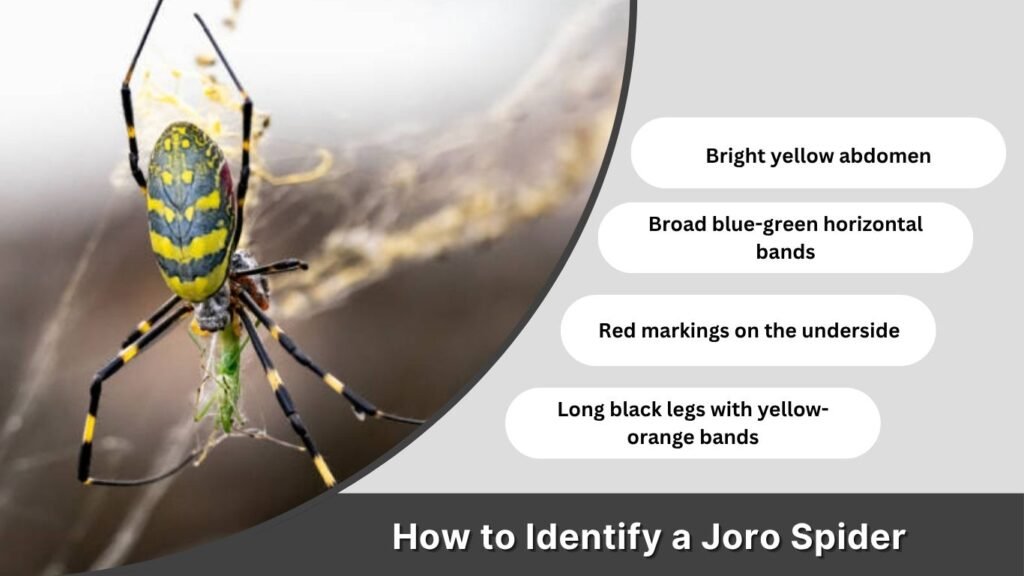
Large females are distinctive, but immature Joros may resemble native garden spiders and golden silk orb-weavers.
Adult Female Identification
Look for:
- Bright yellow abdomen
- Broad blue-green horizontal bands
- Red markings on the underside
- Long black legs with yellow-orange bands
- Body measuring up to approximately 1.2 inches
- Large golden, multilayered web
Including the legs, a mature female may appear several inches across.
Male Joro Spider
Males are only about 0.16–0.31 inches long and are far less colorful. They have a light-brown front body and an elongated greenish-brown abdomen with yellowish stripes. Several small males may occupy the web of one adult female.
Joro Spider vs Golden Silk Orb-Weaver
The native golden silk orb-weaver has silvery spots rather than the Joro’s broad blue-green abdominal bands. It also has orange-yellow legs with dark bands and noticeable black hair tufts near several leg joints.
Joro females generally have smoother-looking black legs marked by narrow yellow or orange bands.
Are Joro Spiders Invasive?
The Joro spider is considered a non-native invasive species in Georgia. However, scientists are still investigating its long-term ecological effects.
Joros eat flying insects, including some pests, but they may also capture bees, butterflies, and other beneficial species. Researchers have not yet determined whether they significantly displace native spiders or cause broader ecosystem damage.
This uncertainty is one reason public reports are useful. Location, abundance, and photo records help researchers track the species and study how its population changes.
Are Joro Spiders Poisonous?
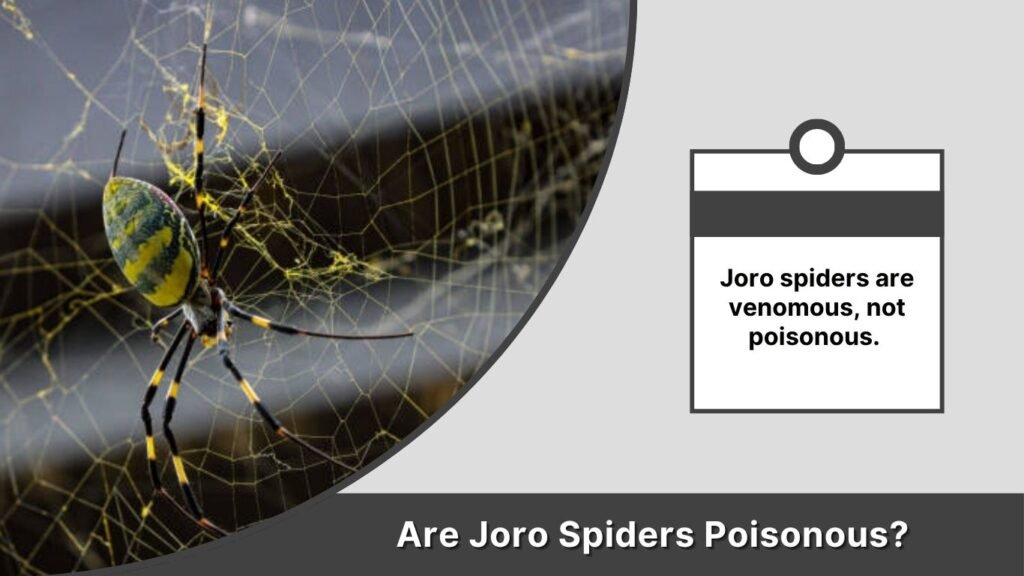
Joro spiders are venomous, not poisonous. They use venom to immobilize insect prey, but their venom is not considered medically significant to humans.
They are timid and usually freeze, retreat, or drop away when disturbed. Bites are rare and generally require the spider to be squeezed or trapped against the skin. A bite may cause temporary pain, redness, itching, swelling, or minor blistering.
Wash a suspected bite with soap and water and apply a wrapped cold pack. Seek medical care for breathing difficulty, facial swelling, widespread hives, worsening pain, spreading redness, pus, or other severe symptoms.
How to Get Rid of Joro Spiders in Georgia
It is usually unnecessary to eliminate every Joro spider on a property. Focus on individuals and webs that interfere with entrances, walkways, porches, play areas, or outdoor seating.
Remove the Spider and Web
Use a long broom, rake, pole, or stick to wrap up the web and remove the spider from the pathway. Wear gloves and avoid handling the spider directly.
Simply knocking down the web may provide only temporary relief because the spider can rebuild. Removing the spider with the web is more effective for a specific unwanted location.
Reduce Web-Building Locations
Trim branches touching porches or walkways, clear excessive vegetation near entrances, and turn off unnecessary outdoor lighting. Lights attract flying insects, which can make nearby areas attractive web sites.
Avoid Widespread Spraying
UGA advises against broad-area insecticide applications for Joro spiders. Most spider insecticides are broad-spectrum products that can also kill bees, butterflies, predatory insects, and native spiders.
Contact treatments may kill individual spiders, but spraying entire yards or fogging landscapes may cause more ecological harm than removing inconvenient webs manually.
Should You Kill Joro Spiders in Georgia?
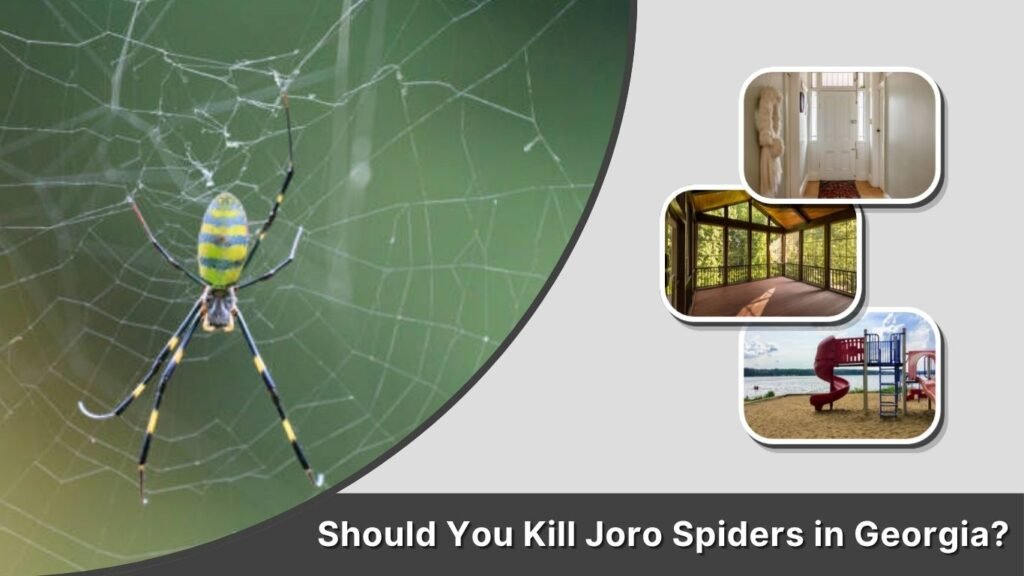
You do not need to kill every Joro spider you find. A web located away from people can generally be left alone.
Removal may be reasonable when a spider builds:
- Across a frequently used doorway
- Over a porch, deck, or walkway
- Near children’s play equipment
- Around a beehive
- Inside a pollinator garden
- Where accidental contact is unavoidable
Rules may prohibit disturbing or killing wildlife on parks and other public lands. In those locations, photograph and report the spider without interfering with it.
FAQs
Are Joro spiders common in Georgia?
Yes. The species is established in Georgia and is especially noticeable from August through October. Its range continues to be monitored through verified reports submitted to Joro Watch and EDDMapS.
Do Joro spiders survive Georgia winters?
Adult spiders normally die after freezing weather arrives. Their egg sacs remain attached to bark, leaves, buildings, and other surfaces throughout winter. Hundreds of spiderlings may hatch from each sac during spring.
Can a Joro spider bite a person?
It can bite, but bites are uncommon. Joro spiders are timid and do not chase or attack people. Most bites would likely occur after the spider is squeezed, handled, or trapped against the skin.
Are Joro spider webs dangerous?
The strong webs can be startling or inconvenient when stretched across walkways, but they are not physically dangerous. The spider generally tries to escape when its web is disturbed rather than attacking the person who walked through it.
How can I report a Joro spider in Georgia?
Take clear photographs and submit the observation through Joro Watch, EDDMapS, or the EDDMapS mobile app. Include the location, number of spiders, and pictures showing identifying features whenever possible.
