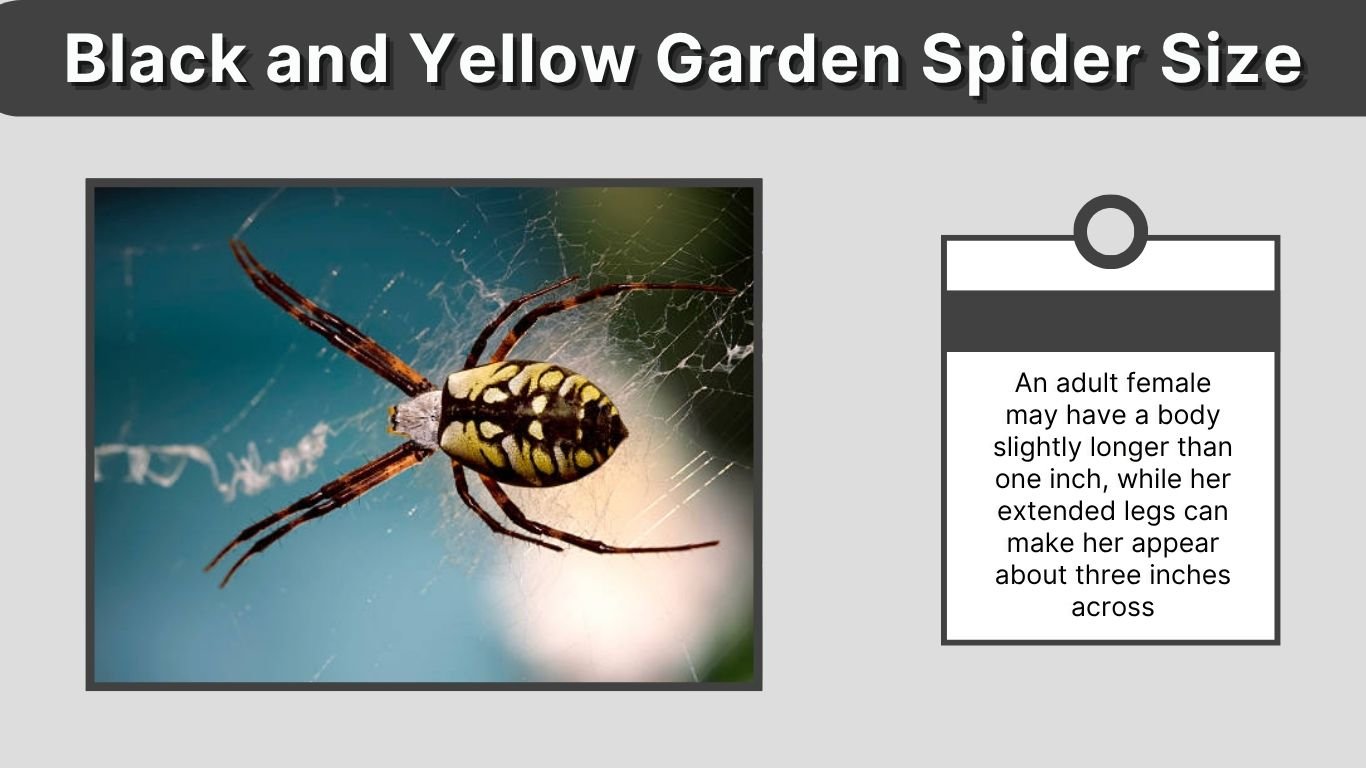
The black and yellow garden spider is one of the largest and most noticeable orb-weavers found in North American gardens. An adult female may have a body slightly longer than one inch, while her extended legs can make her appear about three inches across. Males are dramatically smaller and often go unnoticed beside the female’s large web. Size varies with sex, age, nutrition, and the way the spider holds its legs.
Black and Yellow Garden Spider Size Overview
The black and yellow garden spider, scientifically known as Argiope aurantia, is also called the yellow garden spider, writing spider, zipper spider, and corn spider.
Adult females generally measure 19–28 millimeters, or approximately ¾–1⅛ inches, in body length. Adult males usually measure only 5–8 millimeters, or approximately ¼ inch, excluding their legs.
| Measurement | Adult female | Adult male |
| Body length | ¾–1⅛ inches | About ¼ inch |
| Metric body length | 19–28 mm | 5–8 mm |
| Approximate size with legs | Up to about 3 inches | Usually under 1 inch |
| Body shape | Broad and oval | Thin and narrow |
| General appearance | Large and brightly colored | Small and brownish |
Scientific size measurements normally refer only to the spider’s body—from the front of the cephalothorax to the end of the abdomen—and do not include the legs.
How Big Is a Yellow Garden Spider With Its Legs?
A mature female yellow garden spider commonly appears approximately 2½–3 inches across when her legs are extended. Some individuals may look slightly larger or smaller depending on their posture and how the measurement is taken. University extension material describes a leg span near 2½ inches, while an NC State comparison places the species at approximately three inches across.
The spider often holds its eight legs together in four pairs. This creates an X-shaped posture and may make the animal look narrower than it really is. When the legs are fully spread, its overall size becomes much more impressive.
Body Size vs Leg Span
Body length and total size should not be treated as the same measurement. A female with a one-inch body may appear three inches long when her legs are included.
When comparing photographs or measuring a spider, consider whether the measurement refers to:
- Body length only
- Front-to-back leg span
- Side-to-side width
- Abdomen length
- Web size
Statements claiming that the spider itself is four or five inches long may include the surrounding web, an unusually stretched posture, or an inaccurate visual estimate.
Female Yellow Garden Spider Size
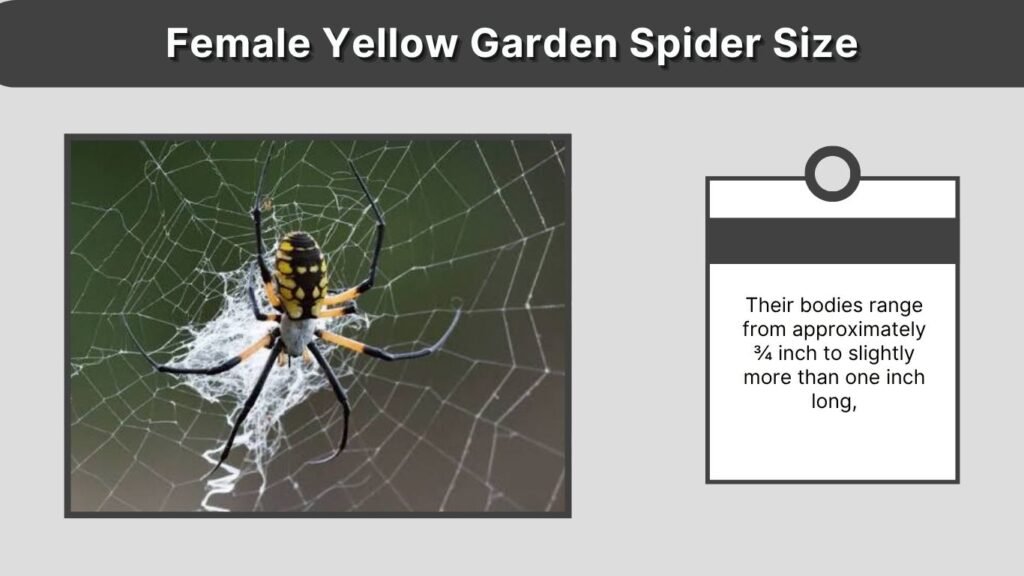
Female black and yellow garden spiders are responsible for the large, decorated webs commonly noticed in late summer. Their bodies range from approximately ¾ inch to slightly more than one inch long, making them among the largest conspicuous orb-weavers in many parts of the United States.
A full-grown female has:
- A broad, egg-shaped abdomen
- Bold black-and-yellow markings
- A silvery cephalothorax
- Long black legs with orange or yellow sections
- A total leg span commonly approaching three inches
Females become especially large before producing egg sacs because their abdomens expand as eggs develop. A well-fed female may therefore look noticeably heavier near the end of summer than she did earlier in the season.
Male Yellow Garden Spider Size
Male yellow garden spiders are much smaller than females. Their bodies usually measure approximately 5–8 millimeters long, although some references place the upper limit near 9 millimeters.
Males are also less colorful. They usually have narrow brown bodies, long slender legs, and less noticeable yellow patterning. Their small size allows them to remain near a female’s web without immediately attracting attention.
A male may appear to be a baby spider, but mature males can be distinguished by their enlarged pedipalps—the short appendages located near the mouth.
Male vs Female Size Comparison
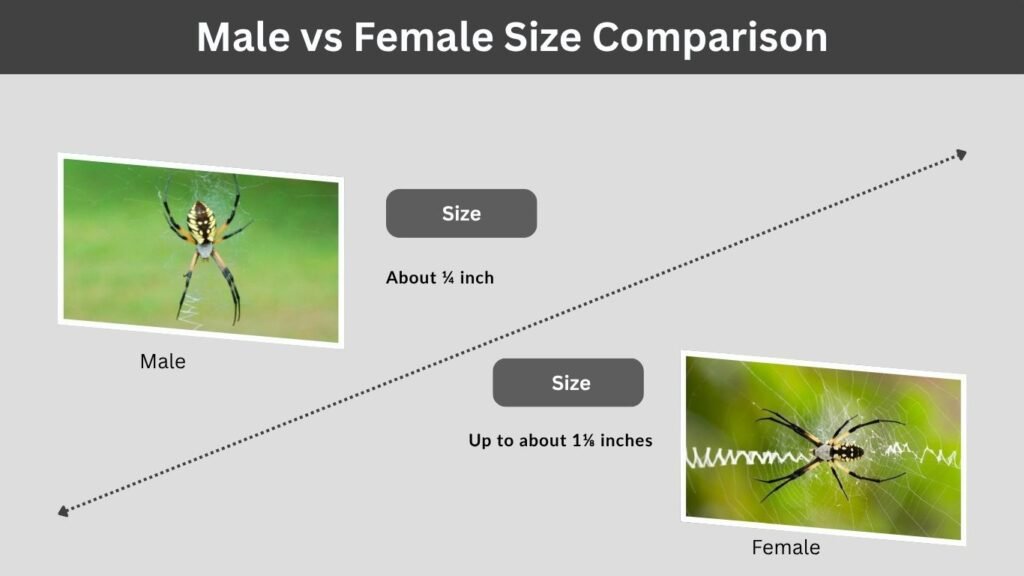
The size difference between male and female yellow garden spiders is an example of sexual dimorphism. Females may be approximately three or four times longer in body length and many times heavier than males.
| Feature | Female | Male |
| Body length | Up to about 1⅛ inches | About ¼ inch |
| Build | Heavy and rounded | Thin and delicate |
| Color | Bright yellow and black | Mostly brown |
| Location | Center of the large web | Edge of the female’s web |
| Visibility | Easy to notice | Frequently overlooked |
The enormous difference often causes people to assume that the male and female belong to separate species.
How Fast Do Yellow Garden Spiders Grow?
Yellow garden spiders begin life as tiny spiderlings. They emerge from their protective egg sacs, disperse on silk, and grow by repeatedly shedding their exoskeletons.
Juveniles remain much smaller than adults during spring and early summer. Their growth becomes especially noticeable during warm months when insects are abundant. By late summer, mature females have reached their maximum size and become highly visible in gardens and fields. Adult spiders are too large to disperse by ballooning, although younger spiderlings commonly use this method.
What Affects Their Final Size?
Several factors influence the size of an individual spider:
- Biological sex
- Age and developmental stage
- Amount of available prey
- Temperature and growing season
- Health and parasite exposure
- Time since its most recent molt
- Whether the female is carrying eggs
A small yellow garden spider may simply be an immature female rather than an adult male.
Yellow Garden Spider Size Comparison
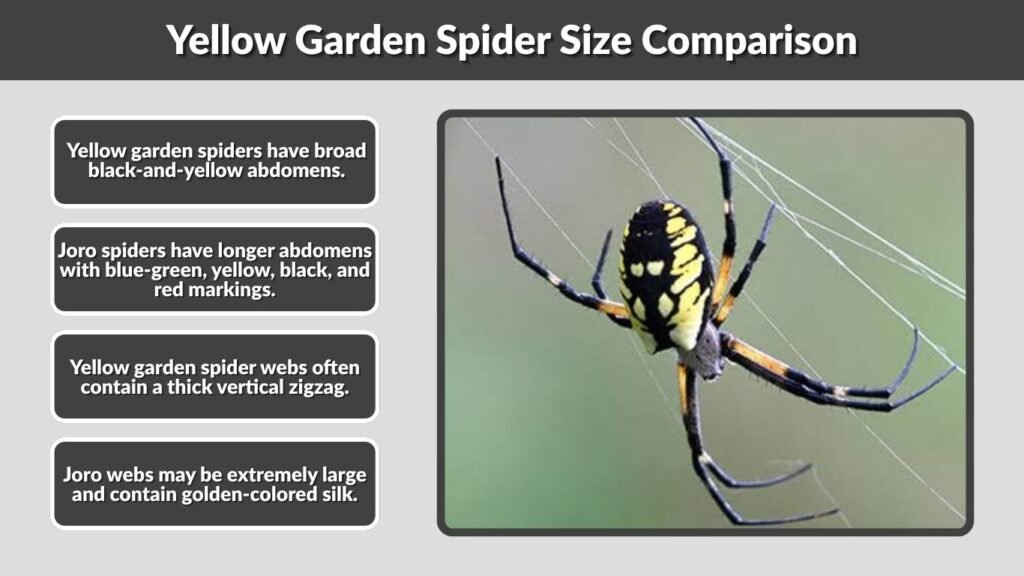
A large female yellow garden spider has a body roughly comparable in length to a U.S. quarter or the end section of an adult thumb. With her legs extended, she may cover an area similar to a credit card’s shorter dimension.
Despite this impressive appearance, most of the spider’s visible size comes from its long, lightweight legs. Its actual body is much smaller than the entire outline suggests.
Yellow Garden Spider vs Joro Spider
Female Joro spiders are generally somewhat larger overall. A mature Joro spider may have a leg span approaching four inches, compared with approximately three inches for a black and yellow garden spider.
The species can also be distinguished by appearance:
- Yellow garden spiders have broad black-and-yellow abdomens.
- Joro spiders have longer abdomens with blue-green, yellow, black, and red markings.
- Yellow garden spider webs often contain a thick vertical zigzag.
- Joro webs may be extremely large and contain golden-colored silk.
Yellow Garden Spider vs Banded Garden Spider
The banded garden spider, Argiope trifasciata, is a related orb-weaver that may be confused with the yellow garden spider. Female banded garden spiders usually measure approximately 20–30 millimeters long, while males measure approximately 15–20 millimeters, according to UF/IFAS.
The female banded garden spider may therefore have a body similar in length to a yellow garden spider, but its abdomen is more elongated and covered with numerous thin horizontal bands.
How Big Is the Web?
The spider’s web is much larger than the spider itself. A female may build an orb web up to approximately two feet across. She usually rests head-down at the center, where she can detect vibrations created by trapped insects.
The web often contains a thick white zigzag called a stabilimentum. This structure makes both the web and its occupant easier to recognize.
A large web can make the spider appear even bigger, particularly when it is positioned at eye level between tall plants.
Does a Larger Yellow Garden Spider Mean More Danger?
A larger female is not necessarily more aggressive or dangerous. Black and yellow garden spiders are orb-weavers that depend on their webs to catch insects. They do not chase people and usually remain still, shake the web, retreat, or drop into vegetation when disturbed.
Their venom is used to subdue insect prey. Although a defensive bite is possible if the spider is grabbed or trapped against the skin, the species is not considered medically dangerous to most people.
The best approach is to observe the spider without handling it. Its large size allows it to capture grasshoppers, flies, moths, wasps, and other garden insects.
FAQs
What is the largest size of a black and yellow garden spider?
An adult female may reach approximately 1⅛ inches in body length. When her long legs are extended, she can appear about three inches across. Measurements vary depending on posture and whether only the body or the complete leg span is included.
Why are female yellow garden spiders so large?
Females need a larger body for producing eggs, building substantial webs, and capturing enough prey to support reproduction. Males invest more energy in locating mates and remain dramatically smaller and lighter than females.
Is a small yellow garden spider a baby?
It may be a juvenile female, an adult male, or a different orb-weaver species. Adult males are only around ¼ inch long and usually brownish, while immature females gradually develop the broad abdomen and bright markings associated with adults.
What is the size of a yellow garden spider egg sac?
The papery, pear-shaped egg sac is commonly around one inch across. It may appear nearly as large as the female’s body and can contain hundreds or sometimes more than 1,000 eggs.
Are yellow garden spiders bigger than wolf spiders?
It depends on the wolf spider species. Some wolf spiders have larger or heavier bodies, while a yellow garden spider may appear larger because of its long legs. Yellow garden spiders remain in orb webs, whereas wolf spiders actively hunt on the ground.
