
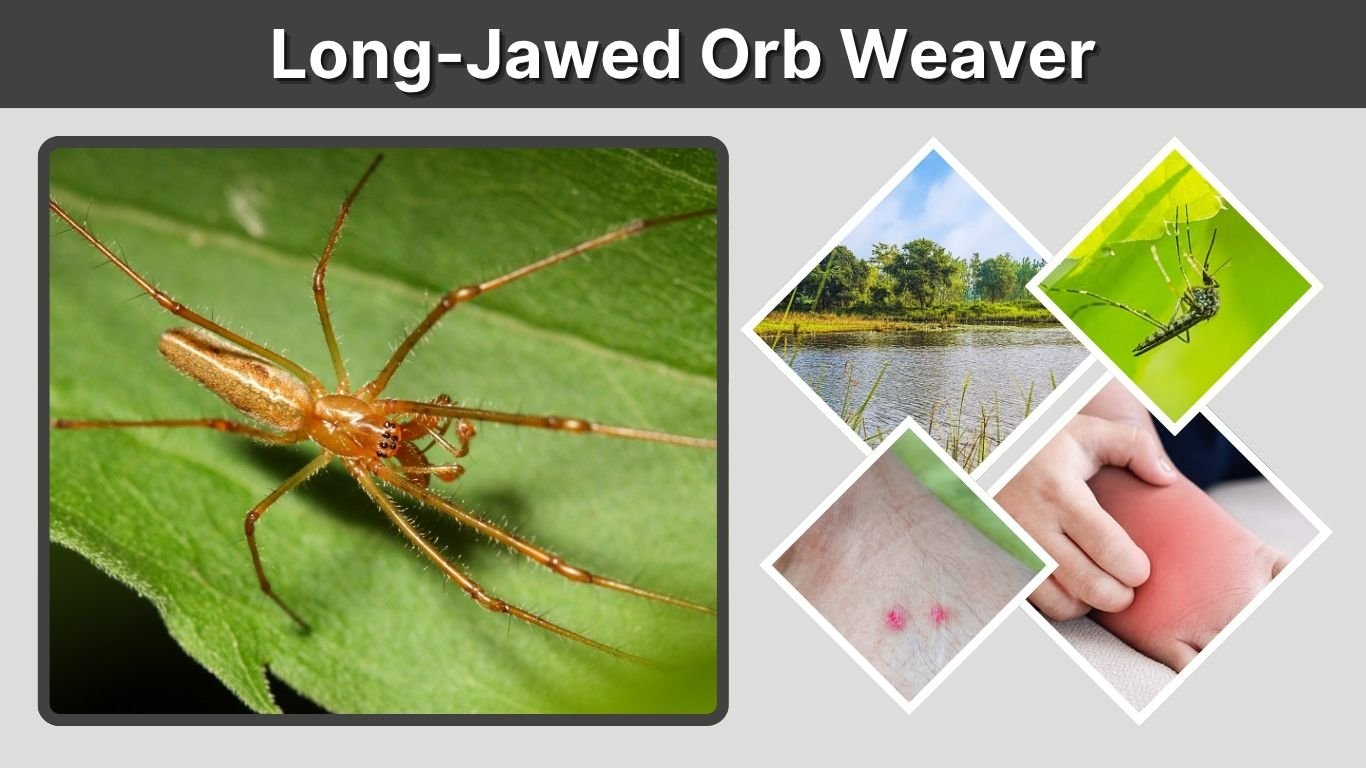
The long-jawed orb weaver is a slender, long-legged spider commonly found around ponds, streams, wetlands, gardens, and grassy fields. Its noticeably elongated jaws may look intimidating, but this spider is not considered dangerous to humans. Long-jawed orb weavers are beneficial predators that build delicate circular webs to capture mosquitoes, midges, mayflies, and other flying insects. Their narrow bodies and unusual resting posture also help them blend almost perfectly with grass stems and small twigs.
What Is a Long-Jawed Orb Weaver?
The spiders most commonly called long-jawed orb weavers belong to the genus Tetragnatha. They are members of the family Tetragnathidae, which also contains orchard orb weavers and several related groups.
They are sometimes called stretch spiders because they rest with their front legs extended forward and their rear legs pointing backward. In this position, the spider’s narrow body resembles a blade of grass or small twig.
| Feature | Description |
| Scientific name | Tetragnatha species |
| Family | Tetragnathidae |
| Other name | Stretch spider |
| Body length | Usually no more than about ½ inch |
| Common colors | Green, silver, brown, tan, yellow or gray |
| Habitat | Wetlands, shorelines, fields and gardens |
| Diet | Small flying insects |
| Danger to humans | Not considered dangerous |
Long-Jawed Orb Weaver Identification
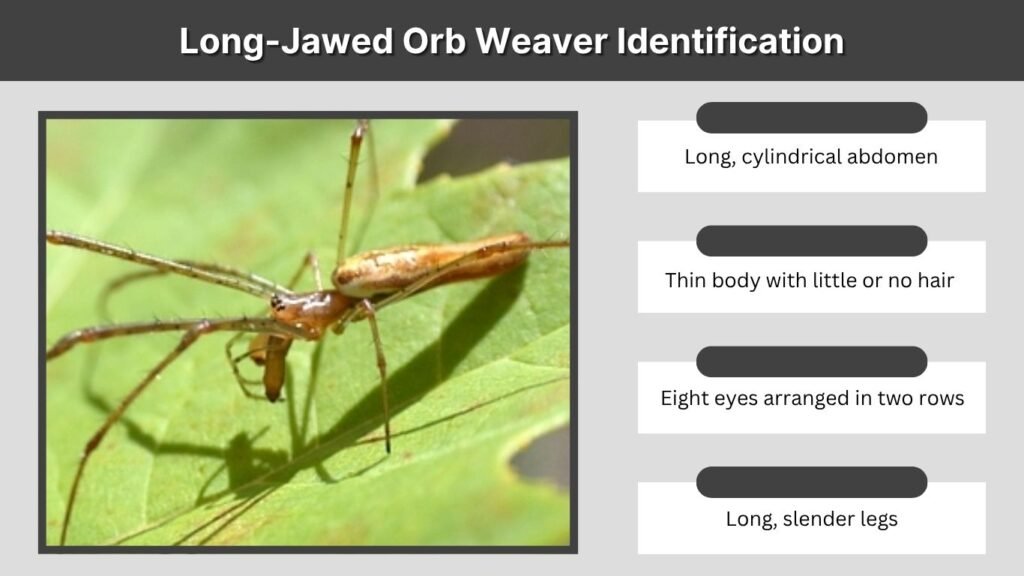
Long-jawed orb weavers have a different body shape from the round, heavy-bodied garden orb weavers many people recognize. Their bodies are narrow, and their legs are extremely long compared with their overall size.
Identification Features
- Long, cylindrical abdomen
- Thin body with little or no hair
- Eight eyes arranged in two rows
- Long, slender legs
- First pair of legs usually the longest
- Enlarged chelicerae or jaws
- Green, silver, brown, yellow or gray coloring
- Horizontal or slightly angled circular web
- Twiglike resting posture
The spider often holds onto a grass blade with its shorter third pair of legs while stretching the remaining legs along the plant. This camouflage can make it difficult to notice even when it is directly in front of you.
Why Does It Have Long Jaws?
The structures commonly described as jaws are called chelicerae. They hold the spider’s fangs and help it grip prey.
Male long-jawed orb weavers usually have especially prominent chelicerae. During mating, the male and female may lock their jaws together. This positioning apparently helps protect the smaller male while he transfers sperm to the female. The name Tetragnatha roughly refers to a “four-jawed” appearance created by the long chelicerae and nearby palps.
Long-Jawed Orb Weaver Size
Most commonly encountered long-jawed orb weavers have a body measuring less than approximately ½ inch, excluding the legs. However, size varies considerably because the family includes numerous species. BugGuide reports a broad family-wide body-length range of approximately 1.2–25 millimeters.
Females are generally larger and have fuller abdomens, while mature males tend to be slimmer and possess more noticeable jaws and enlarged pedipalps.
Green vs. Silver Long-Jawed Orb Weavers
Color alone cannot always identify a species, but two North American species are frequently associated with green and silver appearances.
| Type | Scientific name | Identification |
| Green long-jawed orb weaver | Tetragnatha viridis | Bright green body; frequently associated with pine trees |
| Silver long-jawed orb weaver | Tetragnatha laboriosa | Silvery abdominal patches with brown, tan or greenish areas |
Tetragnatha viridis occurs in the eastern United States and southeastern Canada. The silver long-jawed orb weaver, Tetragnatha laboriosa, occurs across the United States and Canada; reported body lengths are approximately 5.2–9 millimeters for females and 3.8–7.4 millimeters for males.
Some spiders may also appear red, blue-green, golden or metallic because of natural variation, lighting and reflections from their smooth bodies.
Long-Jawed Orb Weaver Habitat
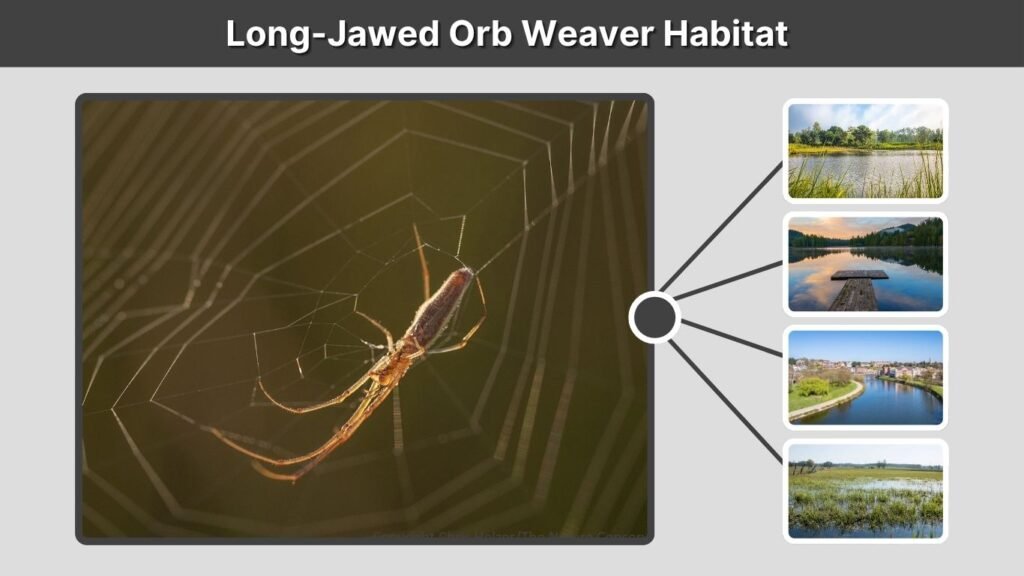
Large long-jawed orb weavers are strongly associated with water. They commonly live on reeds, grasses, shrubs and low branches surrounding:
- Ponds
- Lakes
- Rivers
- Streams
- Marshes
- Swamps
- Wet meadows
- Docks and piers
Their webs are often built within a few feet of the water. Smaller species may occur farther away in grasslands, agricultural fields, gardens and open forests. When they leave the web, the spiders hide beneath branches, leaves, railings and other sheltered surfaces.
Where Are Long-Jawed Orb Weavers Found?
Members of the group occur across the United States and southern Canada. Therefore, long-jawed orb weavers may be encountered in Florida, Texas, California, Washington, Kansas, Ohio, Michigan, Minnesota, Virginia, Colorado and North Dakota, although the exact species differs by location. They are also represented in Alberta and other suitable Canadian regions.
Long-jawed spiders also occur in the UK, Australia and many other parts of the world. For example, Tetragnatha extensa is considered common and widespread across Britain. Australian long-jawed orb weavers may belong to different regional species within the same family.
Long-Jawed Orb Weaver Web
The spider builds a traditional wheel-shaped orb web, but its web is usually more open and contains fewer spokes than the web of many true orb weavers. It is commonly positioned horizontally or at a slight angle rather than standing completely vertically.
This position is especially effective above water. Recently emerged aquatic insects fly upward and become trapped in the sticky silk. Webs may be suspended between reeds, grasses, shoreline plants, dock railings or low tree branches.
When disturbed, the spider may drop from the web on a safety line. Some long-jawed orb weavers can also move across the water’s surface after falling from vegetation.
What Do Long-Jawed Orb Weavers Eat?
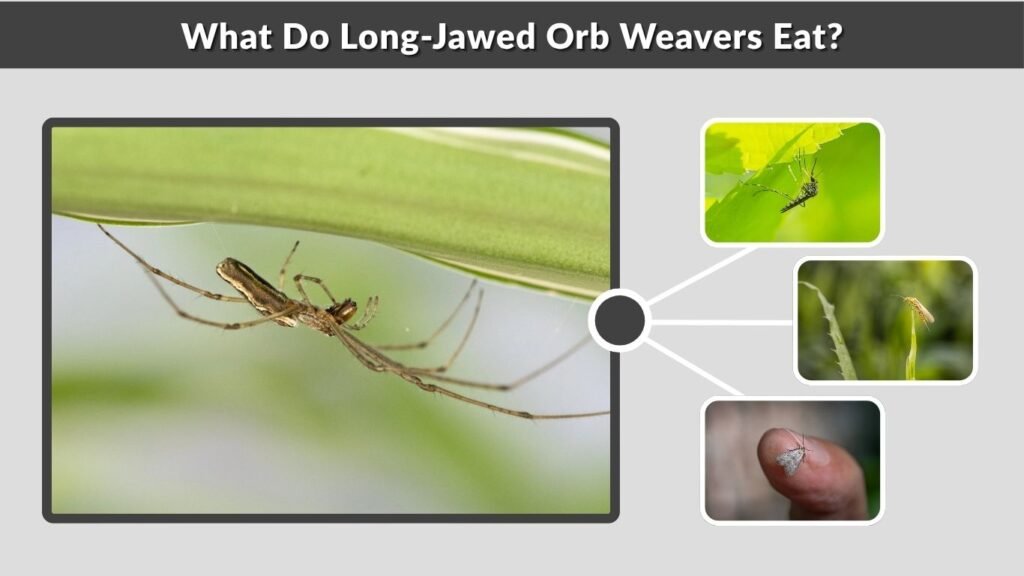
Long-jawed orb weavers primarily eat small flying insects. Common prey includes:
- Mosquitoes
- Midges
- Mayflies
- Stoneflies
- Gnats
- Small moths
- Lacewings
- Adult antlions
- Small flies
When an insect becomes entangled, the spider approaches, bites it to deliver immobilizing venom and wraps it in silk. It may eat the prey immediately or save it until later. Because they capture large numbers of insects around wetlands, these spiders provide natural pest control.
Are Long-Jawed Orb Weavers Poisonous?
Long-jawed orb weavers are not poisonous. They are venomous, as they use venom to immobilize insect prey, but their venom is not considered medically dangerous to humans.
These spiders are shy and normally escape, drop from their webs or remain motionless when approached. Spiders in general rarely bite people, and orb weavers are considered harmless despite their sometimes unusual size and appearance.
Long-Jawed Orb Weaver Bite
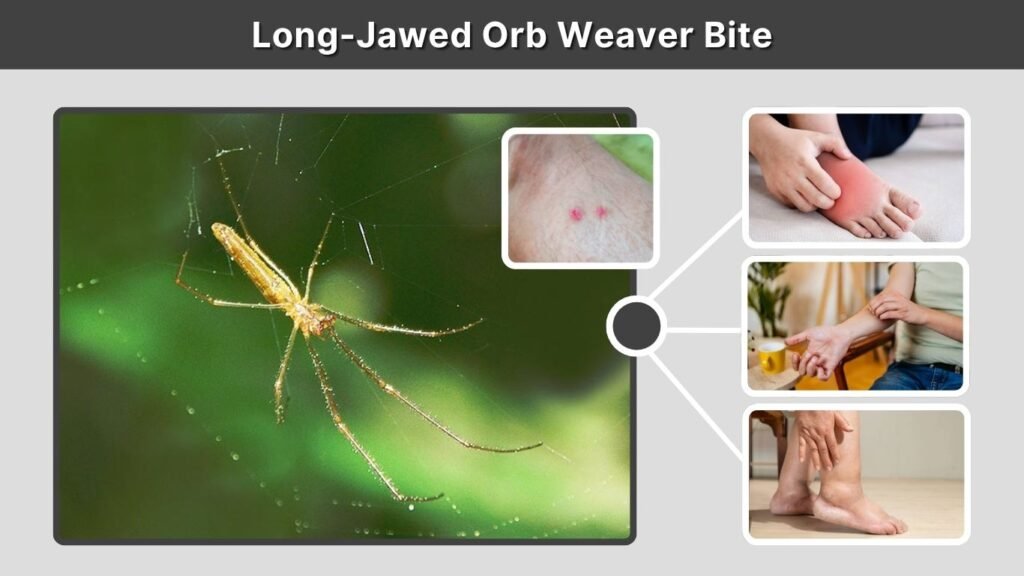
A long-jawed orb weaver may bite if it is trapped against the skin, squeezed or handled roughly. Its long jaws look dramatic, but they are primarily adapted for catching prey and mating rather than attacking people.
A possible bite may cause temporary:
- Pinching or stinging
- Mild redness
- Local swelling
- Itching
- Tenderness around the bite
Wash a suspected bite with soap and water and apply a cloth-wrapped cold pack for 10–20 minutes. Seek medical help when swelling or pain worsens significantly or when symptoms such as hives, wheezing, dizziness or difficulty breathing occur.
Behavior, Reproduction, and Predators
Long-jawed orb weavers remain still for long periods, relying on their narrow bodies and natural coloring to avoid detection. Birds, wasps, larger spiders, frogs and other insect-eating animals may prey on them.
After mating, females place fluffy-looking egg clusters on nearby leaves or plant stems. In temperate regions, adults commonly mature and reproduce during the warmer months. Eggs may survive winter before spiderlings emerge during spring.
FAQs
Is a long-jawed orb weaver dangerous?
No. Long-jawed orb weavers are not considered dangerous to people. They possess venom for immobilizing insects, but they rarely bite unless trapped or handled. A bite would normally be expected to produce only temporary localized discomfort.
Why is the long-jawed orb weaver green?
Green coloring provides camouflage among leaves, grasses and stems. Some species, including Tetragnatha viridis, are naturally bright green, while others may appear greenish, silver, brown or yellow depending on the species and lighting.
Do long-jawed orb weavers eat mosquitoes?
Yes. Mosquitoes and similar small flying insects can become trapped in their orb webs. Spiders living around ponds and wetlands also catch midges, mayflies, stoneflies and other insects emerging from the water.
Do long-jawed orb weavers live inside houses?
They rarely establish themselves indoors. Their preferred habitats are outdoor areas containing vegetation, flying insects and moisture. An individual may occasionally wander into a house but can usually be moved outside safely.
Should I remove a long-jawed orb weaver?
Removal is usually unnecessary because the spider helps control flying insects. When its web blocks a doorway or walkway, gently relocate the spider with a container or remove the web after confirming the spider is no longer occupying it.
