
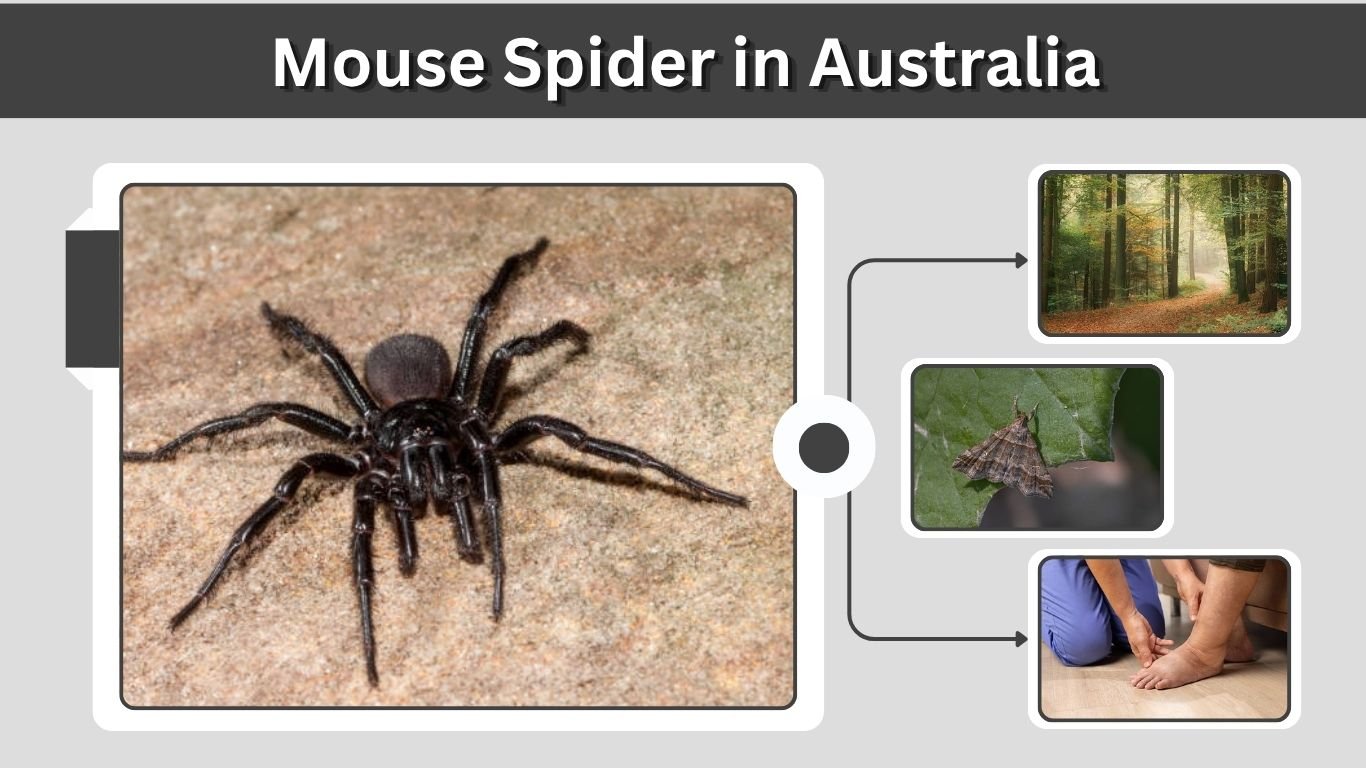
The mouse spider is one of Australia’s most distinctive ground-dwelling spiders. Its glossy body, powerful jaws, and stocky appearance can make it look intimidating—and it is often confused with the more dangerous funnel-web spider. However, mouse spiders spend most of their lives inside underground burrows and rarely interact with people. Although their venom is potentially serious, confirmed bites are uncommon, and severe reactions are rare. Learning how to identify a mouse spider, where it lives, and what to do after a suspected bite can help Australians respond safely.
What Is a Mouse Spider?
Mouse spiders belong to the genus Missulena and the family Actinopodidae. They are mygalomorph spiders, making them relatives of funnel-web spiders, trapdoor spiders, and tarantulas.
Their common name may come from an old belief that they dig mouse-like burrows. Another possibility is that their compact, rounded body was thought to resemble a small mouse. They do not hunt mice and are not closely connected to rodents.
| Feature | Description |
|---|---|
| Scientific genus | Missulena |
| Family | Actinopodidae |
| Body length | Approximately 10–35 mm |
| Colour | Black, dark brown, red, blue or metallic tones |
| Habitat | Underground silk-lined burrows |
| Diet | Insects, spiders and other small invertebrates |
| Activity | Mostly secretive; males wander during mating season |
| Bite risk | Potentially serious but bites are uncommon |
Mouse spiders are native to Australia and occur across much of the mainland. Different species have their own distributions, colours, and periods of activity.
How to Identify a Mouse Spider
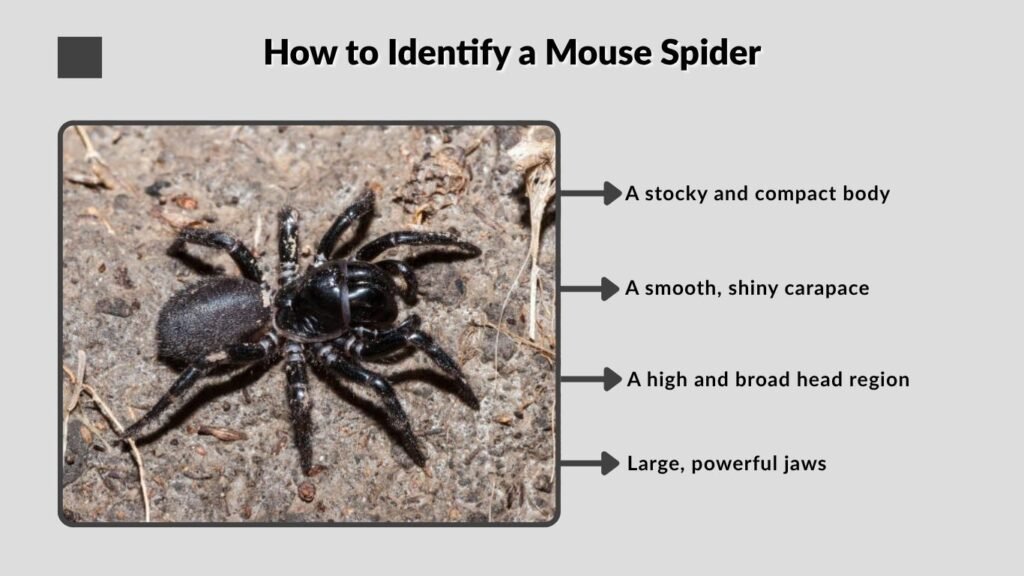
Mouse spiders have a heavy, compact build that distinguishes them from many common garden spiders. Nevertheless, identification based only on colour can be difficult because males and females often look different.
Size and Body Shape
An adult mouse spider generally has a body length of 10–35 mm, excluding the legs. Females are normally larger and heavier than males.
The front section of the body is broad and glossy, while the abdomen is rounded and usually softer in appearance. One of the most noticeable features is the high, bulbous head region. The legs are thick and strong but relatively short compared with those of huntsman and wolf spiders.
Colours and Markings
Female mouse spiders are commonly dark brown or black. Their uniform colouring helps them remain concealed in soil and burrows.
Males can be more colourful. Male eastern mouse spiders may have a pale blue or bluish-grey patch on the abdomen. Male red-headed mouse spiders have a bright red head and jaws combined with a dark blue, grey or black abdomen. Females of the same species are generally dark and do not have the male’s vivid red colouring.
Identification Features
Important mouse spider characteristics include:
- A stocky and compact body
- A smooth, shiny carapace
- A high and broad head region
- Large, powerful jaws
- Thick legs
- Small eyes spread across the front of the head
- Short, blunt spinnerets
- A rounded abdomen
- Bright red or blue colouring in males of some species
The large jaws contain strong fangs capable of penetrating human skin. However, the spider usually uses them to capture prey or defend itself when trapped.
Mouse Spider vs Funnel-Web Spider
Mouse spiders and funnel-web spiders can appear very similar. Both may have glossy black bodies, powerful jaws, thick legs, and an underground lifestyle. Because misidentification could affect medical treatment, people should not handle either spider.
Mouse spiders generally have a more bulbous head, widely spread eyes, and shorter spinnerets. Funnel-web spiders normally have noticeably longer spinnerets extending from the rear of the abdomen. Their fangs may also remain more parallel, while a mouse spider’s fangs can cross slightly.
These differences can be difficult to see without close examination. Therefore, any bite from an unidentified large, dark, heavy-bodied Australian spider should be treated seriously. Do not risk another bite by attempting to examine the spider closely.
Where Do Mouse Spiders Live in Australia?
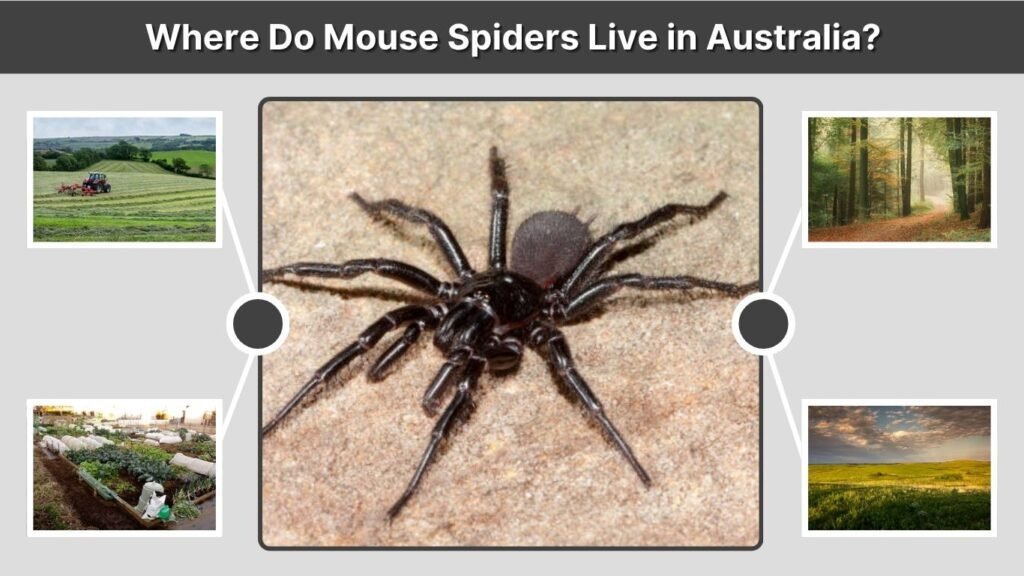
Mouse spiders are distributed across much of mainland Australia. They can inhabit forests, open woodlands, grasslands, semi-arid country, farmland, suburban gardens, and other places with suitable soil.
The red-headed mouse spider has one of the broadest distributions and can be found across mainland Australia. The eastern mouse spider occurs primarily along eastern mainland Australia. Other species may have smaller or more localised ranges.
Their Underground Burrows
Mouse spiders spend most of their lives inside silk-lined burrows dug into soft soil. A burrow may have one or more chambers and an entrance covered by a hinged trapdoor made from silk, soil, and plant material.
Some burrows are relatively shallow, while others can be surprisingly deep. Eastern mouse spider burrows may reach up to one metre in suitable soil. The camouflaged door makes an occupied burrow difficult to notice from above, according to Museums Victoria.
The burrow protects the spider from predators, heat, cold, and water loss. It also provides a safe place for females to lay eggs and raise their spiderlings.
Diet and Hunting Behaviour
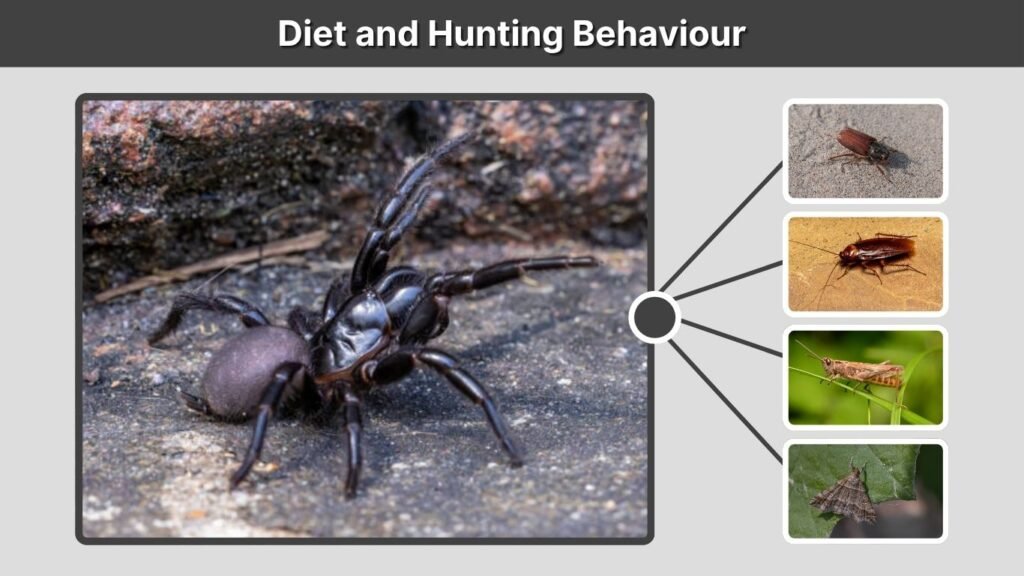
Mouse spiders are predators that help control populations of insects and other small animals. Their diet can include beetles, cockroaches, crickets, moths, ants, other spiders, and small ground-dwelling invertebrates.
Rather than building a web to catch flying insects, a mouse spider usually waits inside or near its burrow. It detects vibrations made by prey walking across the surrounding ground or silk trip lines. The spider then rushes forward, bites the prey, and pulls it into the burrow.
The venom immobilises the prey, while digestive fluids begin breaking down its internal tissues. Like other spiders, the mouse spider consumes liquefied material rather than chewing solid food.
Behaviour and Life Cycle
Female mouse spiders are highly sedentary and may remain in the same burrow for many years. Males become more visible after reaching maturity because they leave their burrows to search for females.
Depending on the species and local climate, wandering males may be seen during autumn, early winter, or after rainfall. They sometimes cross gardens, footpaths, driveways, and roads. Some fall into swimming pools and become trapped.
After mating, the female produces an egg sac inside her protected burrow. The young initially remain with their mother before dispersing. Mouse spiderlings of some species can release silk and travel through the air, a behaviour known as ballooning. This helps them colonise areas beyond their mother’s burrow.
Are Mouse Spiders Dangerous?
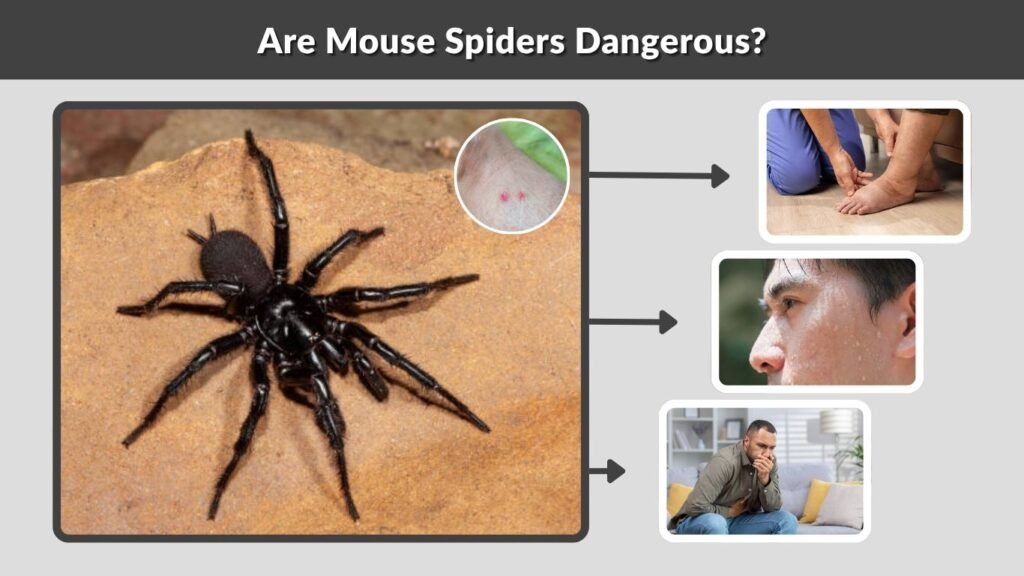
Mouse spiders should be treated as medically significant. Their venom contains neurotoxic components with similarities to those found in funnel-web spider venom. Nevertheless, a potentially powerful venom does not mean that every bite causes severe poisoning.
Most confirmed mouse spider bites have produced minor or moderate effects. A review of documented cases found that severe envenomation was rare and much less common than with funnel-web bites. Some bites may deliver little or no venom, commonly called a dry bite.
Possible symptoms include:
- Immediate pain around the bite
- Redness or swelling
- Tingling or numbness
- Sweating
- Headache
- Nausea or vomiting
- Muscle twitching or spasms
- Breathing difficulty
- Confusion or loss of consciousness
Serious symptoms require immediate emergency treatment. Children and people who develop rapidly worsening symptoms may face greater risks.
What to Do After a Suspected Bite
Call Triple Zero (000) immediately if someone is bitten by a suspected mouse spider, funnel-web spider, or unidentified large black spider. Keep the person calm and still while waiting for professional instructions.
Australian first-aid sources currently differ about pressure immobilisation for a positively identified mouse spider. Healthdirect recommends it for suspected mouse-spider or unidentified large-black-spider bites, while the Australian Venom Research Unit says it is not currently recommended for a confirmed mouse-spider bite. Because distinguishing a mouse spider from a funnel-web can be extremely difficult, follow the emergency dispatcher’s instructions for the specific situation. Healthdirect advises treating a bite from an unidentified big black spider as a medical emergency.
Do not cut the wound, suck out the venom, apply a tight arterial tourniquet, or attempt to capture the spider by hand. If it can be done without danger, take a clear photograph from a safe distance. Never delay medical assistance to catch or identify the spider.
Preventing Mouse Spider Encounters
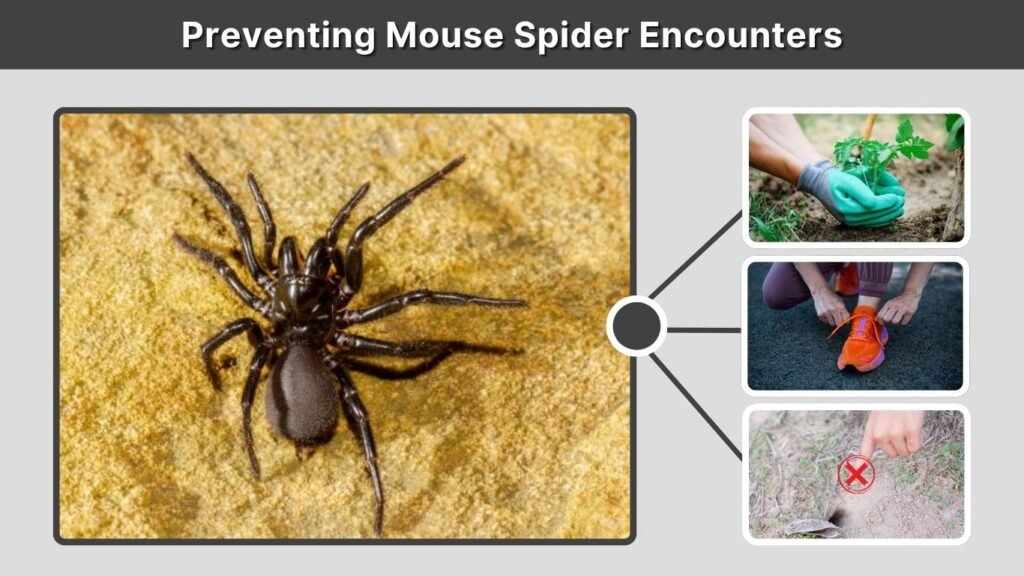
Mouse spiders do not normally seek out people or deliberately enter homes. Wandering males may accidentally reach garages, sheds, pools, or ground-level rooms.
You can reduce accidental encounters by wearing gloves while gardening, checking shoes left outdoors, and using footwear when walking outside at night. Avoid placing fingers into visible soil holes or underneath logs, stones, pots, and garden materials.
Seal gaps beneath exterior doors and repair damaged window screens. Keep clothing, towels, toys, and footwear off the ground in garages and outdoor areas. If a mouse spider appears in an unsafe location, contact a professional spider relocator instead of touching it.
FAQs
Can a mouse spider kill a human?
Mouse spider venom can potentially cause serious neurotoxic symptoms, but severe envenomation is rare. Most confirmed bites have caused only local or moderate effects. Every suspected bite should still receive urgent professional assessment because mouse spiders can be confused with highly dangerous funnel-web spiders.
Are mouse spiders aggressive?
Mouse spiders are not naturally interested in attacking humans. Females usually stay inside their burrows, while males wander to find mates. A spider may raise its front legs, display its fangs, or bite when trapped, squeezed, handled, or threatened.
Do mouse spiders enter houses?
They do not normally live inside houses. Wandering males can accidentally enter buildings through open doors or gaps, particularly during mating periods or after changing weather. They may also become trapped in garages, sheds, and swimming pools.
Where are red-headed mouse spiders found?
Red-headed mouse spiders occur across mainland Australia, although their abundance varies between regions. Adult males are easy to recognise by their bright red head and jaws. Females are dark brown or black and are considerably more difficult to distinguish from other burrowing spiders.
Should I kill a mouse spider in my garden?
Killing it is usually unnecessary. Mouse spiders are native predators that control insects and normally avoid people. Keep children and pets away, do not handle it, and allow it to move away. In a high-risk location, ask an experienced professional to relocate it safely.
