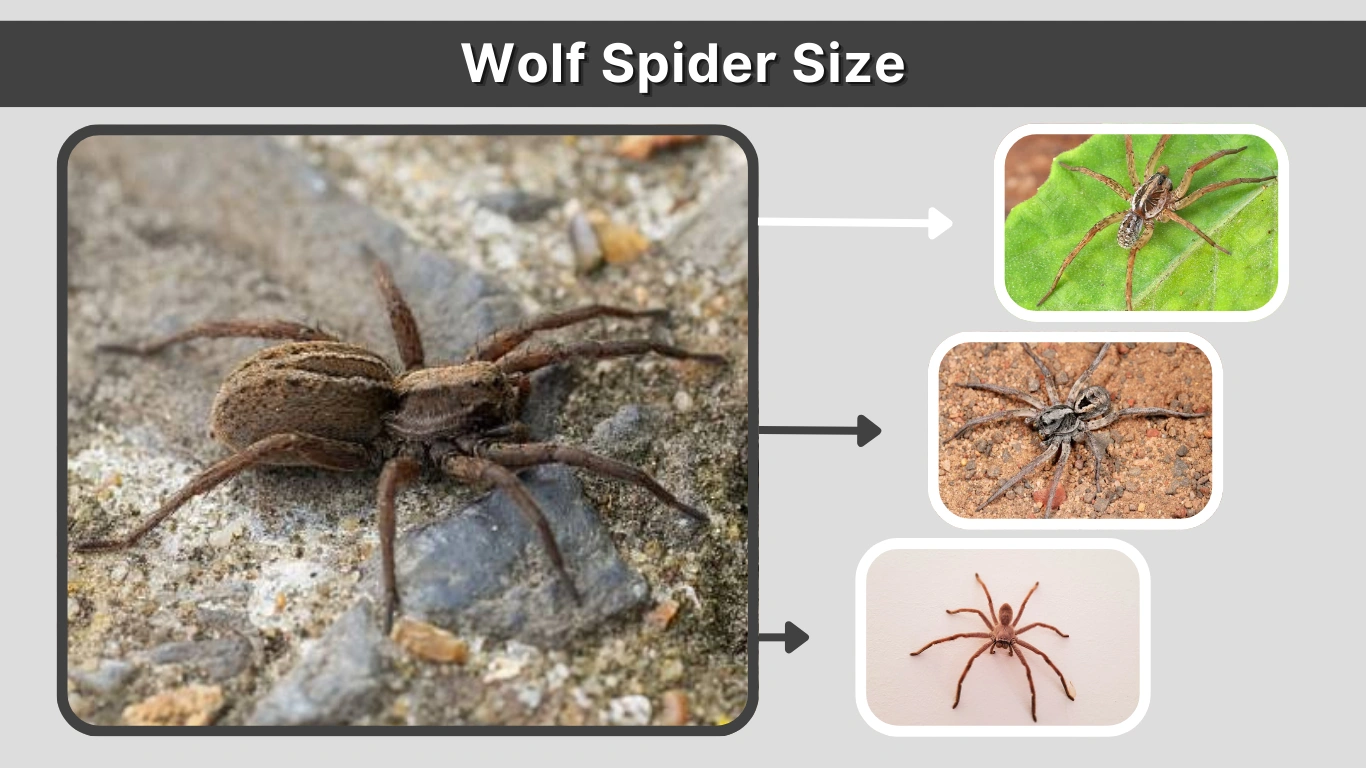
Wolf spiders are known for their speed, hunting skills, and intimidating appearance. But one of the most common questions people ask is about wolf spider size. How big do they really get? While they can look huge when spotted indoors, most wolf spiders are smaller than people think. However, some species—like the Carolina wolf spider—can grow surprisingly large. In this guide, we’ll break down the average wolf spider size, maximum size, regional differences, and how they compare to other spiders.
What Is the Average Size of a Wolf Spider?
The average wolf spider size ranges from ½ inch to 2 inches in body length. When including their legs, their total leg span can reach 2 to 4 inches depending on the species.
Here’s a clearer breakdown:
- Body length: 0.5–2 inches
- Leg span: 2–4 inches
- Weight: Very light, usually less than 1 gram
Most adult wolf spiders fall between 1 and 1.5 inches long (body only). If you’re wondering about a wolf spider’s full size, remember that their legs make up much of their visible size, which is why they often look larger than they truly are.
The average size of a wolf spider also depends on gender. Females are typically larger and bulkier than males. Males tend to have longer legs but slimmer bodies.
Wolf Spider Maximum Size: How Big Is the Biggest One?
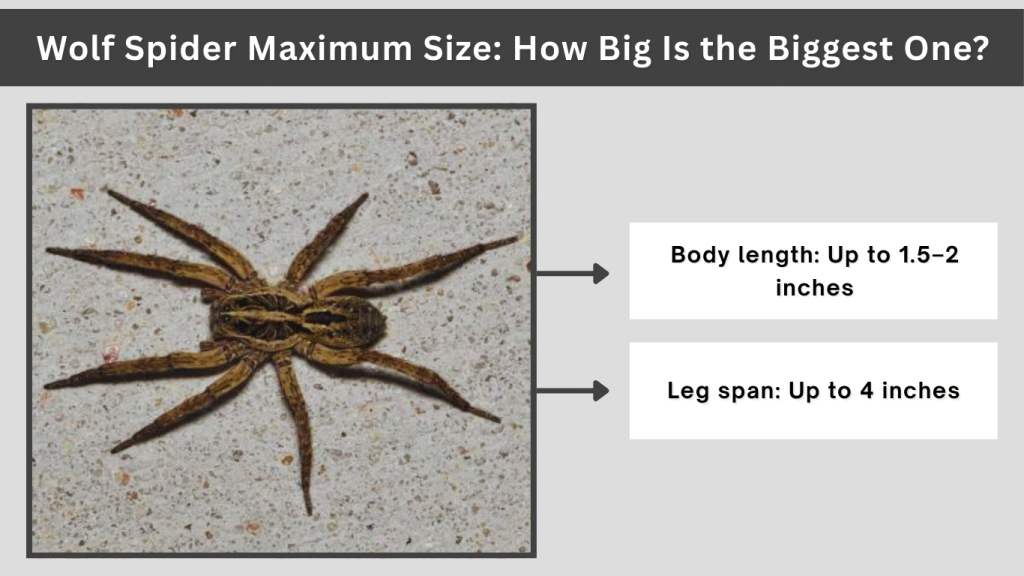
When people search for the wolf spider biggest size or wolf spider maximum size, they’re usually thinking of the largest North American species.
The biggest wolf spiders can reach:
- Body length: Up to 1.5–2 inches
- Leg span: Up to 4 inches
That’s about the size of a small mouse when fully stretched out. However, even at their maximum size, wolf spiders are still smaller than tarantulas.
The terms giant wolf spider size or large wolf spider size often refer to these bigger species, especially the Carolina wolf spider. While they can look enormous in photos, they rarely exceed a 4-inch leg span.
Carolina Wolf Spider Size (The Largest in the U.S.)
The Carolina wolf spider (Hogna carolinensis) is the largest wolf spider species in the United States.
Typical Carolina wolf spider size:
- Body length: 1–1.5 inches
- Leg span: 3–4 inches
When people search for giant Carolina wolf spider size or Carolina wolf spider size with legs, this is usually the spider they’re referring to.
These spiders are commonly found in:
- Texas
- Florida
- Arizona
- California
- Southern states
Despite their impressive size, they are not aggressive and prefer to run rather than bite.
Wolf Spider Size by State
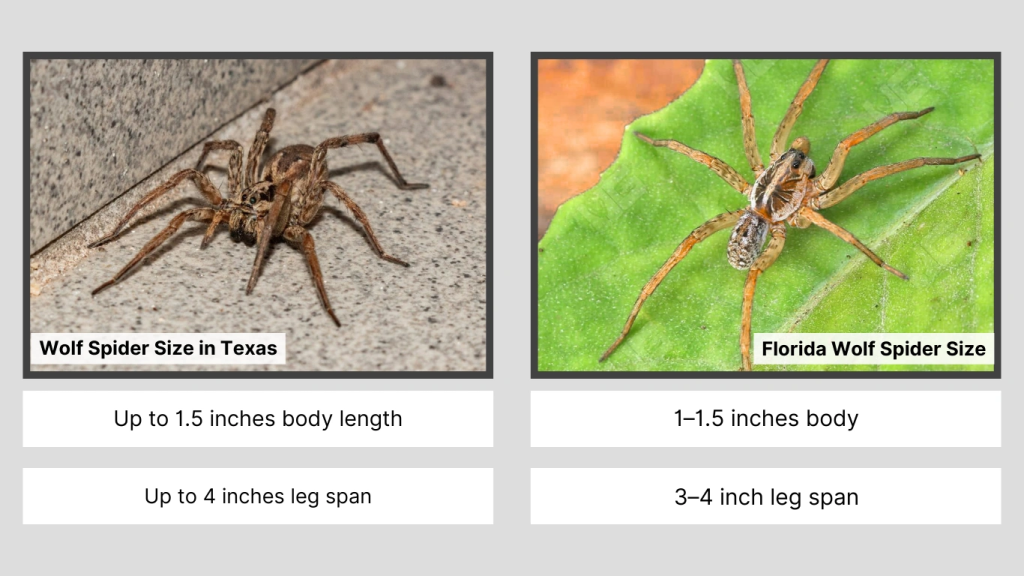
Many searches focus on regional size differences, such as wolf spider Texas size or wolf spider Florida size. The truth is that wolf spider size depends on the species in that area—not the state itself.
Wolf Spider Size in Texas
In Texas, the Carolina wolf spider is common. That means:
- Up to 1.5 inches body length
- Up to 4 inches leg span
So when people search Texas wolf spider size, they’re often seeing one of the larger species.
Florida Wolf Spider Size
Florida also hosts large wolf spiders. Typical sizes:
- 1–1.5 inches body
- 3–4 inch leg span
Florida’s warm climate supports larger spider growth, which explains why many sightings there seem “giant.”
Michigan and Northern States
In Michigan, Minnesota, Maine, and other northern states, wolf spiders are usually slightly smaller:
- 0.5–1.25 inches body
- 2–3 inches leg span
Colder climates often support smaller species like the rabid wolf spider.
Western States (Arizona, California, Colorado)
Western states like Arizona and California can have larger desert-adapted wolf spiders. Sizes are similar to Texas varieties, especially in warmer regions.
Male vs Female Wolf Spider Size
There is a noticeable difference between male and female wolf spider size.
- Female wolf spiders: Larger, heavier-bodied
- Male wolf spiders: Smaller bodies, longer legs
Females can be up to 25% larger than males. If you see a particularly big wolf spider carrying a white ball underneath her abdomen, that’s a female carrying her egg sac.
Pregnant wolf spiders often appear even larger due to the egg sac attached to their spinnerets.
Giant Wolf Spider Species Around the World
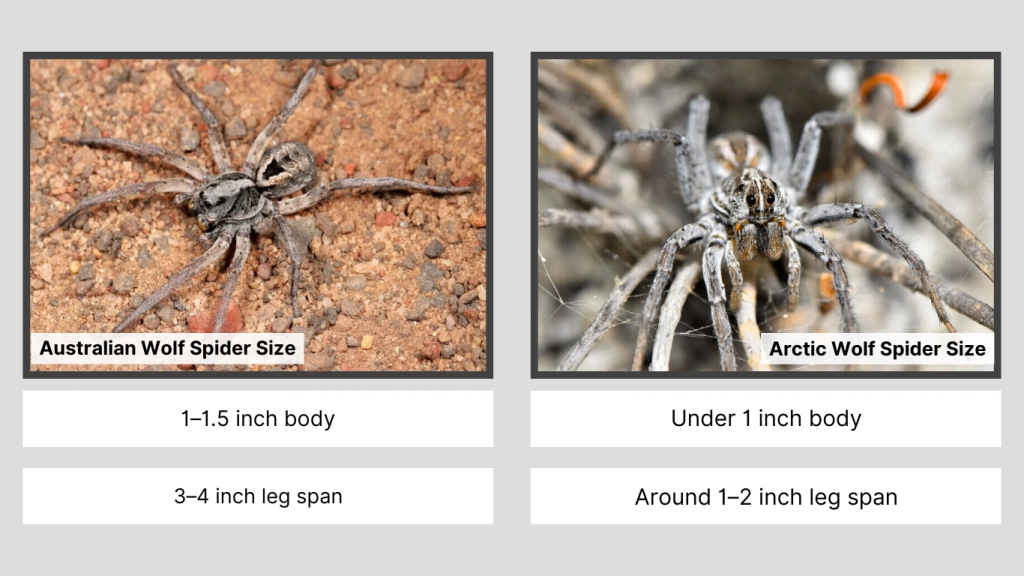
Wolf spiders are found worldwide, and some international species grow quite large.
Australian Wolf Spider Size
Australian wolf spiders can reach similar sizes to the Carolina wolf spider:
- 1–1.5 inch body
- 3–4 inch leg span
Arctic Wolf Spider Size
Arctic wolf spiders are much smaller:
- Under 1 inch body
- Around 1–2 inch leg span
Cold environments limit their growth.
Other Notable Species
- Spanish wolf spider: Medium-sized
- Chinese wolf spider: Around 1 inch body
- Desert wolf spider: Often larger in warm climates
Despite rumors, no wolf spider grows to tarantula-level size.
Wolf Spider Size Comparison: How Do They Stack Up?
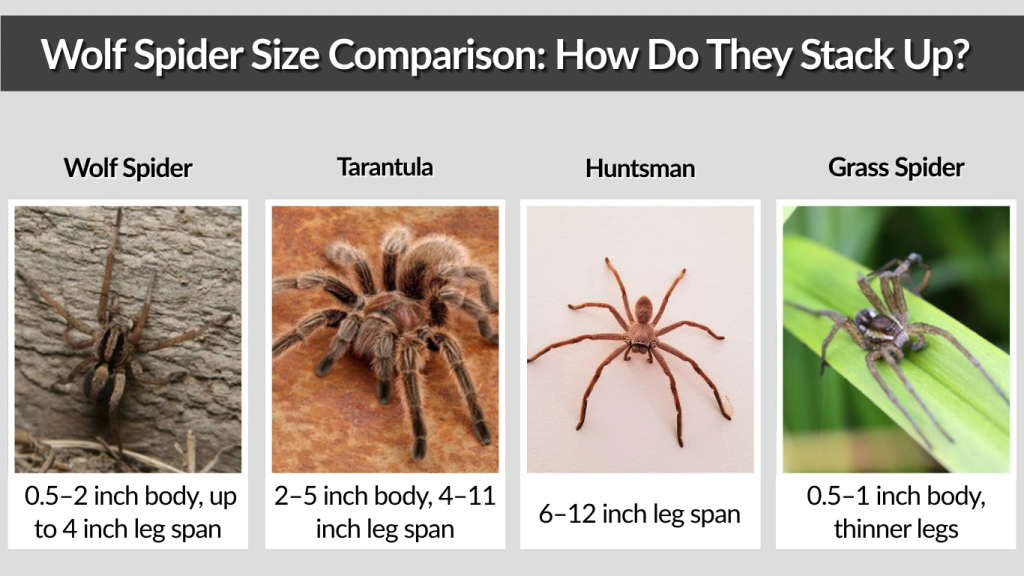
Many people search for comparisons like wolf spider vs tarantula size or brown recluse vs wolf spider size because wolf spiders often look much larger than they really are. Let’s break down the differences.
Wolf Spider vs Tarantula Size
One of the most common comparisons is wolf spider vs tarantula size.
- Wolf spider: 0.5–2 inch body, up to 4 inch leg span
- Tarantula: 2–5 inch body, 4–11 inch leg span
Tarantulas are significantly larger and heavier. Even the largest wolf spider is much smaller than an average tarantula. If a spider looks hand-sized or larger, it is almost certainly a tarantula—not a wolf spider.
Wolf Spider vs Huntsman Size
Huntsman spiders are often confused with wolf spiders.
- Wolf spider: Up to 4 inch leg span
- Huntsman spider: 6–12 inch leg span
Huntsman spiders have much longer, sideways-spreading legs, making them appear crab-like. In terms of size, huntsman spiders are typically much larger.
Wolf Spider vs Grass Spider Size
Grass spiders are slimmer and smaller.
- Wolf spider: Stocky body, thicker legs
- Grass spider: 0.5–1 inch body, thinner legs
Wolf spiders are generally bulkier and slightly larger overall.
Brown Recluse vs Wolf Spider Size
People frequently compare wolf spider brown recluse size.
- Brown recluse: 0.25–0.75 inch body
- Wolf spider: 0.5–2 inch body
Wolf spiders are almost always larger than brown recluses. If the spider looks big and hairy, it’s unlikely to be a brown recluse.
Fishing Spider vs Wolf Spider Size
Fishing spiders can rival wolf spiders in size.
- Fishing spider: Up to 3 inch leg span
- Wolf spider: Up to 4 inch leg span
They are similar in size, but fishing spiders are usually found near water and have longer legs relative to body size.
Wolf Spider Size Chart (Quick Reference)
Here’s a simplified wolf spider size chart for comparison:
| Type | Body Length | Leg Span |
| Average Wolf Spider | 0.5–1.5 in | 2–3 in |
| Carolina Wolf Spider | 1–1.5 in | 3–4 in |
| Rabid Wolf Spider | 0.5–1 in | 2 in |
| Arctic Wolf Spider | Under 1 in | 1–2 in |
| Tarantula (for comparison) | 2–5 in | 4–11 in |
This table helps answer searches like wolf spider sizes, wolf spider max size, and wolf spider size vs tarantula quickly.
Other Size-Related Questions
Some searches focus on specific body parts or features.
Wolf Spider Fang Size
Wolf spider fangs are relatively small—usually just a few millimeters long. While they look intimidating, they are tiny compared to tarantula fangs.
Wolf Spider Bite Size
A wolf spider bite is typically small, similar to a bee sting. The bite area is usually less than 1 inch wide, with mild swelling in most cases.
Wolf Spider Egg Sac Size
Female wolf spiders carry a round egg sac attached to their abdomen. The egg sac is about the size of a small pea or marble, depending on the species.
Wolf Spider Hole Size
Burrowing wolf spiders dig small holes about:
- 0.5–1 inch wide
- Several inches deep
If you see a neat, round hole in sandy soil, it may belong to a burrowing wolf spider.
Are Wolf Spiders Bigger Than They Look?
Many people overestimate the actual size of a wolf spider. There are a few reasons for this:
- Long legs make them appear larger.
- Hairy bodies create a bulkier look.
- Fast movement exaggerates their presence.
- Indoor sightings make them seem bigger due to contrast against walls or floors.
When measured carefully, most wolf spiders are smaller than the human palm. Even a full size wolf spider rarely exceeds a 4-inch leg span.
Final Verdict: How Big Do Wolf Spiders Really Get?
So, what is the real answer to what is the size of a wolf spider?
- Average size: 0.5–1.5 inches body length
- Large species: Up to 2 inches body length
- Maximum leg span: Around 4 inches
- Females: Larger than males
The Carolina wolf spider is the largest in the United States, while Arctic species are much smaller. Compared to tarantulas and huntsman spiders, wolf spiders are moderate in size—not giants.
Although they can look intimidating, their size is often exaggerated by lighting, leg spread, and surprise encounters.
FAQs
What is the average size of a wolf spider?
The average wolf spider measures between 0.5 and 1.5 inches in body length. Including legs, most have a leg span of 2 to 3 inches. Larger species can reach up to 4 inches across.
What is the largest wolf spider ever recorded?
The largest commonly known wolf spider is the Carolina wolf spider. It can grow up to 2 inches in body length with a leg span of about 4 inches, making it the biggest in North America.
Are wolf spiders bigger than tarantulas?
No. Tarantulas are significantly larger. While wolf spiders can reach a 4-inch leg span, tarantulas may grow up to 11 inches across, depending on the species.
How big are wolf spiders in Texas?
In Texas, wolf spiders—especially the Carolina species—can reach up to 1.5 inches in body length and around 4 inches in leg span.
Do female wolf spiders get bigger than males?
Yes. Female wolf spiders are usually larger and heavier-bodied than males. They also carry egg sacs, which can make them appear even bigger.