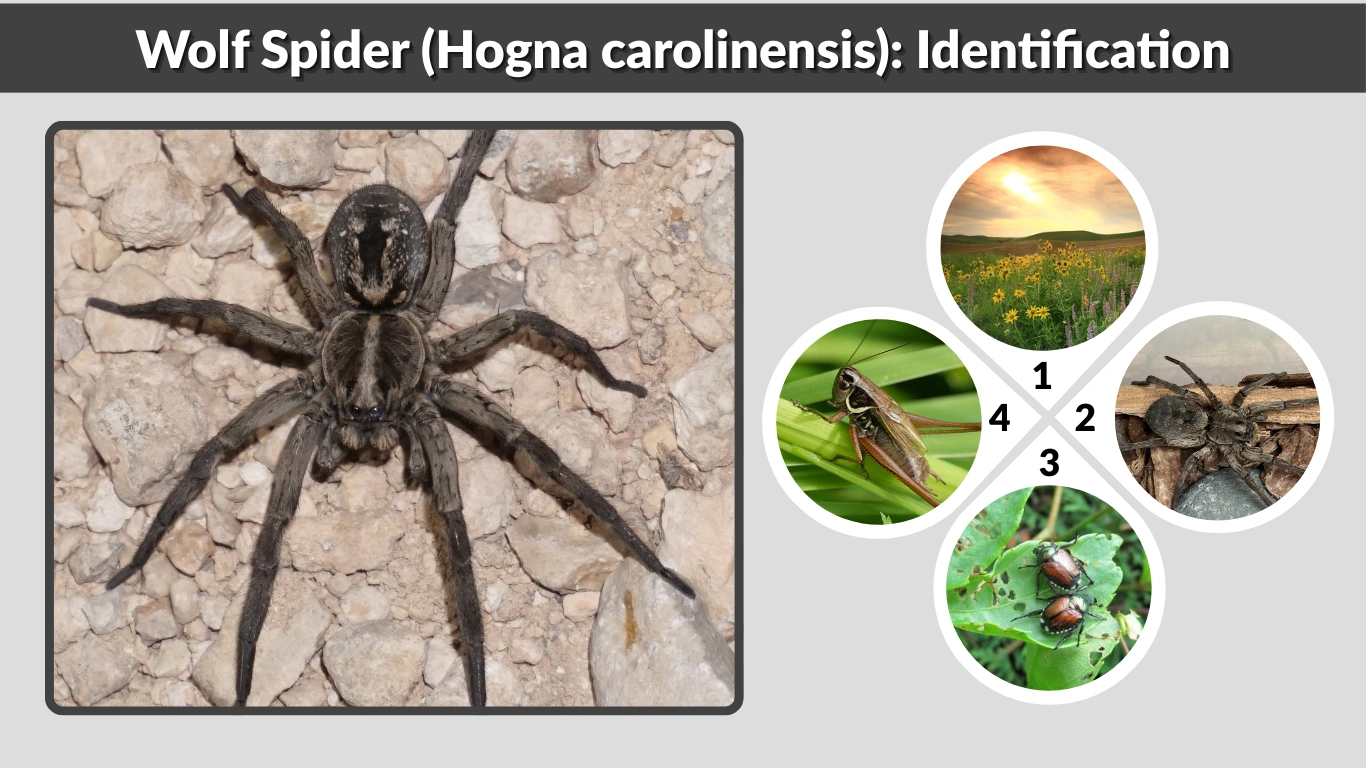
The wolf spider (Hogna carolinensis) is one of the most impressive ground-dwelling spiders in North America. Known as the Carolina wolf spider, it holds the distinction of being the largest wolf spider species on the continent. Unlike web-building spiders, this powerful hunter actively chases its prey, relying on speed and sharp eyesight rather than silk traps. Although its size can appear intimidating, Hogna carolinensis is generally harmless to humans and plays an important role in controlling insect populations in natural and residential environments.
Scientific Classification and Naming
The Carolina wolf spider belongs to the family Lycosidae, a group commonly referred to as wolf spiders. The name “Lycosidae” comes from the Greek word lykos, meaning wolf, which reflects the spider’s hunting style.
Its scientific classification is as follows:
- Kingdom: Animalia
- Phylum: Arthropoda
- Class: Arachnida
- Order: Araneae
- Family: Lycosidae
- Genus: Hogna
- Species: Hogna carolinensis
The species name “carolinensis” refers to the Carolinas, where the spider was first identified and studied. Today, however, its range extends well beyond that region.
Physical Appearance and Identification
Size and Body Structure
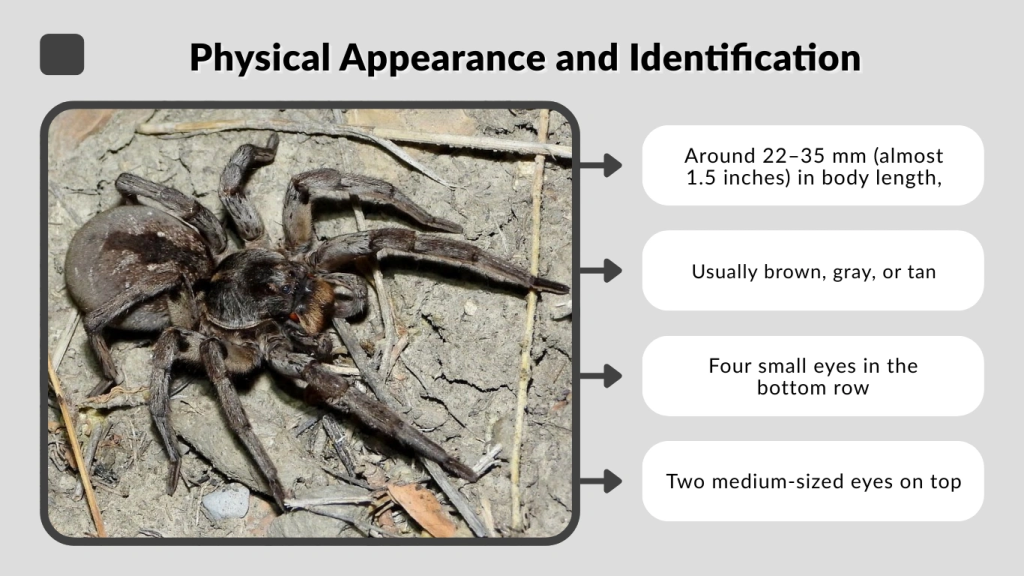
One of the most striking features of Hogna carolinensis is its size. Adult females typically measure around 22–35 mm (almost 1.5 inches) in body length, while males are slightly smaller. When including leg span, this spider can reach up to 4 inches across, making it the largest wolf spider species in North America.
The body is robust and muscular, built for speed and endurance. Unlike delicate web spiders, wolf spiders have strong legs adapted for running and pouncing. Females are generally bulkier, especially when carrying egg sacs.
Coloration and Markings
The Carolina wolf spider is usually brown, gray, or tan, allowing it to blend seamlessly into soil and leaf litter. Its coloration often includes subtle stripes or mottled patterns along the abdomen and cephalothorax. These markings act as camouflage in sandy or grassy environments.
The body is covered in fine hairs, giving it a slightly fuzzy appearance. This hair coverage enhances sensory perception and helps detect vibrations in the environment.
Eye Arrangement (Key Identifier)
A key feature that distinguishes wolf spiders from many other species is their unique eye arrangement. Hogna carolinensis has eight eyes arranged in three rows:
- Four small eyes in the bottom row
- Two large forward-facing eyes in the middle row
- Two medium-sized eyes on the top row
The large middle eyes provide excellent night vision, which is crucial for their nocturnal hunting lifestyle. When light reflects off these eyes at night, they may appear to glow.
Habitat and Geographic Distribution
Where Is Hogna carolinensis Found?
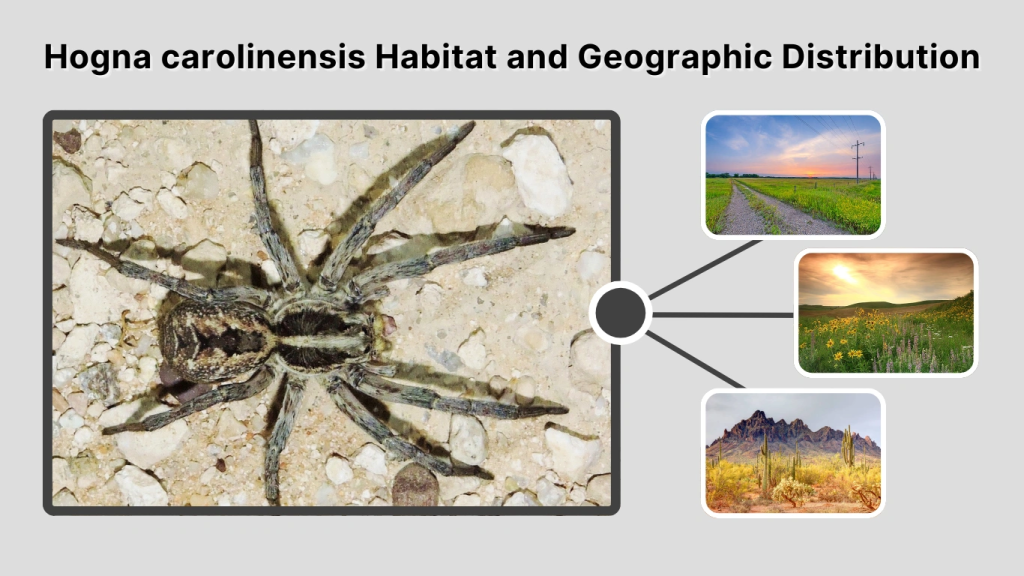
The Carolina wolf spider is widely distributed across the United States. It is particularly common in the southeastern and central regions but can also be found in parts of the Midwest and Southwest. Its adaptability allows it to survive in both warm and temperate climates.
This species prefers open habitats rather than dense forests.
Preferred Living Conditions
Hogna carolinensis thrives in sandy soils, grasslands, prairies, deserts, and woodland edges. Unlike many spiders that rely heavily on webs, this species often creates burrows in the ground. These burrows may be several inches deep and are sometimes lined with silk to reinforce the walls.
During the day, the spider typically remains inside or near its burrow to avoid predators and extreme heat. At night, it emerges to hunt.
Occasionally, these spiders may wander into homes, especially during cooler months or periods of heavy rain. However, they do not infest houses and usually enter by accident while searching for prey or shelter.
Behavior and Hunting Strategy
Active Hunter (No Web Hunting)
Unlike orb-weaving spiders, the Carolina wolf spider does not build webs to capture prey. Instead, it actively hunts insects on the ground. Using its keen eyesight and rapid reflexes, it stalks and chases down prey such as crickets, beetles, and grasshoppers.
Its hunting style resembles that of a wolf, which explains the common name. The spider relies on stealth, speed, and sudden bursts of movement rather than traps.
Burrowing and Ambush Behavior
Many individuals construct vertical burrows in sandy soil. These burrows serve as safe retreats and ambush points. The spider may wait at the entrance, sensing vibrations caused by passing insects. When prey approaches, it lunges quickly to capture it.
The Carolina wolf spider is primarily nocturnal, meaning it hunts mostly at night when temperatures are cooler and prey is active.
Defensive Behavior
Although Hogna carolinensis is not aggressive toward humans, it will defend itself if threatened. When disturbed, it may raise its front legs and display its fangs as a warning posture. This defensive stance is meant to scare away predators rather than invite confrontation.
If given the opportunity, the spider usually prefers to run away. Wolf spiders are extremely fast runners and rely on speed as their primary escape mechanism. Bites are rare and typically occur only when the spider is handled or accidentally trapped against the skin.
Diet and Ecological Role
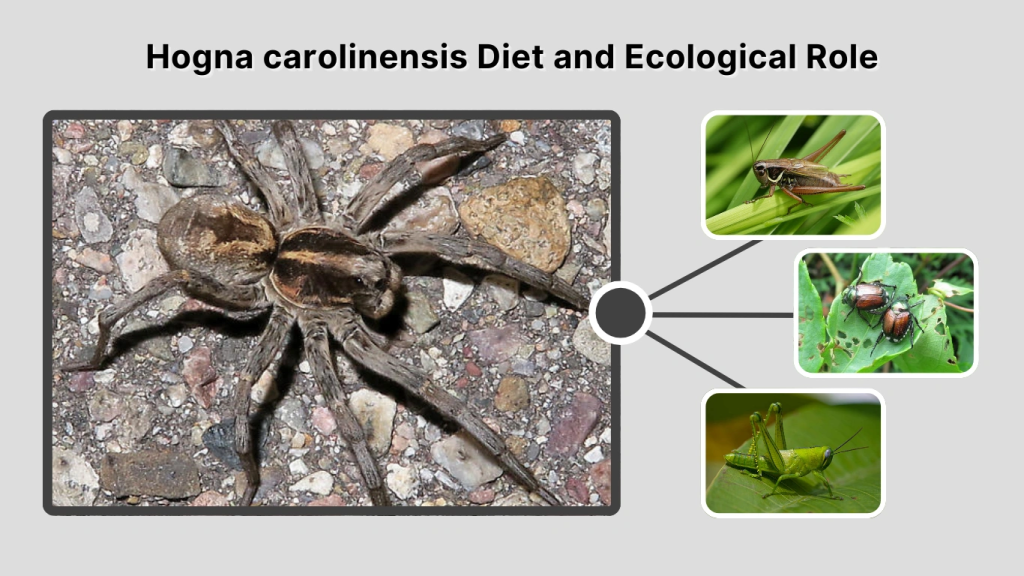
The Carolina wolf spider is a carnivorous predator that feeds mainly on ground-dwelling insects. Its diet commonly includes crickets, beetles, grasshoppers, ants, and other small arthropods. Occasionally, it may prey on other spiders.
By controlling insect populations, Hogna carolinensis plays a valuable ecological role. In agricultural and suburban areas, it helps reduce pest species that can damage crops or invade homes. Because it does not rely on webs, it actively reduces insects at ground level, contributing to natural pest management.
In turn, wolf spiders serve as prey for birds, reptiles, and small mammals, making them an important part of the food chain.
Reproduction and Life Cycle
Mating and Courtship
Mating typically occurs during the warmer months. Male wolf spiders approach females cautiously and perform courtship displays that may include leg movements and vibrations. These signals help the female recognize the male as a potential mate rather than prey.
Because females are larger and powerful hunters, males must be careful during courtship to avoid being attacked.
Egg Sac and Spiderlings
After mating, the female produces an egg sac that contains dozens to hundreds of eggs. One of the most fascinating traits of wolf spiders is their maternal care. The female attaches the egg sac to her spinnerets and carries it with her wherever she goes.
When the eggs hatch, the spiderlings climb onto their mother’s back and remain there for several days or even weeks. During this time, the mother continues hunting and protecting her young until they are ready to disperse.
Lifespan
The typical lifespan of Hogna carolinensis is about one to two years. Females often live slightly longer than males, especially if they successfully reproduce. Growth occurs through molting, during which the spider sheds its exoskeleton several times before reaching maturity.
Is the Carolina Wolf Spider Dangerous?
Despite its large size and intimidating appearance, the Carolina wolf spider is not considered dangerous to humans. Its venom is designed to subdue insects rather than cause serious harm to people.
Bites are uncommon and usually occur only when the spider is provoked or accidentally pressed against the skin. Symptoms may include mild pain, redness, swelling, and slight itching. These effects are generally short-lived and resolve without medical treatment.
Serious reactions are rare but could occur in individuals with allergies or compromised immune systems. In such cases, medical attention should be sought. Compared to spiders like the brown recluse, Hogna carolinensis poses far less medical concern.
Wolf Spider vs Similar Species
Wolf Spider vs Brown Recluse
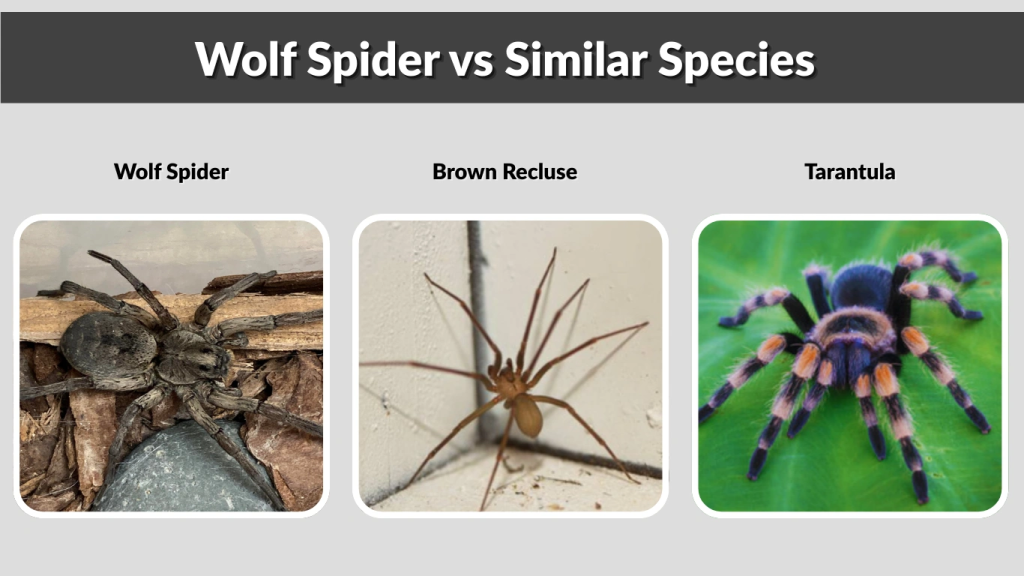
Wolf spiders are often mistaken for brown recluse spiders due to their similar brown coloration. However, there are important differences. Brown recluse spiders have six eyes arranged in three pairs, while wolf spiders have eight eyes in three distinct rows.
Additionally, brown recluses typically display a violin-shaped marking on the cephalothorax. The Carolina wolf spider lacks this marking and has a more robust, hairy body. Most importantly, brown recluse venom can cause tissue damage, while wolf spider venom is much milder.
Wolf Spider vs Tarantula
Although both are large and hairy, wolf spiders are much smaller than tarantulas. Tarantulas have thicker bodies and longer lifespans and are more common in arid southwestern regions.
Wolf spiders are faster and more agile runners, while tarantulas rely more on ambush and strength. The Carolina wolf spider also lacks the dense, heavy hair coverage typical of tarantulas.
Interesting Facts About Hogna carolinensis
- It is the largest wolf spider species in North America.
- Its eyes can reflect light at night, creating a glowing effect.
- Females show advanced maternal care by carrying both egg sacs and spiderlings.
- It can sprint quickly to capture prey or escape predators.
- Some individuals create surprisingly deep burrows in sandy soil.
Conclusion
The wolf spider (Hogna carolinensis) is an impressive yet misunderstood arachnid. As the largest wolf spider in North America, it commands attention with its size and speed. However, it is not aggressive and rarely poses any threat to humans. Instead, it serves as a beneficial predator that helps control insect populations and maintain ecological balance. Understanding this species can replace fear with appreciation for one of nature’s most skilled ground hunters.