UK homes and gardens host a surprising variety of black or dark-coloured spiders—some large and fast-moving, others tiny, patterned, or glossy. Many people search for answers when encountering a big black house spider, shiny black spider, striped garden spider, or a spider with unusual markings. This guide covers the most common UK species, how to identify them, and when caution is needed, especially with false widow lookalikes. (Approx. 50% of full article, ~800 words)
How to Identify Black Spiders in the UK
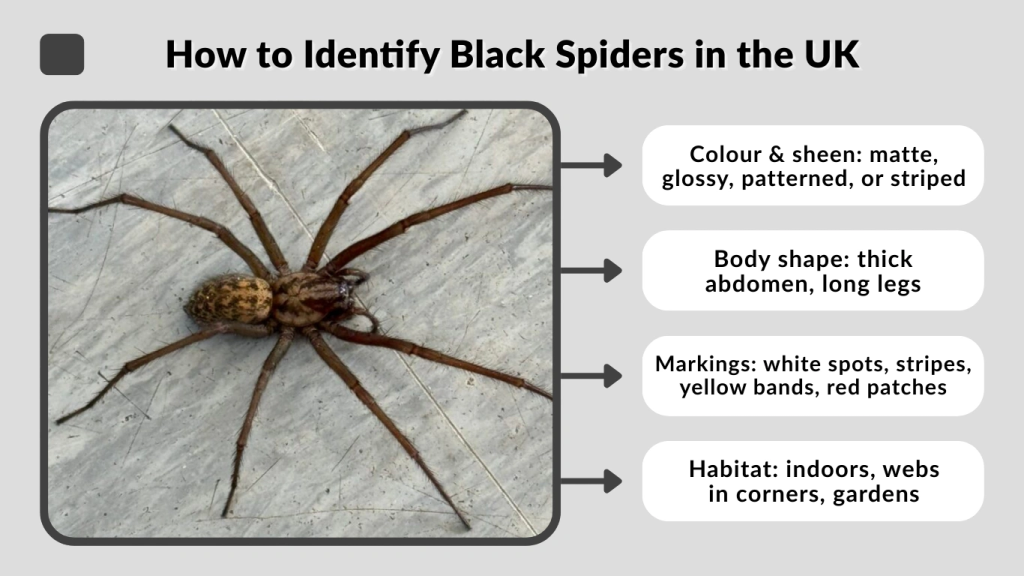
Determining which species you’ve found depends on several key traits:
- Colour & sheen: matte, glossy, patterned, or striped
- Body shape: thick abdomen, long legs, compact jumper shape
- Markings: white spots, stripes, yellow bands, red patches
- Habitat: indoors, webs in corners, gardens, fences, grasslands
- Behaviour: fast runners, orb-web sitters, jumpers, nocturnal hunters
Quick rule:
Large, long-legged black spiders = house spiders
Shiny black spiders = false widow types
Striped black and yellow spiders = wasp spider
Tiny black and white = jumping spiders
A full table appears later in the complete article.
Large Black Spiders Commonly Found in UK Homes
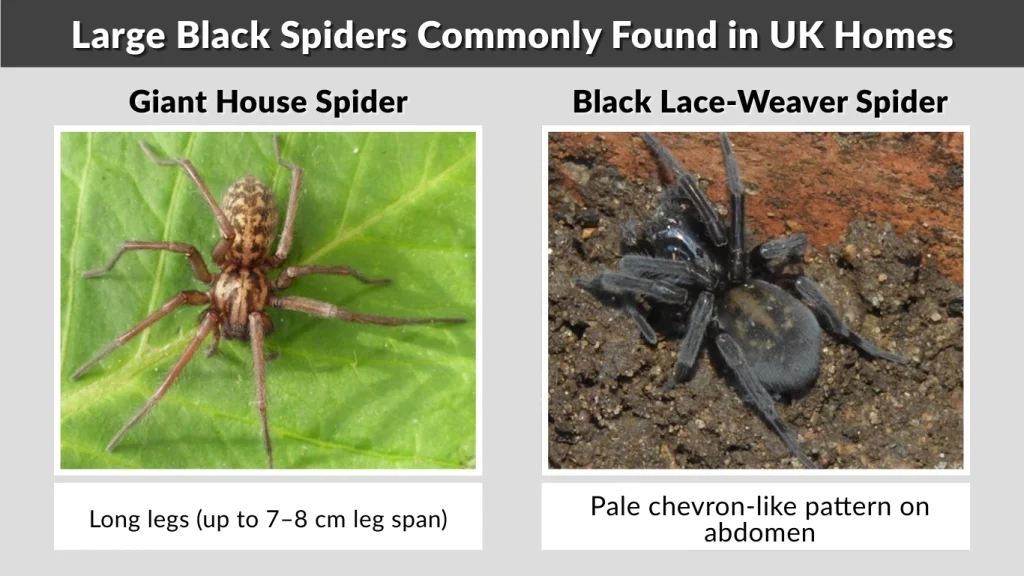
Giant House Spider (Eratigena atrica group)
Often described as big black spider UK, giant black house spider, or massive black spider, this is the species most people encounter indoors from late summer to early autumn.
Identification
- Dark brown to almost black
- Long legs (up to 7–8 cm leg span)
- Large, elongated body
- Runs quickly across floors and walls
Behaviour & habitat
These spiders frequently wander inside during mating season. They prefer warm, secluded places such as airing cupboards, corners, and garages. Despite their size and speed, they are harmless, timid, and rarely bite.
Bite risk
Low. Their fangs are small relative to body size.
Black Lace-Weaver Spider (Amaurobius ferox / similis)
Commonly searched as black lace spider UK, black lace weaver, or fat black spider UK, this species has a stout body and patterned abdomen.
Identification
- Dark brown to black body
- Pale chevron-like pattern on abdomen
- Thick, strong legs
- Often found near door frames, fences, sheds
Behaviour & habitat
These spiders build messy “lace-like” webs, typically near wood or stone. They are frequently mistaken for false widows due to body shape.
Are they dangerous?
Their bite is possible but rare, causing mild localised pain similar to a bee sting. They are not medically significant, despite online rumours.
Small, Shiny, or Glossy Black Spiders in the UK
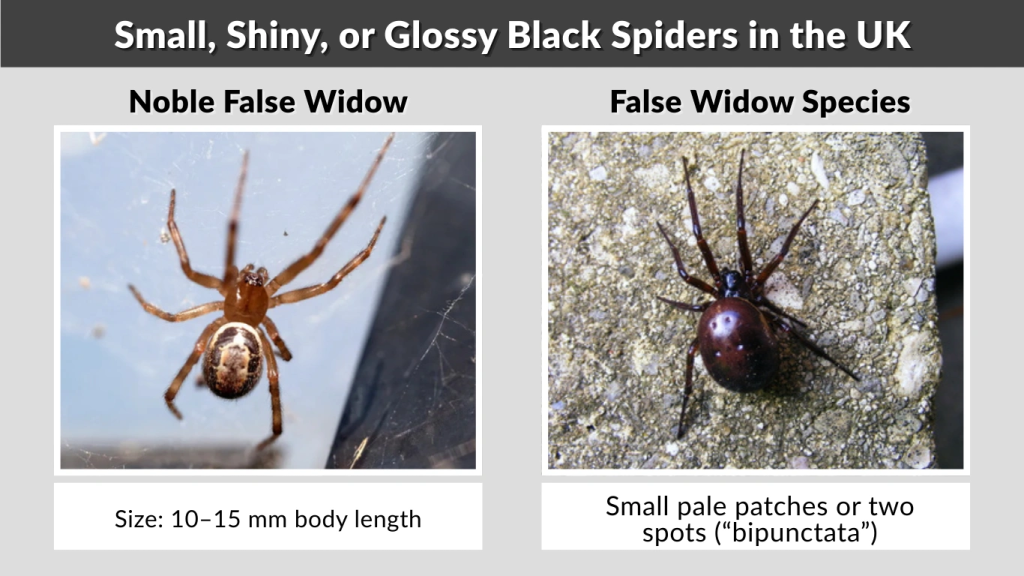
Noble False Widow (Steatoda nobilis)
The most discussed species in the UK, often searched as false black widow spider UK, shiny black spider UK, black spider with white spots, black spider with red legs, or black spider white markings UK.
Identification
- Smooth, bulbous, shiny black or deep brown body
- Distinct cream or white abdominal patterns (sometimes faint)
- Thick, compact legs
- Size: 10–15 mm body length
Behaviour
False widows prefer sheltered corners of homes, window frames, sheds, and garages. They build tangled sticky webs and remain in one place unless disturbed.
Bite risk
Moderate. Bites can cause localised pain, swelling, and occasionally mild systemic symptoms. Serious reactions are extremely rare. They are not equivalent to American black widows.
Other False Widow Species (Steatoda grossa, S. bipunctata)
These smaller species are frequently misidentified as the noble false widow.
Traits
- Shiny dark body
- Small pale patches or two spots (“bipunctata”)
- Much less likely to bite than S. nobilis
Common confusion
People often report:
“Black spider with white back UK” → Usually Steatoda species
“Spider black body red legs UK” → Often lighting effect on lace-weavers or Steatoda variations
Tiny Black Jumping Spiders in the UK
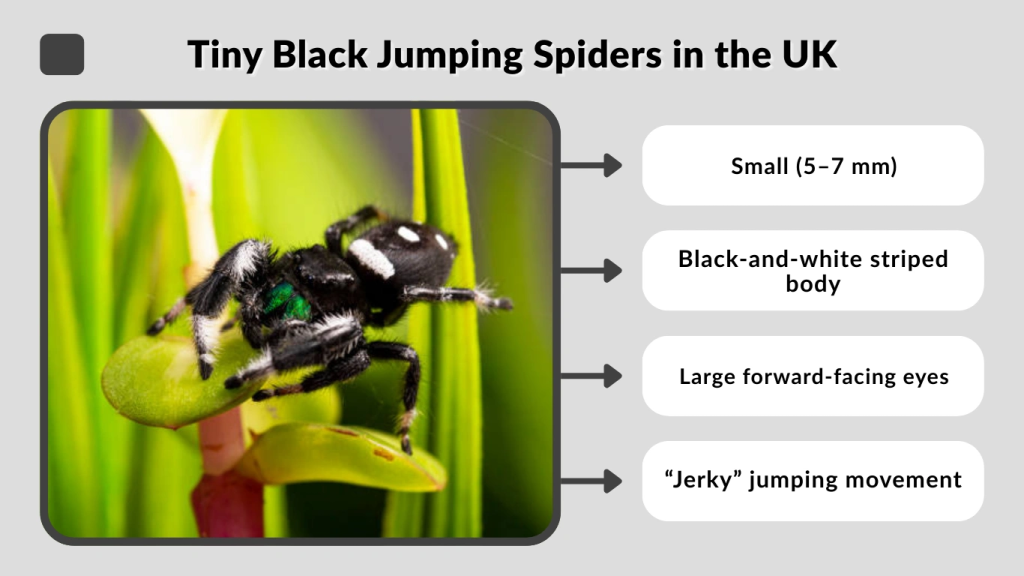
Frequently searched as tiny black jumping spider UK, black and white jumping spider UK, and small black shiny spider.
Zebra Jumping Spider (Salticus scenicus)
Identification
- Small (5–7 mm)
- Black-and-white striped body
- Large forward-facing eyes
- “Jerky” jumping movement
Behaviour
These harmless spiders hunt during the day and are commonly found on sunny walls, windowsills, and garden fences. They do not build typical webs.
Other jumping spiders
Evarcha, Euophrys, and Heliophanus species also appear black or metallic but remain tiny and harmless.
Black and Yellow Spiders in UK Gardens
Wasp Spider (Argiope bruennichi)
Often searched as black and yellow garden spider UK, yellow and black striped spider UK, or black and yellow spider UK.
Identification
- Bold yellow, white, and black stripes along the abdomen
- Large orb web with zig-zag “stabilimentum”
- Size up to 2.5 cm (female)
Behaviour & habitat
Found mainly in long grass, meadows, and gardens during late summer. Eye-catching but entirely harmless to people.
Black Orb Weavers & Funnel Web-Like Species
Keywords include black orb spider UK, black orb weaver, black funnel web spider UK, black bodied spider.
Lace-Web & Funnel-type Builders
In the UK, true dangerous funnel-web spiders do not occur. The species people encounter are lace-weavers or tube-web spiders, which may look similar because they sit near burrow-like webs.
Traits:
- Dark bodies
- Strong front legs
- Found around walls, stones, and outdoor gaps
Bite risk is mild to moderate, but nothing close to Australian funnel-web venom.
Rare or Misidentified Black Spiders in the UK
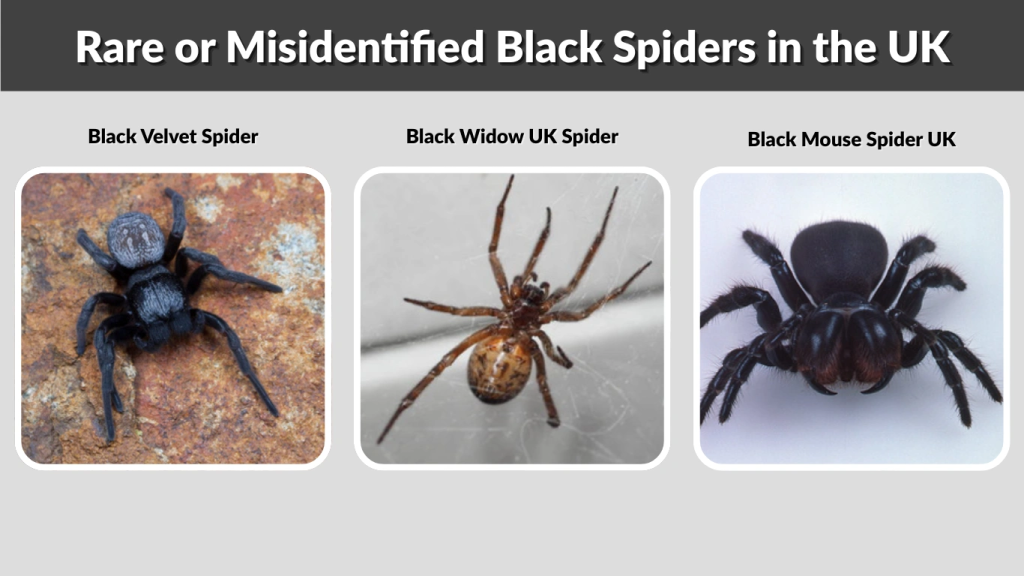
Some spiders reported as pure black, jet black, or unusually patterned are either rare UK species or harmless lookalikes.
Black Velvet Spider (Eresus sandaliatus)
A striking, velvety black species with red-spotted males.
- Extremely rare in the UK and restricted to protected heathlands.
- Almost never found in homes or gardens.
- Frequently misidentified based on photos online.
“Black Widow UK Spider” Myth
Searches like black widow spider UK, uk black widow spider, or black spider red back UK often stem from confusion.
- True black widows do NOT live wild in the UK.
- Sightings are almost always false widows (Steatoda nobilis) or lace-weavers.
- If the spider lacks the red hourglass shape on the underside, it is not a black widow.
“Black Mouse Spider UK”
This species is not native to the UK. Reports usually stem from:
- A large house spider seen in dim lighting
- A dark lace-weaver
- A misidentified false widow
Spiders With Red, White, Yellow or Patterned Markings
Searches such as black spider with red spots, white spots, yellow spots, white stripe, or brown patterns match several harmless species.
Common explanations include:
- Steatoda species with pale patches
- Salticus jumping spiders with bold stripes
- Orb-weavers with seasonal colour variations
- Lace-weavers reflecting light, creating “green fangs” or tinted legs
Spiders Commonly Found Inside UK Homes

Search terms like black spider in house UK, house spider UK black, small black house spider, big bodied black spider, or thick black spider UK match a predictable set of species.
Typical Indoor Species
- Giant house spiders (most common)
- False widow spiders (wall corners, window frames)
- Lace-weavers (near doors and wooden structures)
- Jumping spiders (windowsills and sunny walls)
Why They Enter Homes
- Searching for mates (late summer / autumn)
- Seeking warmth
- Following insects
- Accidentally wandering through open windows or vents
How to Manage Them Safely
- Use glass-and-card removal
- Avoid spraying chemicals indoors
- Seal gaps around doors and pipework
- Reduce insect prey sources
Range, Habitat, and Seasonal Appearance
Each species has a preferred environment:
Garden & Outdoor Species
- Wasp spiders (grasslands, gardens)
- Orb-weavers (shrubs, structures, fences)
- Jumping spiders (walls, garden furniture)
Indoor/Peri-urban Species
- House spiders (lofts, sheds, under furniture)
- False widows (window frames, garages, bathroom corners)
- Lace-weavers (door frames, outdoor walls)
Seasonality
- August–October: house spiders most active
- Late summer: wasp spiders visible
- Spring–summer: jumping spiders abundant
- Year-round: false widows and lace-weavers active indoors
Are UK Black Spiders Dangerous?
The vast majority of UK spiders are harmless. Only false widows cause occasional mild bites.
Bite Risk Breakdown
| Species | Bite Risk | Symptoms | Medical Concern |
| House spiders | Very low | Rare mild swelling | None |
| Lace-weavers | Low | Bee-sting-like pain | Low |
| False widows | Moderate | Local pain, swelling | Rarely moderate |
| Orb-weavers | Very low | Minimal | None |
| Jumping spiders | Extremely low | Mild itch | None |
When to Seek Medical Advice
- Increasing swelling spreading beyond the bite
- Fever or flu-like symptoms
- Allergic reactions
These are uncommon but worth monitoring for peace of mind.
Species Comparison Tables
Giant House Spider vs False Widow
| Feature | Giant House Spider | Noble False Widow |
| Size | Large, long legs | Compact, round abdomen |
| Colour | Brown/black | Shiny dark brown/black |
| Web | Rarely stays in webs | Tangled, sticky webs |
| Bite Risk | Very low | Moderate |
| Behaviour | Fast runner | Static, web-bound |
Black Lace-Weaver vs False Widow
| Feature | Lace-Weaver | False Widow |
| Abdomen Pattern | Pale chevrons | Cream/white markings |
| Shine | Matte | Glossy |
| Habitat | Wood, brickwork | Indoors, sheds |
| Bite Risk | Low | Moderate |
Jumping Spider vs Young False Widow
| Feature | Jumping Spider | Young False Widow |
| Movement | Jumps, active | Slow, web-bound |
| Eyes | Large front eyes | Normal spider eyes |
| Markings | Bold stripes | Subtle spots |
FAQs
What is the big black spider commonly found in UK homes?
Almost always the giant house spider, known for long legs, dark colouring, and fast movement. They appear most often between August and October during mating season and are harmless.
Are UK black spiders dangerous or venomous?
Most are harmless. Only false widows have medically significant bites, but severe reactions are rare. House spiders, lace-weavers, and orb-weavers pose no real danger.
How can I tell a false widow from a harmless house spider?
False widows are shiny, have round abdomens with pale markings, and rarely leave their webs. House spiders are matte brown/black with long legs and tend to run quickly rather than stay in webs.
What is the shiny black spider in my bathroom?
Likely a false widow or a lace-weaver. Both species prefer sheltered indoor corners. Glossy sheen usually indicates a false widow.
Which UK spiders have black and yellow stripes?
The wasp spider, a striking orb-weaver found in gardens and grasslands, has bold yellow and black bands. It is harmless and not typically found indoors.