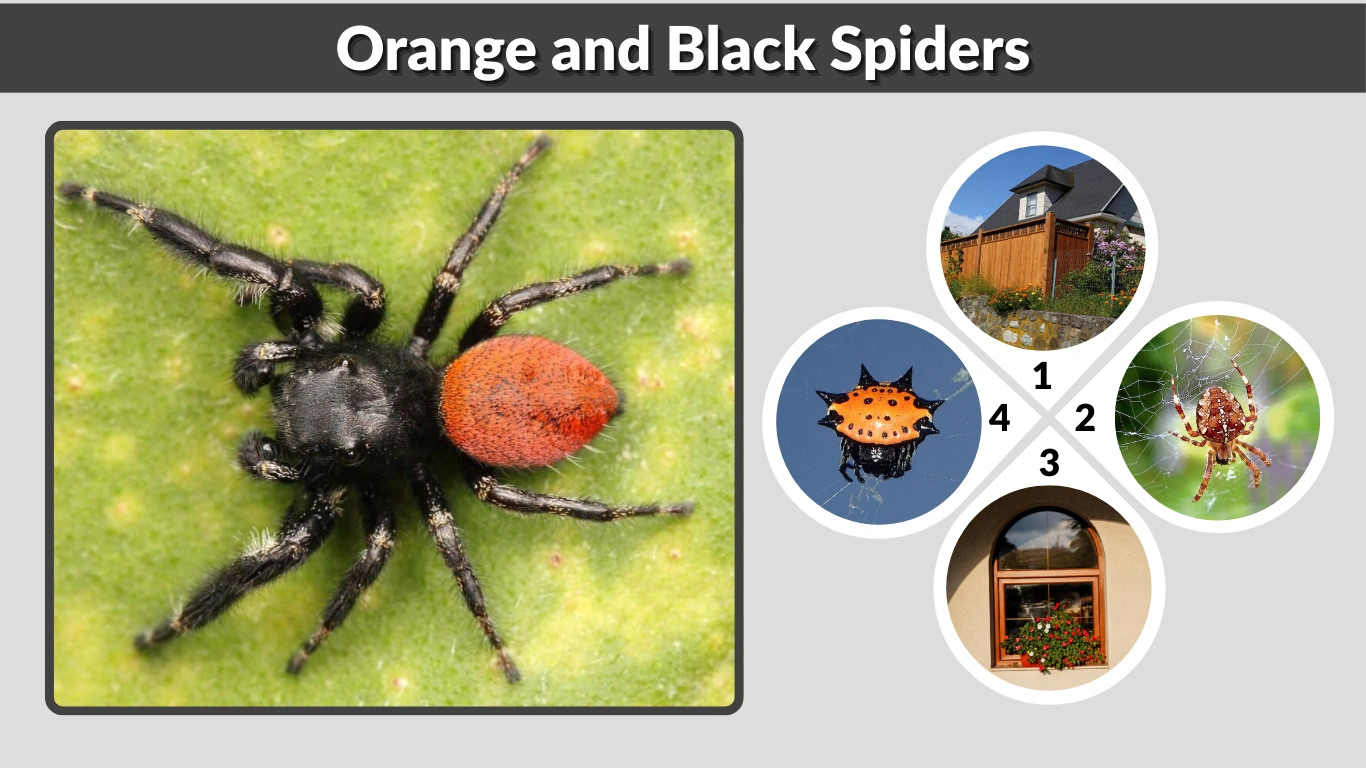
Orange-and-black spiders attract immediate attention because their bold colors stand out in gardens, homes, and forests. These distinctive patterns often raise questions about whether the spider is harmful, how to identify it, and what species it might belong to. Many harmless spiders share these colors, including jumping spiders and orb weavers, while a few resemble dangerous species. This guide explains how to identify them, what the colors mean, and how to distinguish common species safely.
What Are Orange and Black Spiders?
Orange-and-black coloration occurs in many spider families across North America, Europe, Asia, and Australia. These colors serve several evolutionary functions: camouflage among flowers and leaves, mimicry of more dangerous species, and bright warning colors that deter predators.
Many orange-and-black spiders are harmless, extremely common, and beneficial, feeding on insects, pests, and mosquitoes.
Families that frequently show these colors include:
- Salticidae (Jumping Spiders): compact, fuzzy, and often brightly colored
- Araneidae (Orb Weavers): large abdomens, patterned coloring, giant webs
- Theridiidae (Cobweb Spiders): widow relatives, sometimes rusty-orange markings
- Lycosidae (Wolf Spiders): less common, but some species show orange striping
Even though their appearance varies widely, the color cues help narrow down identification.
Identification Guide
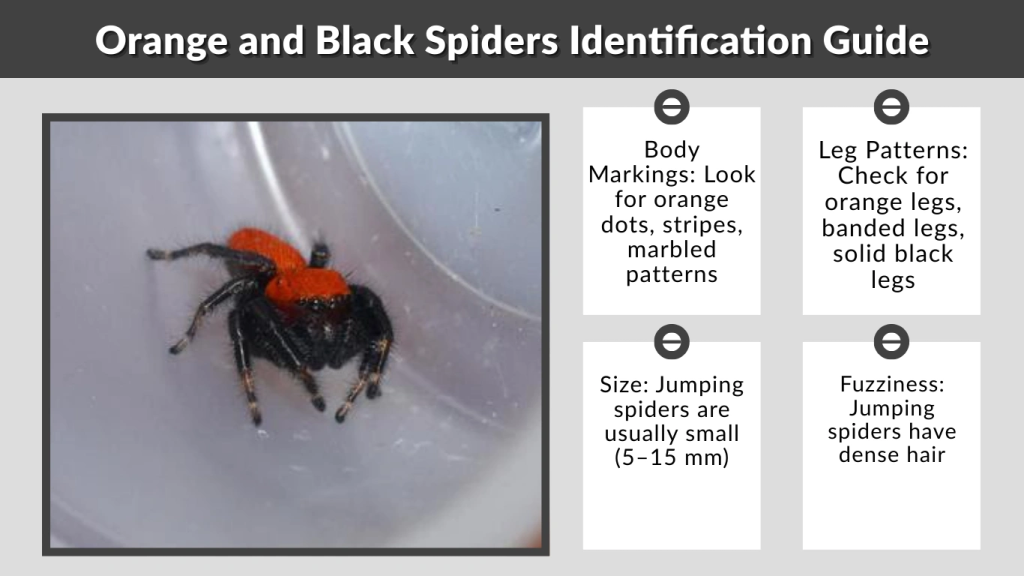
Below is a simplified list to help identify most orange-and-black spiders:
- Body Markings: Look for orange dots, stripes, marbled patterns, or full orange abdomens.
- Leg Patterns: Check for orange legs, banded legs, solid black legs, or orange joints.
- Size: Jumping spiders are usually small (5–15 mm), while orb weavers can be large (15–30 mm+).
- Fuzziness: Jumping spiders have dense hair; orb weavers have smooth, shiny bodies.
- Body Shape: Orb weavers have round, bulbous abdomens; jumping spiders have compact bodies.
- Behavior: Jumping spiders move in quick bursts; orb weavers stay still on webs.
- Range: Some species such as the Spiny Orb Weaver are common in Florida; Regal Jumping Spiders dominate the Southeast.
This ID framework helps match your spider to one of the major groups described below.
Common Orange-and-Black Species
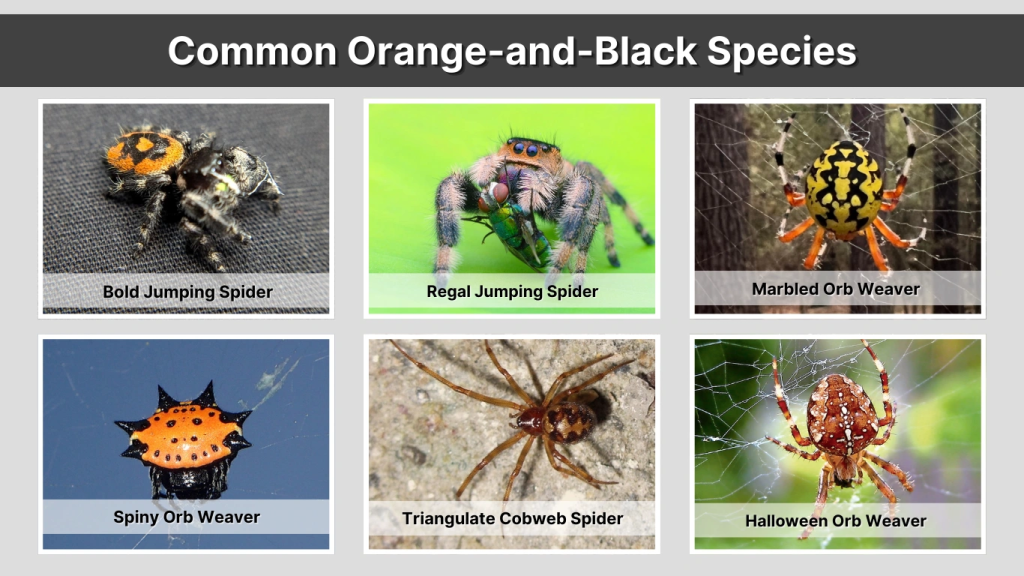
Below are the most commonly encountered spiders that match orange-and-black descriptions, including those with orange dots, stripes, or legs.
Bold Jumping Spider (Phidippus audax)
The Bold Jumping Spider is one of the most frequently mistaken species because its black body often features an orange or white central dot. Juveniles are especially colorful, displaying bright orange markings that fade to white as they mature. These small, energetic spiders prefer sunny walls, fences, and gardens where they hunt insects by sight rather than webs.
Despite their intimidating look, they are entirely harmless to humans. Their orange-dot pattern is often the source of search terms like “black spider with orange dot,” “fuzzy black spider with orange spot,” and similar queries.
Regal Jumping Spider (Phidippus regius)
The Regal Jumping Spider is a large, charismatic jumping spider found mainly in the southeastern United States. Males are shiny black with bold white stripes, while females and juveniles may show orange abdomens with black spots—leading many people to search for “orange spider with black back” or “orange-bodied spider with black legs.”
These spiders are extremely curious, often approaching humans out of exploration rather than aggression. Their colors help them absorb sunlight and blend into bark and foliage.
Marbled Orb Weaver (Araneus marmoreus)
One of the most dramatic orange spiders, the Marbled Orb Weaver has a bright orange abdomen with black marbling. Some individuals are almost pumpkin-colored, inspiring the nickname “Halloween Spider.” These orb weavers spin large circular webs near forests, parks, and backyards.
Their large size and vivid coloration often cause alarm, but they are gentle, non-aggressive, and vital for insect control. Their patterned abdomen explains many searches involving “orange spider with black spots” or “orange and black striped spider.”
Spiny Orb Weaver (Gasteracantha cancriformis)
Common in Florida and tropical regions, this species displays bright orange, yellow, black, or white color combinations. Its spiky, crab-like shape makes it instantly recognizable. Many Florida searches for “orange and black spider Florida” refer to this species.
The Spiny Orb Weaver is completely harmless and tends to build webs low in gardens and over walkways.
Triangulate Cobweb Spider (Steatoda triangulosa)
Part of the false widow group, this spider features orange-brown patterns on a dark body. Although related to widow spiders, it is mild-tempered and medically insignificant. People often confuse it for a poisonous spider due to its shape, but it poses very little danger.
Its mottled orange-and-black patterns match queries like “black spider orange abdomen” or “black spider with orange on back.”
Halloween Orb Weaver
Named for its seasonal appearance and festive coloration, this orb weaver often shows orange bodies with black banded legs. They appear most often in late summer and fall when they reach full size and build massive webs.
These spiders are common around homes, porches, and wooded trails and are a frequent subject of identification searches.
Color Pattern Breakdown
Orange Spots or Dots on Black Spiders
Many jumping spiders display bright orange or reddish dots on a black abdomen. These dots may serve as social signals, helping spiders recognize age and sex. Predators often avoid these colors because bright markings can resemble toxic insects.
Orange Stripes on the Body or Legs
Striped patterns are especially common in young jumping spiders and many orb weavers. Orange stripes can run along the abdomen, across the cephalothorax, or in bands across the legs. These markings help break up the spider’s outline, making it harder for predators to see movement. In other species, the stripes serve as visual cues during courtship displays where bright contrasts attract mates.
Orange Body, Black Legs Variants
Some orb-weaving spiders feature solid orange abdomens paired with black legs or black leg bands. This combination creates a visually striking contrast often mistaken for a venomous species. However, most spiders with orange bodies and black legs—such as Marbled Orb Weavers and Halloween Orb Weavers—are gentle and non-aggressive. Their coloring helps them blend into autumn foliage, bark, and leaf litter. In many cases, juveniles show more intense coloration that fades as they mature.
Behavior and Habitat
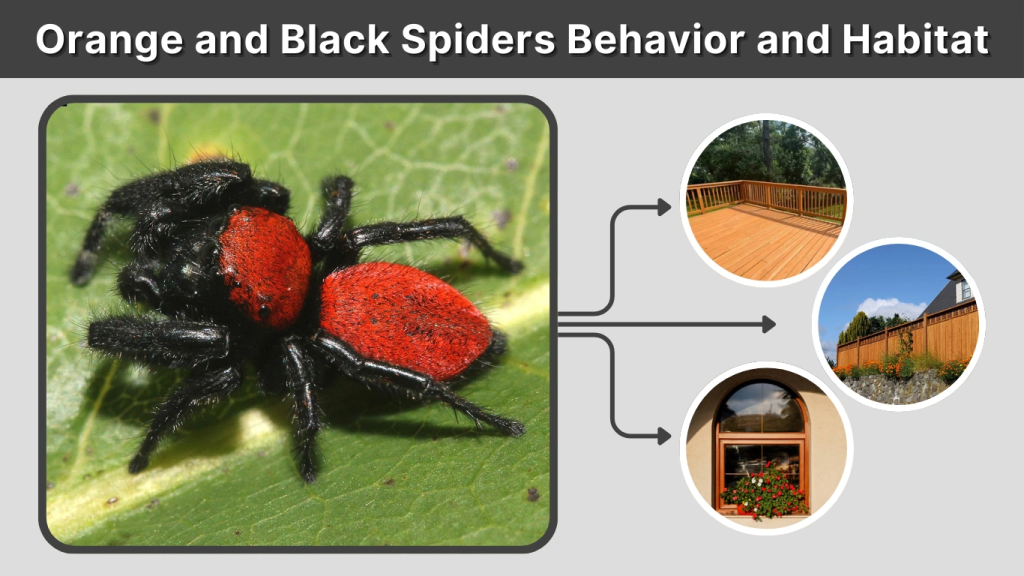
Orange-and-black spiders live in a wide range of environments, from urban gardens to dense forests. Jumping spiders prefer sunny surfaces such as decks, fences, and windowsills, where they can hunt insects using their exceptional vision. They are active during the day and rely on ambush-style hunting rather than webs.
Orb weavers, by contrast, construct elaborate circular webs between tree branches, railings, and vegetation. They are most active at night, often rebuilding their webs daily. Their bright colors may seem conspicuous, but the patterns are surprisingly effective in attracting insects drawn to UV-reflective silk.
Cobweb spiders and false widow species hide in sheltered corners—under furniture, in garages, and around window frames. Although some resemble widow spiders, their venom is much weaker, and bites are extremely rare.
Most orange-and-black spiders contribute significantly to controlling mosquitoes, flies, and garden pests.
Are Black and Orange Spiders Dangerous?
The majority of orange-and-black spiders are not dangerous to humans. Jumping spiders, orb weavers, and cobweb spiders may appear intimidating due to their bold colors, but their venom poses no significant medical risk. In fact, bites from these spiders are uncommon because they prefer retreating over confrontation.
Confusion arises because some species mimic the appearance of black widows or other venomous spiders. False widows, for example, share a similar shape but differ in coloration, web structure, and behavior. While widow spiders sometimes show red or orange markings, they are far less common than people assume.
General safety guidelines include:
- Avoid handling unknown spiders.
- Wear gloves when working in wood piles or cluttered sheds.
- Observe from a distance if unsure.
In almost all cases, an orange-and-black spider found indoors or outdoors is harmless and beneficial.
Comparison Table
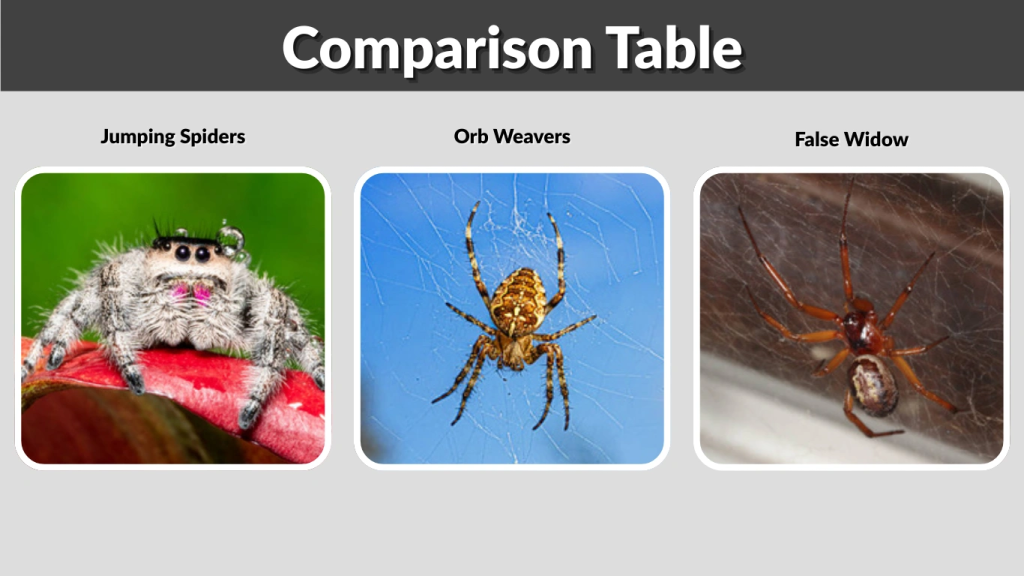
| Feature / Pattern | Jumping Spiders | Orb Weavers | Widow / False Widow |
| Markings | Dots, bright orange spots | Bands, full orange abdomen | Dark body with faint markings |
| Body Shape | Compact, fuzzy | Rounded, large abdomen | Smooth, teardrop shape |
| Behavior | Active hunters | Web builders | Slow, secretive |
| Danger Level | Very low | Very low | Moderate (rare) |
How to Identify Your Spider (Checklist)
Use this quick checklist to narrow down your identification:
- Does it jump or run quickly? → Likely a jumping spider
- Does it sit in a large circular web? → Orb Weaver
- Is the abdomen round and patterned? → Could be Marbled or Halloween Orb Weaver
- Is the body compact with bright orange dots? → Bold or Regal Jumping Spider
- Are the legs banded or striped? → Common among Orb Weavers
- Is the environment tropical or in Florida? → Spiny Orb Weaver is common
- Does it resemble a widow but with orange or brown? → False widow species
These clues help match your spider to a known species or pattern group.
When to Leave It Alone
Spiders with orange-and-black coloration are almost always harmless and should be left undisturbed whenever possible. Orb weavers, especially females guarding egg sacs, are essential for reducing insect populations. Jumping spiders are curious but gentle predators that rarely bite and often patrol homes for pests.
Leaving these spiders in place allows them to continue controlling insects naturally. Relocation is only recommended if the spider is indoors and causing concern, and even then, a cup-and-paper method is safest for both you and the spider.
FAQs
What spider is black with an orange dot?
This description most often matches the Bold Jumping Spider, especially juveniles that display bright orange spots before turning white with age. These spiders are small, fuzzy, and highly active during the day. Many harmless species have similar spots, but none pose a significant danger to humans.
Is a black and orange spider poisonous?
Most orange-and-black spiders, including jumping spiders and orb weavers, are not medically significant. Although all spiders have venom, their bites rarely cause more than mild irritation. Confusion occurs because some species resemble black widows, but true widow encounters are far less common than most people assume.
What does it mean if a spider has orange legs?
Orange legs often indicate an orb-weaving species or a juvenile jumping spider. These colors may help the spider blend into foliage or signal maturity. Leg coloration alone does not indicate danger and is not a reliable sign of venomous species.
Are orange-bodied spiders dangerous?
Spiders with bright orange bodies—especially Marbled Orb Weavers and Halloween Orb Weavers—look dramatic but are completely harmless. Their enhanced coloration often peaks in fall and helps camouflage them among leaves. These spiders rarely bite and prefer to remain on their webs.
How can I tell if my spider is a jumping spider or an orb weaver?
Jumping spiders move quickly, have large forward-facing eyes, and do not build webs for catching prey. Orb weavers are larger, rounder, and sit in the center of an intricate circular web. Both groups may display orange-and-black colors, but their behavior provides the clearest distinction.