
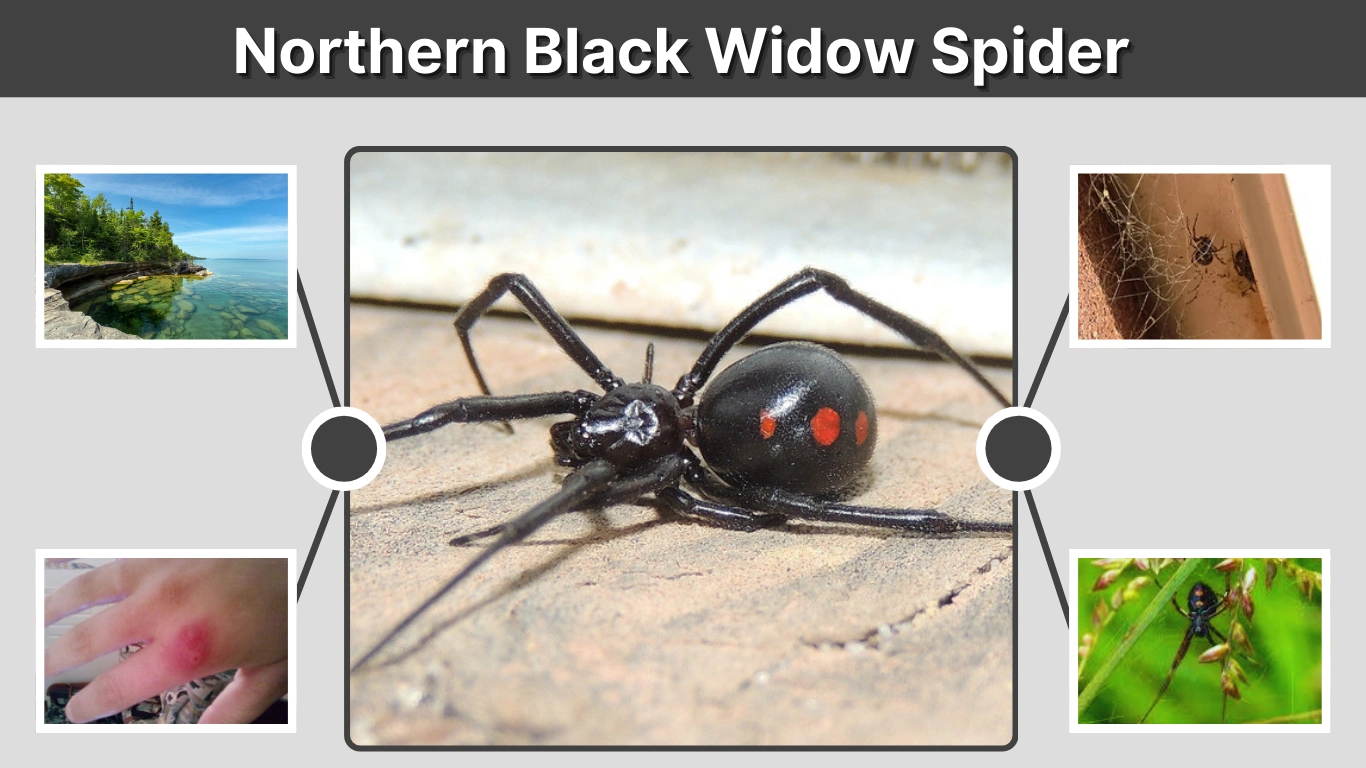
The northern black widow (Latrodectus variolus) is one of North America’s most recognizable venomous spiders, known for its jet-black body and iconic red markings. Although its venom can cause significant symptoms, the species is far less aggressive than many people assume. Encounters are more common in the eastern and northern United States and parts of Canada, especially in places like Michigan, Minnesota, Maine, and Ontario. This guide explains how to identify males and females, understand bite symptoms, recognize look-alike spiders, and know where this species lives.
What a northern black widow looks like
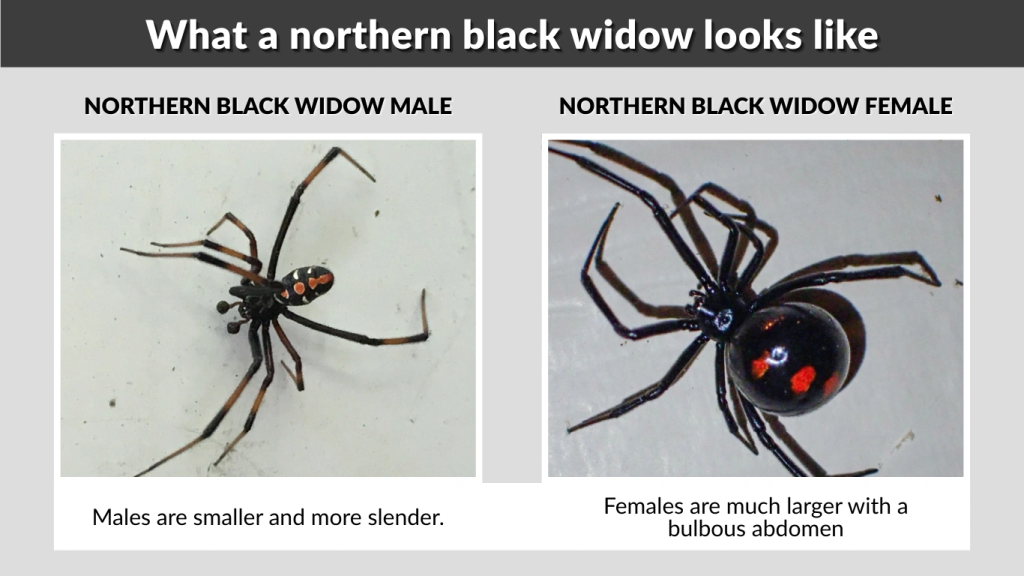
Adult female northern black widow
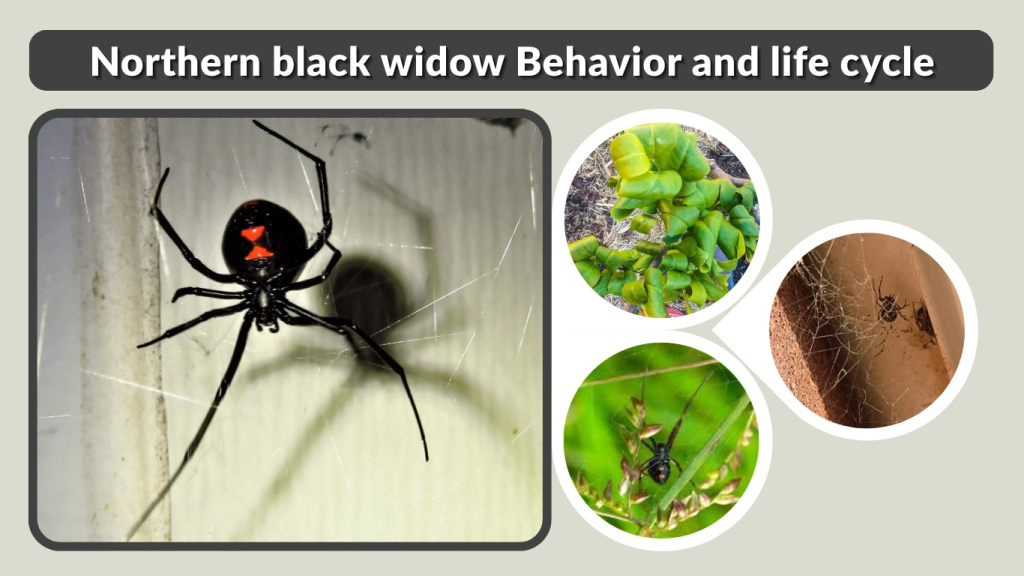
Adult females are the form most people recognize. They have a shiny black body, long slender legs, and a round abdomen. One of the most distinctive traits is the red marking on the underside of the abdomen. Unlike the southern black widow’s clear hourglass shape, the northern black widow typically shows a broken or split hourglass, often appearing as two separate red spots. Some females may also have small red dots on the top of the abdomen.
Adult females usually range between 9–13 mm in body length, excluding their legs. Their webs are typically spun close to the ground in dark corners, crevices, or cluttered spaces. Females tend to stay within their web retreat, emerging mainly at night to repair the structure or capture prey.
Northern black widow male
Males differ dramatically in appearance from females. They are smaller—typically 3–5 mm—with a slimmer body and longer legs relative to their size. Instead of a solid black body, males are often brown or grayish-black with white or yellow stripes and spots. These patterns can resemble juvenile females or other harmless cobweb spiders.
Male northern black widows rarely bite and pose almost no medical risk due to their extremely small venom glands. Their primary activity occurs during mating season, when they wander to locate adult females. Because they are more mobile, males are more likely to be spotted in open areas, though they are still easy to overlook due to their size.
Northern black widow male vs female
A few key differences make identification easier:
- Size: Females are much larger with a bulbous abdomen; males are smaller and more slender.
- Coloration: Females are glossy black; males are patterned with pale stripes.
- Markings: Females display the species’ signature broken hourglass; males may show faint or incomplete markings.
- Behavior: Females stay in webs; males travel widely when searching for mates.
- Bite risk: Only females pose a meaningful medical concern.
This contrast frequently leads people to believe they are looking at two different species when they are simply observing opposite sexes.
Size of northern black widow
The northern black widow is slightly smaller on average than the southern and western species, especially in colder regions.
- Females: 9–13 mm body length
- Males: 3–5 mm body length
- Leg span: Females appear significantly larger due to proportionally long legs
Size can vary depending on climate, diet, and age.
Look-alike spiders
Northern black widows are often confused with several harmless species. Common look-alikes include:
- False widows (Steatoda species) – Dark and shiny but lack the true widow’s hourglass.
- Broad-faced sac spiders – Smaller with a tan or gray body, often mistaken for juvenile widows.
- Common house spiders (Parasteatoda spp.) – Brown with mottled patterns and messy webs.
- Ground spiders – Dark but lack glossy sheen and widow body shape.
When identifying spiders, the underside marking is often the clearest distinguishing feature.
Range and habitat
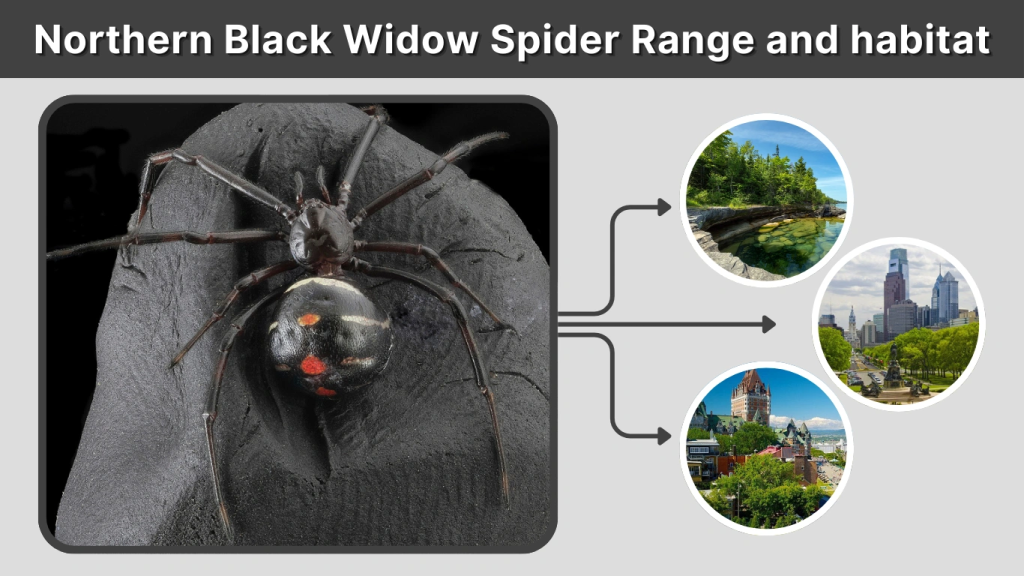
Where northern black widows live
The northern black widow inhabits eastern Canada and the northeastern to midwestern United States. Its range extends southward but is most strongly associated with cooler climates compared to the southern black widow.
Core distribution includes:
- Northeastern U.S.
- Great Lakes region
- Mid-Atlantic states
- Parts of southeastern Canada
Sightings increase in natural wooded areas, rural farmlands, and human-built structures that provide shelter.
Michigan, Maine, Minnesota & Ontario
Michigan
Northern black widows are found throughout Michigan, especially in the Lower Peninsula. They prefer wooded areas, old barns, sheds, basements, and outdoor equipment left undisturbed. Sightings are more common in mid- to late summer, when mature females are active.
Maine
In Maine, northern black widows occur in warm, sheltered pockets such as woodpiles, rock walls, crawlspaces, and garages. They are not widespread but appear consistently enough to warrant awareness. Most encounters occur near human structures rather than deep forest habitats.
Minnesota
Minnesota represents part of the species’ northwestern range. The spiders are uncommon but present, especially in the southeastern and central parts of the state. Because of harsh winters, they tend to remain hidden in well-protected areas—sheds, foundations, basements, and cluttered storage zones.
Ontario
Ontario has one of the most documented northern black widow populations in Canada, particularly along the southern portion near Lake Erie and Lake Ontario. They prefer warm, sunny locations with nearby shelter—railroad ties, stored lumber, abandoned buildings, cottage structures, and rocky outcrops.
Northern black widow bite and venom
Is the northern black widow poisonous?
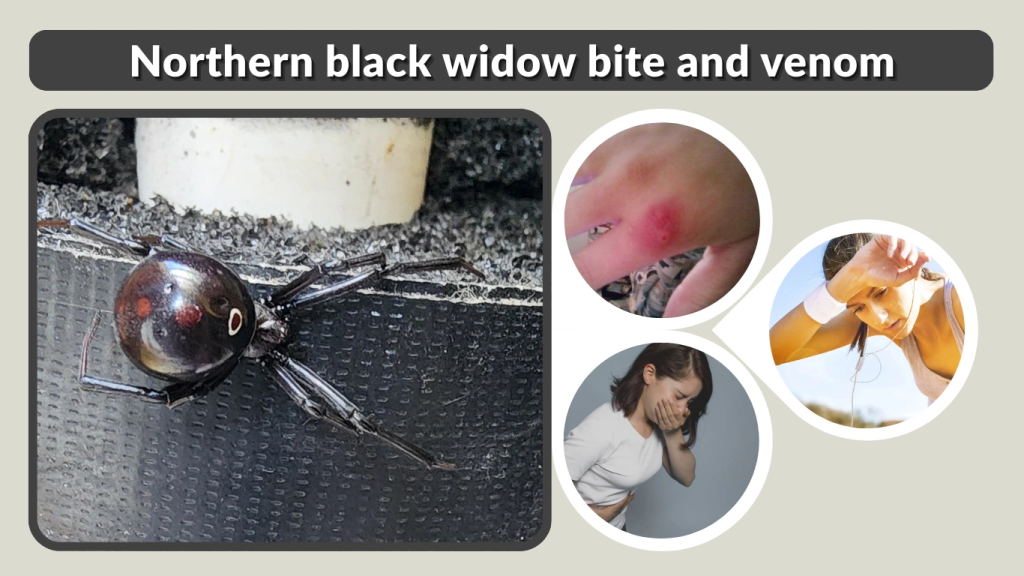
The northern black widow is venomous, not poisonous. Its venom contains potent neurotoxins similar to other widow species. Although it can cause significant symptoms, severe outcomes are rare when medical attention is available. Most bites occur accidentally when humans reach into cluttered or hidden areas where a female is guarding her web.
Bite symptoms
Symptoms often develop gradually, beginning with localized pain or a pinprick sensation. Over the next hour, discomfort may spread to larger muscle groups. Common signs include:
- Sharp pain at the bite site
- Muscle cramping or spasms
- Sweating and chills
- Restlessness or anxiety
- Abdominal rigidity or chest tightness
- Headache or nausea
These symptoms can last from several hours to a few days, depending on the individual and bite severity.
First aid and medical care
Immediate steps include:
- Washing the bite with soap and water
- Applying a cold pack to reduce swelling
- Keeping the bite site still and elevated if possible
- Avoiding alcohol or strenuous activity
Seek medical care if symptoms intensify, if the bite is on a child or elderly individual, or if the victim experiences breathing difficulty, severe muscle cramps, or extreme pain. Antivenom exists but is typically reserved for serious cases. Most patients recover fully within 24–72 hours.
Behavior and life cycle
Daily and seasonal habits
Northern black widows are nocturnal, hunting and repairing webs after dark. During the day, females hide inside their retreat—often a curled leaf, crevice, or hidden nook within their web’s structure. Activity increases during warm seasons, especially from late spring through early fall.
Mating and reproduction
Males rely on chemical cues to locate females and use silk vibrations to signal courtship. Females may lay several egg sacs throughout the season, each containing hundreds of eggs. Spiderlings disperse by ballooning—producing silk threads that carry them on air currents. Only a fraction survive to adulthood.
Ecological role
Despite their fearsome reputation, northern black widows help reduce insect populations, feeding on flies, beetles, cockroaches, ants, and other arthropods. They also serve as prey for birds, praying mantises, and wasps.
Northern vs southern vs western black widow
Key differences
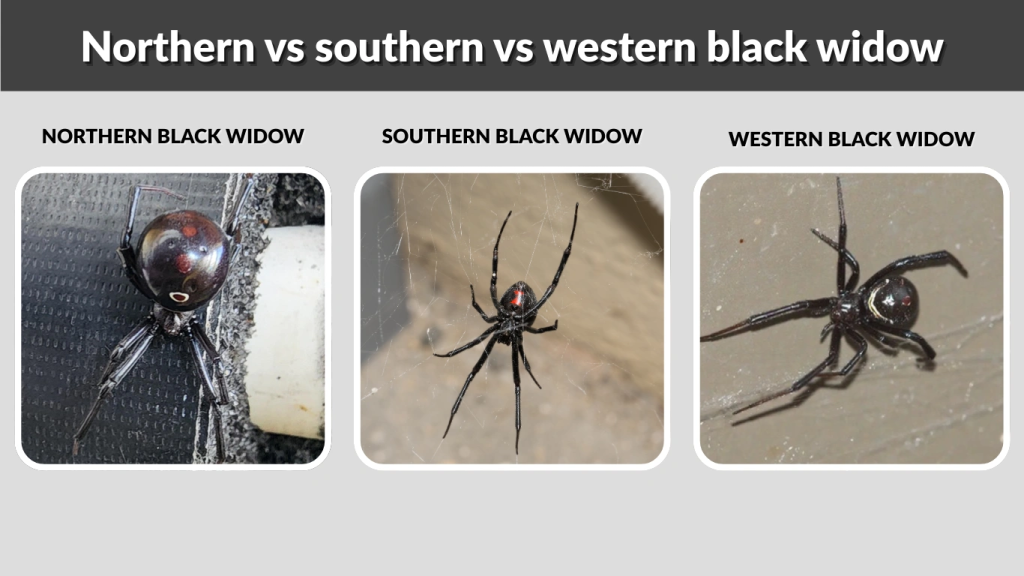
- Markings: Northern black widows have a broken or split hourglass; southern widows have a solid hourglass.
- Size: Northern widows are slightly smaller on average.
- Range: Northerns dominate cooler regions; southern and western species prefer warmer zones.
- Behavior: Differences are minimal, though northern widows may hide deeper in sheltered locations in cold climates.
Comparison table
| Feature | Northern (L. variolus) | Southern (L. mactans) | Western (L. hesperus) |
| Hourglass shape | Broken/split | Solid hourglass | Solid hourglass |
| Female size | 9–13 mm | 12–15 mm | 13–16 mm |
| Male appearance | Striped, small | Striped, small | Striped, small |
| Primary range | Northeast & Great Lakes | Southeast U.S. | Western U.S. |
| Medical impact | Significant but rare fatalities | Similar | Similar |
Prevention and control
Reducing encounters
- Remove clutter around buildings
- Keep firewood and lumber elevated and away from structures
- Reduce insects around exterior lighting
- Seal cracks where spiders might enter
Safe inspection habits
Wear gloves when handling stored items, outdoor equipment, or lumber. Use a flashlight before reaching into dark corners, basements, barns, or sheds. Shake out shoes, towels, and gloves left outside.
Removal
To remove a northern black widow:
- Use a glass and paper method for safe relocation
- Seal the container before releasing the spider outdoors
- For repeated sightings or multiple females, consider professional pest control
FAQ
Is the northern black widow dangerous?
Yes, but serious outcomes are rare with modern medical care. Females are the dangerous ones; males pose little risk.
Where are northern black widows commonly found?
They occur across the northeastern U.S., Great Lakes region, and parts of southeastern Canada, including Ontario.
How large do northern black widows get?
Females reach 9–13 mm in body length; males remain much smaller at 3–5 mm.
Do northern black widows have the same venom as southern black widows?
Their venom is similar in composition and can cause comparable symptoms, though severity varies by individual.
What spiders resemble northern black widows?
False widows, common house spiders, and juvenile widows are frequently mistaken for the species.