
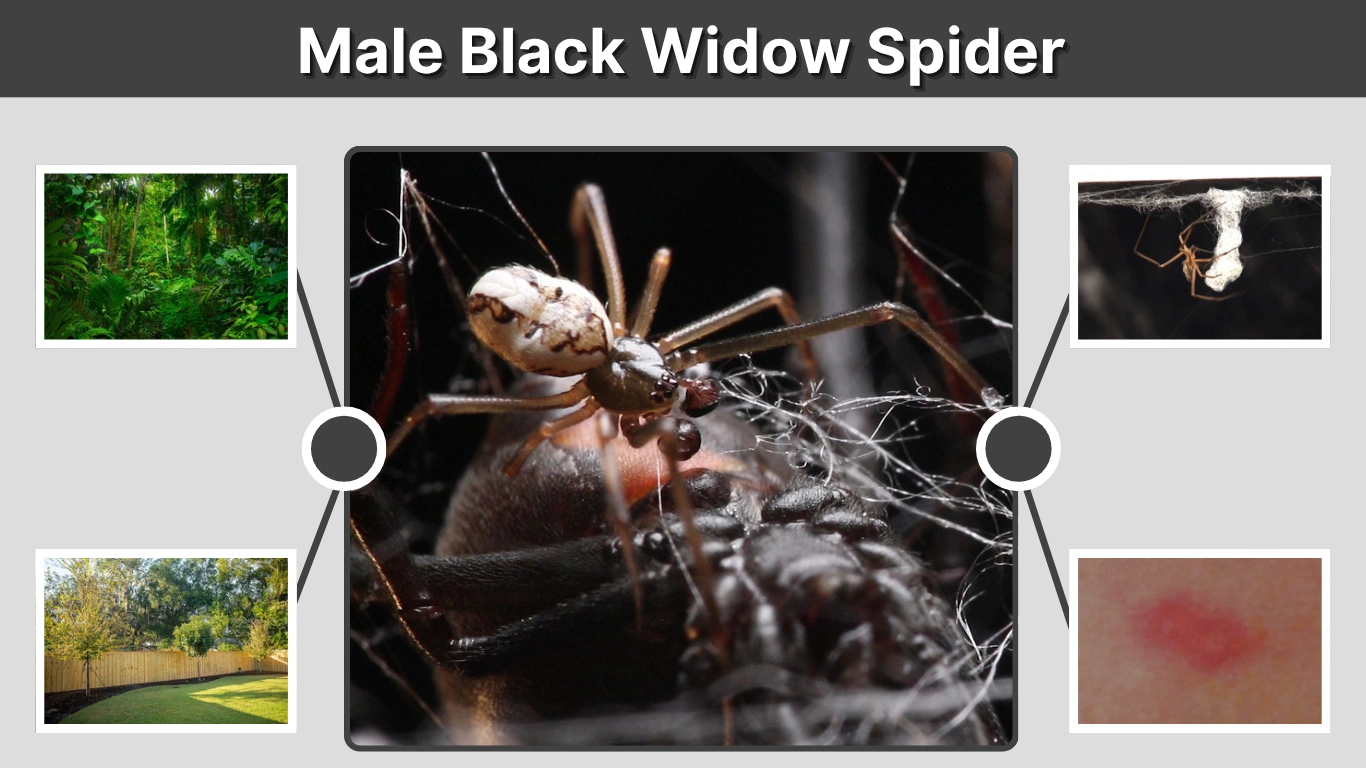
Black widow spiders are well-known for their striking appearance and formidable reputation, but most people only recognize the female. The male black widow spider is far less understood, often overlooked due to its small size and softer appearance. Despite their intimidating association, male widows are not as dangerous as many believe. This detailed guide explains what male black widow spiders look like, how to identify them, their behavior, their size, and how dangerous they truly are.
What Is a Male Black Widow Spider?
A male black widow spider is the smaller, lighter-colored counterpart to the well-known female widow. Both belong to the genus Latrodectus, which includes the Western, Southern, and Northern black widow species found across North America. Unlike females, males are not glossy black and rarely exhibit the classic red hourglass shape. Instead, they appear brownish or grayish with faint markings and slimmer bodies.
Male black widows are not called anything special; they are simply “male black widow spiders.” Their role in nature is straightforward—locate a female, mate, and complete their short life cycle. Their reduced venom potency and non-aggressive personality make them far less threatening than their notorious mates.
Male Black Widow Spider Identification
Appearance & Markings
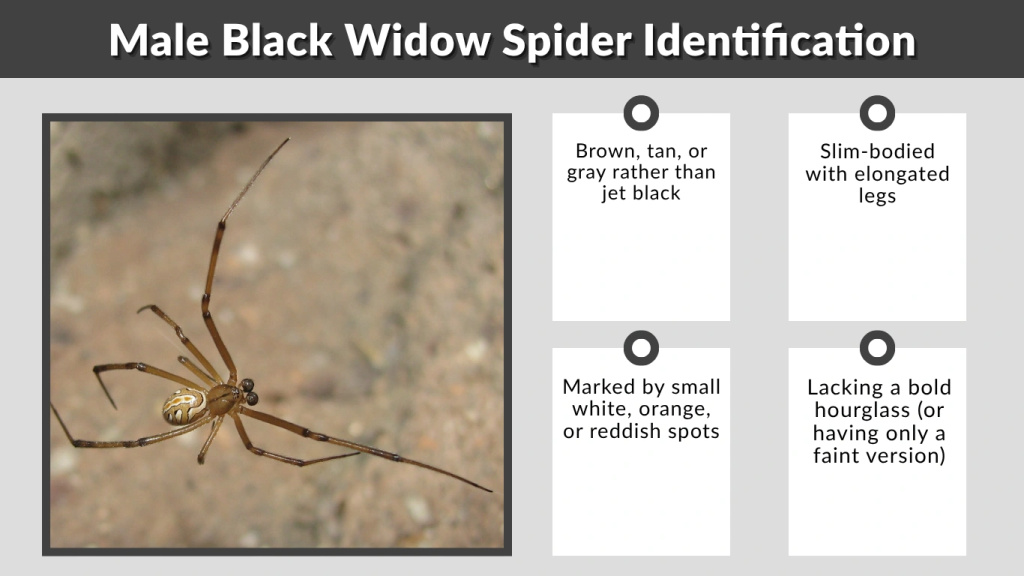
Male black widow spiders look dramatically different from females. While females have a round, shiny black abdomen with a bold red hourglass, males tend to appear:
- Brown, tan, or gray rather than jet black
- Slim-bodied with elongated legs
- Marked by small white, orange, or reddish spots
- Lacking a bold hourglass (or having only a faint version)
They almost resemble a completely different species, which leads many people to misidentify them as harmless house spiders. Juvenile widows also resemble males, which is why young females can be mistaken for male widows.
Size Comparison to the Female
Male black widows are tiny compared to females. While an adult female can reach 1.5 inches with legs extended, males are usually:
- ⅛ to ¼ inch in body length
- Significantly thinner and lighter
- More delicate in structure
The male’s abdomen is smaller and less bulbous, giving them a more agile appearance. Because of their size, many homeowners overlook male black widows entirely.
Pictures & Photo-Based ID Checklist
When looking at pictures of male black widow spiders, use this quick visual checklist:
- Does the spider look brown or tan?
- Is the abdomen narrow instead of round?
- Are there pale stripes or dots instead of a clear hourglass?
- Do the legs appear longer and more slender?
- Is the spider much smaller than a typical female?
Regional variations exist. Western males often show more defined orange spots. Southern males tend to be lighter, while Northern males sometimes carry mixed gray patterns.
Behavior of Male Black Widow Spiders
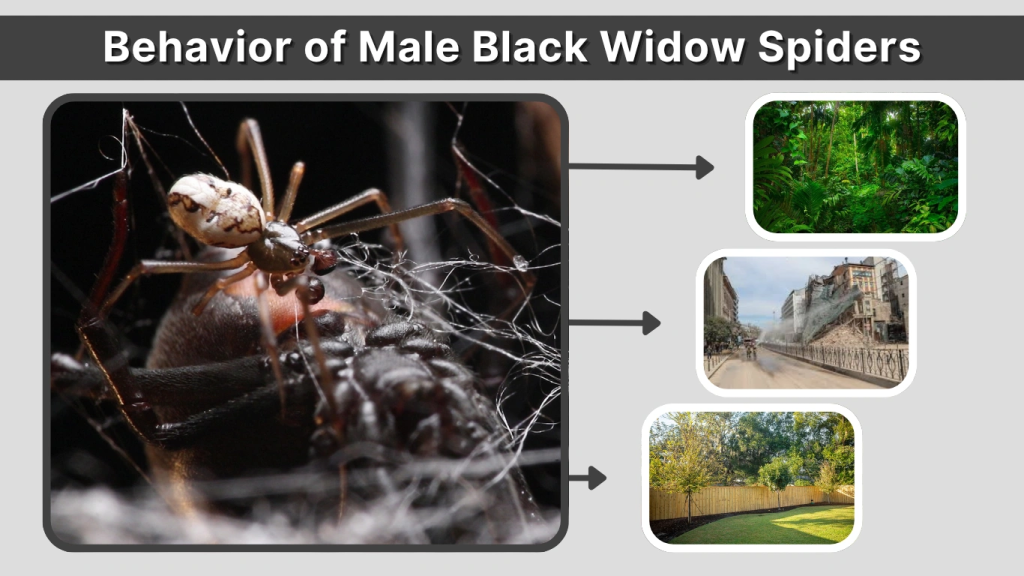
Male black widows behave very differently from the females that remain in their webs. Males are active wanderers, spending most of their adult life searching for a mate. They travel through vegetation, around buildings, and along fences, often appearing indoors in warm seasons.
They are also noticeably less aggressive. Male widows almost never bite humans, and when they do, the bite is mild. Their natural instinct is to flee rather than defend themselves.
Traits of Male Widow Behavior
- Much less aggressive than females
- Wander frequently in search of female webs
- Do not defend territories
- Possess weaker venom
- Rarely build large, structured webs
Their movement patterns, small size, and non-threatening nature make them more of a curiosity than a danger.
Mating & Cannibalism Myth
Do Female Black Widows Eat the Male?
One of the most common questions is whether female black widows eat their mates. While cannibalism does occur, it is not as common in the wild as people assume. Males approach females cautiously and often survive the encounter. Cannibalism is more frequently observed in laboratory settings where escape space is limited.
Male’s Role After Mating
After mating, the male’s biological purpose is complete. They often remain near the female’s web, sometimes coexisting peacefully. Their shorter lifespan—often only a few months after reaching adulthood—means they rarely live long after mating, whether cannibalized or not.
How Dangerous Is a Male Black Widow Spider?
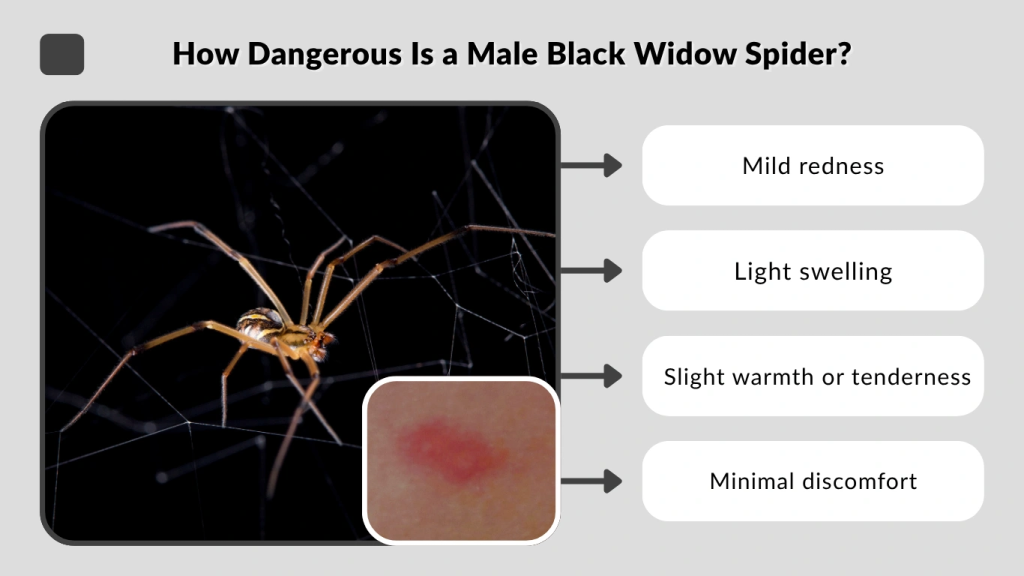
Male black widow spiders are significantly less dangerous than females. Their venom glands are smaller, their fangs are shorter, and their venom is less potent. While the female’s bite can cause severe symptoms, the male’s bite is usually mild and often compared to a small ant sting. Most bites occur only when the spider is trapped against the skin.
Are Male Black Widows Poisonous?
Yes—but not in a medically significant way. Male widows do possess venom, but it is not considered dangerous to humans. Their toxin is weaker, and they inject far less of it. Most people who are bitten report only minor swelling or itching, and serious reactions are nearly unheard of.
Male Black Widow Bite Symptoms
In the rare case a male bites, symptoms may include:
- Mild redness
- Light swelling
- Slight warmth or tenderness
- Minimal discomfort
- Symptoms fading within hours
Children, elderly individuals, and those with sensitivities may experience slightly stronger reactions, but medically serious outcomes are exceedingly rare.
Male Black Widow Habitat & Webs
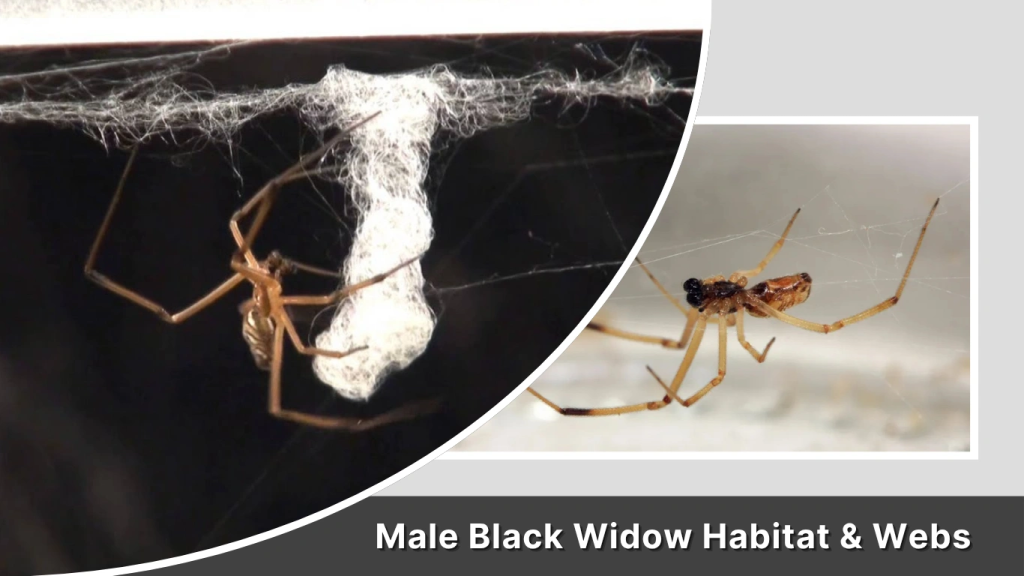
Male widows do not build the large, messy webs that females are known for. Instead, they often create small, temporary silk lines, mainly used for navigation. Their priority is not hunting or trapping prey but finding females.
Common places to find males include:
- Beneath outdoor furniture
- In woodpiles
- Along fences
- Inside garages or sheds
- Under eaves or porch corners
They are far more mobile, so they may appear in unexpected indoor areas during mating season.
Regional Males: Western, Southern & Northern Black Widows
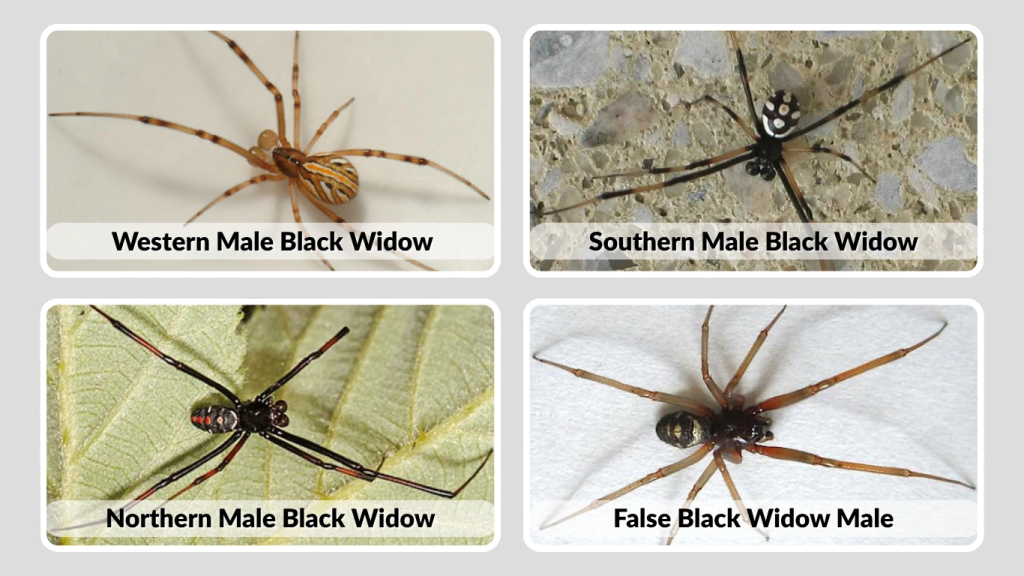
Male black widows differ slightly depending on the species:
Western Male Black Widow (Latrodectus hesperus)
- Light brown coloration
- Distinct orange or yellow spots
- Slender, glossy legs
Southern Male Black Widow (Latrodectus mactans)
- Pale tan or sandy brown
- Faint streaks across the abdomen
- Smaller than Western males
Northern Male Black Widow (Latrodectus variolus)
- Grayish tones
- More noticeable dorsal markings
- Often confused with false widows
False Black Widow Male vs Real Male Widow
False black widow males (Steatoda) can appear similar but usually have:
- Purplish-brown color
- Rounder abdomen
- No red markings
- Different web shape
Understanding these subtle visual differences helps avoid misidentification.
Male Black Widow Spider Facts
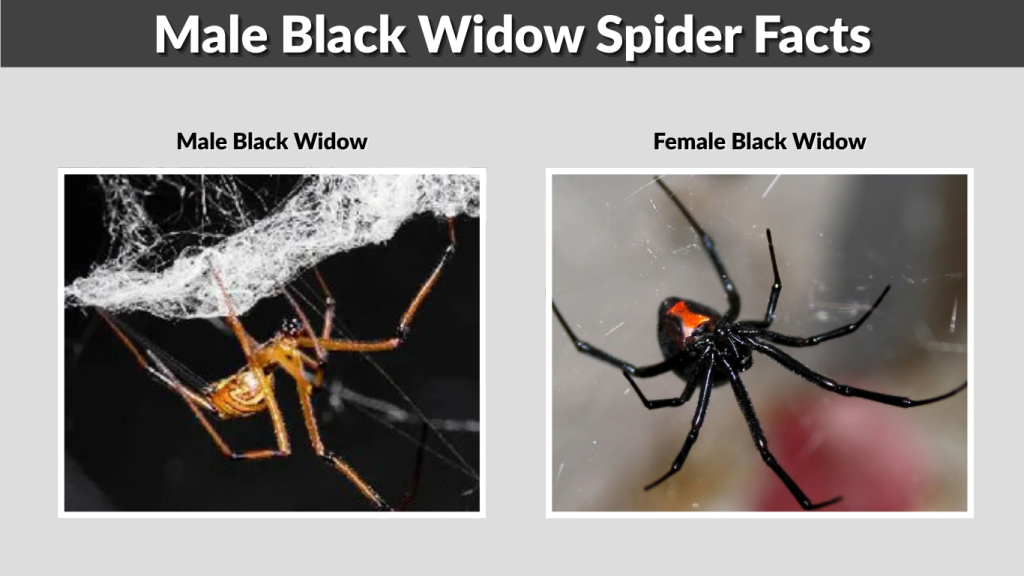
| Trait | Male Black Widow | Female Black Widow |
| Size | Small, slim | Large, round abdomen |
| Color | Brown/gray | Shiny black |
| Markings | Spots/stripes | Red hourglass |
| Danger Level | Low | High |
| Aggression | Very low | Defensive |
| Web Type | Minimal, temporary | Large, tangled web |
Male widows contribute to population survival but pose almost no threat to humans. Their behavior, appearance, and venom all reflect a role centered around reproduction rather than defense or hunting.
FAQs
What does a male black widow spider look like?
Male black widows are small, slim-bodied spiders with brown or tan coloration and faint spots instead of the female’s bold red hourglass. Their legs appear longer and thinner, and the abdomen is narrow rather than rounded. They are often mistaken for harmless house spiders because of their soft coloration.
Is the male black widow spider poisonous or dangerous?
Male black widows do have venom, but it is far weaker than the female’s. Their bites are extremely rare and usually cause minor symptoms such as redness or itching. They are not considered medically dangerous, and most people recover without needing medical treatment.
How big is a male black widow spider?
Male black widow spiders typically measure between ⅛ and ¼ inch in body length. Their small size is one of the easiest identification markers. Even with legs extended, they remain much smaller and more delicate-looking than fully grown female black widows.
Does the female black widow really eat the male?
Cannibalism does occur, but far less frequently in natural settings than popular myths suggest. Many males successfully mate and escape unharmed. The idea of routine male consumption is more commonly observed in cramped laboratory conditions rather than in the wild.
How do you identify a male vs female black widow?
Male black widows are small, light brown, and have spots instead of a bold hourglass. Females are large, glossy black, and display the classic red hourglass on the underside of their abdomen. Females stay on webs, while males wander in search of mates, making them easier to encounter indoors.