
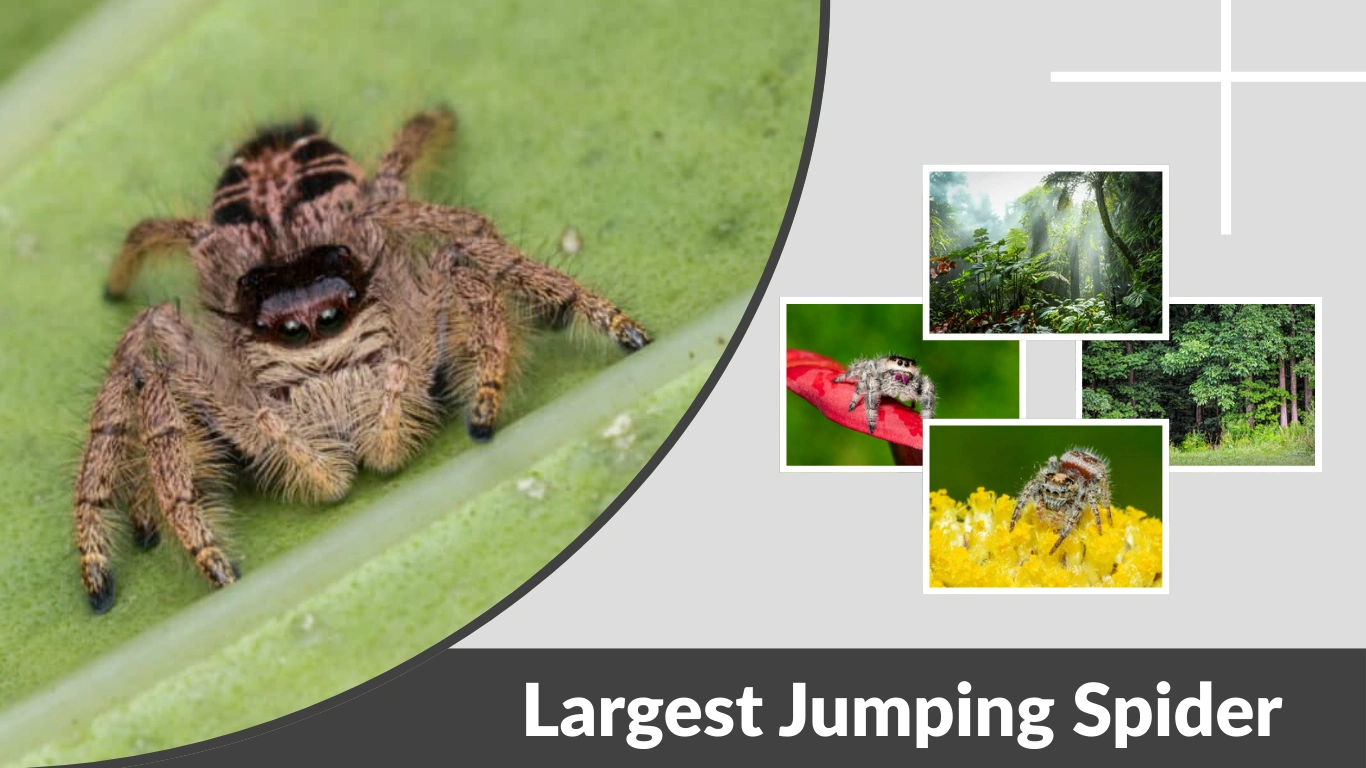
The largest jumping spider challenges the common belief that all jumping spiders are tiny, harmless specks on walls and leaves. While most members of the Salticidae family are small, several giant species grow surprisingly large, with thick bodies, strong legs, and powerful hunting abilities. These oversized jumpers are famous for their excellent vision, intelligent behavior, and impressive leaps. Learning about the biggest jumping spiders reveals how big they can truly grow and how they survive.
What Is Considered the Largest Jumping Spider?
When scientists and spider enthusiasts talk about the “largest” jumping spider, they usually mean the species with the greatest body length and overall mass. Unlike long-legged spiders where leg span is the main focus, jumping spider size is more often judged by body thickness, weight, and head-to-abdomen length. This is because jumping spiders rely on strong, compact bodies to power their sudden leaps and control their prey.
Most jumping spiders measure only a few millimeters long, but a small group within the Salticidae family stands apart. These giant species can reach close to an inch in body length, making them several times larger than the jumping spiders people commonly see in homes or gardens. Their large size gives them stronger jumping ability, the power to subdue bigger prey, and a more noticeable presence in their environments.
The term “largest jumping spider” does not always point to just one species. Instead, it often refers to a handful of closely related spiders, mostly from tropical regions, that consistently grow bigger and heavier than the rest of the family.
Which Species Are the Largest Jumping Spiders?
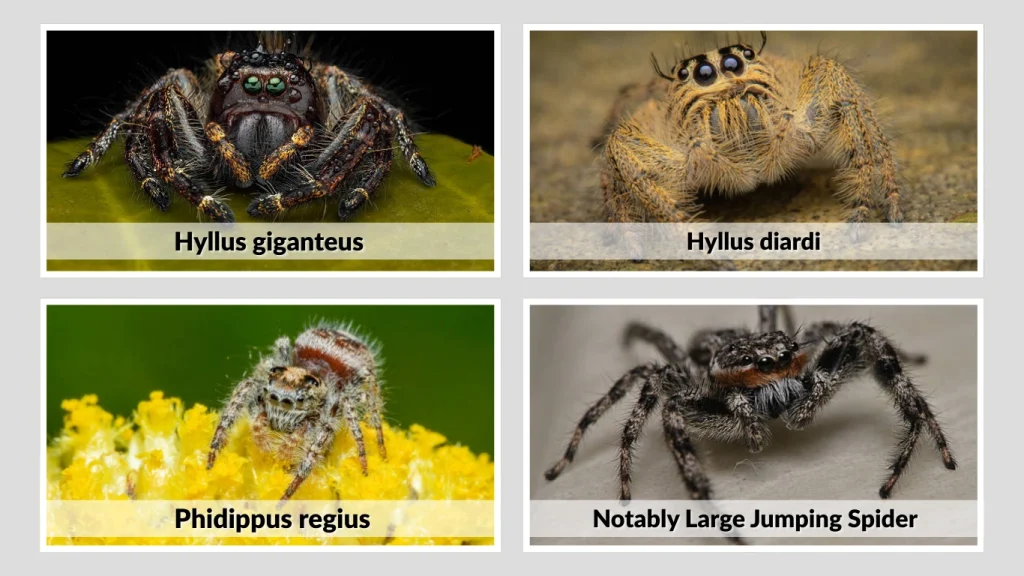
Hyllus giganteus
Hyllus giganteus is widely regarded as the largest jumping spider in the world. Native to Southeast Asia, this species is famous for its thick body, powerful front legs, and impressive size. Adult females can reach around 18 to 25 millimeters in body length, making them giants among jumping spiders.
Unlike smaller jumpers that appear delicate, Hyllus giganteus looks solid and muscular. Its large cephalothorax houses strong jumping muscles and oversized eyes that give it excellent depth perception. This spider is an ambush predator, using its size and strength to overpower insects that many smaller jumping spiders could not handle. Because of its unusual size, Hyllus giganteus is often featured in scientific studies, documentaries, and exotic spider collections.
Hyllus diardi
Hyllus diardi is another massive member of the jumping spider family and is often compared directly with Hyllus giganteus. Found in parts of South and Southeast Asia, this species has a broad, flattened body and strong, thick legs that give it a robust appearance.
Although it may be slightly shorter than Hyllus giganteus, Hyllus diardi is extremely heavy-bodied, which makes it one of the heaviest jumping spiders known. Its large size allows it to hunt sizable insects, and it often occupies tree trunks, foliage, and forest edges where prey is abundant. In the wild, its muted colors help it blend into bark and leaves despite its impressive dimensions.
Phidippus regius (Largest in North America)
In North America, Phidippus regius is considered the largest commonly encountered jumping spider. While it does not reach the extreme size of the giant Asian Hyllus species, it is still very large compared to most other jumping spiders.
Phidippus regius, often called the regal jumping spider, can reach about 15 to 22 millimeters in body length. It is well known for its fuzzy appearance, bold coloration, and curious behavior. This species is frequently studied because it is widespread, easy to observe, and demonstrates the intelligence and visual abilities that jumping spiders are famous for. In the United States, it represents the upper size limit most people will ever see in a jumping spider.
Other Notably Large Jumping Spider Species
Several other species are also described as “giant” jumping spiders, even if they are slightly smaller than Hyllus giganteus. These include other members of the Hyllus genus and some large Phidippus species found in warmer climates. While they may not hold the world record, they consistently grow much larger than typical jumping spiders and share similar thick bodies, strong legs, and powerful hunting styles.
Identification Features of the Largest Jumping Spiders
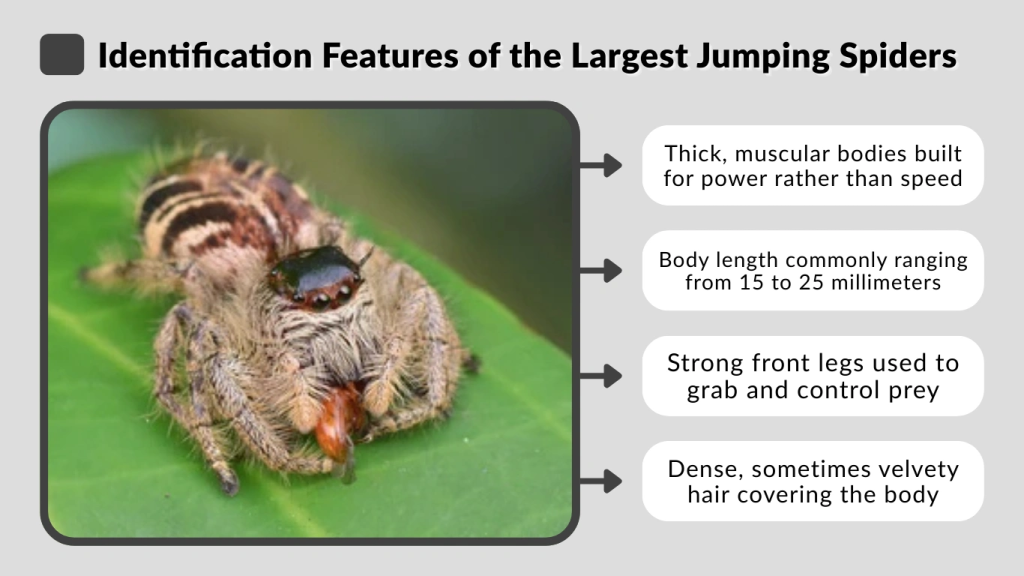
The largest jumping spiders share a set of physical traits that clearly separate them from their smaller relatives.
- Thick, muscular bodies built for power rather than speed
- Body length commonly ranging from 15 to 25 millimeters
- Large, forward-facing principal eyes that provide sharp vision
- Strong front legs used to grab and control prey
- Dense, sometimes velvety hair covering the body
- Slow stalking movements followed by explosive, accurate jumps
These features allow giant jumping spiders to hunt effectively and dominate environments where smaller jumpers would struggle.
How Big Can the Largest Jumping Spider Get?
The maximum size of the largest jumping spiders depends on the species, sex, and environmental conditions. In the biggest known species, adult females are usually larger than males, sometimes by several millimeters. Well-fed individuals living in warm, insect-rich habitats often grow significantly bigger than those in harsher environments.
In ideal conditions, the largest jumping spiders can reach close to one inch in body length, with thick abdomens and strong legs that give them a heavy, solid appearance. This is enormous by jumping spider standards, considering that many common species are less than a quarter of that size. Their large bodies not only allow longer jumps, but also enable them to tackle prey that would be impossible for smaller species to subdue.
Habitat and Geographic Distribution
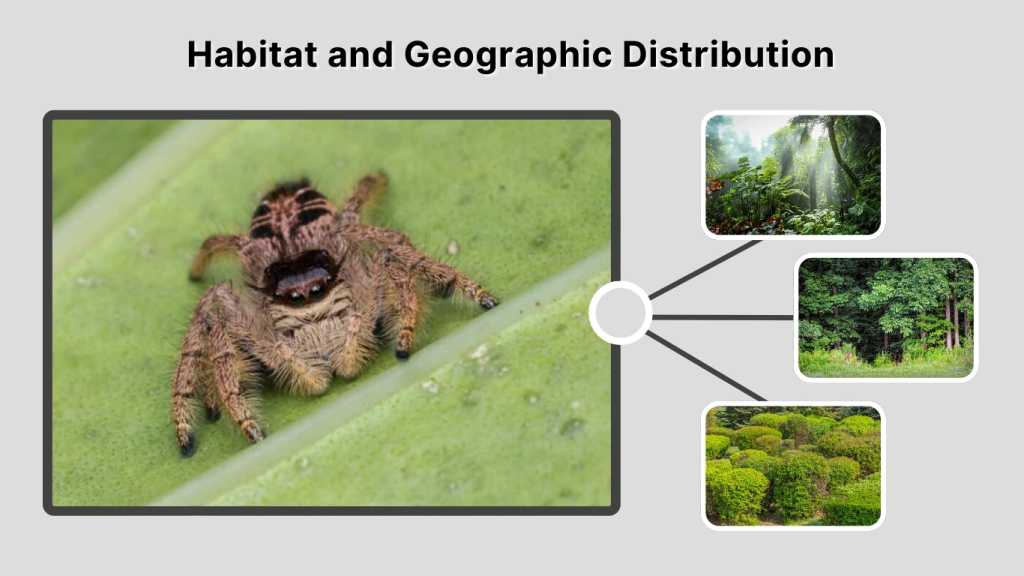
Giant jumping spiders are most commonly found in tropical and subtropical regions, where warm temperatures and abundant insect life support larger body growth. Southeast Asia is the global center for the biggest jumping spider species, especially members of the Hyllus genus. These spiders inhabit rainforests, woodland edges, and dense shrub zones where they can stalk prey on leaves, bark, and branches.
Large jumping spiders are also found in parts of Africa, Australia, and the Americas. In North America, Phidippus regius thrives in warm states, living on plants, fences, and even building walls. Regardless of region, the largest jumping spiders prefer environments that provide good visibility, surfaces for climbing, and steady insect populations.
Diet and Hunting Behavior
The largest jumping spiders are active, visual hunters rather than web builders. Instead of waiting for insects to become trapped, they stalk prey during the day using their excellent eyesight. Their large forward-facing eyes allow them to judge distance, movement, and depth with remarkable accuracy, even compared to many much larger animals.
- Feed mainly on flies, moths, beetles, and grasshoppers
- Often target prey nearly their own body size
- Slowly approach prey before launching a sudden leap
- Use strong front legs to seize and pin insects
- Deliver a quick venomous bite to immobilize prey
- Sometimes prey on other spiders and small arthropods
Because of their larger size, giant jumping spiders can overpower insects that smaller species would avoid. This allows them to fill an important predator role in their ecosystems.
Lifecycle and Growth of Giant Jumping Spiders
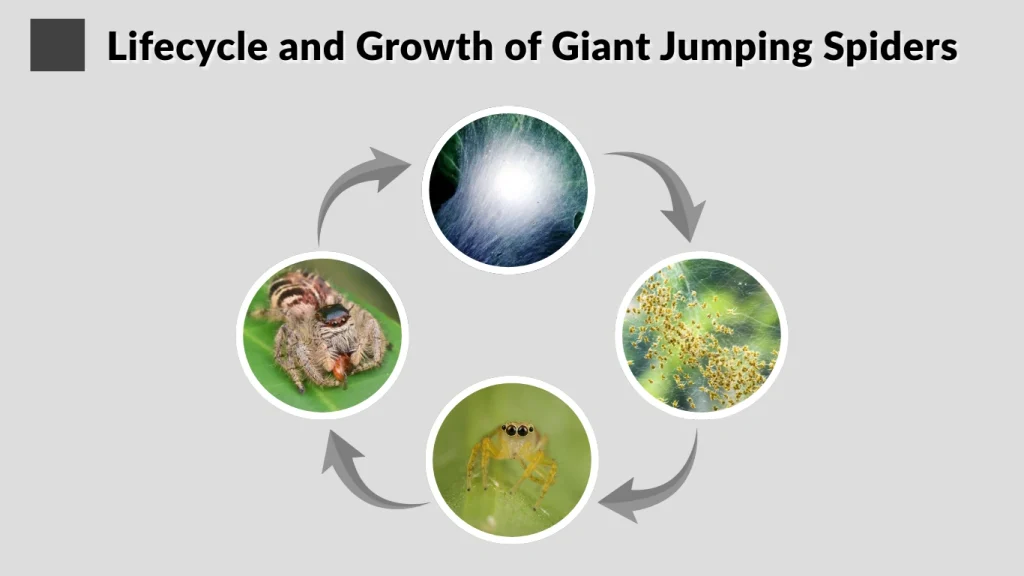
Egg Stage and Spiderlings
The lifecycle of the largest jumping spiders begins when females lay eggs in silken sacs hidden under leaves, bark, or sheltered surfaces. These egg sacs protect the developing spiderlings from predators and environmental threats. After hatching, spiderlings remain near the egg sac for a short period before dispersing into their surroundings.
At this stage, young jumping spiders are extremely small and vulnerable. They hunt tiny insects and mites while avoiding ants, wasps, birds, and larger spiders. Survival during early life is low, which is why females often produce many eggs at once.
Molting and Size Development
Like all spiders, giant jumping spiders grow by molting. They shed their exoskeletons multiple times as they increase in size. Each molt allows the spider to expand its body, strengthen its legs, and develop more powerful jumping muscles.
The number of molts varies by species and environment, but larger jumping spiders typically take longer to mature than smaller ones. Abundant food, warm temperatures, and safe habitat conditions can significantly influence how large an individual eventually becomes.
Adult Stage and Longevity
Once adulthood is reached, growth stops and the spider focuses on hunting and reproduction. Adult giant jumping spiders establish small hunting territories and actively search for mates. Lifespan varies by species, but most large jumping spiders live between one and three years. Females often live longer than males, especially if they successfully reproduce.
Behavior and Interaction With Humans
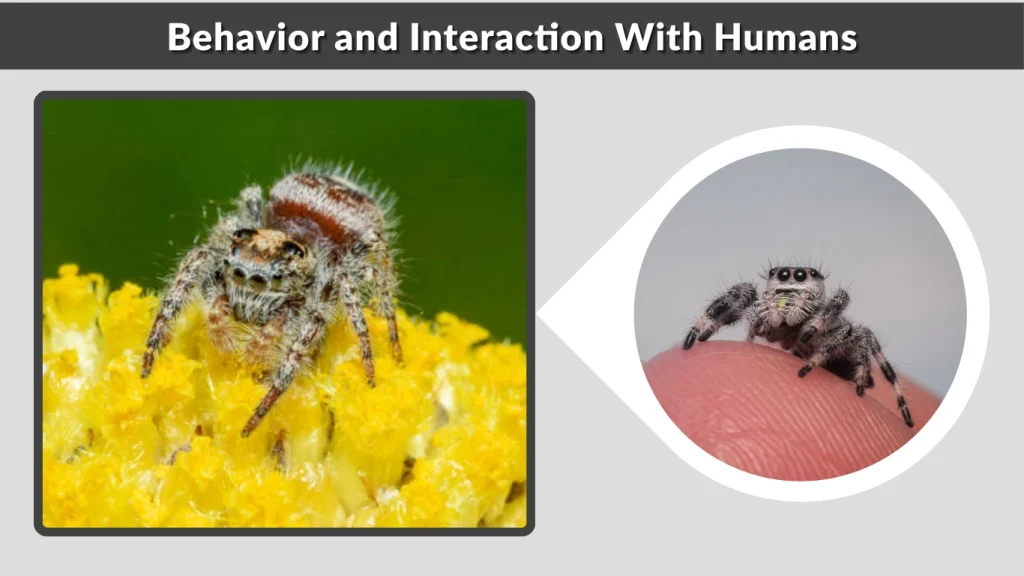
Large jumping spiders are known for their alert and curious behavior. Unlike many spiders that flee quickly, jumping spiders often turn to face large objects, including humans. This behavior comes from their strong vision and tendency to visually investigate their surroundings.
Despite their size, giant jumping spiders are not aggressive. They prefer to retreat or jump away when disturbed. Bites are rare and usually occur only when a spider is trapped against skin. Many people who encounter large jumping spiders notice their intelligent movements, head tilting, and apparent “watching” behavior, which has made them popular among spider enthusiasts.
Are Large Jumping Spiders Dangerous?
Even the largest jumping spiders are considered low-risk to humans. Their venom is designed to subdue insects, not large animals. If a bite does occur, it usually results in mild redness, slight swelling, and short-term discomfort.
Serious reactions are extremely uncommon. Unlike some medically significant spiders, giant jumping spiders do not possess strong necrotic or neurotoxic venom. For this reason, they are often regarded as one of the safest large spiders to encounter.
Differences Between Giant and Typical Jumping Spiders
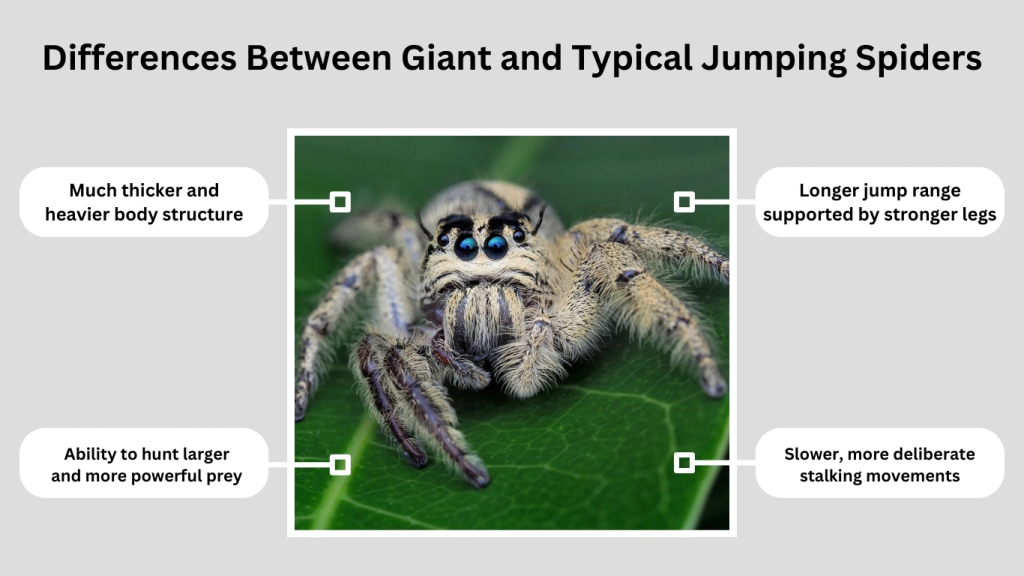
Although they share the same basic body plan, giant jumping spiders differ noticeably from their smaller relatives.
- Much thicker and heavier body structure
- Longer jump range supported by stronger legs
- Ability to hunt larger and more powerful prey
- Slower, more deliberate stalking movements
- More visible courtship and territorial displays
- Greater physical presence that deters some predators
These differences allow giant jumping spiders to occupy slightly different ecological niches than smaller species, giving them access to prey resources unavailable to most jumping spiders.
Why the Largest Jumping Spiders Matter in Ecosystems
The largest jumping spiders play an important role as mid-level predators. By feeding on large insects, they help regulate populations that could otherwise damage vegetation or spread disease. They also serve as prey for birds, reptiles, and mammals, linking insect communities to higher levels of the food web.
Because of their visual hunting style, giant jumping spiders also help shape insect behavior and distribution. Their presence can influence where insects feed, hide, and reproduce, contributing to overall ecological balance.
FAQs
What is the largest jumping spider in the world?
The largest jumping spider is generally considered to be Hyllus giganteus, a species native to Southeast Asia. Adult females can reach nearly one inch in body length, making them several times larger than most common jumping spiders.
How big can a giant jumping spider grow?
In ideal conditions, the largest jumping spiders can reach about 18 to 25 millimeters in body length. Females are usually larger than males, and individuals in warm, food-rich environments often grow significantly bigger than average.
Where do the largest jumping spiders live?
Giant jumping spiders are mostly found in tropical and subtropical regions, especially Southeast Asia, parts of Africa, Australia, and the Americas. They commonly inhabit forests, shrubs, and vegetation-rich areas where insects are abundant.
Are large jumping spiders aggressive?
Large jumping spiders are not aggressive toward humans. They are alert and curious but usually avoid confrontation. Most encounters end with the spider retreating or jumping away rather than attempting to bite.
How long do the largest jumping spiders live?
Most large jumping spiders live between one and three years. Females often live longer than males, particularly if they successfully reproduce and avoid predators throughout their adult life.