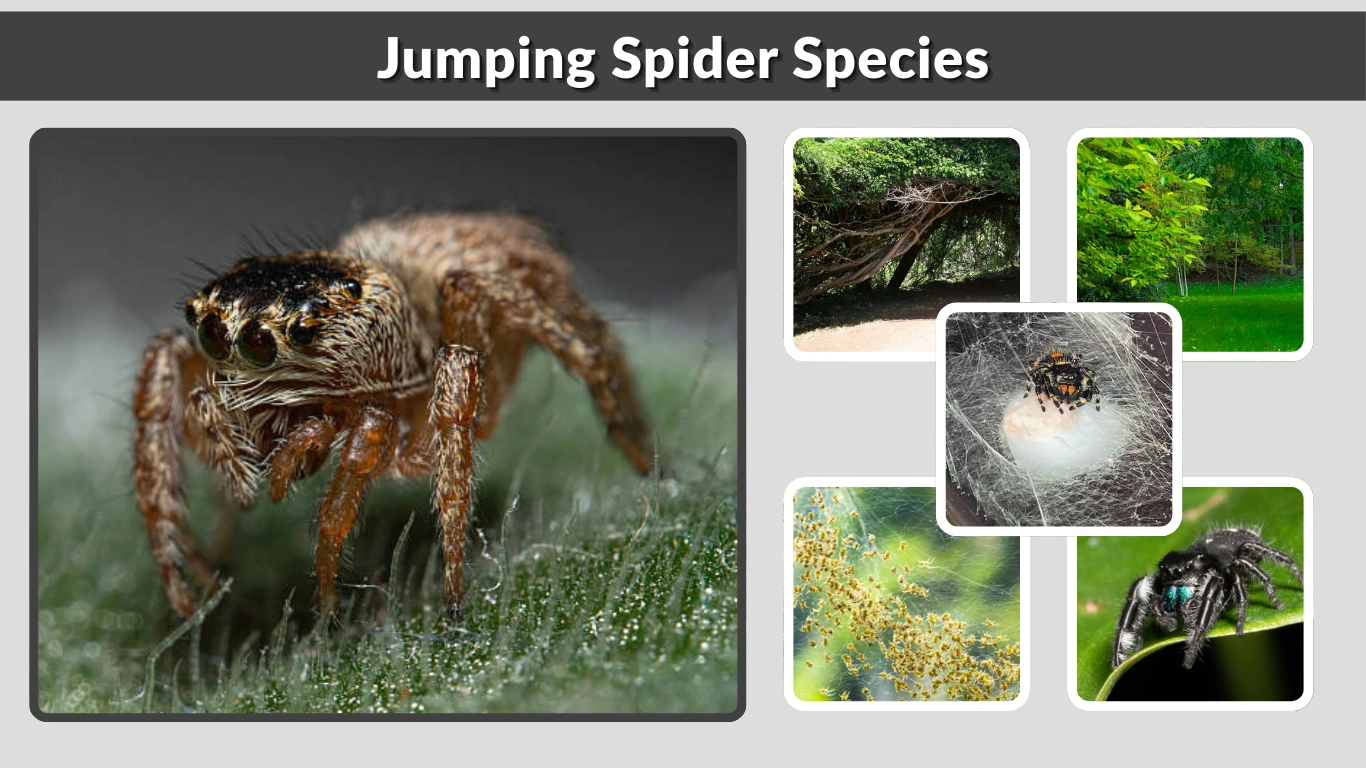
Jumping spider species belong to the family Salticidae, one of the largest and most diverse spider families on Earth. Unlike web-building spiders, they actively hunt their prey using sharp eyesight and sudden, controlled jumps. These spiders are found on every continent except Antarctica and thrive in forests, grasslands, deserts, and even inside human homes. With thousands of species displaying striking colors, patterns, and behaviors, jumping spiders are among the most fascinating arachnids studied today.
What Are Jumping Spider Species?
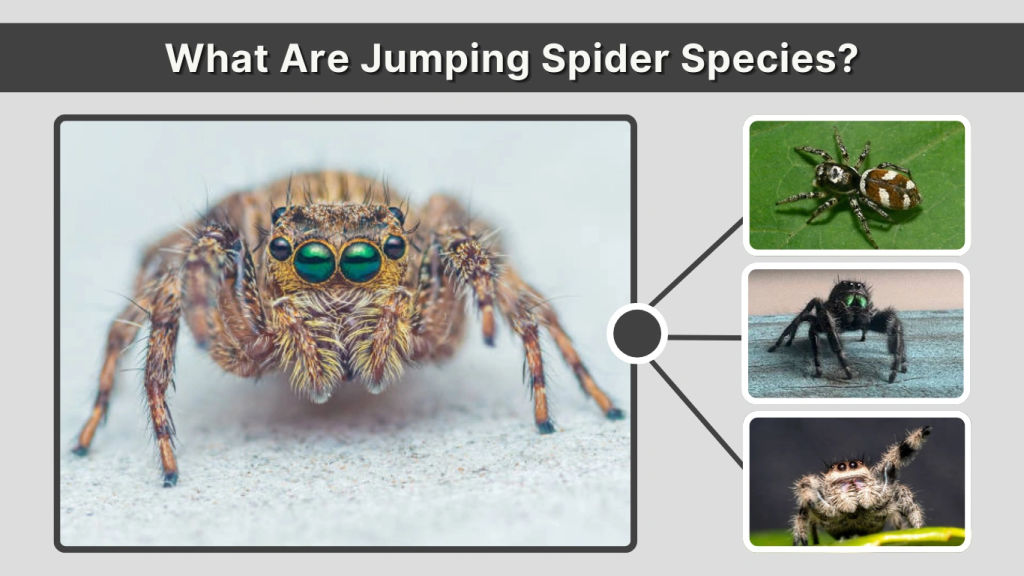
Jumping spiders are small to medium-sized spiders best known for their compact bodies, short powerful legs, and large forward-facing eyes. These eyes give them exceptional vision, allowing them to track prey, recognize movement, and judge distances accurately before leaping. Instead of trapping insects in webs, jumping spiders stalk their prey much like tiny cats, then pounce with impressive precision.
Members of the family Salticidae vary widely in appearance. Some species are fuzzy and brightly colored, while others are smooth and camouflaged to blend into bark, leaves, or sand. Their adaptability has allowed them to colonize nearly every terrestrial habitat. Many species are active during the day, making them easier to observe than most spiders.
Although they possess venom to subdue prey, jumping spiders are not aggressive toward humans. Bites are rare and usually mild. Because they feed on flies, mosquitoes, and other small insects, they are often considered beneficial around homes and gardens.
Scientific Classification of Jumping Spider Species
Family Salticidae
All jumping spider species belong to the family Salticidae. This family contains more than 6,000 described species and hundreds of genera, making it the largest spider family in the world. Fossil evidence suggests that jumping spiders have been evolving for tens of millions of years, developing advanced eyesight and complex behaviors that set them apart from most other spiders.
Salticids are found across tropical, subtropical, and temperate regions. The greatest diversity occurs in warm forested areas, where different species specialize in tree bark, leaf litter, flowers, or canopy habitats. Their success comes from their flexible hunting strategies, ability to adapt to micro-habitats, and complex courtship behaviors.
Major Genera of Jumping Spiders
Jumping spider species are grouped into genera based on body shape, eye structure, reproductive organs, and behavior. Some of the best-known genera include Phidippus, Salticus, Plexippus, Marpissa, and Hasarius.
The genus Phidippus contains many of the largest and most colorful jumping spiders, especially in North America. Salticus includes smaller species often seen on walls and fences. Plexippus species are widespread in warm regions and frequently live near buildings. These genera help scientists organize thousands of species and understand how they evolved.
How Scientists Identify New Species
Identifying jumping spider species involves close examination of physical and genetic features. Researchers study body proportions, eye spacing, leg length, and the arrangement of hairs and scales. Color patterns can be useful, but they often vary within a single species.
The most important features are usually microscopic structures of the reproductive organs, which are unique to each species. In recent years, DNA analysis has become a powerful tool, allowing scientists to confirm whether a spider represents a new species or a variation of an existing one.
How to Identify Jumping Spider Species
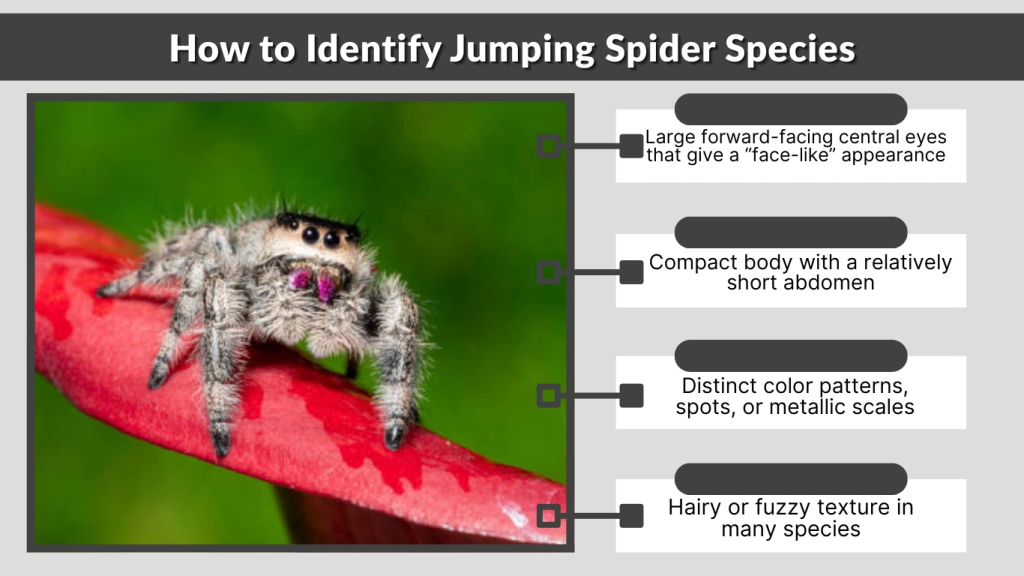
Jumping spiders share several core traits, but species can be distinguished by a combination of physical details and behavior.
- Large forward-facing central eyes that give a “face-like” appearance
- Compact body with a relatively short abdomen
- Distinct color patterns, spots, or metallic scales
- Hairy or fuzzy texture in many species
- Jerky, alert movements instead of smooth crawling
- Short, controlled jumps supported by a silk safety line
- Preference for sunny surfaces such as leaves, walls, and tree trunks
Diversity of Jumping Spider Species Worldwide
Jumping spider species represent one of the most diverse arachnid groups on the planet. Scientists have described more than 6,000 species, and new ones are discovered every year, especially in tropical rainforests and remote regions. Many habitats support dozens of species living side by side, each adapted to a narrow ecological niche.
Tropical areas show the greatest variety, with brilliantly colored spiders occupying flowers, understory plants, and canopy leaves. In temperate regions, species diversity is lower, but jumping spiders still play an important ecological role. Some species are highly localized, found only on a single island, mountain range, or forest type, making them especially important for biodiversity research.
This remarkable diversity reflects millions of years of adaptation, resulting in spiders that mimic ants, beetles, or wasps, as well as species that rely on camouflage, speed, or visual signaling to survive.
Well-Known Jumping Spider Species
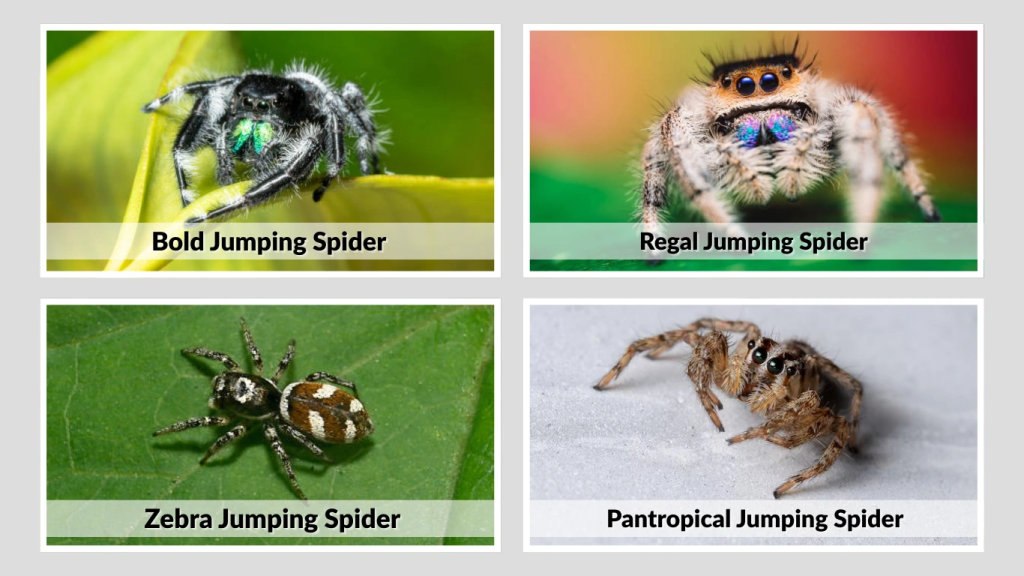
Bold Jumping Spider (Phidippus audax)
The bold jumping spider is one of the most recognizable jumping spider species in North America. It usually appears black with bright white or orange spots on its abdomen and a slightly fuzzy body. This species is commonly found on walls, fences, tree trunks, and garden plants. Bold jumping spiders are active hunters, often seen turning to “watch” movement, which highlights their excellent eyesight and alert nature.
Regal Jumping Spider (Phidippus regius)
The regal jumping spider is famous for its size and striking colors. Females are often black with orange, red, or white markings, while males usually appear black and white with metallic green mouthparts. This species is common in the southeastern United States and nearby regions. Regal jumping spiders are popular in spider research and the pet hobby because of their bold behavior and strong visual responses.
Zebra Jumping Spider (Salticus scenicus)
The zebra jumping spider is a small but widespread species known for its black-and-white striped pattern. It is frequently seen on house walls, windows, fences, and outdoor structures. Unlike many spiders, it tolerates human presence well and often hunts flies in open, sunny locations. Its compact shape and high-contrast markings make it one of the easiest jumping spiders to identify.
Pantropical Jumping Spider (Plexippus paykulli)
The pantropical jumping spider is found in warm regions around the world. It often lives on buildings, tree trunks, and outdoor walls. Males and females have distinct patterns, usually brown, gray, and white. This species is well adapted to human environments and frequently hunts insects attracted to lights, making it one of the most globally distributed jumping spiders.
Habitats of Different Jumping Spider Species
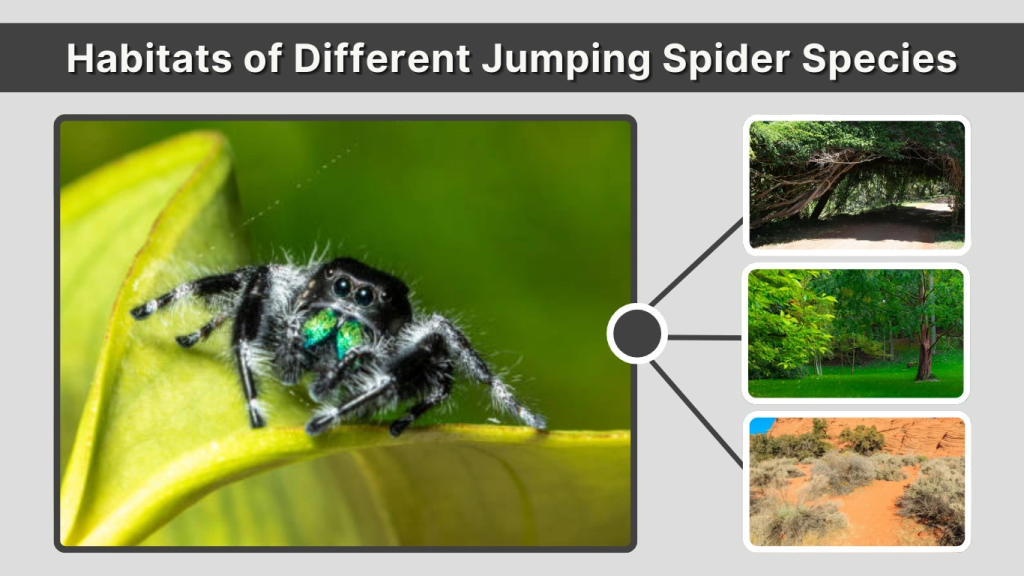
Jumping spider species occupy a remarkable range of environments, from dense forests to city buildings. Their excellent vision and active hunting style allow them to survive in places where web-building spiders may struggle.
- Forest canopies, tree bark, and leaf surfaces
- Grasslands, shrubs, and agricultural areas
- Deserts, cliffs, and rocky landscapes
- Gardens, parks, and backyard vegetation
- House walls, ceilings, and window frames
- Coastal zones and mangrove ecosystems
Behavior Differences Among Jumping Spider Species
Although all jumping spiders rely on vision and jumping to hunt, their behavior varies widely between species. Some are fast-moving stalkers that actively chase prey across leaves and walls. Others are patient ambush hunters that wait motionless before striking. Many species attach a silk safety line before jumping, preventing fatal falls.
Courtship behavior is one of the most fascinating differences among jumping spider species. Males often perform complex dances using leg waves, body vibrations, and colorful displays to attract females. These movements are highly species-specific and help prevent mating between different species. Some jumping spiders also show problem-solving abilities, such as detouring around obstacles to reach prey, which has made them important subjects in behavioral research.
Life Cycle of Jumping Spider Species
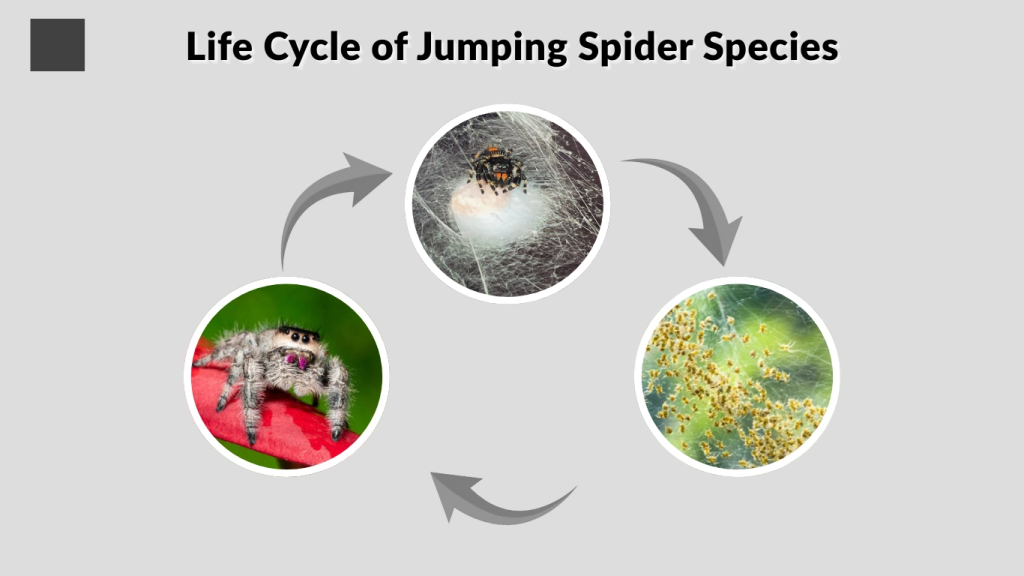
Egg and Nesting Stage
Female jumping spiders lay eggs inside silk nests hidden under leaves, bark, rocks, or man-made surfaces. Many species guard their egg sacs, protecting them from predators and environmental threats. The number of eggs varies by species, but a single sac may contain dozens of developing spiderlings.
Spiderling Growth
After hatching, spiderlings remain in the nest for a short time before dispersing. They begin hunting very small insects almost immediately. As they grow, they molt multiple times, shedding their exoskeleton to allow for body expansion. Mortality is high at this stage, which is why many eggs are produced.
Adult Stage
Once mature, jumping spiders focus on feeding and reproduction. Adult lifespan varies by species and climate but often ranges from several months to over a year. Males usually die sooner, while females may survive long enough to produce multiple egg sacs.
Why Jumping Spider Species Are Important
Jumping spiders are more than just interesting arachnids; they play an important role in ecosystems and scientific research.
- Natural control of flies, mosquitoes, and plant pests
- Support of food webs as both predators and prey
- Indicators of habitat quality and biodiversity
- Key subjects in vision and cognition studies
- Educational and pet-keeping interest worldwide
Are Jumping Spider Species Dangerous to Humans?
Most jumping spider species are harmless to humans. They are shy, non-aggressive, and prefer to flee rather than bite. Bites are rare and usually occur only when a spider is trapped or crushed against skin. When they do happen, symptoms are typically mild, such as slight redness or itching.
Their venom is designed to subdue small insects, not people. Serious reactions are extremely uncommon. In most cases, simple cleaning of the area is sufficient, and medical care is rarely needed.
Conservation Status of Jumping Spider Species
The conservation status of most jumping spider species is poorly documented. While many are widespread and stable, others have very limited ranges and depend on specific habitats. Deforestation, pesticide use, urban expansion, and climate change all pose growing threats.
Because many species remain undiscovered or unstudied, habitat protection is crucial. Preserving forests, wetlands, and natural vegetation helps protect not only jumping spiders but also the countless insects and animals that share their ecosystems.
FAQs
How many jumping spider species are there worldwide?
Scientists have described more than 6,000 jumping spider species, making Salticidae the largest spider family. New species are discovered every year, especially in tropical regions. Because many habitats remain under-studied, the true number of jumping spider species is likely much higher.
What is the most common jumping spider species?
The most commonly seen species vary by region, but the bold jumping spider, zebra jumping spider, and pantropical jumping spider are among the best-known worldwide. These species adapt well to human environments, which is why they are frequently observed on walls, fences, and garden plants.
Can jumping spider species live indoors?
Yes, many jumping spider species can live indoors, especially those adapted to warm environments and artificial structures. They often enter homes while hunting insects attracted to lights. Indoors, they usually stay near windows, ceilings, and walls where prey is easy to find.
Are jumping spider species harmful to humans?
Jumping spider species are not considered dangerous to humans. They are non-aggressive and rarely bite. When bites do occur, they are usually mild and similar to a small insect sting. These spiders are more beneficial than harmful because they help control pest insects.
Which jumping spider species are kept as pets?
Species from the genus Phidippus, especially the regal jumping spider and bold jumping spider, are most commonly kept as pets. They are popular because of their size, colors, and interactive behavior. Proper enclosures, humidity, and a steady supply of small insects are essential for their care.