

A hornet’s nest may look like a gray or tan paper ball, football, or teardrop hanging from a tree, but appearance depends heavily on the species. Bald-faced hornets build large exposed paper nests, while true European hornets usually hide their nests inside hollow trees, wall voids, attics, or other cavities. Some insects commonly called “ground hornets” actually nest underground and may be yellowjackets or solitary wasps rather than true hornets. Inside a social hornet nest are multiple layers of hexagonal brood cells surrounded by a protective paper envelope.
What Does a Hornet Nest Look Like?
A typical exposed hornet nest has a distinctive paper-mâché appearance.
Common characteristics include:
- Gray, tan, or brown coloration
- Layered or swirling paper texture
- Round, oval, football, or teardrop shape
- One main entrance
- Enclosed outer covering
- Internal layers of hexagonal cells
- Attachment to a tree branch, shrub, building, or protected cavity
Hornets and related social wasps make paper by chewing weathered wood fibers and mixing them with saliva.
The result is surprisingly strong but lightweight.
| Nest Feature | Typical Appearance |
| Material | Gray/brown paper |
| Shape | Round to football-shaped |
| Entrance | Usually one visible opening |
| Interior | Several comb layers |
| Cells | Hexagonal |
| Location | Trees, shrubs, cavities, buildings |
| Size | From golf-ball size to basketball size or larger |
What Does a Bald-Faced Hornet Nest Look Like?
The bald-faced hornet (Dolichovespula maculata) builds the classic large aerial nest most people imagine when they hear “hornet nest.”
Technically, bald-faced hornets are yellowjackets rather than true hornets.
Their nests are:
- Gray or gray-brown
- Completely enclosed
- Oval to football-shaped
- Covered in swirling paper layers
- Suspended above ground
- Equipped with an entrance near the lower portion
They commonly hang from:
- Tree branches
- Large shrubs
- Roof eaves
- Utility structures
- Occasionally other elevated locations
Penn State describes bald-faced hornets as builders of exposed, round paper nests, unlike European hornets that normally use enclosed cavities.
How Big Can a Bald-Faced Hornet Nest Get?
A mature nest can become approximately the size of a basketball or larger.
It starts very small in spring but expands as the worker population grows through summer.
The outside may show layers of different shades because workers gather wood fibers from several sources.
What Does the Beginning of a Hornet Nest Look Like?
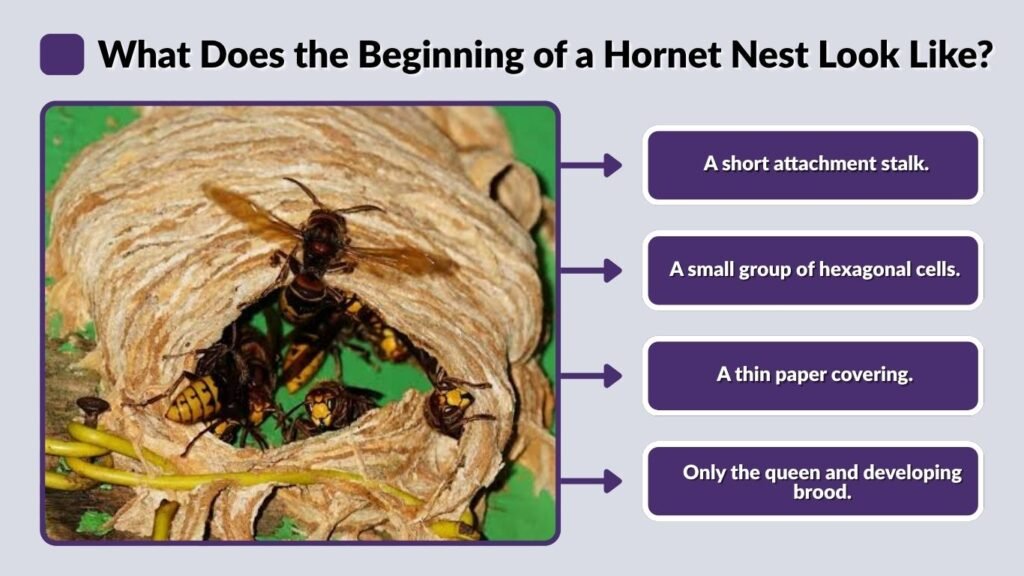
A new social wasp nest can look surprisingly small.
In spring, an overwintered queen begins the colony by herself.
An early exposed nest may consist of:
- A short attachment stalk
- A small group of hexagonal cells
- A thin paper covering
- Only the queen and developing brood
It may initially be only golf-ball sized.
Once the first workers emerge, construction accelerates.
A simplified progression looks like:
Queen starts nest → first cells → first workers → expanding combs → enclosed mature nest
By late summer, a nest that began with only a few cells may contain hundreds of workers.
What Does the Inside of a Hornet’s Nest Look Like?
Inside a mature social hornet or yellowjacket nest are multiple horizontal combs containing rows of hexagonal cells.
The structure typically includes:
- Eggs
- White larvae
- Pupae
- Empty brood cells
- Adult workers
- Queen
- Supporting paper structures
- Outer protective envelope
The cells are somewhat similar in appearance to honeycomb, but hornets make theirs from paper rather than wax.
Several comb layers may be stacked one above another with spaces between them so workers can move through the colony.
Do not cut open an active nest to inspect it. Social wasps vigorously defend their brood and queen.
What Does a European Hornet Nest Look Like?
The European hornet (Vespa crabro) is a true hornet and behaves differently from bald-faced hornets when choosing a nesting location.
Its nest is usually hidden inside a cavity.
Common locations include:
- Hollow trees
- Wall voids
- Attics
- Barns
- Sheds
- Other protected spaces
Penn State notes that European hornets build paper nests but generally place them in protected aerial cavities instead of making the conspicuous exposed nests typical of bald-faced hornets.
What Can You See From Outside?
Often, very little.
You may notice:
- Hornets entering a hole in a tree
- Repeated activity around siding
- Wasps entering an attic opening
- A brown paper structure partly visible inside a cavity
The nest itself may contain several comb layers surrounded by an outer paper envelope.
What Does a Hornet Nest Look Like in a Tree?

A tree can contain two very different-looking types of nests.
Hanging From a Branch
A large football-shaped gray nest hanging openly from a branch is frequently a bald-faced hornet nest in North America.
Its layered outer envelope is clearly visible.
Inside a Hollow Tree
Repeated large wasps flying into a hole in the trunk may indicate a European hornet colony.
In this situation, the paper nest itself could be almost completely hidden.
Penn State identifies hollow standing trees as one of the characteristic nesting locations for European hornets.
What Does a Hornet Nest Look Like on a House?
Hornet-like wasps may nest in several parts of a building.
Possible sites include:
- Under roof eaves
- Attics
- Wall cavities
- Behind siding
- Around rooflines
- Inside sheds
- Under decks
A visible gray football-shaped nest attached under an eave may belong to bald-faced hornets or another aerial yellowjacket.
European hornets are more likely to use an enclosed cavity.
Repeated traffic into a small building opening can be a stronger clue than an exposed nest.
Avoid sealing an active entrance before the colony has been properly addressed. Trapping a colony inside a wall can cause insects to search for another exit, potentially toward indoor spaces.
What Does a Ground Hornet Nest Look Like?
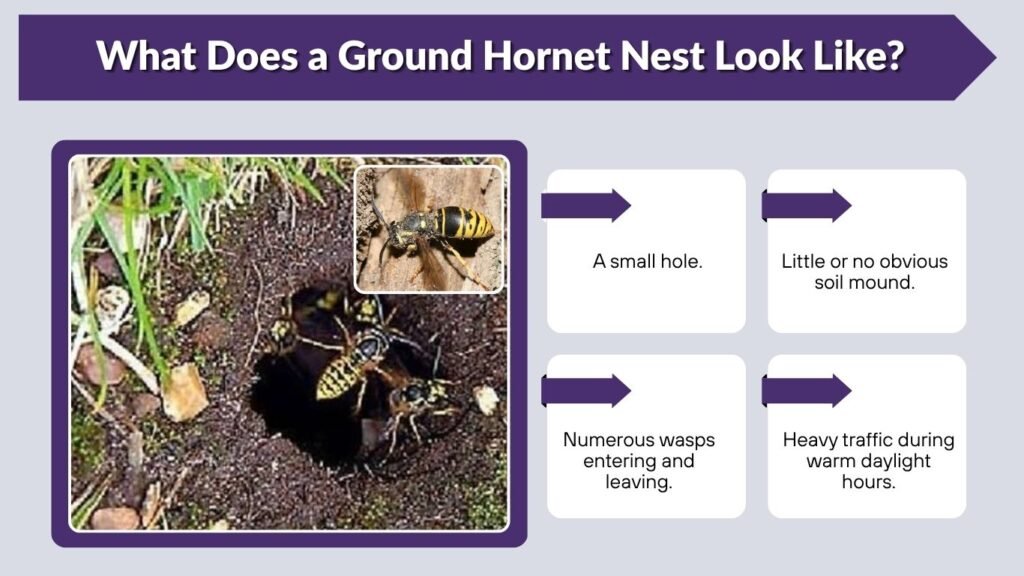
“Ground hornet” is not a precise scientific name.
In North America, the term may refer to:
- Ground-nesting yellowjackets
- Cicada killers
- Other burrowing wasps
Ground Yellowjacket Nest
The paper nest itself is underground and usually cannot be seen.
From above, you may notice:
- A small hole
- Numerous wasps entering and leaving
- Little or no obvious soil mound
- Heavy traffic during warm daylight hours
Penn State notes that underground yellowjacket nests can have their entire paper structure concealed beneath the soil.
These colonies can be highly defensive.
Cicada Killer Nest
Cicada killers are large wasps sometimes called ground hornets, but they are solitary.
Their nests usually look like:
- A burrow in bare soil
- A noticeable pile of excavated dirt
- Several nearby holes where multiple females nest in the same favorable area
European hornets, by comparison, are social and do not normally construct this type of individual soil burrow.
Bald-Faced Hornet Nest vs. Paper Wasp Nest
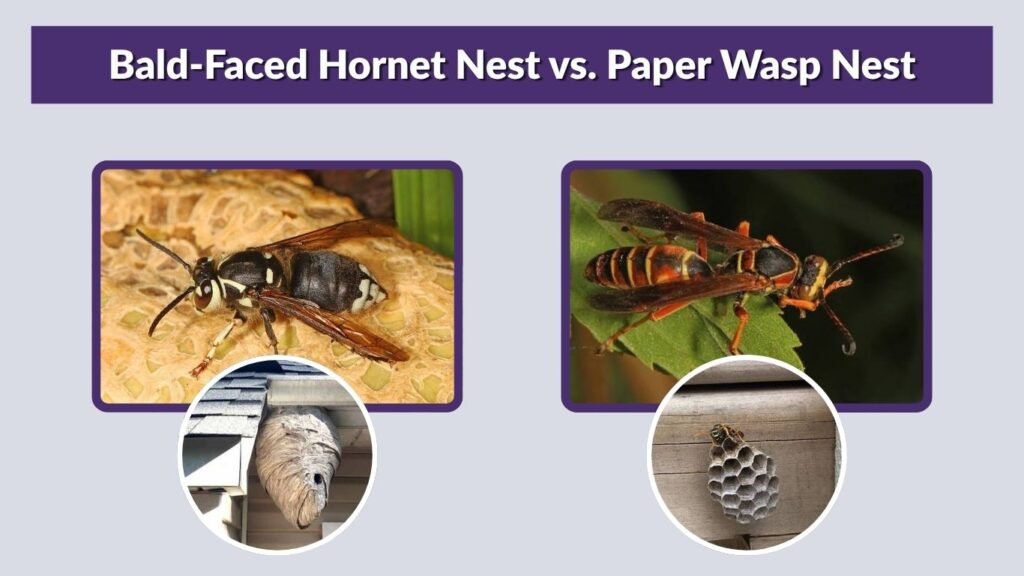
These nests are easy to distinguish once you see their structure.
| Feature | Bald-Faced Hornet | Paper Wasp |
| Outer envelope | Yes | No |
| Shape | Football/oval | Umbrella-like |
| Cells visible | Usually hidden | Clearly exposed |
| Typical color | Gray/brown | Gray/tan |
| Common location | Trees, shrubs, eaves | Eaves, decks, branches |
A paper wasp nest resembles a small open umbrella made of exposed hexagonal cells.
An aerial bald-faced hornet nest encloses its cells completely within multiple paper layers.
What Does a Giant Hornet Nest Look Like?
The Northern giant hornet (Vespa mandarinia), formerly widely called the “murder hornet,” generally nests in protected cavities, particularly pre-existing underground spaces such as rodent burrows. USDA describes queens as commonly selecting underground cavities with narrow entrances.
However, the species was officially declared eradicated from the United States after the Washington State infestation was eliminated.
Therefore, a large underground wasp nest elsewhere in the United States should not automatically be identified as a northern giant hornet nest.
What Does a Japanese Hornet Nest Look Like?
“Japanese giant hornet” is an older/common name often applied to the northern giant hornet.
Its nest is usually concealed rather than hanging openly from a branch.
Typical sites include:
- Underground cavities
- Abandoned rodent burrows
- Hollow spaces around tree roots
- Occasionally other protected cavities
From outside, only the entrance and hornet traffic may be visible.
Small Hornet Nest vs. Mature Nest

Nest size changes rapidly through the season.
Spring
The queen builds a very small nest and raises the first workers.
Early Summer
Workers begin expanding the nest and colony numbers increase.
Late Summer
The nest may become large and contain hundreds of insects.
Fall/Winter
In temperate climates, workers and the old queen die after cold weather arrives. Newly produced queens leave to overwinter elsewhere.
The abandoned paper structure normally isn’t reused the next year by the same colony.
Is an Empty Hornet Nest Safe?
An old nest seen during winter is often abandoned, but do not assume a nest is empty based solely on appearance.
Watch from a safe distance for insect traffic before approaching it.
During summer, repeated flight into and out of an opening is a strong sign of an active colony.
Large active nests near:
- Doors
- Walkways
- Children’s areas
- Decks
- Windows
- Work areas
may warrant professional pest-control assistance, particularly if anyone nearby has a severe sting allergy.
FAQs
1. What does a typical hornet nest look like?
An exposed hornet-like nest usually appears gray or brown, papery, layered, and oval or football-shaped. It contains enclosed hexagonal brood combs. However, true European hornets usually hide their nests inside hollow trees, walls, attics, or other cavities.
2. What does the inside of a hornet nest look like?
Inside are several layers of hexagonal paper cells containing eggs, larvae, and pupae. The combs are stacked with spaces that allow workers to move throughout the colony, and an outer paper envelope protects the entire structure.
3. What does a bald-faced hornet nest look like?
It is a large gray or brownish paper structure shaped roughly like a football or teardrop. Bald-faced hornets commonly suspend these enclosed nests from trees, shrubs, or structures. They are actually aerial yellowjackets rather than true hornets.
4. What does a hornet nest in the ground look like?
Usually only an entrance hole and regular wasp traffic are visible. In North America, a colony commonly described as “ground hornets” may actually be ground-nesting yellowjackets. Their paper nest can remain completely hidden underground.
5. What does a European hornet nest look like?
European hornets make a multilayered paper nest, but it is normally concealed inside a hollow tree, wall void, attic, or another protected cavity. You may see only large hornets repeatedly entering and exiting a small opening.