
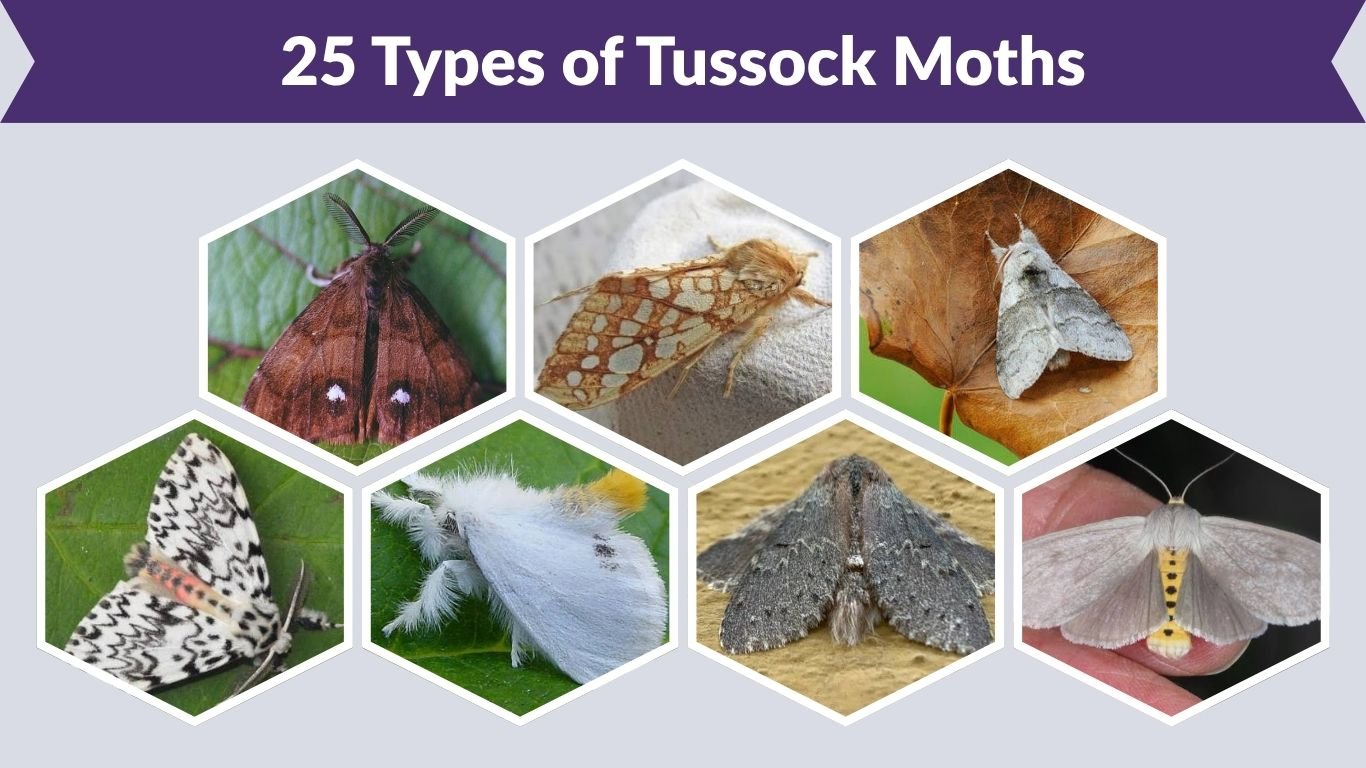
Tussock moths are a diverse group of hairy moths best known for their striking caterpillars, which often have raised tufts, long hair pencils, and bold colors. They can be found in forests, gardens, grasslands, wetlands, orchards, and suburban areas around the world. While adult moths are usually harmless, the hairs of some caterpillars may irritate sensitive skin. In this guide, you’ll discover 25 types of tussock moths, along with their identification features, habitats, behaviors, diets, and life cycles.
1. White-marked Tussock Moth

The White-marked Tussock Moth is one of the most recognizable tussock moths in North America, especially because of its striking caterpillar. The larva has bright tufts, long hair pencils, and bold markings that make it easy to distinguish from many other caterpillars. Adults are much less colorful, with males being winged while females are nearly wingless.
Identification
- Scientific name: Orgyia leucostigma
- Caterpillars have four prominent white or cream-colored tufts along the back.
- Bright red spots are visible near the head and rear of the caterpillar.
- Long black hair pencils project from the front and back of the body.
- Adult males have mottled gray-brown wings.
- Adult females are pale, heavy-bodied, and nearly wingless.
- Male wingspan is usually around 1 to 1.4 inches.
Habitat
White-marked Tussock Moths are commonly found in deciduous forests, parks, gardens, orchards, and suburban areas. They are especially frequent where broadleaf trees and ornamental plants are abundant. Because the larvae can feed on many different tree species, they are able to survive in a wide range of habitats. They may also occur around streets, yards, and landscaped areas containing mature trees.
Behavior
Adult males are active flyers and search for females by detecting pheromones. Females remain close to the cocoon from which they emerged because their reduced wings prevent normal flight. The caterpillars are more noticeable than the adults and may be seen feeding openly on leaves. Their long hairs provide some protection from predators and can cause skin irritation in sensitive people who handle them.
Diet and Life Cycle
The caterpillars feed on a wide variety of trees and shrubs, including oak, maple, willow, apple, birch, and elm. Females lay masses of eggs on or near their old cocoons, often covering them with a protective frothy material. Eggs may overwinter before hatching in spring. The young caterpillars feed for several weeks, then spin hairy cocoons and pupate. Adults emerge afterward, and multiple generations may occur in warmer regions.
2. Rusty Tussock Moth
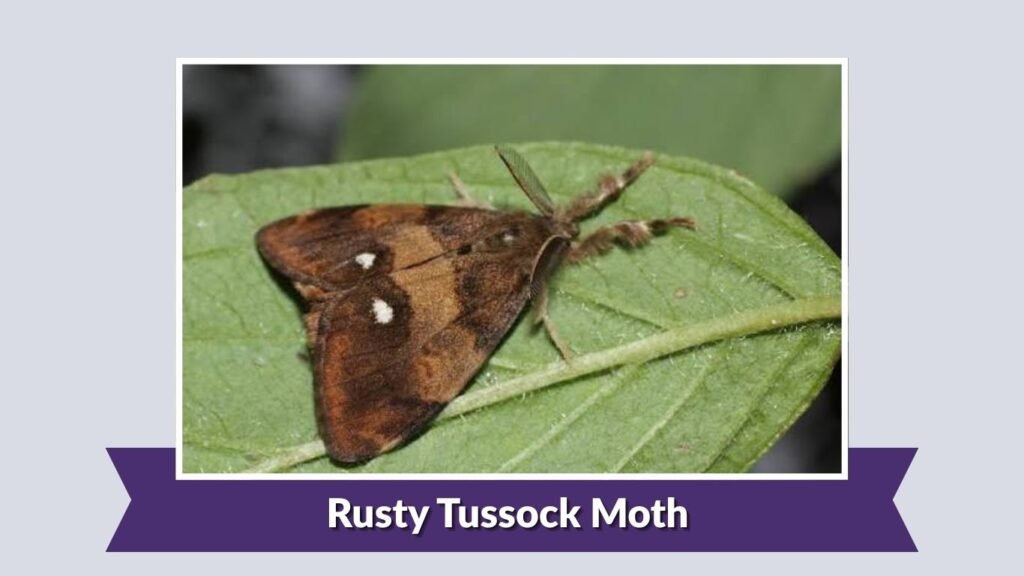
The Rusty Tussock Moth is a distinctive species known for its colorful, hairy caterpillar and strong difference between adult males and females. Also called the Vapourer Moth in some regions, it occurs across Europe, Asia, and parts of North America. Its caterpillars feed on many trees and shrubs and are especially noticeable during the warmer months.
Identification
- Scientific name: Orgyia antiqua
- Caterpillars have four cream or yellowish tussocks along the back.
- Long black hair pencils project from the front and rear.
- Red or orange spots may appear along the body.
- Adult males have rusty brown wings with a white spot.
- Females are grayish, heavy-bodied, and nearly wingless.
- Male wingspan is generally around 1 to 1.4 inches.
Habitat
Rusty Tussock Moths inhabit forests, parks, hedgerows, gardens, orchards, and urban landscapes. Their ability to use many different host plants allows them to survive in both natural and human-modified environments.
Behavior
Males fly actively during the day and evening while searching for females. Wingless females remain close to their cocoons and release pheromones to attract mates. Caterpillars often feed openly on foliage and their conspicuous hairs may discourage predators.
Diet and Life Cycle
Larvae feed on oak, birch, willow, hawthorn, apple, and numerous other woody plants. After several weeks of feeding, they form cocoons containing their own body hairs. Females usually lay eggs directly on or beside the empty cocoon. Depending on climate, eggs may overwinter before hatching.
3. Banded Tussock Moth
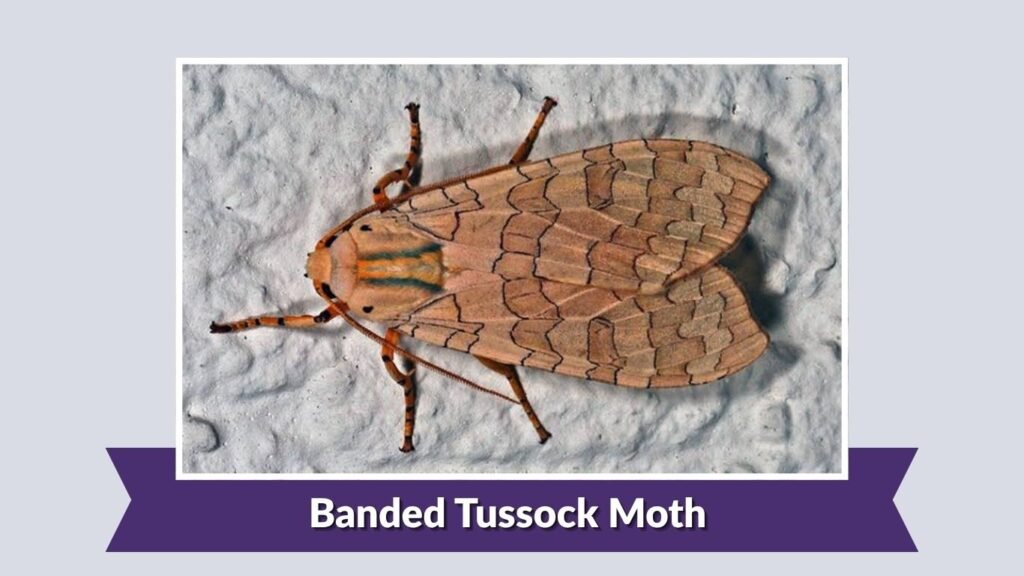
The Banded Tussock Moth is best recognized by its densely hairy caterpillar, which can vary from pale yellow to gray or brown. Adults have understated cream-colored wings with darker markings. It is widespread across eastern North America and frequently occurs in forests, gardens, and wooded suburban areas.
Identification
- Scientific name: Halysidota tessellaris
- Caterpillars are densely covered with yellowish, tan, or gray hairs.
- Several long black and white hair pencils extend from the body.
- Adult forewings are cream to yellowish with darker wavy bands.
- Adults have a hairy yellow-orange thorax.
- Wingspan is approximately 1.5 to 2 inches.
- Caterpillar coloration may vary considerably.
Habitat
Banded Tussock Moths favor deciduous forests, woodland edges, parks, gardens, and areas containing mature broadleaf trees. Their broad diet allows them to occupy many different wooded environments.
Behavior
Adults are nocturnal and may visit artificial lights. Caterpillars are usually found on the upper or lower surfaces of leaves. When disturbed, they may curl their bodies or drop from foliage. Their dense hairs help discourage some potential predators.
Diet and Life Cycle
Caterpillars feed on many deciduous trees, including oak, willow, birch, ash, elm, and walnut. Females deposit eggs in groups on host plants. Larvae feed throughout summer before forming hairy cocoons. The species generally overwinters in the pupal stage.
4. Spotted Tussock Moth

The Spotted Tussock Moth has one of the more colorful tussock caterpillars, often displaying yellow, black, and white hairs with prominent dark tufts. The adult is comparatively modest, with cream-colored wings marked by brown patterns. This species is widely distributed across much of North America.
Identification
- Scientific name: Lophocampa maculata
- Caterpillars commonly have yellow or cream hairs at both ends.
- The middle section usually contains darker black hairs.
- Several long hair pencils extend from the body.
- Adult wings are yellowish cream with brown markings.
- The abdomen often has an orange or yellow tone.
- Wingspan is generally around 1.4 to 2 inches.
Habitat
Spotted Tussock Moths occur in deciduous and mixed forests, parks, gardens, woodland margins, and mountain habitats. They are particularly associated with areas containing willow, poplar, maple, and alder.
Behavior
Adults are active primarily at night and may be attracted to porch lights or moth lights. Caterpillars move slowly across leaves and branches while feeding. Their dense hairs and bold coloration may discourage predators from attempting to eat them.
Diet and Life Cycle
The larvae consume foliage from willow, poplar, maple, birch, alder, and other broadleaf trees. After reaching maturity, the caterpillar spins a cocoon containing incorporated hairs. It pupates inside before emerging later as an adult moth.
5. Hickory Tussock Moth

The Hickory Tussock Moth is particularly famous for its striking white caterpillar covered with black markings and long hair pencils. It is common in eastern North America and can sometimes appear in large numbers. The caterpillar’s hairs may irritate sensitive skin, so handling it directly is best avoided.
Identification
- Scientific name: Lophocampa caryae
- Caterpillars are predominantly white and densely hairy.
- Black tufts occur along the center of the back.
- Long black hair pencils extend near the front and rear.
- Adult forewings are cream-colored with brown spots.
- Hindwings are generally pale.
- Adult wingspan is around 1.5 to 2 inches.
Habitat
Hickory Tussock Moths inhabit deciduous forests, wooded suburbs, parks, gardens, and places where hickory, walnut, oak, and related trees grow. They are especially noticeable during late summer and early autumn.
Behavior
Adults fly mainly at night. Caterpillars may initially feed in groups when young but become more solitary as they mature. Their long hairs serve as a defensive feature and can cause temporary irritation after contact with human skin.
Diet and Life Cycle
Despite the name, the caterpillars are not restricted to hickory. They feed on walnut, oak, ash, willow, elm, and several other trees. Mature larvae leave their food plants and form cocoons in protected places. They usually overwinter as pupae and emerge as adults the following season.
6. Sycamore Tussock Moth

The Sycamore Tussock Moth is closely associated with sycamore trees and is most easily identified during its caterpillar stage. The larva is covered with pale hairs and has especially long orange and white hair pencils. Adults are pale yellowish moths with relatively subtle markings.
Identification
- Scientific name: Halysidota harrisii
- Caterpillars have dense cream, white, or yellowish hairs.
- Long orange and white hair pencils occur near both ends.
- Adult wings are pale cream or yellow.
- Forewings may show faint brownish bands.
- The thorax is noticeably hairy.
- Adults are medium-sized compared with other tussock moths.
Habitat
Sycamore Tussock Moths are most common in deciduous forests, river corridors, parks, and urban landscapes containing American sycamore trees. They may also occur wherever other suitable host trees grow.
Behavior
Adults are mainly nocturnal and are occasionally attracted to lights. Caterpillars usually remain on their host trees, feeding on leaves during summer. Their pale coloration can blend surprisingly well with the undersides of leaves and light-colored bark.
Diet and Life Cycle
Sycamore is the primary host plant, although larvae may occasionally use related trees. Females lay eggs on foliage, and young larvae begin feeding after hatching. Mature caterpillars form cocoons incorporating body hairs and eventually pupate before adult emergence.
7. Milkweed Tussock Moth

The Milkweed Tussock Moth is also known as the Milkweed Tiger Moth and is strongly associated with milkweed plants. Its caterpillars are colorful, hairy, and often found feeding in groups. Because they consume milkweed, they share their habitat with monarch butterfly caterpillars.
Identification
- Scientific name: Euchaetes egle
- Caterpillars have dense tufts of black, white, and orange hairs.
- Young larvae may appear pale and feed in groups.
- Mature larvae develop a much more colorful appearance.
- Adults have plain gray wings.
- The abdomen is yellow-orange with black spots.
- Wingspan is approximately 1.2 to 1.8 inches.
Habitat
Milkweed Tussock Moths live in meadows, fields, roadsides, gardens, prairies, and open woodland where milkweed grows. They are widespread across eastern and central North America.
Behavior
Young caterpillars commonly feed together in clusters, sometimes skeletonizing sections of milkweed leaves. Older larvae tend to separate and feed individually. Adults are nocturnal and communicate using chemical signals when locating mates.
Diet and Life Cycle
The larvae feed mainly on milkweed and occasionally related plants. Females lay clusters of eggs on the undersides of leaves. Caterpillars pass through several growth stages before forming cocoons among leaf litter or vegetation. Pupae may overwinter before adults emerge.
8. Definite Tussock Moth

The Definite Tussock Moth is a North American species whose caterpillar displays the classic tussock appearance of upright back tufts and long hair pencils. Adults show strong sexual differences: males are winged, while females have greatly reduced wings and remain close to where they developed.
Identification
- Scientific name: Orgyia definita
- Caterpillars have four prominent pale yellow tussocks.
- Long black hair pencils extend near the front and rear.
- The head is often yellow or orange.
- Males have brownish or yellow-brown wings.
- Adult females are nearly wingless.
- Caterpillars have a compact but densely hairy appearance.
Habitat
Definite Tussock Moths inhabit deciduous forests, parks, orchards, gardens, and suburban areas across parts of eastern North America. They thrive where a variety of broadleaf trees and shrubs are available.
Behavior
Male moths actively fly while searching for females, whereas females stay near their cocoons. Caterpillars crawl across leaves and branches during feeding. Like other Orgyia caterpillars, their hairs may irritate sensitive skin.
Diet and Life Cycle
The caterpillars eat leaves of willow, oak, maple, elm, apple, and other deciduous plants. After feeding and growing, larvae form cocoons in sheltered locations. Females emerge, mate nearby, and lay eggs around the cocoon, beginning another generation.
9. Douglas-fir Tussock Moth

The Douglas-fir Tussock Moth is an important western North American forest moth because its caterpillars feed heavily on conifer foliage. Periodic population outbreaks can cause substantial defoliation of Douglas-fir and true fir trees. The caterpillar is colorful and bears several conspicuous tufts.
Identification
- Scientific name: Orgyia pseudotsugata
- Caterpillars have four pale or cream tussocks along the back.
- Long dark hair pencils extend from the front and rear.
- Red spots and colorful markings occur along the body.
- Males have gray-brown patterned wings.
- Females are nearly wingless and have large bodies.
- Caterpillar hairs may cause irritation after contact.
Habitat
Douglas-fir Tussock Moths are found primarily in coniferous forests of western North America. They are strongly associated with Douglas-fir, white fir, grand fir, and related conifers.
Behavior
Populations can remain low for years and then increase dramatically, producing localized outbreaks. Caterpillars feed openly on needles and may disperse on silk threads. Adult females remain near their cocoons while males fly in search of them.
Diet and Life Cycle
Larvae feed primarily on Douglas-fir and true fir needles. Eggs are generally laid in masses near the female’s cocoon and overwinter. Caterpillars hatch in spring when new foliage is available. They feed for several weeks, pupate in cocoons, and emerge as adults later in the season.
10. Western Tussock Moth

The Western Tussock Moth is a distinctive species of western North America with a brightly patterned, densely hairy caterpillar. It occurs across woodland, scrub, chaparral, and landscaped areas and uses a variety of trees and shrubs as food plants.
Identification
- Scientific name: Orgyia vetusta
- Caterpillars have several upright pale tussocks on the back.
- Long black hair pencils extend from both ends of the body.
- Red, orange, black, and cream markings may be visible.
- Adult males are brown or gray-brown and fully winged.
- Females are largely wingless.
- Larval hairs can irritate sensitive skin.
Habitat
Western Tussock Moths inhabit oak woodland, chaparral, forest margins, gardens, parks, and shrublands throughout parts of western North America. Their broad host range enables them to survive in many vegetated habitats.
Behavior
Male adults fly while searching for stationary females. Caterpillars may wander noticeably when searching for new foliage or a pupation site. Their upright tussocks and long hair pencils create a distinctive profile that helps separate them from ordinary hairy caterpillars.
Diet and Life Cycle
The larvae feed on oak and numerous other woody plants. After completing their growth, caterpillars build cocoons attached to bark, branches, or other sheltered surfaces. Females emerge with reduced wings, mate near the cocoon, and lay eggs that produce the next generation.
11. Pale Tussock Moth

The Pale Tussock Moth is a widespread European species whose caterpillar is much more dramatic than its adult form. The larva is usually bright green or yellow-green with prominent dorsal tufts and a striking red tail tuft, making it one of the easier tussock moth caterpillars to recognize.
Identification
- Scientific name: Calliteara pudibunda
- Caterpillars are usually bright green or yellow-green.
- Four dense tussocks stand upright along the back.
- A prominent reddish or pinkish tail tuft is present.
- Adults are pale gray or whitish with darker markings.
- Females are generally larger and paler than males.
- Male antennae are strongly feathered.
Habitat
Pale Tussock Moths occur in deciduous forests, gardens, parks, hedgerows, orchards, and wooded countryside. They are especially common where beech, oak, birch, and other broadleaf trees grow.
Behavior
Adults are mainly active after dark, with males using their feathered antennae to locate female pheromones. During the daytime, adults usually rest against tree trunks or vegetation. Caterpillars are often seen feeding openly during late summer and autumn.
Diet and Life Cycle
The caterpillars feed on a wide range of deciduous trees and shrubs, including beech, oak, birch, hazel, willow, and fruit trees. Mature larvae descend from host plants and form cocoons in sheltered areas. The species generally overwinters as a pupa, with adults emerging the following spring or early summer.
12. Dark Tussock Moth

The Dark Tussock Moth is a robust, hairy moth best known for its distinctive caterpillar, which carries dense tufts and long projecting hairs. Its darker coloration helps it blend into bark, dried vegetation, and shaded habitats. The species occurs mainly in open woodland, heathland, grassland, and other areas with plenty of low-growing plants.
Identification
- Scientific name: Dicallomera fascelina
- Caterpillars are densely covered with gray, brown, and black hairs.
- Several raised tussocks appear along the back.
- Long hair pencils extend from parts of the body.
- Adult wings are grayish to dark brown with irregular markings.
- The body is thick and noticeably hairy.
- Males have more strongly feathered antennae than females.
Habitat
Dark Tussock Moths favor heathland, moorland, grassland, woodland clearings, coastal areas, and scrub. They generally prefer open habitats containing a mixture of grasses, herbs, and low shrubs rather than dense closed-canopy forest.
Behavior
Adults are primarily nocturnal and generally remain hidden during daylight. Males fly in search of females and may occasionally be attracted to artificial lights. Caterpillars are often more easily observed than the adults because they feed openly on low vegetation.
Diet and Life Cycle
The larvae consume a variety of herbaceous plants and shrubs, including heather, broom, bramble, and other low-growing vegetation. Caterpillars develop through several stages before forming a cocoon close to the ground. The species typically completes one generation per year, with the immature stages surviving through colder periods.
13. Reed Tussock Moth

The Reed Tussock Moth is associated with wetlands and waterside vegetation, making it somewhat different from many forest-dwelling tussock moths. Its hairy caterpillar feeds among reeds, grasses, and marsh plants, while the adult has comparatively modest pale-colored wings.
Identification
- Scientific name: Laelia coenosa
- Caterpillars are densely hairy with prominent dorsal tufts.
- Body coloration can include yellow, brown, gray, and black.
- Long hairs project outward from the body.
- Adult wings are generally pale cream, whitish, or light brown.
- Males have noticeably feathered antennae.
- Females usually have a heavier body than males.
Habitat
Reed Tussock Moths inhabit marshes, reed beds, wetlands, lakesides, river margins, and other damp areas. Dense stands of reeds and grasses provide both food and shelter for developing larvae.
Behavior
Adults usually fly at night and remain close to wetland habitats. Males are more active flyers, searching through reed beds for females. Caterpillars climb stems and leaves while feeding and may remain hidden deep inside dense vegetation during unfavorable weather.
Diet and Life Cycle
The larvae feed mainly on reeds, sedges, grasses, and other wetland vegetation. Eggs are laid near suitable food plants, allowing young caterpillars to begin feeding shortly after hatching. Mature larvae create protective cocoons among vegetation before pupating. Adults emerge later and reproduce near the same marshy habitats.
14. Satin Moth
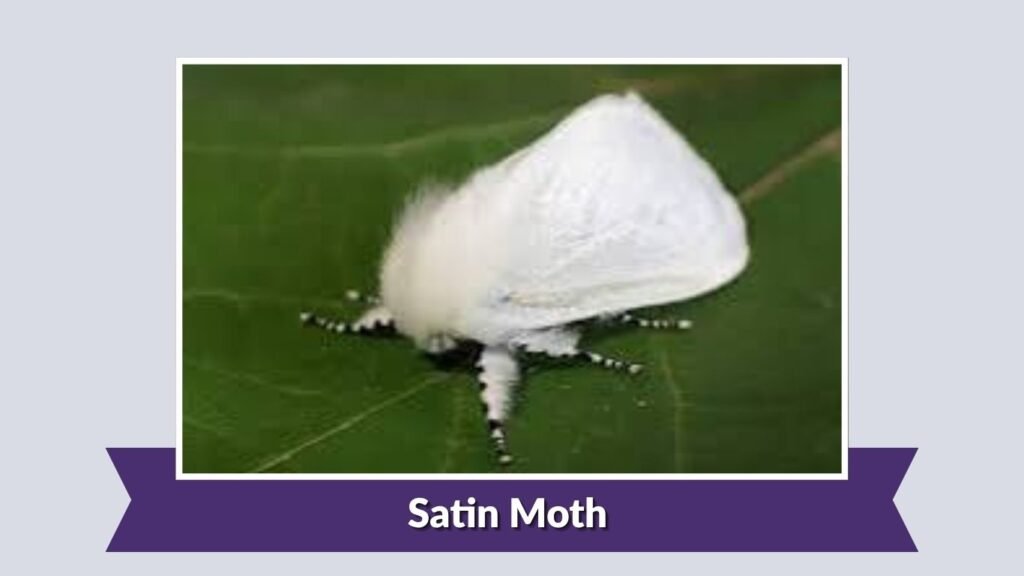
The Satin Moth is an attractive white tussock moth with smooth, silky-looking wings that give the species its common name. Although adults appear delicate, the larvae can feed heavily on poplar and willow trees and may occasionally cause noticeable defoliation.
Identification
- Scientific name: Leucoma salicis
- Adult wings are clean white with a satin-like sheen.
- The body is white and covered with fine hairs.
- Legs may show darker markings.
- Caterpillars are dark with reddish or orange spots.
- Larvae possess numerous long pale hairs.
- Adult wingspan is generally around 1.5 to 2 inches.
Habitat
Satin Moths are associated with woodland, river valleys, parks, roadsides, gardens, and plantations containing poplar or willow trees. They can also establish themselves in urban landscapes where these trees are commonly planted.
Behavior
Adults are nocturnal and frequently come to lights during summer. During daylight, their white wings make them conspicuous on dark surfaces but less noticeable against pale bark. Caterpillars often feed together when young before becoming more dispersed.
Diet and Life Cycle
Larvae primarily eat poplar and willow foliage. Females deposit egg masses on bark and cover them with protective material. Young larvae may overwinter in sheltered crevices before resuming feeding in spring. After completing development, they pupate in loose cocoons, and adults emerge during summer.
15. Vapourer Moth
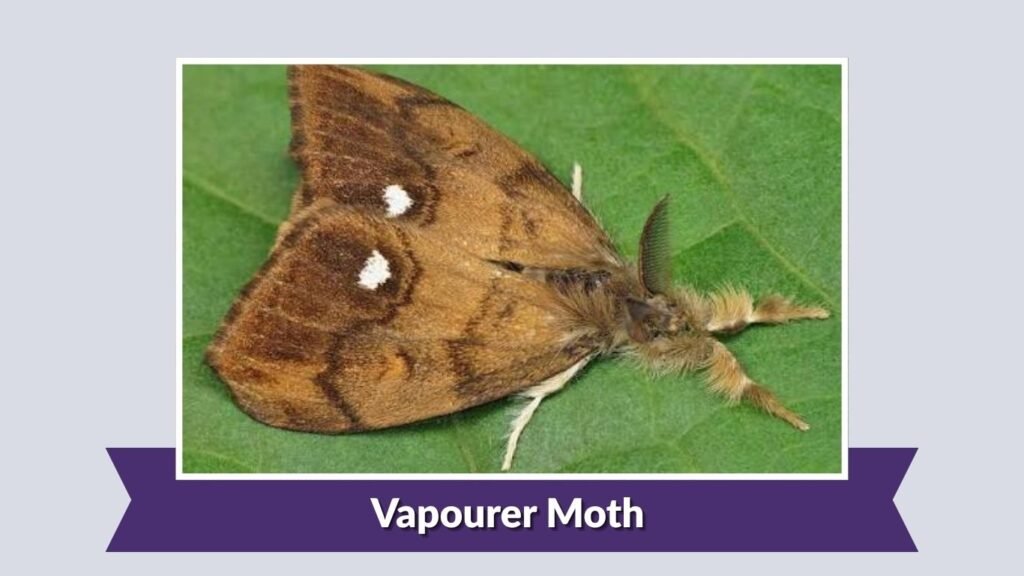
The Vapourer Moth is a highly distinctive tussock moth whose caterpillar has four raised yellowish tufts and long hair pencils. It is also widely known as the Rusty Tussock Moth, so it represents the same species listed earlier under that alternate common name. Its dramatic caterpillar is commonly encountered in gardens, parks, and woodland.
Identification
- Scientific name: Orgyia antiqua
- Caterpillars have four prominent yellow or cream dorsal tussocks.
- Long black hair pencils extend from the front and rear.
- Red spots occur along the sides of the body.
- Males have rusty brown wings with a white marking.
- Females are virtually wingless.
- Female bodies are pale gray and rounded.
Habitat
Vapourer Moths occur in woodland, gardens, hedgerows, orchards, parks, and urban areas. Their larvae can survive on numerous tree and shrub species, allowing the moth to occupy a broad range of environments.
Behavior
Unlike many moths, males may fly during daylight as well as around dusk. Females remain near their cocoons because they cannot fly. They release pheromones that attract males from surrounding areas.
Diet and Life Cycle
Larvae feed on oak, willow, birch, hawthorn, apple, rose, and many other woody plants. After forming a hairy cocoon and pupating, adults emerge. The female usually lays her eggs directly on or beside the old cocoon, where they may remain until conditions are favorable for hatching.
16. Gypsy Moth

The Gypsy Moth, now more commonly called the Spongy Moth, is one of the best-known members of the tussock moth group. Its caterpillars can occur in enormous numbers and are capable of defoliating large areas of forest. Oak is a particularly important host tree.
Identification
- Scientific name: Lymantria dispar
- Caterpillars have five pairs of blue spots followed by six pairs of red spots.
- Larvae are covered with numerous long hairs.
- Adult males are brown with darker wavy markings.
- Females are much paler, usually white or cream.
- Females have a larger, heavier body.
- Egg masses have a tan, sponge-like appearance.
Habitat
Spongy Moths occur in deciduous and mixed forests, parks, wooded suburbs, orchards, and other environments containing suitable host trees. Introduced populations have become major forest pests in parts of North America.
Behavior
Young larvae may disperse by producing silk threads that allow wind to carry them to nearby trees. Adult males actively fly in search of females. In some populations, females have limited or no flight ability.
Diet and Life Cycle
Caterpillars feed on hundreds of plant species, with oak among their preferred hosts. Females lay large egg masses on bark, rocks, outdoor structures, and other surfaces. Eggs overwinter and hatch in spring. After feeding, larvae pupate and adults emerge during summer.
17. Browntail Moth

The Browntail Moth is a white adult moth named for the noticeable brown tuft at the end of its abdomen. Its caterpillar deserves particular caution because its tiny hairs can cause an irritating skin rash and respiratory discomfort in some people.
Identification
- Scientific name: Euproctis chrysorrhoea
- Adults have mostly white wings.
- A brown or reddish-brown abdominal tuft is visible at the rear.
- Caterpillars are dark brown with white markings.
- Two reddish-orange spots occur near the rear of mature larvae.
- Caterpillars have dense irritating hairs.
- Adults have a wingspan of roughly 1.2 to 1.6 inches.
Habitat
Browntail Moths occur in coastal areas, woodland edges, hedgerows, orchards, parks, and residential areas. Caterpillars often construct winter webs on the tips of branches.
Behavior
Adults fly mainly at night and are strongly attracted to artificial lights. Caterpillars live communally in silken webs during part of their development. Their hairs can break loose and remain irritating even after being shed.
Diet and Life Cycle
Larvae feed on oak, apple, cherry, pear, hawthorn, and numerous other broadleaf plants. Young caterpillars build communal webs where they overwinter. Feeding resumes in spring, followed by pupation and adult emergence in summer. Females then deposit egg clusters on host foliage.
18. Yellow-tail Moth

The Yellow-tail Moth is a white tussock moth named for the golden-yellow tuft located at the end of the female’s abdomen. Adults look simple and clean compared with the darker, more heavily patterned caterpillars.
Identification
- Scientific name: Euproctis similis
- Adult wings are mainly pure white.
- Females possess a conspicuous yellow abdominal tuft.
- Caterpillars are dark gray or blackish.
- Larvae have yellowish or reddish markings and numerous hairs.
- Adult body is covered with white hairs.
- Wingspan is commonly around 1.2 to 1.6 inches.
Habitat
Yellow-tail Moths live in deciduous woodland, gardens, hedgerows, parks, scrubland, and countryside containing broadleaf trees and shrubs. They can also occur in suburban areas with established vegetation.
Behavior
Adults are nocturnal and may gather around outdoor lighting during summer. During daylight they remain inactive on vegetation. Caterpillars feed openly but may rest together beneath leaves when young.
Diet and Life Cycle
The larvae eat leaves from hawthorn, blackthorn, oak, willow, apple, and other deciduous plants. Females lay eggs in groups and cover them with hairs from their abdominal tuft. Larvae develop through the warmer months before pupating in protective cocoons.
19. Black Arches

The Black Arches is an attractive tussock moth with bold black zigzag lines across pale wings. Males and females can differ noticeably in size and coloration. The species is strongly associated with wooded environments and can be especially common in areas with mature oak trees.
Identification
- Scientific name: Lymantria monacha
- Forewings are white or gray with black zigzag markings.
- Abdomen may show pinkish or reddish bands.
- Males are generally smaller and darker than females.
- Antennae of males are strongly feathered.
- Caterpillars are hairy with dark and pale markings.
- Adults have a relatively broad wingspan.
Habitat
Black Arches inhabit deciduous, mixed, and coniferous forests, along with parks and wooded landscapes. They occur particularly where oak, birch, spruce, pine, and other host trees are abundant.
Behavior
Adults fly mainly at night during summer and may be attracted to lights. Males fly actively while detecting female pheromones. During population increases, caterpillars can become numerous enough to cause significant tree defoliation.
Diet and Life Cycle
Larvae feed on a wide variety of trees, including oak, birch, pine, spruce, and fir. Eggs are usually deposited on bark in protected locations and survive through winter. Caterpillars hatch in spring, feed for several weeks, and eventually pupate before adults emerge in summer.
20. Scarce Vapourer

The Scarce Vapourer is an unusual tussock moth in which males possess normal wings while females are almost completely wingless. Its caterpillars have the characteristic raised tufts and long hairs associated with the tussock moth group.
Identification
- Scientific name: Orgyia recens
- Caterpillars have several upright tufts along the back.
- Long hair pencils project from the front and rear.
- Body markings combine dark, pale, and sometimes reddish tones.
- Adult males have brownish patterned wings.
- Females are nearly wingless with rounded bodies.
- Males have feathered antennae for detecting pheromones.
Habitat
Scarce Vapourers inhabit wetlands, heathland, moorland, woodland margins, and areas containing low shrubs. They tend to have more localized populations than the widespread Vapourer Moth.
Behavior
Adult males actively fly while searching for females, whereas females remain close to the cocoon from which they emerged. Caterpillars spend much of their time among low vegetation and shrubs.
Diet and Life Cycle
Larvae feed on various shrubs and herbaceous plants, including heather, bog myrtle, willow, and related vegetation. Following larval development, they form hairy cocoons. Wingless females emerge, mate nearby, and deposit eggs close to their pupation site.
21. Fir Tussock Moth

The Fir Tussock Moth is associated mainly with coniferous forests where its caterpillars feed on fir and related trees. Like other tussock moths, the larva has prominent hair tufts that provide protection while it feeds among needles and branches.
Identification
- Caterpillars have dense tufts of pale and dark hairs.
- Several upright tussocks occur along the back.
- Long hair pencils may extend from the front and rear.
- Adults are generally grayish or brownish.
- Wing patterns help adults blend into tree bark.
- Males typically have strongly feathered antennae.
Habitat
Fir Tussock Moths are most closely associated with coniferous forests, mountain woodland, and areas where fir trees dominate. They can also occur in mixed forests containing spruce, pine, and other conifers.
Behavior
Adults are usually active after dark, while males search for females using pheromone cues. Caterpillars remain on host trees and may move between branches while feeding. Their coloration and dense hairs provide camouflage and protection among conifer needles.
Diet and Life Cycle
Larvae primarily feed on fir foliage and may also use other conifers depending on the species and location. Eggs are deposited on or close to suitable host trees. Caterpillars hatch and feed through the growing season before forming cocoons. After pupation, adults emerge and reproduce, completing the annual cycle.
22. Pine Tussock Moth

The Pine Tussock Moth is a North American tussock moth strongly associated with pine forests. Its hairy caterpillar is much more noticeable than the adult and is adapted for living among pine needles and branches. The species occurs primarily in the eastern United States, where its larvae feed on several pine species.
Identification
- Scientific name: Dasychira pinicola
- Caterpillars have dense tufts of gray, cream, or brown hairs.
- Longer hair pencils project from several areas of the body.
- Adults are generally grayish or brownish.
- Dark markings help adults blend with pine bark.
- The body is noticeably hairy.
- Males typically have feathered antennae.
Habitat
Pine Tussock Moths are primarily found in pine forests and mixed woodland containing suitable conifers. They may occur in both natural forests and planted pine stands. Jack pine is among the documented host trees, making areas dominated by this tree especially suitable for larval development.
Behavior
Adults are generally most active during the warmer part of the year. Males fly in search of females, while caterpillars spend much of their time among pine needles. Their dense hairs help protect them and make the larvae more difficult for some predators to handle.
Diet and Life Cycle
The caterpillars feed primarily on pine foliage, including jack pine and other Pinus species. Females lay eggs near suitable host trees, and the larvae begin feeding after hatching. Mature caterpillars eventually form protective cocoons and pupate. Adults later emerge, mate, and begin another generation.
23. Eucalyptus Tussock Moth (Omnivorous Tussock Moth)

The name Eucalyptus Tussock Moth is sometimes informally applied to hairy tussock caterpillars feeding on eucalyptus. A more established Australian example is the Omnivorous Tussock Moth, whose larvae feed on eucalyptus as well as many other trees and shrubs. It occurs across much of coastal Australia.
Identification
- Scientific name: Acyphas semiochrea
- Caterpillars are densely covered with long hairs.
- Hair coloration may include white, gray, yellow, and darker shades.
- Adults are relatively small to medium-sized.
- Wings are generally pale with subdued markings.
- The body has a noticeably hairy appearance.
- Wingspan is around 1.2 inches.
Habitat
These tussock moths occur in woodland, forest margins, gardens, plantations, and other vegetated habitats across coastal regions of Australia. They can live in areas containing eucalyptus, acacia, pine, and numerous native shrubs.
Behavior
Adults generally remain inconspicuous compared with their hairy larvae. Caterpillars move among leaves and branches while feeding and may become locally abundant when suitable host plants are plentiful. As with other hairy caterpillars, unnecessary handling is best avoided.
Diet and Life Cycle
The species has a broad diet. Larvae have been recorded feeding on eucalyptus, acacia, Pinus radiata, Pultenaea, Dodonaea, and several other plants. Caterpillars eventually form cocoons and pupate before emerging as adults. After mating, females deposit eggs near plants that can provide food for the next generation.
24. Painted Tussock Moth (Painted Apple Moth)

The Painted Apple Moth is a true tussock moth native to Australia and is sometimes described more generally as a painted tussock moth. Its caterpillars are conspicuously hairy and can feed on a wide variety of woody plants. The species became especially well known because of concerns about its ability to damage ornamental, agricultural, and native vegetation.
Identification
- Scientific name: Teia anartoides
- Caterpillars have prominent tufts of dense hair.
- Longer hair pencils occur toward the front and rear.
- Larvae may display mixtures of dark, pale, yellowish, and reddish markings.
- Adult males are winged.
- Adult females have greatly reduced wings.
- Females remain close to their emergence sites.
Habitat
Painted Apple Moths can occupy forests, gardens, orchards, parks, nurseries, and suburban landscapes where appropriate host plants are available. Their broad plant diet makes them capable of surviving in many types of vegetated environments.
Behavior
Adult males actively search for females by following sex pheromones; chemical communication in this species has been studied in detail. Females are far less mobile because their wings are reduced. Caterpillars spend most of their active period feeding on foliage before moving to protected areas for pupation.
Diet and Life Cycle
Larvae are capable of feeding on numerous trees and shrubs rather than depending on only one host. Females lay eggs close to suitable vegetation. After hatching, the larvae pass through several growth stages, becoming increasingly hairy. Mature caterpillars form cocoons and pupate before adults emerge and begin the reproductive cycle again.
25. Orgyia Tussock Moths

Orgyia Tussock Moths belong to the genus Orgyia, a widespread group containing several familiar species, including the White-marked, Definite, Fir, Rusty, Western, and Douglas-fir Tussock Moths. Many members are best recognized by their spectacular caterpillars, which possess upright tussocks and long hair pencils.
Identification
- Genus: Orgyia
- Caterpillars commonly have four prominent dorsal hair tussocks.
- Long hair pencils often extend near the head and rear.
- Caterpillars may display red, yellow, black, white, or gray markings.
- Adult males usually have fully developed wings.
- Females of many species have greatly reduced wings.
- Male antennae are often strongly feathered.
Habitat
Members of Orgyia occur in forests, woodland, parks, gardens, orchards, scrub, and other areas containing suitable host plants. Different species may favor deciduous trees, conifers, shrubs, or a mixture of vegetation.
Behavior
One of the most interesting traits of many Orgyia species is the contrast between the sexes. Males are active flyers and use their sensitive antennae to detect female pheromones. Females of several species are flightless and remain close to the cocoon after emerging.
Diet and Life Cycle
Their caterpillars feed on numerous woody plants, with particular hosts varying by species. After several larval stages, the caterpillar constructs a cocoon that often incorporates some of its own hairs. Pupation occurs inside. Adult females may remain near the cocoon, mate, and lay eggs nearby, while males disperse in search of additional females.
FAQs
1. Are tussock moths dangerous to humans?
Adult tussock moths are generally harmless, but the caterpillars of some species have hairs that can irritate the skin. Contact may cause itching, redness, or a mild rash in sensitive people, so it is better to avoid handling hairy tussock caterpillars directly.
2. What do tussock moth caterpillars eat?
Tussock moth caterpillars feed on a wide range of trees, shrubs, and other plants. Depending on the species, common host plants include oak, willow, birch, maple, pine, fir, apple, hawthorn, and milkweed.
3. Why do tussock moth caterpillars have hair tufts?
Their dense hairs and raised tussocks help protect them from predators. Some hairs make the caterpillar difficult or unpleasant to eat, while others may cause irritation when touched. The hair tufts also give many tussock caterpillars their distinctive appearance.
4. Where are tussock moths commonly found?
Tussock moths occur in forests, gardens, parks, grasslands, wetlands, orchards, and suburban areas. Different species prefer different habitats, ranging from coniferous forests to milkweed fields and deciduous woodlands.
5. What is the life cycle of a tussock moth?
A tussock moth begins as an egg, hatches into a caterpillar, develops through several larval stages, forms a cocoon, and then becomes a pupa. The adult moth later emerges to mate and lay eggs, beginning the cycle again. Some species overwinter as eggs, larvae, or pupae.