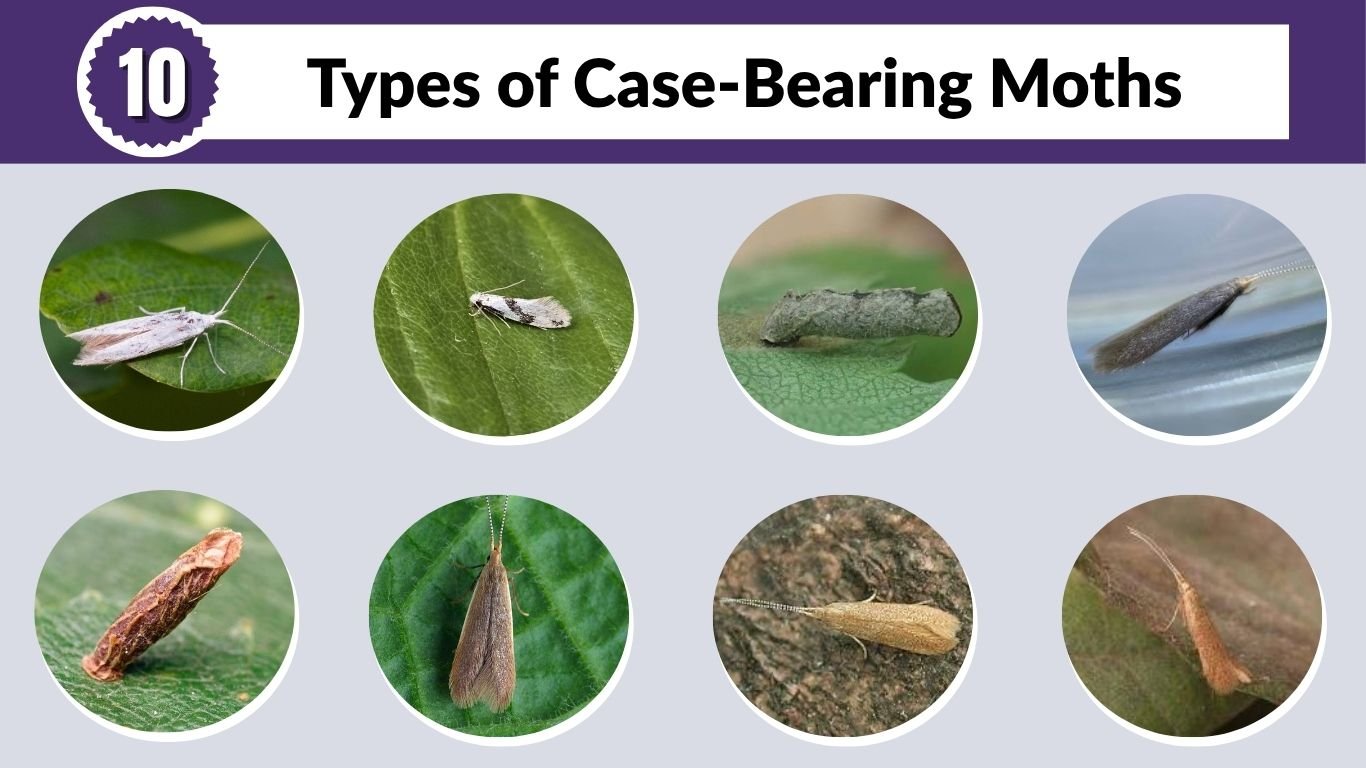
Case-bearing moths are small but fascinating insects whose caterpillars build portable shelters from silk, leaves, seeds, and other plant material. Many belong to the Coleophoridae family and can be identified more easily by their larval cases than by the adult moths themselves. Different species specialize on plants such as oak, elm, apple, hazel, heather, and cowberry. Here are 10 types of case-bearing moths, with details about their identification, habitat, behavior, diet, and life cycle.
1. Sea-lavender Case-bearer

The Sea-lavender Case-bearer (Coleophora limoniella) is a tiny coastal moth closely tied to common sea-lavender. Unlike many case-bearing moths that live in woodland, this specialist favors saltmarsh environments. Its caterpillar feeds among the flowers and seeds while living inside a portable protective case.
Identification
- Adult wingspan is around 10–11 mm.
- Forewings are orange-ochreous with distinctive silvery streaks.
- Antennae are alternately marked with dark and pale rings.
- Larvae live inside small portable cases made from parts of sea-lavender seed capsules.
- Adults are small, slender moths typical of the family Coleophoridae.
Habitat
This species is strongly associated with coastal saltmarshes where common sea-lavender grows naturally. In Britain, it is concentrated mainly along suitable coastal areas of southeastern England, East Anglia, Lincolnshire, and the Isle of Wight. Because its caterpillar depends heavily on its host plant, the moth is rarely found far from established sea-lavender colonies.
Behavior
Adult Sea-lavender Case-bearers can be active during the daytime and around dusk. They may fly close to their host plants and can also come to lights. The larvae remain protected while feeding, carrying their cases between flowers and seedheads.
Diet and Life Cycle
The caterpillars feed mainly on the seeds of common sea-lavender (Limonium vulgare). As the larva grows, it moves into progressively larger seed capsules and uses them as portable cases.
Later in development, the larva bores into a plant stem and overwinters there. Pupation occurs after winter, and adults generally appear from July through August, beginning another generation.
2. Ragged-Robin Case-bearer
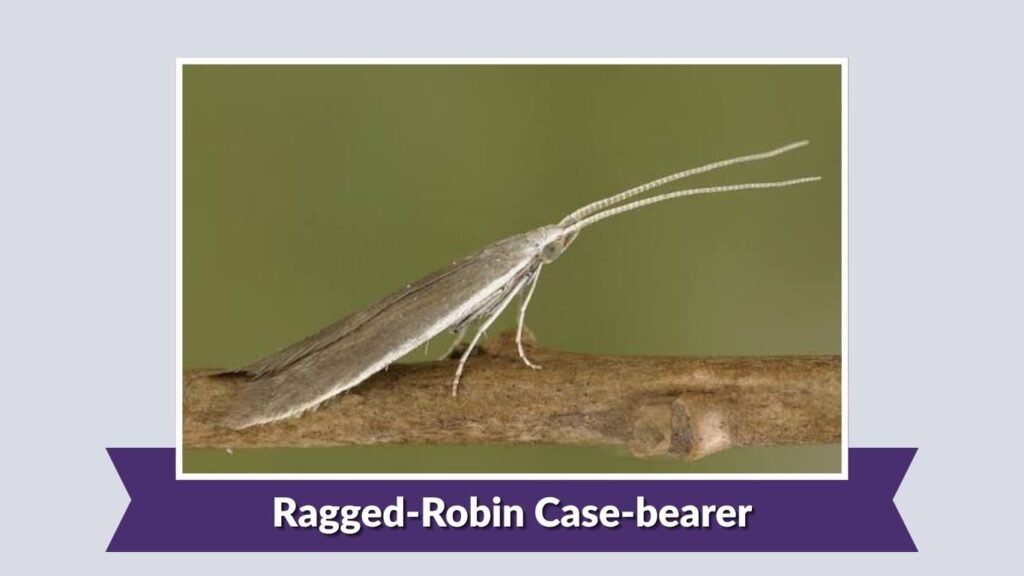
The Ragged-Robin Case-bearer (Coleophora albella) is a slender case-bearing moth whose caterpillar is especially associated with Ragged-Robin and other Silene plants. The adult has a relatively pale appearance with a noticeable white streak running along the forewing, while the caterpillar spends much of its immature life concealed within a portable case.
Identification
- Wingspan is approximately 16–18 mm.
- Adults are mainly light gray.
- A broad white costal streak extends along much of each forewing.
- Antennae have clearly visible alternating rings.
- Larvae construct portable cases while feeding on seeds.
- The slim body and narrow wings are typical of Coleophora moths.
Habitat
Ragged-Robin Case-bearers occur in habitats containing their preferred host plants. Damp meadows, marshy grasslands, woodland clearings, roadside vegetation, and other flower-rich locations can provide suitable conditions.
Ragged-Robin often grows in damp soils, so the moth may be particularly associated with moist, traditionally managed grassland where these flowering plants remain abundant.
Behavior
Adults usually fly from late spring through midsummer. Their narrow bodies and pale coloration make them relatively inconspicuous when resting among vegetation.
The caterpillar behaves very differently from a typical exposed moth larva. It remains protected by its case and moves it between feeding sites, reducing exposure to predators and unfavorable weather.
Diet and Life Cycle
Larvae feed on the seeds of Silene species, with Ragged-Robin being an important host. They construct cases while feeding among developing seedheads.
The caterpillar remains within its case through winter. After overwintering, development resumes and pupation normally takes place in May. Adult moths appear from the end of May and may continue flying well into July.
3. Yellow Oak Case-bearer

The Yellow Oak Case-bearer (Coleophora flavipennella) is a small brownish moth whose caterpillars live and feed on oak trees. Although the adult can be extremely difficult to distinguish from related case-bearing species, its larval case and feeding signs can provide useful identification clues.
Identification
- Wingspan is approximately 11–13 mm.
- Forewings are usually ochreous to yellowish brown.
- The costal area may appear slightly paler.
- Adult appearance is very similar to several related Coleophora species.
- Young larval cases incorporate a recognizable oval piece of oak leaf.
- Feeding larvae produce small circular mines or holes in oak leaves.
Habitat
Yellow Oak Case-bearers occur wherever suitable oak trees (Quercus) grow. Typical habitats include deciduous woodland, forest edges, mature parkland, hedgerows, and areas with scattered oak trees.
The species is widely but locally distributed across much of Britain and southern Ireland. Its presence is often easier to determine by searching oak foliage for larval cases and characteristic feeding damage.
Behavior
Adults are mostly active during summer and may be attracted to artificial lights. Because several related case-bearing moths look almost identical as adults, specialist examination may be required for certain identification.
Larvae stay attached to their portable cases while feeding. They place the opening of the case against the leaf and eat through a small area without exposing most of their bodies.
Diet and Life Cycle
The caterpillars feed on oak leaves. Young larvae create cases containing pieces cut from the host leaf. As they grow, these cases are replaced or enlarged.
Larvae overwinter while still immature and resume feeding on oak during spring. Adults generally appear in July and August, although larval activity can be observed over a much longer period.
4. Small Elm Case-bearer
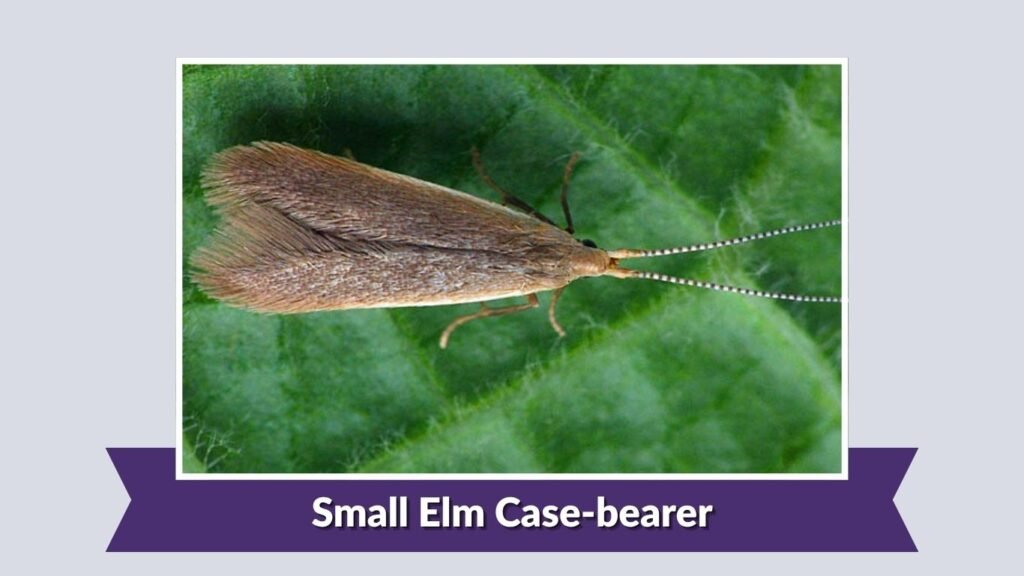
The Small Elm Case-bearer (Coleophora badiipennella), also known as the Pale Elm Case-bearer, is a tiny moth closely associated with elm trees. Its larvae create distinctive mines in elm leaves before cutting out part of the leaf to form a protective case. The species is often easier to recognize from these feeding signs than from the adult moth itself.
Identification
- Adult wingspan is approximately 9–11 mm.
- Forewings are generally plain reddish brown.
- Adults have the slender shape typical of case-bearing moths.
- Early larvae produce narrow mines extending from the elm leaf’s midrib.
- Larvae cut out an oval or rounded piece of leaf to construct their first case.
- Mature cases may develop a small serrated ridge along the upper surface.
Habitat
Small Elm Case-bearers occur primarily in places where elm (Ulmus) grows. They are particularly associated with woodland edges and locations containing young elm saplings rather than only large mature trees.
In Britain, the species has a local distribution throughout much of England. Hedgerows, woodland rides, scrub, parks, and other areas containing regenerating elm can offer suitable habitat.
Behavior
The larvae begin life as leaf miners before changing to the characteristic case-bearing lifestyle. Once the case has been constructed, the caterpillar carries it from one feeding location to another.
Adults are relatively elusive but may occasionally come to lights during their summer flight season.
Diet and Life Cycle
Elm is the primary larval food plant. Young caterpillars first create a narrow gallery inside an elm leaf. They later remove part of the leaf and use it to construct a case.
From this shelter, the larva makes additional small feeding mines. After completing development and pupation, adults typically emerge during June and July.
5. Elm Case-bearer

The Elm Case-bearer (Coleophora limosipennella), sometimes called the Dark Elm Case-bearer, is another small species that depends primarily on elm trees. Its later larval case has a distinctive serrated upper edge and is often held almost flat against the leaf while the caterpillar feeds.
Identification
- Wingspan is usually around 10–13 mm.
- Adult forewings are plain grayish-ochreous.
- A pale cream streak runs along the front edge of the forewing.
- Mature larval cases have a noticeably serrated upper edge.
- The case is usually positioned almost parallel to the elm leaf.
- Early leaf mines may resemble those of the Small Elm Case-bearer.
Habitat
Elm Case-bearers are primarily associated with woodland, hedgerows, parks, and other landscapes where elm trees survive. In Britain, they are found mainly in southern and southeastern England.
Because the caterpillar depends strongly on elm, areas with healthy young growth and established elm stands provide the most suitable breeding habitat.
Behavior
Adults are elusive and are less frequently noticed than their larval feeding signs. They generally emerge during early summer.
The caterpillar initially feeds inside the leaf before adopting its portable case. Once case-bearing begins, it presses the opening against the leaf surface and feeds while keeping most of its body protected inside.
Diet and Life Cycle
The larvae feed primarily on elm (Ulmus). Young larvae mine leaves during autumn and construct small cases from leaf material. They overwinter while still immature, usually attached to the host tree.
Feeding resumes during late spring. As the caterpillar develops, its case becomes larger and more strongly serrated. After pupation, the adult moth usually emerges in June or July, completing the annual cycle.
6. Apple & Plum Case-bearer

The Apple & Plum Case-bearer (Coleophora spinella) is a small case-bearing moth associated with fruit trees and common hedgerow plants. Its caterpillars begin by mining leaves and later construct portable protective cases. Adults are rather plain and closely resemble several related Coleophora species, making larval host plants and feeding signs particularly useful for identification.
Identification
- Adult wingspan is approximately 10–12 mm.
- Forewings are usually grayish, brownish, or ochreous.
- Wings lack strong longitudinal white markings.
- Adults are difficult to separate visually from several similar case-bearers.
- Larvae create blotch-like mines in leaves.
- Older caterpillars live inside portable cases made from plant material.
Habitat
Apple & Plum Case-bearers occur in orchards, gardens, hedgerows, scrubland, open woodland, and other habitats containing their larval food plants. They are widespread through much of England and Wales, extend into southern Scotland, and occur more locally in Ireland.
Behavior
The larvae initially remain within leaf mines. As they grow, they switch to the characteristic case-bearing lifestyle and move between leaves while carrying their shelters. When feeding, the caterpillar keeps most of its body protected inside the case.
Adults are mainly encountered during summer and may be attracted to lights at night.
Diet and Life Cycle
Larvae feed on several members of the rose family, especially apple, hawthorn, and blackthorn. They create blotch mines and later continue feeding from a series of portable cases.
Development continues through the immature stages before pupation. Adults typically fly during June and July, when mating and egg laying begin another generation.
7. Hazel Case-bearer

The Hazel Case-bearer (Coleophora fuscocuprella) is a tiny, inconspicuous moth best identified by the feeding activity of its larvae. Caterpillars produce numerous small blotches on leaves while carrying short, curved cases. Hazel and birch are particularly important host plants, although several related deciduous trees may also support the species.
Identification
- Adult wingspan is about 7.5–10 mm.
- Forewings are dark, shiny gray or bronzy gray.
- Antennae show alternating pale and dark sections.
- Adults are small and difficult to identify confidently by appearance alone.
- Larvae construct short pistol-shaped cases.
- Feeding produces many small pale blotches across host leaves.
Habitat
Hazel Case-bearers favor woodland margins, woodland rides, hedgerows, heathland, and other habitats where hazel and birch are abundant. In Britain, they are particularly associated with southern England, although historical records exist farther north.
Behavior
The larva usually feeds from the lower surface of a leaf. It presses the opening of its portable case against the leaf and removes tissue while keeping most of its body concealed.
Adults are small and unobtrusive. They may occasionally visit artificial lights but are generally much easier to locate by searching for larval cases and feeding marks.
Diet and Life Cycle
Caterpillars feed principally on hazel and birch, although alder and hornbeam are also recorded hosts. They produce small leaf mines while carrying their characteristic curved cases.
There is generally one generation per year. Mature larvae overwinter in their cases and later pupate. Adults normally fly from mid-May through late June.
8. Caledonian Case-bearer

The Caledonian Case-bearer (Coleophora idaeella) is a northern case-bearing moth strongly associated with cowberry. In Britain, it is particularly characteristic of the Scottish Highlands. Its unusually long larval development, including two overwintering periods, distinguishes its life cycle from that of many smaller case-bearing moths.
Identification
- Adult males have a wingspan of approximately 13–15 mm.
- Females are slightly smaller at around 11.5–13.5 mm.
- Adults have narrow wings typical of Coleophora species.
- Larvae live in portable cases while feeding on cowberry.
- Identification of adults can require specialist examination.
- Full-grown larvae are commonly found during May.
Habitat
The Caledonian Case-bearer favors pine woodland and heather-dominated habitats containing healthy patches of cowberry. In Britain, its distribution is particularly centered on the eastern Scottish Highlands.
Sheltered woodland margins and heathlands containing a mixture of Scots pine, heather, and cowberry provide especially suitable conditions.
Behavior
Larvae remain closely associated with their low-growing host plants. They feed while protected inside portable cases, moving between suitable cowberry leaves as necessary.
The case provides physical protection and helps make the small caterpillar difficult for predators to detect among dense heathland vegetation.
Diet and Life Cycle
The caterpillars feed on cowberry (Vaccinium vitis-idaea), mining its leaves while remaining connected to a protective case.
Development is unusually prolonged. The larva overwinters twice before reaching maturity, and full-grown caterpillars can be found around May. After completing development, the insect pupates and eventually emerges as the slender adult moth.
9. Cowberry Case-bearer
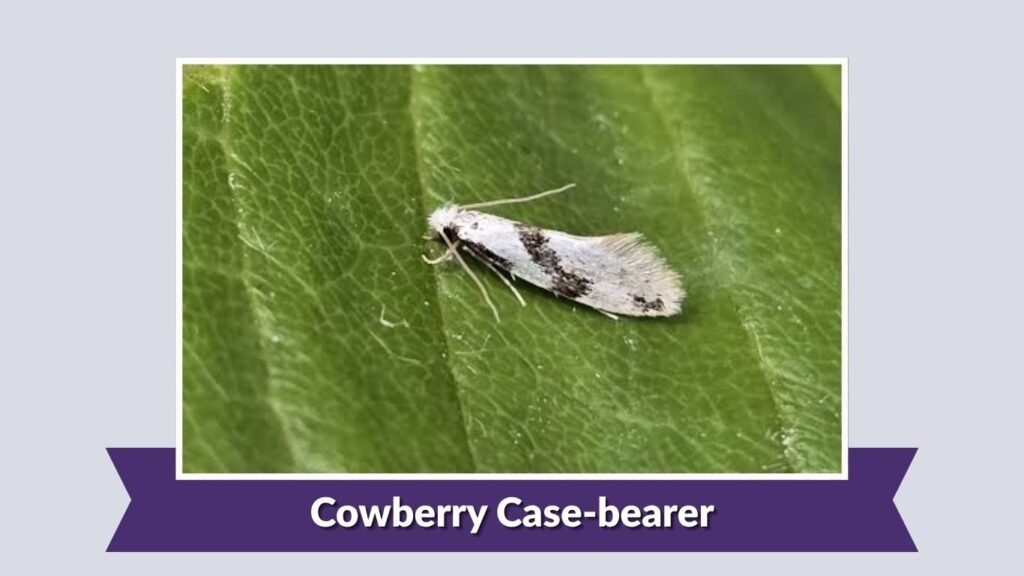
The Cowberry Case-bearer (Coleophora vitisella) is especially fascinating because of its highly distinctive larval shelter. Instead of constructing a simple tubular case, the caterpillar uses dozens of tiny circular pieces cut from cowberry leaves, arranging them in layers that resemble a stack of miniature coins.
Identification
- Adult wingspan is approximately 10–13 mm.
- Adults resemble several other Coleophora species.
- Mature larval cases are about 6 mm long.
- The case contains roughly 40 small discs of cowberry leaf.
- Leaf discs resemble a neatly stacked pile of coins.
- A white silken keel runs along the underside of the case.
- Numerous tiny feeding mines may appear on cowberry leaves.
Habitat
Cowberry Case-bearers favor sheltered moorland and Scots pine woodland where cowberry grows abundantly.
In Britain, populations occur mainly in the Scottish Highlands, with additional populations recorded in the Pennine Hills and Clwyd Hills. Its highly specialized diet means suitable host-plant habitat strongly determines where the moth can survive.
Behavior
The caterpillar repeatedly removes small circular pieces from cowberry leaves and incorporates them into its case. As a result, occupied plants may contain numerous tiny fleck mines and larger holes where leaf discs were removed.
The completed case has a curved, walking-stick-like appearance and is far more distinctive than the relatively plain adult moth.
Diet and Life Cycle
The larva specializes on cowberry (Vaccinium vitis-idaea). Its development extends into a second year, with mature cases commonly found during April and May.
After completing larval development, the caterpillar pupates. Adults normally fly from late May to early July, reproducing among habitats containing suitable cowberry patches.
10. Least Case-bearer

The Least Case-bearer (Coleophora juncicolella) is among the smallest members of its family, with adults measuring only a few millimeters across the wings. It is a specialist of heathland environments, where its caterpillars construct remarkably well-camouflaged cases from individual heather leaves arranged in a neat pattern.
Identification
- The wingspan is only about 6–8 mm.
- Adults are primarily grayish white.
- Their unusually small size helps distinguish them from similar species.
- Mature larval cases measure around 4–5 mm.
- Cases contain approximately 7–10 pieces of mined heather leaves.
- Leaf pieces form a distinctive herringbone pattern.
- Cases closely resemble small fragments of heather vegetation.
Habitat
Least Case-bearers occur mainly on heaths and moors where heather grows abundantly. They are widespread in suitable habitats across much of Britain and may occasionally appear in gardens containing established heather plants.
Behavior
Adults have an interesting tendency to fly during sunny afternoons rather than being strictly nocturnal. They can be disturbed from heather during late June and July.
The larval case provides exceptional camouflage. Its overlapping pieces of heather make it resemble an ordinary part of the plant, helping conceal the caterpillar while it feeds.
Diet and Life Cycle
Caterpillars feed mainly on common heather (Calluna vulgaris), with bell heather also recorded as a host. They mine the leaves and incorporate pieces into their protective cases.
Fully developed larvae are generally found from March through May. After pupation, adults emerge mainly during late June and July, completing t
FAQs
1. What are case-bearing moths?
Case-bearing moths are small moths whose caterpillars build portable protective cases from silk and plant material. Many belong to the family Coleophoridae and are closely associated with specific host plants.
2. Why do case-bearing moth larvae carry cases?
The cases protect the caterpillars from predators, weather, and other environmental threats. Larvae usually remain partly hidden inside while feeding and retreat completely when disturbed.
3. What do case-bearing moth caterpillars eat?
Their diet varies by species. Common host plants include oak, elm, apple, plum, hazel, birch, heather, cowberry, and sea-lavender. Many species are highly specialized and feed on only a few closely related plants.
4. Are case-bearing moths harmful to plants?
Most species cause only minor feeding damage and are not serious pests. Their larvae may create small leaf mines or holes, but healthy plants usually tolerate this without significant harm.
5. Where can case-bearing moths be found?
Case-bearing moths occur in many habitats, including woodlands, hedgerows, heathlands, orchards, gardens, wetlands, and coastal saltmarshes. Their distribution largely depends on the availability of suitable larval host plants.