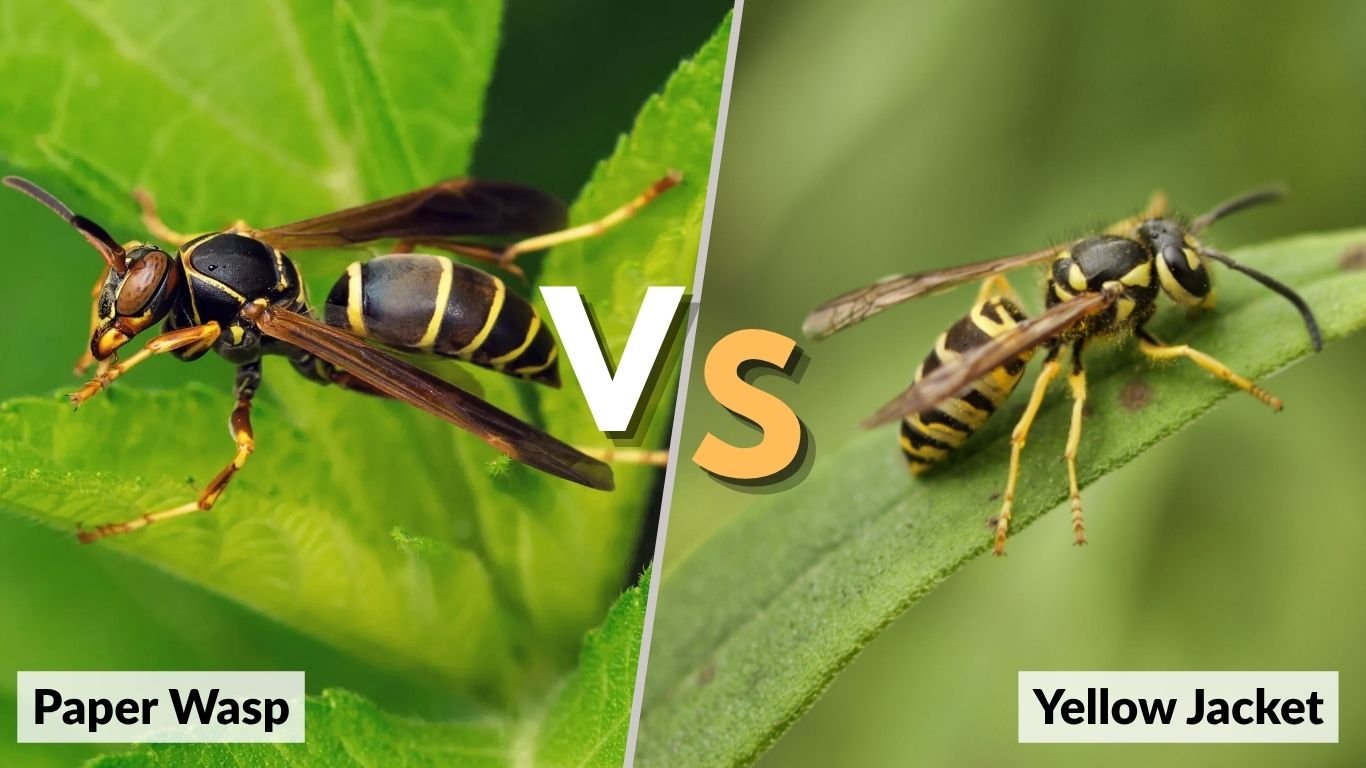
Paper wasps and yellow jackets are often confused because both can have yellow-and-black markings, live in social colonies, and defend their nests with painful stings. However, they differ noticeably in body shape, nesting habits, behavior, diet, and aggression. Paper wasps usually have slender bodies, long legs, and exposed umbrella-shaped nests. Yellow jackets are stockier, more aggressive around food, and commonly build enclosed nests underground or inside structures. Correct identification helps you understand the risk, avoid disturbing a colony, and choose the safest control method.
Paper Wasp vs Yellow Jacket: Quick Comparison
The easiest way to tell these insects apart is to examine their body shape, flight behavior, nest design, and activity around people. Paper wasps often fly with their long legs hanging below them, while yellow jackets have compact bodies and faster, more direct movements.
| Feature | Paper Wasp | Yellow Jacket |
|---|---|---|
| Body shape | Slender with a narrow waist | Shorter, thicker, and compact |
| Typical color | Brown, reddish, black, and yellow | Bright yellow and black |
| Leg appearance | Long legs that hang during flight | Shorter legs held close to the body |
| Nest type | Open comb with visible cells | Enclosed paper nest |
| Common nest location | Eaves, branches, railings, sheds | Underground, wall cavities, attics |
| Aggression | Usually defensive near the nest | Often highly defensive and persistent |
| Food attraction | Less interested in human food | Common around meat, sweets, and garbage |
| Colony size | Usually relatively small | May contain hundreds or thousands |
| Sting ability | Can sting repeatedly | Can sting repeatedly |
| Garden role | Hunts caterpillars and insects | Hunts insects and scavenges food |
Appearance and Identification
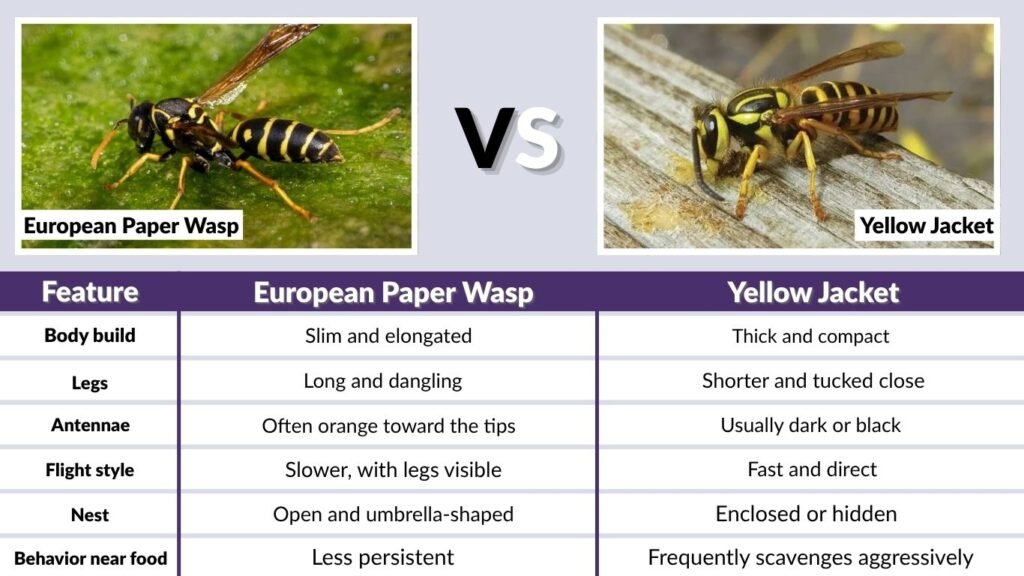
Although color can help with identification, body shape and posture are usually more reliable. Some paper wasps, especially European paper wasps, closely resemble yellow jackets because they have strong yellow-and-black markings.
Paper Wasp Appearance
Paper wasps have slim, elongated bodies with a clearly visible narrow waist between the thorax and abdomen. Their legs are unusually long and often trail beneath the body during flight.
Depending on the species, paper wasps may appear:
- Brown with yellow markings
- Reddish brown
- Black and yellow
- Mostly dark with orange or red areas
Their antennae may appear orange, brown, or dark. Their wings are usually narrow and fold lengthwise when the insect is resting.
Yellow Jacket Appearance
Yellow jackets are more compact and robust. They have bold yellow-and-black bands, shorter legs, and a thicker-looking abdomen. Their markings are usually sharper and more contrasting than those of many native paper wasps.
Yellow jackets may initially be mistaken for bees, but they have smooth, shiny bodies rather than the noticeably hairy bodies of most bees.
European Paper Wasp vs Yellow Jacket
The European paper wasp is one of the most commonly misidentified species because it has yellow-and-black markings similar to a yellow jacket. However, it still has the narrow body, long legs, and orange-tipped antennae typical of paper wasps.
| Identification Feature | European Paper Wasp | Yellow Jacket |
|---|---|---|
| Body build | Slim and elongated | Thick and compact |
| Legs | Long and dangling | Shorter and tucked close |
| Antennae | Often orange toward the tips | Usually dark or black |
| Flight style | Slower, with legs visible | Fast and direct |
| Nest | Open and umbrella-shaped | Enclosed or hidden |
| Behavior near food | Less persistent | Frequently scavenges aggressively |
Paper Wasp Nest vs Yellow Jacket Nest
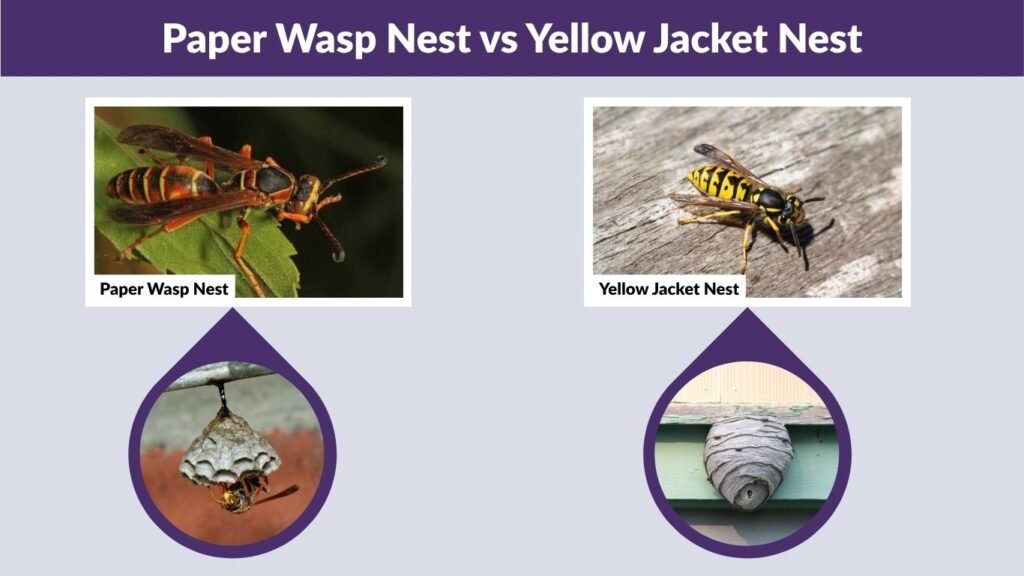
Nest appearance is one of the clearest differences between paper wasps and yellow jackets. However, you should never approach an active colony closely just to identify it.
What Does a Paper Wasp Nest Look Like?
A paper wasp nest consists of one exposed comb made from chewed wood fibers mixed with saliva. The nest usually resembles an upside-down umbrella and is attached to a surface by a narrow stalk.
The hexagonal cells remain visible because there is no outer paper covering. Paper wasps commonly attach their nests to:
- Roof eaves
- Porch ceilings
- Window frames
- Deck railings
- Tree branches
- Fences
- Sheds
- Outdoor furniture
- Mailboxes
- Play structures
Paper wasp nests generally remain smaller than mature yellow jacket nests.
What Does a Yellow Jacket Nest Look Like?
Yellow jackets build layered paper combs surrounded by a protective outer envelope. Most nests are hidden, so people often see only a small entrance hole rather than the colony itself.
Common nesting locations include:
- Abandoned rodent burrows
- Soil cavities
- Wall voids
- Attics
- Roof spaces
- Hollow trees
- Dense shrubs
- Beneath decks
- Inside siding
A mature yellow jacket colony may contain many hundreds or even thousands of workers.
Yellow Jacket Nest vs Paper Wasp Nest
| Nest Feature | Paper Wasp Nest | Yellow Jacket Nest |
|---|---|---|
| Shape | Flat, open umbrella-shaped comb | Rounded or layered enclosed structure |
| Outer covering | None | Paper envelope surrounds the comb |
| Cells visible | Yes | Usually hidden |
| Typical location | Exposed under sheltered surfaces | Underground or inside cavities |
| Attachment | Single narrow stalk | Supported inside a cavity or structure |
| Colony size | Usually dozens of adults | Often hundreds or thousands |
| Entrance activity | Wasps land directly on the comb | Heavy traffic through one opening |
| Removal difficulty | Sometimes manageable when very small | Often requires professional treatment |
Behavior and Aggression
Both insects defend their colonies, but yellow jackets are generally more likely to cause conflicts with people.
Paper Wasp Behavior
Paper wasps spend much of their time collecting caterpillars and other insects to feed their larvae. Away from the nest, they are not usually interested in chasing people.
They may become defensive when someone:
- Approaches the nest closely
- Shakes the surface supporting it
- Blocks their flight path
- Attempts to knock it down
- Uses a mower or power tool nearby
A paper wasp may hover near a person as a warning before attacking. However, sudden nest disturbance can produce an immediate defensive response.
Yellow Jacket Behavior
Yellow jackets are more likely to forage around picnics, garbage cans, outdoor dining areas, pet food, fruit, soda, and meat. Their persistence around food is one reason encounters are common in late summer and fall.
They can defend a nest aggressively and may pursue a person after the area has been disturbed. Ground nests are especially hazardous because they can be accidentally stepped on or disturbed by lawn equipment.
Paper Wasp Sting vs Yellow Jacket Sting
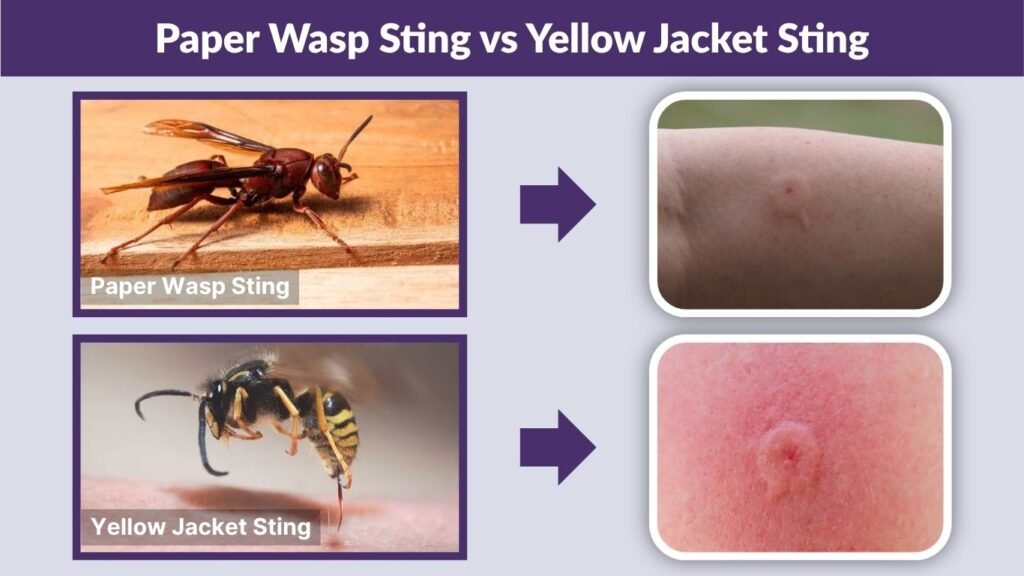
Both paper wasps and yellow jackets have smooth stingers, allowing them to sting more than once. The pain level varies with the sting location, the person’s sensitivity, and the number of stings.
Paper Wasp Sting
A paper wasp sting usually causes immediate sharp pain, redness, swelling, itching, and warmth around the affected area. Most uncomplicated local reactions improve gradually.
Paper wasps usually sting because their nest has been threatened or because they have been trapped against the skin.
Yellow Jacket Sting
A yellow jacket sting can produce similar symptoms, but encounters may result in multiple stings because yellow jackets are highly defensive and often live in large colonies.
A disturbed colony may release alarm chemicals that encourage other workers to attack. Moving away quickly is more important than attempting to swat the insects.
Which Sting Hurts More?
There is no reliable answer that applies to every person. Both stings can be intensely painful. Yellow jackets may create a more dangerous encounter because several workers can attack at once, especially near a large nest.
Seek emergency medical help when a sting causes:
- Difficulty breathing
- Swelling of the lips, tongue, face, or throat
- Dizziness or fainting
- Widespread hives
- Confusion
- Rapidly worsening symptoms
People with known severe insect-sting allergies should follow their prescribed emergency plan.
Diet and Attraction to Human Food
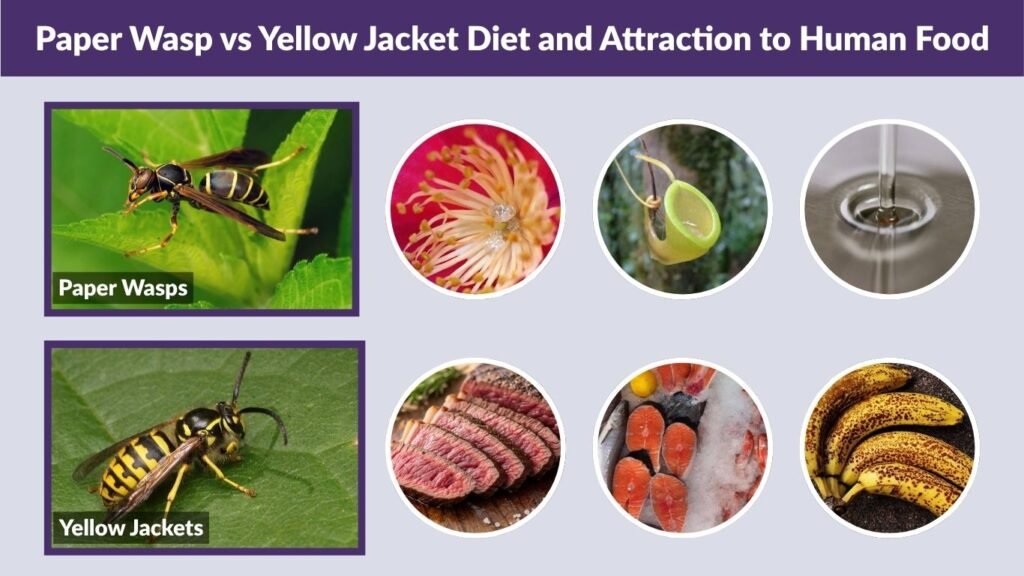
Paper wasps and yellow jackets are both predators, but their feeding habits around people are noticeably different.
What Paper Wasps Eat
Adult paper wasps consume nectar, plant fluids, and other sugary liquids. They hunt caterpillars and soft-bodied insects, chew them into small portions, and feed the material to their larvae.
Because of this behavior, paper wasps can provide useful natural pest control in gardens.
What Yellow Jackets Eat
Yellow jackets hunt insects for their developing larvae, but workers also scavenge many human foods. They may visit:
- Meat
- Fish
- Sugary drinks
- Ripe fruit
- Desserts
- Garbage
- Pet food
- Picnic leftovers
Their attraction to both protein and sugar makes them common around outdoor events and trash containers.
Paper Wasp vs Yellow Jacket vs Hornet
Hornet is a common name used for several large social wasps. True hornets belong to the genus Vespa, although some insects called hornets in North America are technically yellow jackets or related wasps.
Paper wasps generally have exposed nests and slender bodies. Yellow jackets are compact, strongly marked, and often nest underground. Hornets tend to be larger and commonly build enclosed aerial nests or colonies inside cavities, depending on the species.
Regardless of the name, avoid approaching any large active wasp nest.
Which One Is More Dangerous?
Yellow jackets are generally considered the greater everyday risk because they can form large colonies, defend nests vigorously, and frequently interact with people around food.
Paper wasps still deserve caution. A nest beside a door, porch, deck, playground, or frequently used walkway can create a significant sting hazard.
Risk depends on:
- Nest size
- Nest location
- Species
- Time of year
- Number of workers
- Distance from human activity
- Presence of sting-allergic individuals
Should You Remove the Nest?
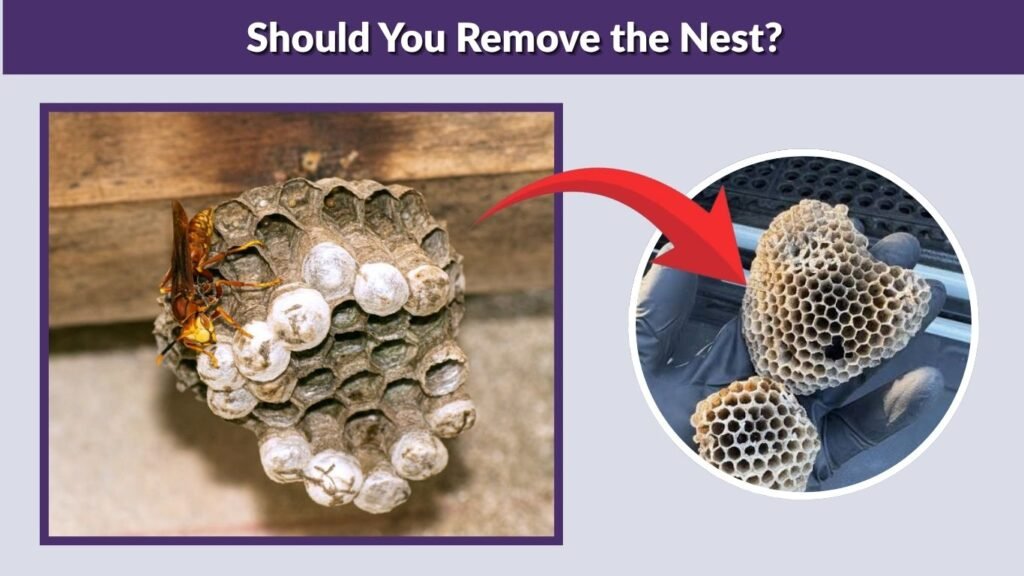
A nest located far from people may sometimes be left undisturbed because both insects help control other pests. Removal becomes more important when the colony is near entrances, walkways, playgrounds, patios, livestock areas, or occupied rooms.
Do not attempt removal when:
- The nest is large
- A ladder is required
- The colony is inside a wall
- The entrance is underground
- You have a sting allergy
- Many insects are entering and leaving
- You cannot identify the species
- The nest is near children or pets
Professional pest control is usually the safest option for a yellow jacket colony, a hidden structural nest, or any highly active colony.
How to Prevent Paper Wasps and Yellow Jackets
Prevention is easiest before colonies become established.
Inspect rooflines, sheds, decks, railings, vents, wall gaps, and outdoor equipment during spring. Seal structural openings after confirming that no active insects are inside.
Keep garbage containers tightly closed, clean spilled drinks, remove fallen fruit, cover outdoor food, and rinse recycling containers. These measures are particularly helpful for reducing yellow jacket activity.
FAQs
Are paper wasps the same as yellow jackets?
No. They are related social wasps, but they differ in body shape, nest construction, behavior, and feeding habits. Paper wasps are slender and build open combs. Yellow jackets are compact and usually build enclosed nests underground or inside protected cavities.
How can you identify a yellow jacket quickly?
Look for a compact, smooth body with bold yellow-and-black bands and relatively short legs. Yellow jackets also tend to fly rapidly and may gather around garbage, sugary drinks, fruit, meat, or outdoor meals.
Are paper wasps less aggressive than yellow jackets?
Paper wasps are generally less aggressive away from their nests. However, they can sting repeatedly when their colony is threatened. Yellow jackets are usually more defensive, particularly around underground nests and during late summer.
Do paper wasps and yellow jackets reuse old nests?
Their colonies are typically seasonal, and old nests are generally not reused by a full colony. However, new queens may build in the same protected area during a later season when the location remains suitable.
Can yellow jackets build nests under siding?
Yes. Yellow jackets may enter gaps in siding and build inside wall or roof cavities. Do not seal an active entrance, because trapped workers may move into the building. Contact a pest-control professional for safe treatment and exclusion.