

A paper wasp queen is the colony’s main reproductive female. She survives winter, starts a new nest in spring, lays the first eggs, and raises the earliest workers alone. Unlike queen ants or honeybees, however, a paper wasp queen may look almost identical to her workers. Her reproductive status is often determined by behavior, dominance, ovarian development, and season rather than an obvious difference in color or body shape.
Paper Wasp Queen Facts
| Feature | Description |
| Sex | Female |
| Primary role | Produces most of the colony’s eggs |
| Appearance | Usually similar to workers |
| Size | Often slightly larger, but sizes overlap |
| Sting | Yes; she may sting repeatedly |
| Spring activity | Builds nests, lays eggs, and hunts alone |
| Winter survival | Newly mated queens overwinter |
| Lifespan | Usually about one annual colony cycle |
| Nest type | Open, umbrella-shaped paper comb |
What Does a Paper Wasp Queen Look Like?
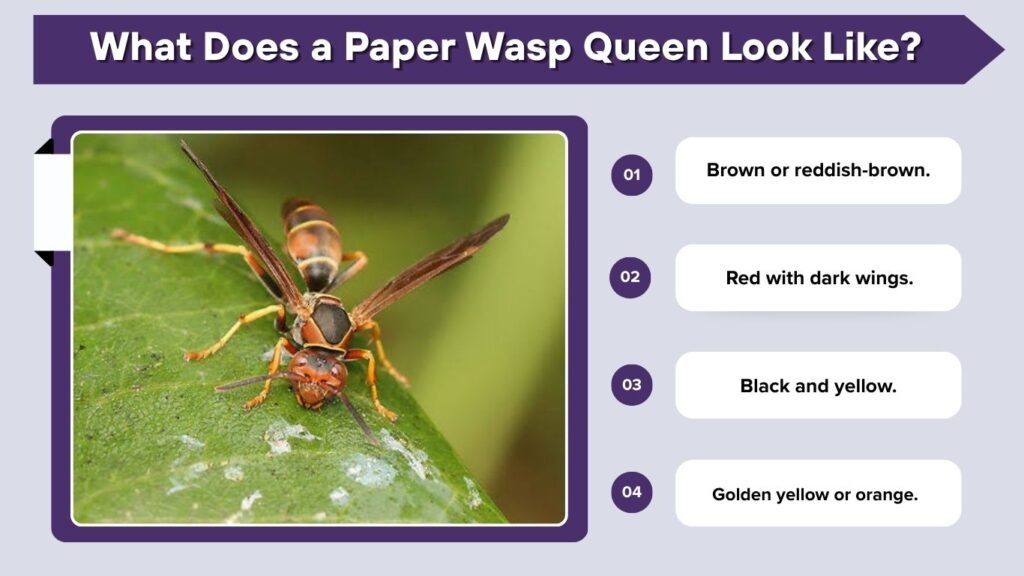
A paper wasp queen has the same basic appearance as other females of her species: a slender body, narrow waist, long antennae, folded wings, and legs that often hang beneath her during flight.
Depending on the species, she may be:
- Brown or reddish-brown
- Red with dark wings
- Black and yellow
- Golden yellow or orange
- Marked with pale facial patterns
The northern paper wasp queen may be brown, reddish, or dark with variable yellow markings. European paper wasp queens are black and yellow with orange-tipped antennae. Red paper wasp queens are usually reddish-brown or orange-red.
Can You Identify a Queen by Appearance?
Appearance alone is often unreliable. In Polistes paper wasps, queens and workers are not as physically distinct as honeybee queens and workers. Queens tend to be larger in certain species, but their measurements frequently overlap with those of workers.
Behavior and season provide better clues. A solitary female building a small nest during early spring is probably a queen, also called a foundress. A female remaining on an established nest and laying most of the eggs is the functional queen.
Paper Wasp Queen vs Worker
Both queens and workers are female, possess stingers, help defend the colony, and may participate in nest care. Their principal difference is reproductive status.
| Feature | Paper wasp queen | Paper wasp worker |
| Main role | Egg production | Foraging, construction, brood care |
| Size | May be slightly larger | Often slightly smaller |
| Appearance | Similar to workers | Similar to queen |
| Ovaries | Usually well developed | Usually less developed |
| Winter survival | New queens overwinter | Usually die in cold weather |
| Spring nest founding | Yes | No |
| Sting | Yes | Yes |
| Time away from nest | Frequent before workers emerge | Frequent while collecting food |
In one study of Polistes gallicus, workers averaged approximately 84% of their queens’ size. However, this relationship cannot be applied to every paper wasp species or used as a dependable visual identification rule.
Queens and workers also have flexible roles. Paper wasps are considered primitively eusocial, meaning their castes are less physically specialized than those of honeybees, ants, and some hornets. A subordinate female or worker may sometimes develop active ovaries and take over reproduction when circumstances change.
How Does a Paper Wasp Become Queen?
In temperate regions, colonies produce reproductive females near the end of summer or during fall. These future queens are commonly called gynes before they mate and begin founding colonies.
After mating, gynes seek protected overwintering locations such as:
- Beneath loose tree bark
- Inside wall gaps
- Under siding or roof materials
- Within attics, sheds, and garages
- Inside hollow trees
- In cracks around windows and doors
They enter a dormant state and remain sheltered while workers, males, and the old queen die with the arrival of cold weather. Fertilized queens emerge in spring and begin new colonies.
How a Queen Starts a New Nest
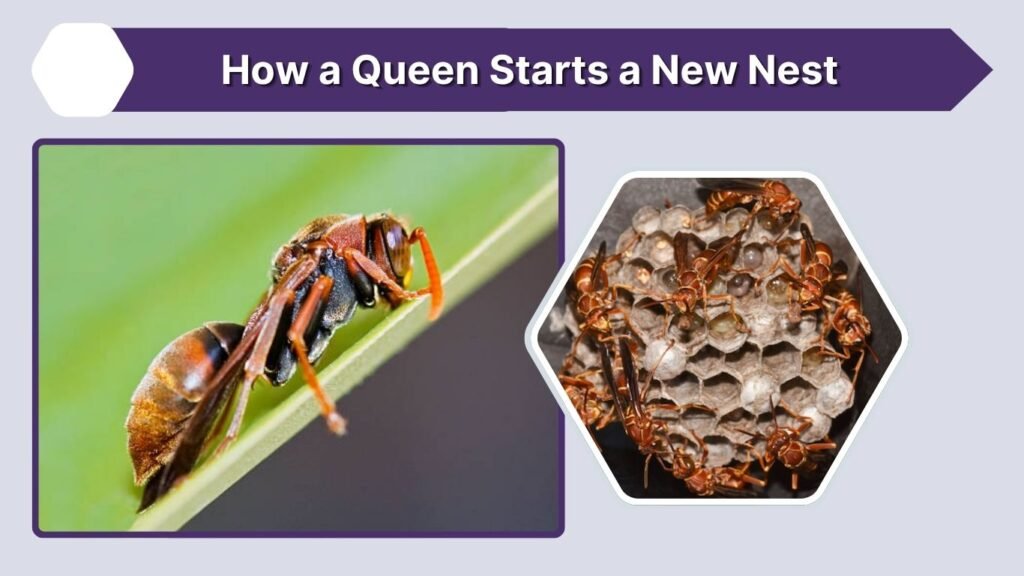
The queen handles every essential job during the colony’s earliest stage.
Choosing a Nesting Site
She selects a sheltered attachment point beneath an eave, porch ceiling, branch, railing, shutter, pipe, or outdoor structure.
Building the First Cells
The queen scrapes weathered wood fibers with her jaws, mixes them with saliva, and forms a paper-like pulp. She first constructs a supporting stalk and then adds several downward-facing hexagonal cells.
Laying and Raising the First Brood
She lays one egg in each suitable cell. After the larvae hatch, she captures caterpillars and other insects, chews them into small portions, and feeds them while continuing to build and defend the nest.
This period is demanding because the queen must repeatedly leave the nest to gather food and construction material. Paper wasp colonies are easiest to manage during this early stage, before workers emerge and colony activity increases.
Can a Nest Have Multiple Queens?
Several females may cooperate when beginning a paper wasp nest. These cofoundresses establish a dominance hierarchy, and the dominant female becomes the primary egg layer.
Subordinate foundresses may forage, build cells, feed larvae, and defend the nest. Cooperative founding can improve the colony’s early survival and productivity, but it may also lead to aggression and competition over reproduction.
Once workers emerge, some subordinate females may remain, leave, or die. The colony usually continues with one dominant reproductive queen.
What Does the Queen Do After Workers Emerge?
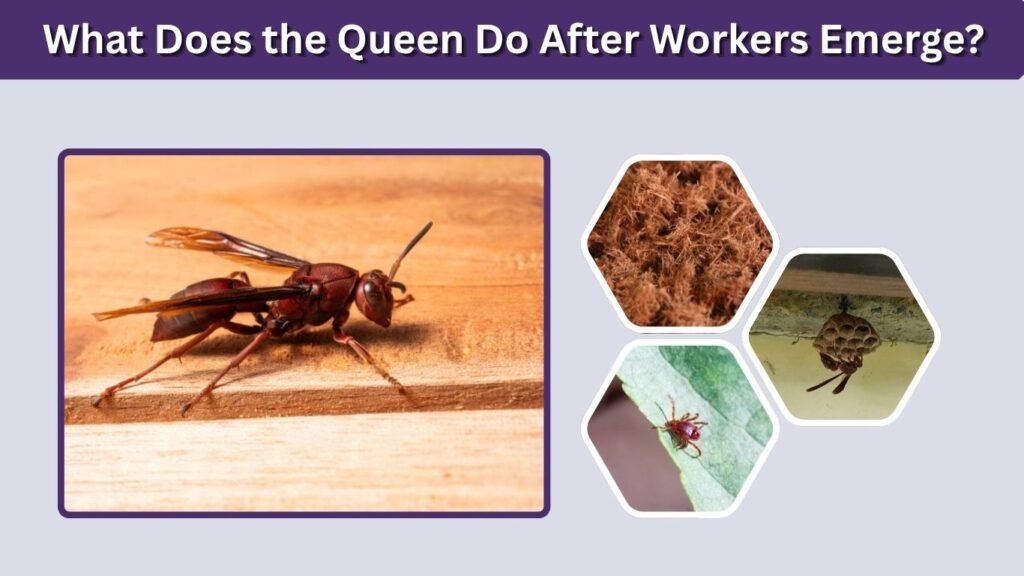
The queen gradually reduces her foraging activity after her first daughters become adults. Workers assume most responsibility for:
- Collecting wood fibers
- Expanding the nest
- Hunting insects
- Feeding larvae
- Guarding the comb
- Maintaining the cells
The queen then spends more time on the nest laying eggs and interacting with workers. She may also participate strongly in defense. Research on northern paper wasps found queens particularly active in confronting unfamiliar wasps that approached their colonies.
What Happens If the Paper Wasp Queen Dies?
The queen’s death does not always cause the colony to collapse immediately. Because paper wasp castes are flexible, a subordinate foundress or worker may develop her ovaries and become the new principal egg layer.
Whether the colony survives depends on:
- The season
- Number of remaining workers
- Presence of developing brood
- Age and reproductive ability of the females
- Availability of food
- Cause of the queen’s death
A queenless colony may experience dominance contests as females compete for reproductive priority. Workers do not mourn in the human sense, although their behavior and social hierarchy may change after the queen disappears.
Do Paper Wasp Queens Sting?

Paper wasp queens can sting. Like workers, they have relatively smooth stingers and can potentially sting more than once.
An early-season queen working alone usually avoids unnecessary conflict because her death would end the young colony. However, she may defend herself or her nest when trapped, crushed, handled, or directly threatened. Paper wasps are generally most defensive close to their comb.
A sting commonly causes immediate burning pain, redness, itching, and localized swelling. Breathing difficulty, facial or throat swelling, widespread hives, severe dizziness, or collapse requires emergency medical care.
How Long Does a Paper Wasp Queen Live?
A paper wasp queen generally lives longer than a worker because she must survive winter and establish a colony the following spring. Her life may extend from late summer or fall through the next colony season.
In cold climates, the original queen normally dies by the end of that season along with her workers. Newly produced, mated queens then overwinter and repeat the cycle. The complete lifespan varies with species, climate, predators, disease, nest success, and winter survival.
Paper Wasp Queen in the House
A solitary paper wasp appearing indoors during fall, winter, or early spring may be an overwintering queen. It does not necessarily mean there is an active nest inside the house.
Queens may emerge during warm winter days and move toward windows. Avoid handling the wasp with bare hands. When practical, isolate the room and use a container to release it outdoors during suitable weather. Repeated sightings may indicate gaps around siding, windows, vents, or roof materials that should be sealed after activity ends.
FAQs
Is a paper wasp queen larger than a worker?
The queen may be slightly larger, particularly around the abdomen, but the difference is often subtle. Queen and worker sizes overlap in many species, so body size alone cannot reliably identify the reproductive female.
How can you tell which paper wasp is the queen?
During spring, a lone female constructing and guarding a new nest is usually the queen. In an established colony, the queen generally remains on the comb and lays most eggs, but identifying her without observing behavior can be difficult.
Does every paper wasp nest have a queen?
An active colony normally has one dominant egg-laying female. Some nests begin with several cooperating foundresses, but a dominance hierarchy typically develops, leaving one female responsible for most egg production.
Can a worker paper wasp become queen?
A worker or subordinate female may become reproductively active after the queen dies. She can develop her ovaries and take over egg laying, although her ability to maintain the colony depends on her mating status, season, and colony condition.
Do paper wasp queens survive winter?
Newly mated queens survive winter in protected shelters. Workers, males, and the old queen normally die during cold weather. The overwintered queens emerge in spring and construct new nests rather than continuing the previous colony.