
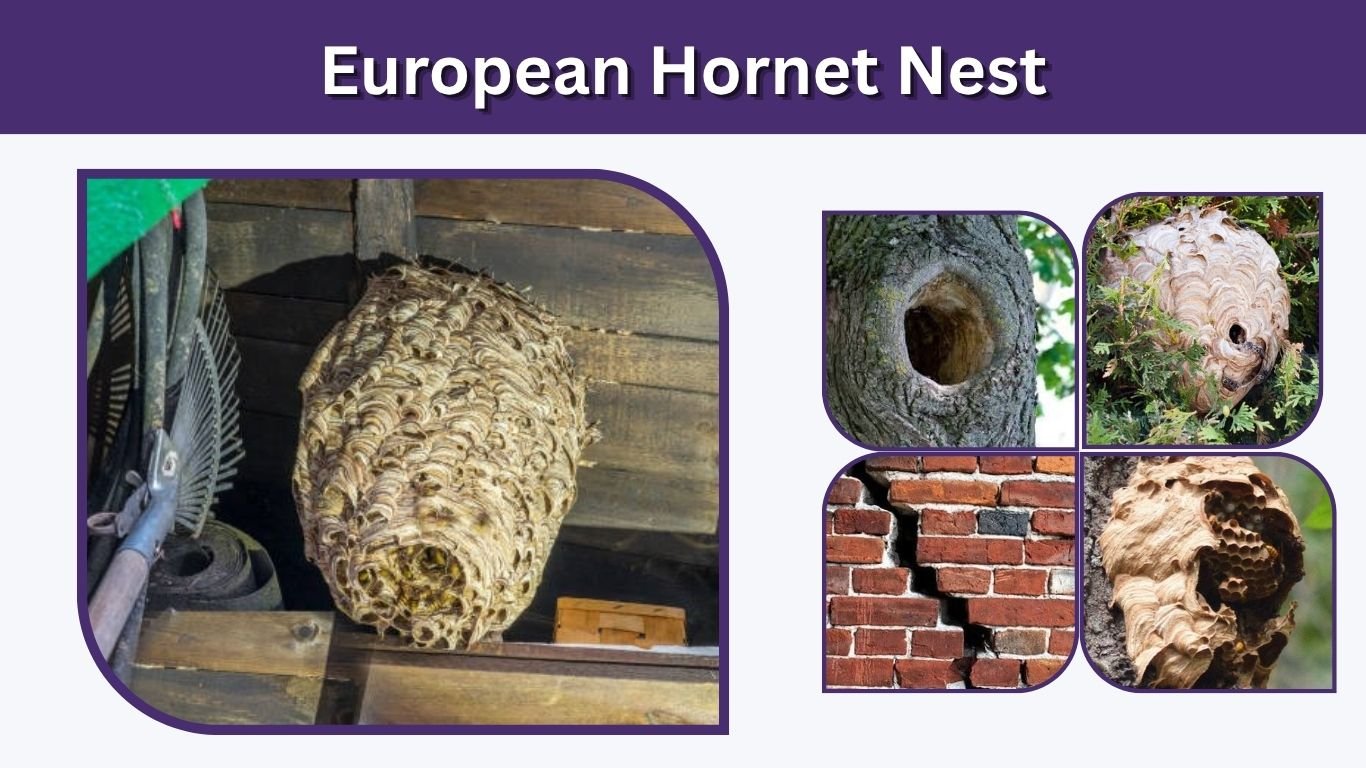
A European hornet nest can be difficult to spot because these large hornets often build inside hollow trees, wall voids, attics, sheds, and other protected cavities. Unlike many familiar paper wasps, European hornets usually keep most of their nest hidden from view. You may notice repeated hornet activity around a small opening before you ever see the actual nest. Understanding what European hornet nests look like, where they are commonly located, and how to find one can help you determine whether a colony is living near your home.
What Does a European Hornet Nest Look Like?
European hornets (Vespa crabro) build paper nests from chewed wood fibers mixed with saliva. The material dries into a light brown or tan paper-like substance.
Inside the nest are multiple layers of hexagonal cells where eggs, larvae, and pupae develop. Larger colonies can contain several combs arranged one beneath another.
European Hornet Nest Identification
A European hornet nest may have:
- Brown, tan, or gray paper-like material
- Several layers of horizontal comb
- Hexagonal brood cells
- A protective outer paper envelope when space allows
- A single main entrance or access point
- Numerous large hornets entering and leaving
- A nest hidden inside a cavity rather than fully exposed
When European hornets nest inside a hollow tree or wall, you may only see the entrance rather than the paper structure itself.
Where Do European Hornets Nest?

European hornets prefer protected cavities that shelter the colony from rain, wind, predators, and temperature changes.
Natural nesting locations are commonly found in wooded habitats, but the hornets also adapt well to buildings and residential environments.
Common European Hornet Nest Locations
European hornets may build nests in:
- Hollow trees
- Tree cavities
- Wall voids
- Attics
- Roof spaces
- Barns
- Sheds
- Chimneys
- Outdoor structures
- Behind siding
- Abandoned buildings
- Large birdhouses
- Other enclosed cavities
Hollow trees are among their most typical natural nesting locations.
European Hornet Nest in a Tree

A European hornet nest in a tree is often hidden inside a hollow trunk or large branch.
You might notice hornets repeatedly flying toward the same hole in a tree. Workers may also remove debris from the cavity or gather nearby wood fibers to expand the nest.
The paper nest itself may remain completely invisible because the colony is deep inside the hollow section.
European hornets also sometimes strip bark from branches to collect sap and nesting material, so frequent hornet activity around a particular tree does not always mean the nest is inside it.
European Hornet Nest in a House
European hornets occasionally establish colonies inside buildings when they find a suitable cavity.
Potential nesting areas include walls, attics, roof spaces, chimneys, soffits, and gaps behind siding.
European Hornet Nest in an Attic
Attics can provide warm, dry, protected spaces where a colony can grow relatively undisturbed.
Hornets may enter through damaged vents, roof gaps, soffits, or other small exterior openings.
If large hornets repeatedly disappear underneath roofing materials or through an attic opening, a colony may be present.
European Hornet Nest in a Wall
Wall voids are another possible nesting location.
A common warning sign is repeated hornet traffic through a crack around siding, windows, roof edges, utility lines, or damaged exterior materials.
Never simply seal an active entrance. Hornets trapped inside the wall may search for another exit, potentially bringing them inside the living space.
Do European Hornets Nest in the Ground?
European hornets normally prefer above-ground cavities, particularly hollow trees and protected spaces inside structures.
However, they can occasionally use cavities at or below ground level.
A European hornet ground nest is therefore possible but much less typical than underground yellowjacket colonies.
If large wasps are repeatedly entering a hole in the soil, careful identification is important because several yellowjacket and solitary wasp species commonly nest underground.
How to Find a European Hornet Nest

Finding a European hornet nest usually involves observing workers rather than searching directly through trees or structures.
Worker hornets regularly travel between their colony and feeding areas.
Watch Their Flight Direction
Observe hornets from a safe distance and watch where they fly after feeding.
Repeated flights in the same direction can provide clues about the nest location.
Look for Regular Entrance Activity
An active nest generally has hornets repeatedly entering and leaving the same opening.
Possible entrances include:
- Tree holes
- Roof gaps
- Wall cracks
- Siding openings
- Attic vents
- Chimney openings
- Gaps around outdoor structures
Continuous activity around one opening is often the strongest indication of a nearby colony.
Check Around Trees and Buildings
Focus on large hollow trees, old sheds, barns, rooflines, wall cavities, and other sheltered spaces.
Do not approach closely enough to disturb the colony.
How Far Do European Hornets Travel From Their Nest?
European hornets do not necessarily forage directly beside their colony.
Workers may travel substantial distances while searching for insects, fruit, tree sap, nectar, and other food.
This means that seeing a European hornet in your garden does not automatically mean its nest is on your property.
Watching several individuals over time provides better information than following a single hornet.
European Hornet Nest Size
European hornet nest size changes dramatically throughout the season.
A newly founded spring nest begins very small. The queen constructs only enough cells to raise the first generation of workers.
Once workers emerge, construction accelerates.
By late summer, a mature colony may contain multiple comb layers and occupy much of the available cavity.
How Many European Hornets Are in a Nest?
Colony population depends on nest age, weather, food availability, and available nesting space.
A mature European hornet colony commonly contains several hundred individuals, although numbers vary considerably between nests.
Populations are generally largest during late summer before reproductive males and new queens leave the colony.
How European Hornets Build Their Nest
The nesting cycle begins when an overwintered queen becomes active during spring.
She searches for a suitable cavity and begins scraping weathered wood from fences, trees, buildings, or other wooden surfaces.
The queen chews these fibers and mixes them with saliva to create paper pulp.
She then constructs several cells and lays eggs inside them.
After the first workers mature, they take over most nest construction, hunting, feeding larvae, and colony defense while the queen concentrates on laying eggs.
Are European Hornet Nests Aggressive?
European hornets usually do not seek out people to sting while they are away from the colony.
Around the nest, however, workers can become strongly defensive.
Approaching the entrance, hitting the tree or wall containing the colony, using lawn equipment nearby, or attempting nest removal can provoke defensive behavior.
The safest approach is to keep people and pets away from an active colony.
How to Get Rid of a European Hornet Nest

Nest removal depends heavily on its location.
An exposed nest may be easier to access than a colony buried inside a wall, roof, chimney, or hollow tree.
Trying to destroy a concealed nest without understanding its structure can create additional problems.
European Hornet Nest Removal
Professional removal is particularly appropriate when the nest is:
- Inside a wall
- Inside an attic
- Behind vinyl siding
- Near a doorway
- Near children’s play areas
- Near frequently used walkways
- High inside a tree
- Difficult to access safely
- Producing hornets inside the house
A pest-control professional can determine where the colony is located and choose a treatment method appropriate for the structure.
Avoid blocking the entrance while the colony remains alive.
Should You Destroy a European Hornet Nest?
Not every European hornet colony requires removal.
A nest deep inside a wooded area or an unused portion of a property may pose relatively little risk.
European hornets are predators that consume flies, caterpillars, grasshoppers, and other insects.
Removal becomes more reasonable when the colony is close to people or when hornets are entering occupied parts of a building.
Do European Hornets Reuse Their Nest?
European hornet colonies are seasonal.
The original queen, workers, and males usually die as cold weather arrives. Newly fertilized queens leave the colony and overwinter individually in protected locations.
The following spring, each surviving queen starts a new colony.
European hornets therefore generally do not reuse the old nest.
An abandoned nest found during winter is normally inactive, although another queen could potentially select the same cavity for a new nest during a later year.
European Hornet Nest in Winter
European hornet nests become inactive as temperatures fall.
Workers, males, and the old queen die, leaving the paper structure behind.
Finding an old European hornet nest in a hollow tree during winter does not normally mean the colony is still alive.
However, overwintering queens may be hiding elsewhere beneath bark, inside buildings, or within other protected spaces until spring.
FAQs
What does a European hornet nest look like?
A European hornet nest consists of brown or tan paper-like material made from chewed wood fibers. It contains layers of hexagonal cells and may have a protective outer envelope. Because nests are frequently built inside cavities, the entire structure is often hidden.
Where do European hornets build their nests?
European hornets commonly nest in hollow trees, attics, wall voids, sheds, barns, roof spaces, chimneys, and other protected cavities. Natural colonies are especially associated with mature trees containing hollow sections.
Do European hornets build nests underground?
They can occasionally occupy cavities near or below ground level, but underground nesting is not typical. European hornets generally prefer hollow trees and elevated enclosed spaces, unlike several yellowjacket species that commonly build nests underground.
How many European hornets live in a nest?
A mature colony may contain several hundred hornets, although colony size varies according to food availability, weather, nesting space, and season. Populations usually reach their highest levels during late summer.
How can I locate a European hornet nest?
Observe worker hornets from a safe distance and watch their repeated flight paths. Regular traffic toward the same tree hole, wall opening, roof gap, attic vent, or structural cavity can indicate the nest entrance.