
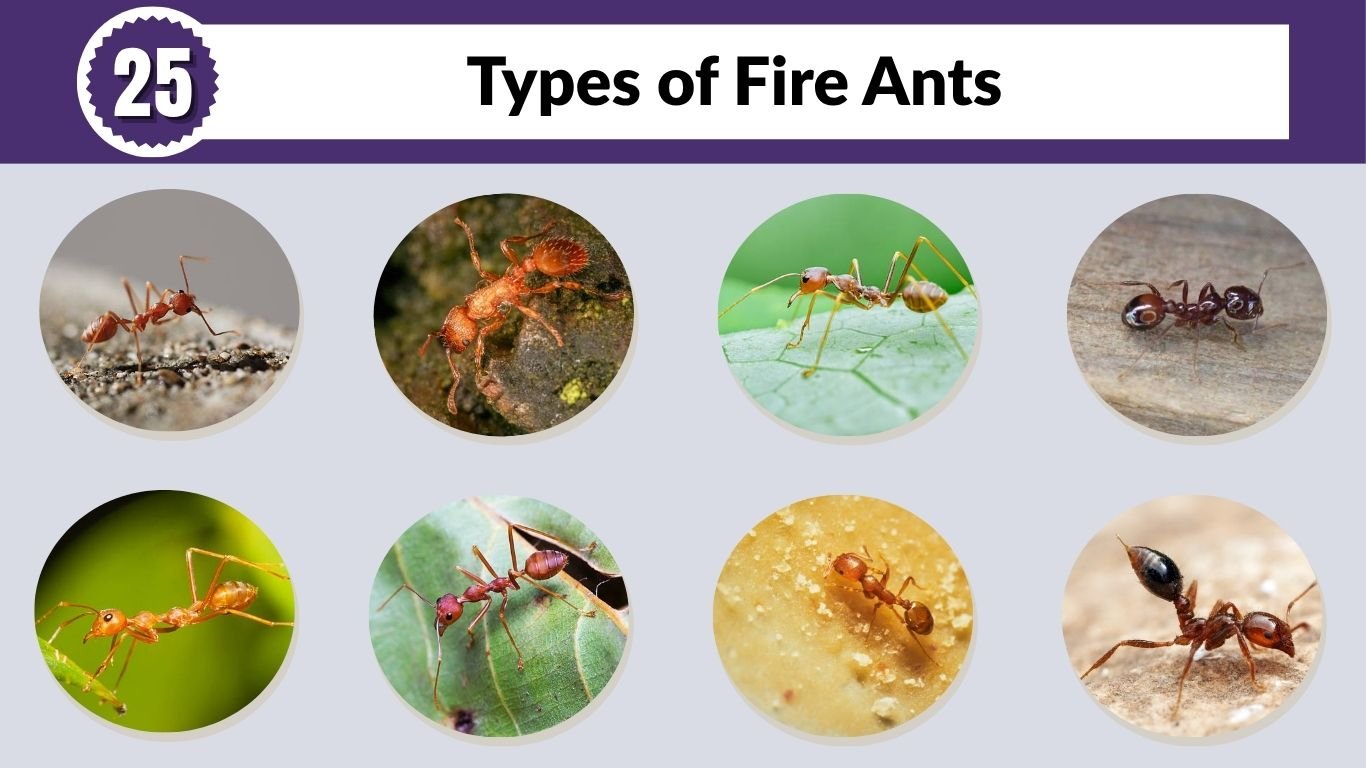
Fire ants are a diverse group of stinging ants known for their aggressive colony defense, painful stings, and ability to thrive in many warm environments. While species such as the Red Imported Fire Ant are widely recognized, many other native and introduced fire ants occur across the Americas and beyond. This guide covers 25 types and common names of fire ants, including their identification features, habitats, behaviors, diets, and life cycles to help you better understand these fascinating but sometimes troublesome insects.
1. Red Imported Fire Ant

The Red Imported Fire Ant is one of the most recognizable fire ants in the world. Originally native to South America, it has spread into many warm regions, especially the southern United States. These ants are highly territorial and are well known for building large soil mounds and defending their colonies aggressively.
Identification
- Workers range from reddish-brown to dark brown.
- Worker ants vary noticeably in size within the same colony.
- The abdomen is usually darker than the head and thorax.
- Colonies often form dome-shaped soil mounds.
- Workers have a two-segmented waist and elbowed antennae.
Habitat and Distribution
Red Imported Fire Ants prefer warm, sunny habitats with disturbed soil. They are commonly found in lawns, pastures, agricultural fields, roadsides, parks, and gardens. Colonies frequently appear near sidewalks, electrical equipment, and building foundations. They are widespread across much of the southeastern United States and occur in several other tropical and subtropical regions.
Behavior and Diet
These ants are aggressive defenders of their nests. When disturbed, large numbers of workers quickly emerge and climb onto nearby animals or people. They are omnivorous and feed on insects, dead animals, seeds, sugary substances, and honeydew produced by sap-feeding insects. They may also attack small reptiles, birds, and other invertebrates.
Lifespan and Life Cycle
A mature colony may contain hundreds of thousands of workers. Queens can survive for several years and continuously produce eggs under favorable conditions. Eggs develop into larvae, then pupae, and finally adults. Winged males and females are produced during reproductive periods and leave the colony on mating flights.
2. Black Imported Fire Ant

The Black Imported Fire Ant is a South American fire ant that has established populations outside its native range. It resembles the Red Imported Fire Ant in behavior and colony structure but can often be distinguished by its darker body coloration.
Identification
- Workers are dark reddish-brown to nearly black.
- The abdomen is typically very dark.
- Workers occur in several different sizes.
- Antennae are elbowed with a two-segmented club.
- Nests may form raised soil mounds.
Habitat and Distribution
Black Imported Fire Ants usually live in open, sunny areas with moist or moderately disturbed soil. They may be found in lawns, fields, pastures, roadsides, and agricultural landscapes. Their natural range is in South America, although introduced populations have occurred in parts of North America.
Behavior and Diet
Colonies are highly defensive. Workers swarm rapidly when a nest is disturbed and can deliver painful stings. Their diet includes insects, carrion, seeds, plant material, sugary liquids, and honeydew. They are active predators of many small arthropods and can compete strongly with native ant species.
Lifespan and Life Cycle
Colonies are centered around one or more reproductive queens. Queens lay eggs that develop through larval and pupal stages before becoming adult workers. Reproductive males and females develop wings and participate in mating flights. After mating, fertilized females establish new colonies by laying their first batches of eggs.
3. Tropical Fire Ant

The Tropical Fire Ant is widely distributed in tropical and subtropical regions. It is often found around agricultural areas, gardens, and disturbed habitats. Although usually less notorious than imported fire ants, it can still deliver a painful sting when threatened.
Identification
- Workers are usually reddish-brown.
- The abdomen may appear darker than the rest of the body.
- Workers show noticeable differences in body size.
- The head may appear relatively broad.
- Colonies often nest directly in exposed soil.
Habitat and Distribution
Tropical Fire Ants thrive in warm climates. They occur in parts of Central America, South America, the Caribbean, the southern United States, and many tropical islands. They often establish nests in dry soil, crop fields, gardens, roadsides, and around human settlements.
Behavior and Diet
These ants are active scavengers and predators. They consume dead insects, living arthropods, seeds, sugary foods, and other organic materials. Workers forage across the ground and may enter homes or agricultural structures in search of food.
Lifespan and Life Cycle
The colony develops through the typical ant stages of egg, larva, pupa, and adult. Queens are responsible for egg production, while workers maintain the nest and gather food. Winged reproductive ants are produced periodically and disperse during warm, humid weather to establish new colonies.
4. Southern Fire Ant

The Southern Fire Ant is a native fire ant found across warmer parts of North America. It commonly lives around homes, gardens, and dry soil. While its sting can be uncomfortable, colonies are generally less aggressive than those of Red Imported Fire Ants.
Identification
- Workers range from yellowish-red to reddish-brown.
- The abdomen is often darker.
- Worker size varies within the colony.
- The body has a two-node waist.
- Nests may occur beneath stones or other objects.
Habitat and Distribution
Southern Fire Ants occur mainly in warm regions of the southern United States and nearby areas. They prefer dry or moderately moist soil and frequently nest beneath rocks, logs, pavement, landscape materials, or around building foundations.
Behavior and Diet
These ants feed on insects, carrion, seeds, grease, sweets, and household food scraps. Workers may enter buildings while searching for food. Colonies defend their nests but usually do not produce the massive aggressive response associated with imported fire ants.
Lifespan and Life Cycle
Queens produce eggs that hatch into larvae and later become pupae. Adult workers emerge after completing development and begin caring for younger colony members. Mature colonies periodically produce winged reproductive males and females that leave to mate and establish new colonies.
5. Golden Fire Ant

Golden Fire Ant is a common descriptive name sometimes used for fire ants that display a yellowish or golden-orange appearance. These ants belong to groups closely related to other fire ants and are generally found in warm environments.
Identification
- Workers may appear golden-yellow to orange-brown.
- The abdomen can be slightly darker.
- Workers are usually small to medium-sized.
- Antennae are distinctly elbowed.
- A two-segmented waist is visible between the thorax and abdomen.
Habitat and Distribution
Golden-colored fire ants generally prefer warm habitats with loose soil. They may establish colonies in grasslands, gardens, forest edges, agricultural areas, and disturbed ground. Their exact distribution varies according to the species referred to by the common name.
Behavior and Diet
These ants are opportunistic feeders. They consume insects, dead arthropods, seeds, nectar, honeydew, and other sugary materials. Workers often forage in groups and may become defensive when their nests are disturbed.
Lifespan and Life Cycle
Like other fire ants, they develop through egg, larval, pupal, and adult stages. Workers handle nest maintenance and food collection, while queens specialize in reproduction. Mature colonies may produce winged males and females that leave during mating flights and create new colonies.
6. Native Fire Ant

The term Native Fire Ant is commonly used for fire ant species that naturally occur in a particular region rather than being introduced from another continent. Native species play important ecological roles as predators, scavengers, and seed collectors.
Identification
- Color may range from yellowish-red to dark reddish-brown.
- Workers often differ in size within a colony.
- Most species have a two-segmented waist.
- Antennae are elbowed with a small club at the tip.
- Nest shape varies depending on the species.
Habitat and Distribution
Native fire ants occupy many habitats, including grasslands, deserts, forests, coastal areas, and open fields. Some prefer exposed soil, while others establish nests underneath rocks, logs, or vegetation. Their geographic range depends on the individual species.
Behavior and Diet
Most native fire ants are omnivorous. They hunt insects, scavenge animal remains, collect seeds, and consume sugary plant secretions. Some species help control other insects, making them important components of local ecosystems.
Lifespan and Life Cycle
Colonies contain queens, workers, and seasonal reproductive individuals. Eggs hatch into larvae that are fed by workers before entering the pupal stage. Adult workers eventually emerge and take on different colony duties. Queens may live for several years under favorable environmental conditions.
7. Hybrid Imported Fire Ant

The Hybrid Imported Fire Ant results from interbreeding between Red Imported Fire Ants and Black Imported Fire Ants. Hybrid populations are especially important because they can survive in some areas that are cooler than the environments typically favored by Red Imported Fire Ants.
Identification
- Workers range from reddish-brown to dark brown.
- Coloration may be intermediate between red and black imported fire ants.
- Workers occur in several size classes.
- Colonies often create noticeable soil mounds.
- Identification may require close examination because hybrids resemble both parent species.
Habitat and Distribution
Hybrid Imported Fire Ants occur mainly in parts of the southeastern United States where populations of Red and Black Imported Fire Ants overlap. They commonly inhabit lawns, fields, roadsides, pastures, and other sunny areas with disturbed soil.
Behavior and Diet
Hybrid colonies can be highly aggressive when disturbed. Workers rapidly emerge from the nest and may sting repeatedly. Their diet includes insects, carrion, seeds, sugary substances, honeydew, and other available food sources.
Lifespan and Life Cycle
Hybrid fire ants follow the same general life cycle as other fire ants. Eggs develop into larvae, pupae, and adults. Queens produce large numbers of offspring, while workers maintain the nest and defend the colony. Winged reproductive ants participate in mating flights, allowing colonies to spread into new areas.
8. Ginger Ant

The Ginger Ant is a small reddish or orange-brown ant that is sometimes grouped with fire ants because of its appearance and defensive behavior. These ants are typically found in warm regions and often nest in soil, under stones, or around disturbed habitats where food is readily available.
Identification
- Workers are usually orange, ginger, or reddish-brown.
- The abdomen may be slightly darker than the rest of the body.
- Workers are generally small to medium in size.
- Antennae are elbowed and clearly segmented.
- Colonies are commonly found in loose or sandy soil.
Habitat and Distribution
Ginger Ants prefer warm environments and may occur in gardens, grasslands, forest edges, agricultural land, and areas near buildings. They often choose sheltered nesting locations beneath rocks, wood, pavement, or plant debris.
Behavior and Diet
These ants are opportunistic feeders that consume small insects, dead arthropods, nectar, honeydew, seeds, and other organic materials. Workers may forage in trails and quickly gather around available food. Colonies can become defensive if their nesting area is disturbed.
Lifespan and Life Cycle
The colony begins when a reproductive queen establishes a nest and lays eggs. The eggs hatch into larvae before developing into pupae and adults. Workers collect food and maintain the colony, while reproductive males and females are produced when conditions favor expansion.
9. Little Fire Ant
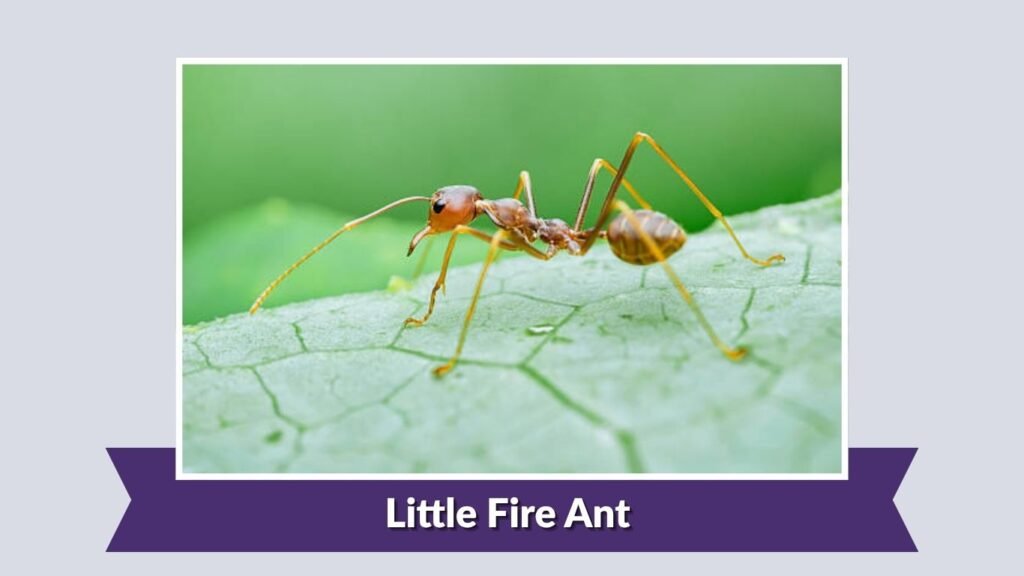
The Little Fire Ant is a tiny invasive ant known for its painful sting despite its very small size. It can establish colonies both on the ground and in vegetation, making it particularly difficult to control once it becomes established.
Identification
- Workers are very small, usually around 1.5 millimeters long.
- The body is pale orange to reddish-brown.
- The abdomen is often noticeably darker.
- Workers move relatively slowly compared with many ants.
- Antennae end in a distinct two-segmented club.
Habitat and Distribution
Little Fire Ants are native to tropical America but have spread to many tropical and subtropical regions. They live in gardens, forests, plantations, orchards, yards, and urban areas. Colonies may nest in soil, leaf litter, tree cavities, plant pots, or other sheltered locations.
Behavior and Diet
Workers feed on insects, honeydew, nectar, and other sugary substances. They often protect sap-feeding insects such as scale insects and aphids because these provide honeydew. Their sting can produce a sharp burning sensation that seems disproportionate to their tiny body size.
Lifespan and Life Cycle
Little Fire Ant colonies may contain multiple queens. Eggs develop into larvae and pupae before becoming adults. Colonies can expand by budding, where queens and workers leave an established nest together and form a nearby colony. This allows infestations to spread rapidly.
10. European Fire Ant
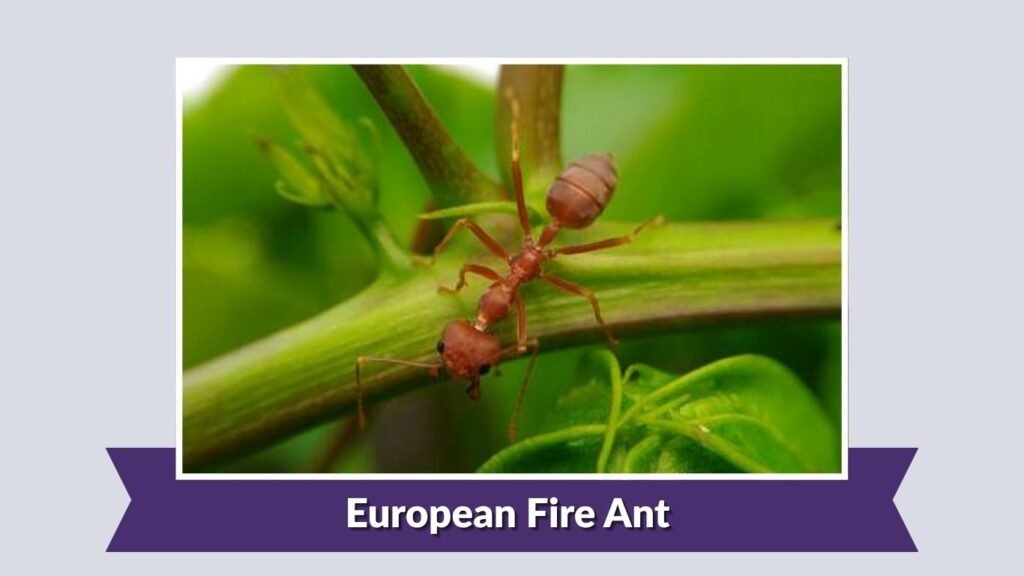
The European Fire Ant is a reddish ant native to Europe and parts of Asia. It has also become established in portions of North America, where it can form dense colonies in lawns, gardens, and other moist habitats.
Identification
- Workers are reddish-brown to orange-brown.
- The head may appear slightly darker than the thorax.
- Workers are usually about 4 to 5 millimeters long.
- The body has a two-segmented waist.
- The antennae are distinctly elbowed.
Habitat and Distribution
European Fire Ants prefer moist, shaded environments. Colonies may occur under logs, rocks, leaves, garden materials, and landscape debris. They can also become common in lawns, parks, forests, and residential landscapes.
Behavior and Diet
These ants are territorial and may sting when their nests are disturbed. They feed on small insects, carrion, nectar, honeydew, and other sugary materials. Workers frequently forage through vegetation and leaf litter while searching for prey.
Lifespan and Life Cycle
Colonies may contain several queens, allowing populations to grow rapidly. Eggs hatch into larvae that are cared for by workers until they pupate. Mature colonies produce winged males and females that participate in mating flights and contribute to the spread of the species.
11. Electric Ant

The Electric Ant is another common name for the Little Fire Ant. The name comes from the surprisingly intense sting produced by such a tiny insect. It is considered an important invasive ant in many tropical locations because colonies can reach extremely high densities.
Identification
- Workers are tiny and usually pale orange or reddish.
- Most workers are about 1.5 millimeters long.
- The abdomen is darker than the head and thorax.
- The body has a slender appearance.
- Workers have a two-segmented antennal club.
Habitat and Distribution
Electric Ants live in tropical and subtropical climates. They can nest in soil, trees, garden plants, buildings, electrical equipment, and plant containers. They are especially successful in humid environments where food and nesting sites are abundant.
Behavior and Diet
These ants feed on small arthropods, nectar, honeydew, and sugary foods. They often form relationships with scale insects and other sap feeders. Workers can fall from trees or vegetation onto people and animals, where they may sting repeatedly when trapped against the skin.
Lifespan and Life Cycle
Colonies often contain many queens and can reproduce through budding. Eggs pass through larval and pupal stages before becoming adult workers or reproductive ants. Because nearby colonies may cooperate rather than fight, extremely large interconnected populations can develop.
12. Black Fire Ant

Black Fire Ant is a broad common name sometimes applied to dark-colored fire ant species, including certain members of the genus Solenopsis. Their darker appearance can help distinguish them from the more familiar bright reddish forms.
Identification
- Workers may be dark brown, reddish-black, or nearly black.
- The abdomen is generally the darkest part of the body.
- Worker size may vary within the same colony.
- The waist contains two distinct nodes.
- Antennae are elbowed and end in a club.
Habitat and Distribution
Dark-colored fire ants can occur in grasslands, agricultural fields, forest margins, gardens, and urban environments. Most species prefer warm climates and build nests in soil or beneath protected objects such as stones, boards, and logs.
Behavior and Diet
Black Fire Ants are usually omnivorous. They feed on insects, carrion, seeds, honeydew, plant materials, and household food scraps. Workers may aggressively defend the colony when the nest is opened or disturbed.
Lifespan and Life Cycle
Queens lay eggs that hatch into larvae before becoming pupae. Adult workers emerge after completing metamorphosis and begin performing tasks such as foraging, nest maintenance, and brood care. Mature colonies eventually produce reproductive males and females.
13. Red Fire Ant

Red Fire Ant is a general name used for reddish species of fire ants, particularly members of the genus Solenopsis. These ants are known for their defensive nature and their ability to sting when their nests are threatened.
Identification
- Workers are reddish-orange to reddish-brown.
- The abdomen is usually darker than the front of the body.
- Worker size can vary considerably.
- The body has a narrow two-segmented waist.
- Colonies commonly nest in exposed soil.
Habitat and Distribution
Red-colored fire ants are most common in warm and subtropical climates. They may inhabit lawns, pastures, roadsides, agricultural areas, gardens, and disturbed ground. Some species also establish colonies near structures and irrigation systems.
Behavior and Diet
Workers are predators and scavengers that consume insects, dead animals, seeds, plant material, nectar, and honeydew. Many species defend their nests aggressively. Disturbing a colony can cause large numbers of workers to emerge and attack the threat.
Lifespan and Life Cycle
A queen establishes or joins a colony and produces eggs throughout much of her life. Eggs become larvae, pupae, and finally adults. Workers are sterile females responsible for colony maintenance, while males and reproductive females are produced during mating periods.
14. Californian Fire Ant

The Californian Fire Ant name is used for fire ants associated with California and nearby western regions. Native fire ant species in this area are generally less invasive than imported fire ants but can still sting when colonies are disturbed.
Identification
- Workers may be yellowish-red, orange, or reddish-brown.
- The abdomen is often darker than the thorax.
- Workers may occur in several different sizes.
- Antennae are elbowed with a terminal club.
- The waist has two noticeable nodes.
Habitat and Distribution
These ants are generally associated with dry and warm habitats in California and the southwestern United States. Colonies may occur in deserts, grasslands, open woodland, gardens, and sandy areas. Nests are usually built directly in soil or underneath rocks.
Behavior and Diet
Californian fire ants forage for small insects, dead arthropods, seeds, nectar, and other available foods. They play an ecological role as predators and scavengers. Colonies usually defend their nesting areas when threatened, and workers are capable of delivering uncomfortable stings.
Lifespan and Life Cycle
The life cycle includes egg, larva, pupa, and adult stages. Queens produce the colony’s eggs, while workers feed developing larvae and maintain the nest. During reproductive periods, winged males and females leave mature colonies to mate and establish new populations.
15. Cotton Ant
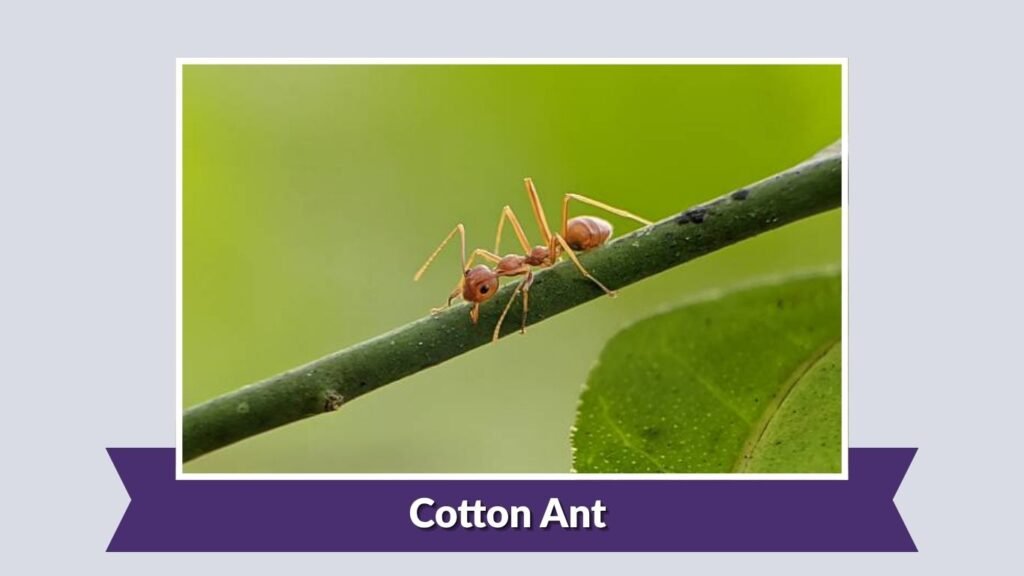
The Cotton Ant is another common name associated with the Southern Fire Ant, Solenopsis xyloni. It is native to parts of the southern United States and is frequently encountered in agricultural land, gardens, lawns, and other open habitats. The name developed partly because these ants have historically been found around cultivated fields.
Identification
- Workers are usually yellowish-red to reddish-brown.
- The abdomen is generally darker than the head and thorax.
- Workers occur in noticeably different sizes.
- The waist consists of two small nodes.
- Mature colonies normally establish nests in soil.
Habitat and Distribution
Cotton Ants occur across much of the southern and southwestern United States. They prefer warm, relatively open habitats such as fields, pastures, gardens, roadsides, and residential lawns. Colonies may also be established beneath rocks, boards, landscape materials, and other objects that provide protection.
Behavior and Diet
These ants are opportunistic omnivores. Workers hunt small insects, scavenge dead arthropods, gather seeds, and consume sugary substances such as nectar and honeydew. They may defend their colony by biting and stinging when the nest is disturbed.
Lifespan and Life Cycle
Eggs laid by the queen develop into larvae, pupae, and adults. Workers care for the developing brood, collect food, and maintain the nest. Mature colonies eventually produce winged males and reproductive females, which leave during mating flights and help establish new colonies.
16. Brazilian Fire Ant
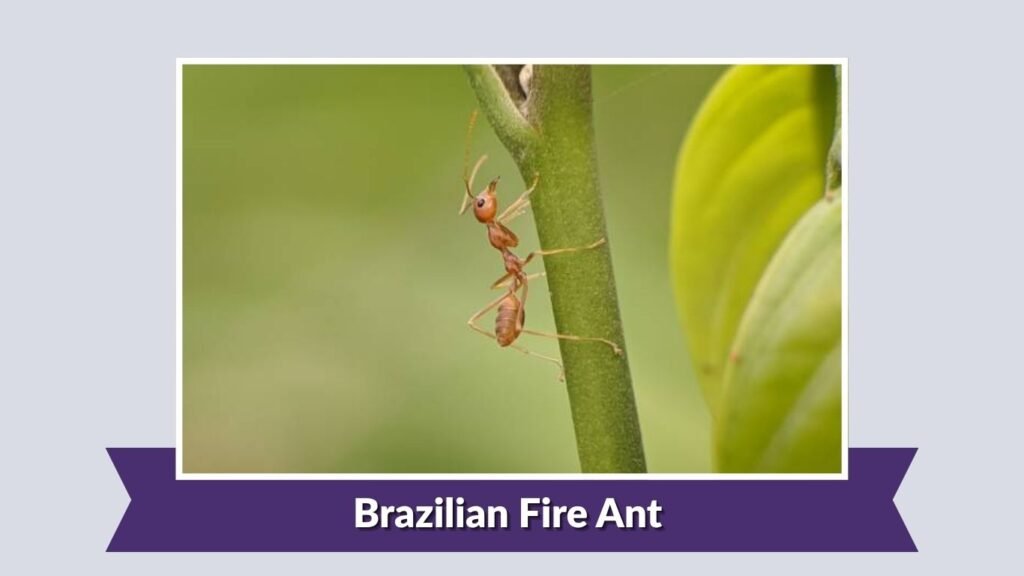
Brazilian Fire Ant is a descriptive common name associated with South American fire ants, particularly species such as Solenopsis saevissima. Brazil supports several native fire ant species that occupy environments ranging from open grassland and farmland to forest edges and urban areas.
Identification
- Workers are generally reddish to reddish-brown.
- The abdomen may be darker than the front of the body.
- Colonies contain workers of different sizes.
- Workers possess elbowed antennae.
- A two-segmented waist is visible between the thorax and abdomen.
Habitat and Distribution
These fire ants are primarily associated with South America, including large areas of Brazil. They commonly inhabit sunny disturbed ground, pastures, agricultural fields, grasslands, gardens, and roadsides. Suitable colonies may also become established close to houses and other human-modified environments.
Behavior and Diet
Brazilian fire ants are active predators and scavengers. Their diet includes insects, other small invertebrates, carrion, seeds, nectar, and honeydew. Colonies can respond aggressively when disturbed, with workers rapidly leaving the nest to defend it.
Lifespan and Life Cycle
Queens are responsible for producing eggs, while workers care for larvae and maintain the colony. Development progresses through egg, larva, pupa, and adult stages. Once a colony matures, it can produce winged reproductive ants that disperse and mate before new colonies are established.
17. Imported Fire Ant

Imported Fire Ant is a collective term most often used for fire ants introduced beyond their native South American range. The Red Imported Fire Ant and Black Imported Fire Ant are the best-known examples. They have become important invasive pests because of their aggressive colony defense, painful stings, and ability to thrive in disturbed habitats.
Identification
- Workers are commonly reddish-brown, dark brown, or nearly black.
- Worker size can vary considerably within colonies.
- The abdomen is usually darker than the head and thorax.
- Antennae have a characteristic two-segmented club.
- Large colonies may construct conspicuous soil mounds.
Habitat and Distribution
Imported fire ants thrive in warm areas containing disturbed soil. Typical habitats include lawns, pastures, parks, agricultural fields, roadsides, school grounds, and landscaped areas. They often colonize places that receive regular sunlight and have access to moisture.
Behavior and Diet
Workers aggressively protect the colony and may swarm onto animals or people when a mound is disturbed. They are omnivores that eat insects, carrion, seeds, plant material, honeydew, and sugary foods. Their flexible feeding habits contribute to their success in new environments.
Lifespan and Life Cycle
A successful colony may eventually contain large numbers of workers. Queens continuously produce eggs during favorable periods. The young develop from eggs into larvae, pupae, and adults, while reproductive males and females are periodically produced for mating and dispersal.
18. Lava-Foot Fire Ant

Lava-Foot Fire Ant is based on the Brazilian Portuguese name “lava-pés,” which is commonly associated with Solenopsis saevissima. It is not a separate fire ant species from the Brazilian form described above, but the name is sometimes encountered when discussing South American fire ants.
Identification
- Workers are typically reddish-brown.
- Larger and smaller workers may occur together.
- The gaster is commonly darker than the thorax.
- Workers have a two-node waist.
- Colonies usually nest directly in soil.
Habitat and Distribution
These fire ants are native to South America and are particularly associated with Brazil and neighboring regions. They inhabit grasslands, pastures, agricultural landscapes, roadsides, forest openings, and disturbed ground around human settlements.
Behavior and Diet
Workers forage for insects, dead animals, plant material, seeds, nectar, and honeydew. They can be strongly defensive when their nests are disturbed. Large numbers of workers may rapidly emerge and sting animals or people standing near the colony.
Lifespan and Life Cycle
The reproductive queen produces eggs that are cared for by workers. Larvae hatch and are fed until they enter the pupal stage and eventually become adults. Mature nests produce reproductive males and females that participate in mating flights and contribute to colony expansion.
19. Red Lava-Foot Ant

Red Lava-Foot Ant is another descriptive translation associated with reddish Brazilian fire ants, rather than a universally recognized separate species. It is particularly connected with the Solenopsis saevissima group of South American fire ants.
Identification
- Workers usually have reddish or reddish-brown coloration.
- The abdomen may appear brown or dark brown.
- Worker ants vary in body size.
- Antennae are elbowed.
- Two nodes occur between the thorax and abdomen.
Habitat and Distribution
These ants primarily occupy tropical and subtropical areas of South America. Colonies can be found in pasture, agricultural land, open woodland, gardens, roadsides, and other disturbed locations where soil conditions are suitable for nesting.
Behavior and Diet
Red Lava-Foot Ants behave as both predators and scavengers. They capture small arthropods and collect dead insects while also consuming seeds, nectar, and honeydew. Their strong colony-defense behavior is responsible for the “fire ant” reputation associated with the group.
Lifespan and Life Cycle
The queen lays eggs that hatch into helpless larvae requiring constant worker care. Larvae eventually pupate before emerging as adults. Some adults develop into workers, while others become reproductive males or females responsible for creating future generations.
20. South American Fire Ant

South American Fire Ant is a broad name covering several fire ant species native to South America rather than one single species. South America is the original home of many members of the Solenopsis fire ant group, including species that later became invasive elsewhere.
Identification
- Color varies from yellowish-red to dark reddish-brown.
- Many species have workers of several different sizes.
- The waist normally contains two distinct nodes.
- Antennae are strongly elbowed.
- Most species have functional stingers.
Habitat and Distribution
South American fire ants occupy an impressive range of environments. They can live in tropical forests, grasslands, river basins, agricultural fields, pastures, roadsides, and urban landscapes. Different species are adapted to different combinations of temperature, rainfall, soil, and vegetation.
Behavior and Diet
Most are omnivorous predators and scavengers. They consume insects, spiders, carrion, seeds, nectar, honeydew, and other available food. Some species form highly aggressive colonies, while others are comparatively less defensive around their nests.
Lifespan and Life Cycle
Their life cycle follows complete metamorphosis through egg, larva, pupa, and adult. Queens provide reproductive output while workers gather food, care for brood, maintain tunnels, and defend the nest. Reproductive individuals eventually disperse to establish additional colonies.
21. Tropical Red Fire Ant

The Tropical Red Fire Ant is another widely used common name for Solenopsis geminata, the species previously discussed as the Tropical Fire Ant and Ginger Ant. It is a successful tropical species that has spread widely beyond portions of its original range.
Identification
- Workers range from reddish-yellow to reddish-brown.
- Major workers have particularly large, broad heads.
- Worker size varies greatly within the colony.
- The abdomen is often darker than the thorax.
- Antennae end in a two-segmented club.
Habitat and Distribution
Tropical Red Fire Ants occur throughout many tropical and subtropical regions. They favor open, sunny, disturbed places and can inhabit farms, grasslands, roadsides, gardens, urban environments, and open forests. Human transportation has helped the species reach many islands and tropical regions.
Behavior and Diet
Workers are aggressive foragers that collect seeds and hunt a variety of small animals. They also scavenge dead insects and consume sugary plant products and honeydew. Colonies may compete with other ground-dwelling ants and can defend food resources vigorously.
Lifespan and Life Cycle
Colonies consist of reproductive queens, workers, developing brood, and seasonal reproductive ants. Eggs hatch into larvae, which are fed and protected by workers. After pupation, adults emerge. Winged males and females are eventually produced and participate in mating flights that allow the population to spread.
22. Golden Native Fire Ant

Golden Native Fire Ant is a descriptive name sometimes applied to yellowish or golden-colored native fire ants. It is not a standardized common name for one universally recognized species, so identification should be based on physical characteristics and geographic location. These ants generally belong to the broader Solenopsis group.
Identification
- Workers may appear yellow, golden-orange, or light reddish-brown.
- The abdomen can be slightly darker than the head and thorax.
- Workers are generally small to medium-sized.
- The waist contains two distinct nodes.
- Antennae are noticeably elbowed.
Habitat and Distribution
Golden-colored native fire ants may occur in warm grasslands, open woodlands, gardens, dry fields, and disturbed areas. Colonies generally develop in soil, beneath stones, or underneath other objects that provide protection from extreme temperatures and predators.
Behavior and Diet
These ants are opportunistic omnivores. Workers hunt small insects and other arthropods while also collecting dead organisms, seeds, nectar, and honeydew. They usually forage along the ground and may defend their colonies when disturbed.
Lifespan and Life Cycle
The queen produces eggs that hatch into larvae. Workers feed and care for the larvae until they pupate and eventually emerge as adults. Mature colonies can produce winged males and females, which leave the nest during reproductive flights and contribute to the formation of new colonies.
23. Desert Fire Ant

Desert Fire Ant is a general descriptive name for fire ants adapted to hot, relatively dry environments. Several Solenopsis species occur in desert and semidesert regions, where they survive high temperatures by nesting underground and adjusting their foraging activity according to environmental conditions.
Identification
- Workers may be yellowish, orange, reddish-brown, or brown.
- The abdomen is frequently darker than the front of the body.
- Workers can vary in size within a colony.
- The body has a characteristic two-segmented waist.
- Colonies usually create underground nests.
Habitat and Distribution
Desert-associated fire ants inhabit dry grasslands, scrublands, desert margins, sandy areas, and open landscapes. They are particularly associated with warm regions of the southwestern United States and other arid environments where suitable fire ant species occur.
Behavior and Diet
Workers commonly forage when temperatures are more favorable, such as during the morning, evening, or cooler parts of the day. They prey on insects, scavenge dead animals, gather seeds, and consume sugary substances when available.
Lifespan and Life Cycle
Development progresses through egg, larva, pupa, and adult stages. The underground nest protects developing brood from extreme surface conditions. Workers care for the young and collect food, while reproductive males and females are produced by mature colonies.
24. Southwestern Fire Ant
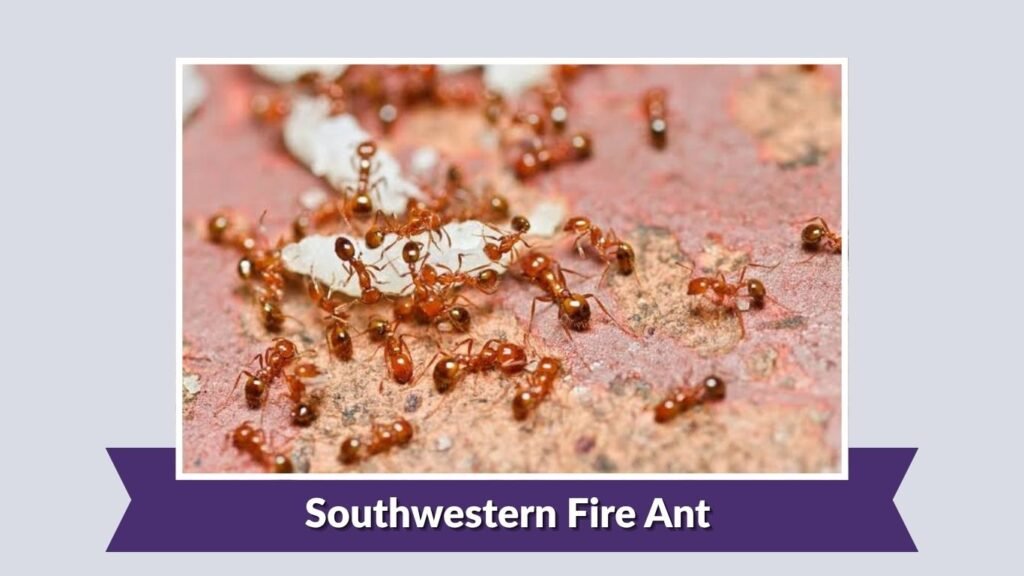
Southwestern Fire Ant is a broad name associated with native fire ants inhabiting the southwestern parts of North America. These ants are well adapted to warm and relatively dry environments and can occur in both natural landscapes and human-modified areas.
Identification
- Workers may be yellowish-red to dark reddish-brown.
- The abdomen is commonly darker than the thorax.
- Worker size can differ substantially.
- Antennae are elbowed and typically terminate in a club.
- The waist consists of two small nodes.
Habitat and Distribution
Southwestern fire ants may inhabit Arizona, New Mexico, California, Texas, and neighboring regions, depending on the species involved. Common habitats include deserts, grasslands, open woodland, agricultural areas, gardens, and disturbed soil near buildings.
Behavior and Diet
These ants hunt small insects and other invertebrates while also scavenging dead animals and collecting seeds. Nectar and honeydew provide important carbohydrate sources. Workers can defend the nest by biting and stinging when the colony is threatened.
Lifespan and Life Cycle
Queens are the primary reproductive members of the colony. Their eggs develop into larvae and then pupae before becoming adults. Workers perform nest construction, food collection, brood care, and colony defense. Winged reproductive ants eventually leave mature colonies to mate.
25. Yellow Fire Ant

Yellow Fire Ant is a descriptive common name sometimes used for pale yellow or yellow-orange ants belonging to or resembling members of the fire ant group. Because the name can refer to different ants in different regions, careful identification is necessary before assigning a particular species.
Identification
- Workers can be pale yellow, golden-yellow, or yellow-orange.
- The abdomen may be slightly darker than the rest of the body.
- Most have elbowed antennae.
- Fire ants characteristically have a two-node waist.
- Workers are generally small but may vary in size.
Habitat and Distribution
Yellow-colored fire ants may inhabit tropical, subtropical, or warm temperate environments depending on the species. Colonies can occur in lawns, fields, gardens, woodland edges, sandy soil, and beneath rocks or other protective objects.
Behavior and Diet
These ants generally feed on a wide variety of resources. Their diet can include insects, dead arthropods, seeds, nectar, honeydew, and other sweet substances. Workers forage around the nest and may respond defensively when the colony is disturbed.
Lifespan and Life Cycle
Their development follows four major stages: egg, larva, pupa, and adult. Workers care for developing broods and maintain the colony, while queens concentrate on reproduction. Mature colonies produce reproductive males and females that can leave the nest and establish future generations.
FAQs
1. How many types of fire ants are there?
Fire ants belong mainly to the genus Solenopsis, which contains many species distributed across the Americas and other regions. However, names such as Red Imported Fire Ant, Tropical Fire Ant, and Southern Fire Ant are among the most commonly encountered. Some common names are also used for the same species.
2. Which fire ant is the most dangerous?
The Red Imported Fire Ant is one of the most troublesome species because colonies can be highly aggressive and workers can sting repeatedly. Their venom commonly causes burning pain followed by itchy, raised pustules. Severe allergic reactions are possible in sensitive individuals.
3. What is the difference between red and black fire ants?
Color is one difference, but it is not always enough for reliable identification. Red Imported Fire Ants are generally reddish-brown with darker abdomens, while Black Imported Fire Ants tend to be much darker. Distribution, worker characteristics, and colony structure can also help distinguish them.
4. Where do fire ants usually build their nests?
Most fire ants build underground colonies in lawns, pastures, gardens, agricultural fields, roadsides, and other open areas. Some form visible soil mounds, while others nest beneath rocks, logs, pavement, or debris. Certain species, such as the Little Fire Ant, can also nest in trees and vegetation.
5. Why do fire ant stings hurt?
Fire ants grasp the skin with their jaws and use their stinger to inject venom. They may pivot around the bite site and sting several times. The venom produces an immediate burning sensation, followed by redness, itching, swelling, and often a small pustule.