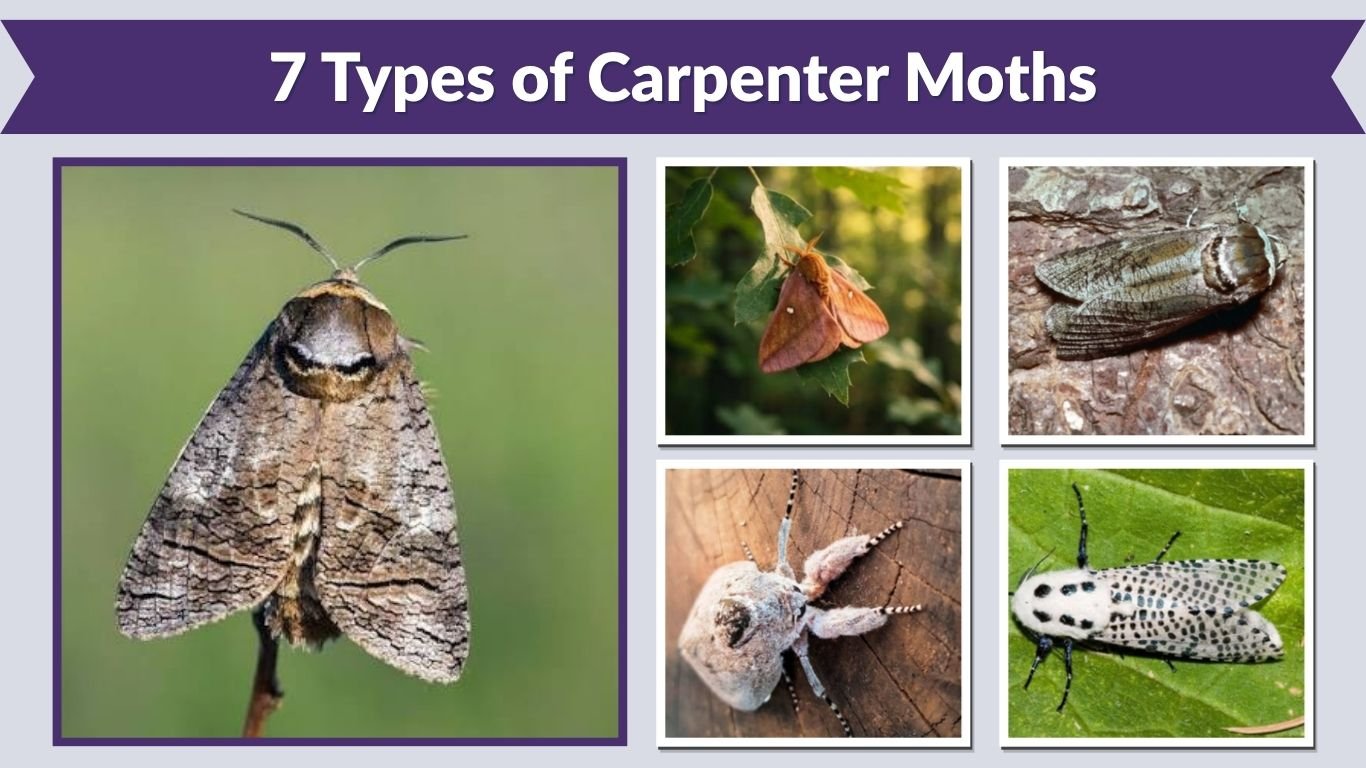
Carpenter moths are stout-bodied insects whose larvae live inside roots, stems, branches, or trunks of woody plants. Their hidden caterpillars may spend several years excavating galleries and feeding on living tissue before emerging as short-lived adults. Some species, including the giant wood moth, rank among the world’s heaviest moths, while others are important pests of orchards and forest trees. These seven types of carpenter moths from around the world reveal their distinctive appearance, habitats, diets, behaviors, and unusual wood-boring life cycles.
1. Carpenterworm Moth

The carpenterworm moth is a large North American species whose larvae excavate tunnels inside hardwood trees. Adult moths possess mottled, bark-like coloring that conceals them against tree trunks, while their wood-boring caterpillars may remain hidden for several years.
Identification
- Females have gray forewings marked with irregular black lines.
- Males are smaller and generally have orange-yellow hindwings.
- Females can reach a wingspan of approximately 7.5 centimeters.
- The adult body is large, thick, and covered with gray hairs.
- Caterpillars are pinkish-red or cream with dark brown heads.
- Round entrance holes and coarse sawdust may reveal larval activity.
Habitat and Distribution
Carpenterworm moths are distributed across most of the United States and southern Canada. They inhabit deciduous forests, river valleys, parks, orchards, farms, shelterbelts, and urban landscapes. They are especially common where mature hardwood trees provide suitable trunks for larval development.
Behavior and Diet
Adult moths are primarily active at night and occasionally approach artificial lights. They rest on tree bark during the day, where their markings make them difficult to detect.
Caterpillars feed inside black locust, oak, maple, willow, cottonwood, poplar, elm, ash, fruit trees, and numerous other hardwoods. Their tunneling can weaken branches, reduce tree vigor, and provide entry points for decay-causing organisms. Adults have reduced mouthparts and generally do not feed.
Lifespan and Life Cycle
Females lay eggs in groups inside bark cracks or near existing wounds. Young caterpillars enter the tree and excavate increasingly larger tunnels as they grow. Their development commonly takes two to four years.
Mature larvae pupate near the gallery entrance. Before the adult emerges, the pupa may push partly outside the opening. Adults usually appear from late spring through midsummer and survive only long enough to mate and reproduce.
2. Goat Moth

The goat moth is a large European carpenter moth named for the powerful goat-like odor produced by its caterpillar. Its larvae spend several years boring through the wood of living trees, while adults use finely patterned gray wings to blend with bark.
Identification
- Adults have broad gray or gray-brown wings.
- Numerous fine, dark lines create a bark-like pattern.
- The body is heavy, furry, and grayish-brown.
- Wingspans typically range from about 7–10 centimeters.
- Mature caterpillars have reddish or purplish backs.
- Larvae possess yellowish sides and shiny black heads.
Habitat and Distribution
Goat moths occur across much of Europe, temperate Asia, and parts of northern Africa. They favor damp woodland, riverbanks, marsh edges, parks, orchards, hedgerows, and other places containing old or weakened deciduous trees. Willows growing beside rivers and ponds are particularly important hosts.
Behavior and Diet
Adults are nocturnal and may visit lights during warm summer nights. Their bark-like wing pattern helps protect them from predators while they rest on trunks during daylight.
Caterpillars tunnel through willow, poplar, oak, elm, alder, apple, pear, and numerous other trees. Young larvae may feed together before creating separate galleries. Infested trees can produce wet sap, wood fragments, and a distinctive odor around the entrance holes. Adult moths do not feed.
Lifespan and Life Cycle
Females place large groups of eggs inside cracks in the bark. The larvae hatch and enter the wood, where they may feed for three to five years. They usually overwinter several times before becoming mature.
Fully grown larvae may leave their host tree to pupate in soil, rotten wood, or plant debris. Adults emerge from late spring through summer. The adult stage is brief compared with the exceptionally long larval period.
3. Leopard Moth

The leopard moth, also called the wood leopard moth, is easily recognized by its white wings covered with dark blue-black spots. Although the adult is attractive, its caterpillars can damage fruit, ornamental, and forest trees by tunneling through their branches.
Identification
- Adults have white or translucent wings with numerous dark spots.
- The spots may appear black, dark blue, or metallic blue.
- The white thorax is marked with six prominent dark spots.
- Males have strongly feathered antennae near their bases.
- Caterpillars are yellowish or orange with shiny black spots.
- Females are generally larger than males.
Habitat and Distribution
Leopard moths are native to Europe, northern Africa, and large areas of Asia. They have also been introduced into northeastern North America. Their habitats include deciduous forests, orchards, olive groves, parks, gardens, plantations, and urban areas containing suitable trees.
Behavior and Diet
Adults fly during warm summer nights and may approach outdoor lights. Females remain relatively inactive while releasing pheromones that attract males.
The caterpillars bore into the stems, branches, and trunks of apple, pear, olive, walnut, elm, ash, maple, willow, and many other deciduous trees. Young larvae may enter smaller twigs before moving into thicker branches. Their tunnels interrupt the movement of water and nutrients, sometimes causing branches to die.
Lifespan and Life Cycle
Females deposit clusters of eggs inside bark crevices, old galleries, or other protected spaces. After hatching, the larvae enter young shoots and eventually move into larger branches.
Larval development usually takes two or three years. Mature caterpillars pupate within their galleries, close to an exit hole. Adults generally emerge from early summer into September, depending on the regional climate, and live for only a short period.
4. Giant Wood Moth
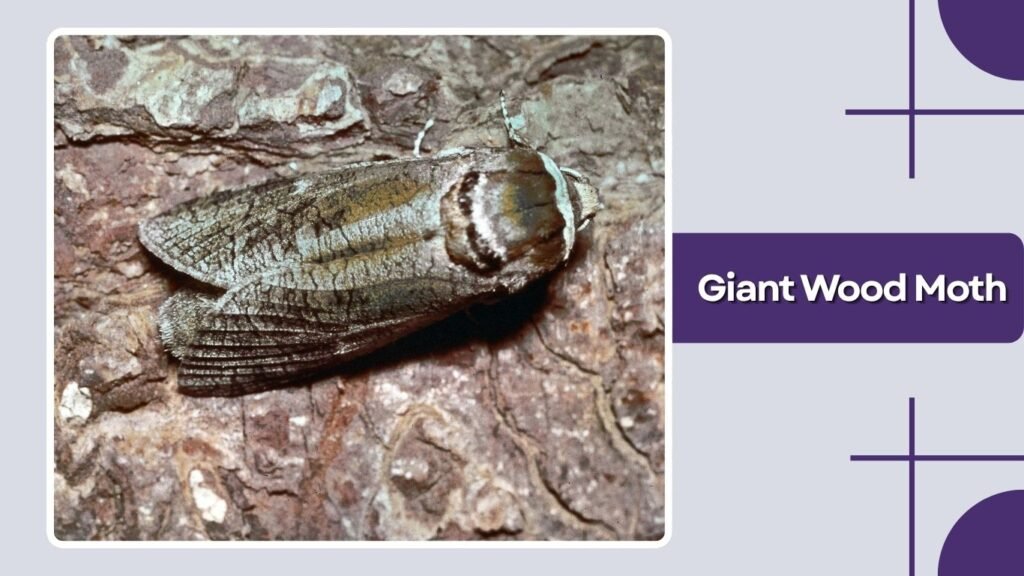
The giant wood moth is an enormous Australian carpenter moth and is considered the world’s heaviest moth. A mature female can weigh around 30 grams, making her considerably heavier than most moths and even some small birds or bats.
Identification
- Females can have a wingspan of approximately 23 centimeters.
- Large females may weigh as much as 30 grams.
- Males are much smaller and more slender.
- Forewings are mottled gray, brown, and cream.
- The long abdomen may extend beyond the folded wings.
- Caterpillars are large, pale grubs with brown heads.
Habitat and Distribution
Giant wood moths are primarily associated with eastern Australia, especially Queensland and New South Wales. They inhabit eucalyptus woodland, open forest, plantations, suburban areas, and places containing established eucalyptus trees. The adults are rarely encountered despite their size because they live briefly and are mainly nocturnal.
Behavior and Diet
The caterpillars bore into eucalyptus roots and trunks, feeding on living plant tissue from inside protected galleries. Their large size and hidden lifestyle make them difficult to observe until the adult moth emerges.
Adult moths cannot feed because their mouthparts are poorly developed. They rely entirely on the energy stored during the caterpillar stage. Females are heavy and do not fly as actively as the smaller males. Both sexes may occasionally approach powerful outdoor lights.
Lifespan and Life Cycle
Females produce thousands of tiny eggs and scatter them near suitable host trees. After hatching, the larvae locate eucalyptus roots or trunks and begin tunneling. Most of the species’ life is spent in this wood-boring stage.
The caterpillar pupates inside its gallery. During emergence, the pupal case may remain projecting from the exit hole. Adults survive for only several days, during which they mate and lay eggs before dying.
5. Witchetty Grub Moth

The witchetty grub moth is an Australian carpenter moth best known for its large edible caterpillar. Witchetty grubs have been an important traditional food for Indigenous Australians and develop underground around the roots of particular acacia shrubs.
Identification
- Adults have broad wings with fine gray and brown mottling.
- Rusty-red coloring may appear near the wing bases.
- The wingspan can reach approximately 16 centimeters.
- Females are larger and more heavily built than males.
- Caterpillars are plump, creamy white, and nearly hairless.
- Mature larvae have brown heads and can reach about seven centimeters.
Habitat and Distribution
Witchetty grub moths are endemic to Australia and are particularly associated with arid and semi-arid inland regions. They inhabit desert scrub, acacia woodland, grassland, and areas where witchetty bushes or small cooba shrubs grow.
Behavior and Diet
The caterpillars live in underground tunnels around the roots of witchetty bushes and related acacias. They feed on root tissue and sap, accumulating the energy needed for metamorphosis and adult reproduction.
The grubs are traditionally collected by carefully digging around host-plant roots. They are valued as a rich source of protein and have deep cultural importance. Adult moths are nocturnal and may be attracted to lights. They lack functional mouthparts and cannot eat.
Lifespan and Life Cycle
Females scatter numerous eggs across the ground while flying. Newly hatched larvae burrow into the soil and locate a suitable acacia root. They create tunnels and remain underground throughout their extended feeding period.
Mature larvae pupate inside their subterranean tunnels. The adult eventually emerges through the soil, mates, and reproduces. Its winged life lasts only a few days, while the larval stage accounts for nearly all its growth and feeding.
6. Aspen Carpenterworm Moth

The aspen carpenterworm moth is a North American species whose larvae develop inside aspens and related poplar trees. Its gray, irregularly patterned wings provide excellent camouflage, making the adult difficult to notice while it rests on the trunk of a host tree.
Identification
- Adults have long gray or gray-brown forewings.
- Fine black lines and patches produce a bark-like pattern.
- The wingspan usually ranges from approximately 5–7 centimeters.
- Females are generally larger and broader-bodied.
- Caterpillars are pale pink, reddish, or cream.
- Larvae have dark brown heads and hardened neck plates.
Habitat and Distribution
Aspen carpenterworm moths are found across parts of the United States and southern Canada. Their recorded range includes the Rocky Mountains, Nevada, Colorado, California, British Columbia, and Ontario.
The species inhabits aspen groves, mountain forests, mixed woodland, river valleys, and other environments where poplar trees grow. Adults may also appear in parks or residential areas containing mature aspens.
Behavior and Diet
Adults are nocturnal and rest on bark during the daytime. Their mottled wings closely resemble lichen-covered or weathered tree trunks. They rarely travel far from suitable breeding habitat.
Caterpillars feed mainly inside trembling aspen and other poplars. They tunnel through the trunk or larger branches, pushing wood fragments and waste from their galleries. Extensive tunneling may weaken the tree and make affected branches more likely to break.
Lifespan and Life Cycle
Females place eggs in bark cracks and rough areas of host trees. The young caterpillars penetrate the bark and excavate galleries that become wider as they grow. Larval development may require several growing seasons.
Mature caterpillars pupate inside their tunnels near prepared exit holes. Adults emerge during the warmer months and survive only briefly. Empty pupal cases may remain attached to the tree after emergence.
7. Pecan Carpenterworm Moth

The pecan carpenterworm moth is a smaller member of the carpenter moth family found in the southeastern United States. Its caterpillars primarily attack pecan and other hickory trees, while adults use their subtle wing patterns to imitate bark.
Identification
- Adults have narrow gray, cream, and brown forewings.
- Dark zigzag lines create a mottled bark-like appearance.
- The wingspan generally measures approximately 3–4.5 centimeters.
- The body is slender compared with larger carpenter moths.
- Caterpillars are pale with reddish or brown markings.
- Larval activity may produce sap, frass, and small entrance holes.
Habitat and Distribution
Pecan carpenterworm moths occur throughout the southeastern United States. Their range extends from North Carolina south to Florida and west through Mississippi and Texas. They inhabit deciduous woodland, pecan orchards, farms, parks, gardens, and areas containing native hickories.
Behavior and Diet
Adults fly mainly at night and may be attracted to lights. During the day, their elongated shape and cryptic markings help them blend into branches and trunks.
Caterpillars bore into pecan, hickory, persimmon, and oak. They feed beneath the bark and inside woody tissue, creating galleries that can weaken small branches. Repeated infestation may reduce a tree’s vigor, although established trees can often tolerate limited damage.
Lifespan and Life Cycle
Females lay eggs in protected bark crevices on suitable host trees. The caterpillars hatch and enter the wood, where they remain concealed while feeding and growing. Development may continue for more than one season.
Mature larvae pupate within their galleries before adults emerge through prepared exit holes. The principal adult flight period extends from March through June, although timing varies with latitude and weather.
FAQs
1. Why are they called carpenter moths?
They receive their name from their wood-boring caterpillars. The larvae excavate galleries inside the roots, trunks, stems, or branches of woody plants, producing damage that resembles carpentry work.
2. Are carpenter moths dangerous to humans?
Adult carpenter moths are harmless and cannot sting. Their caterpillars rarely harm people, although they can damage trees by tunneling through living wood and weakening branches.
3. What do adult carpenter moths eat?
Most adult carpenter moths have reduced mouthparts and do not eat. They depend on the energy stored during their larval stage and live primarily to mate and reproduce.
4. How long do carpenter moths live?
Depending on the species, the complete life cycle may last from one to five years. Most of this time is spent as a wood-boring caterpillar, while the adult generally lives for only several days or weeks.
5. How can you identify a carpenter moth infestation?
Common signs include round holes in bark, piles of sawdust-like frass, leaking sap, weakened branches, and empty pupal cases protruding from galleries. However, similar signs can also be produced by wood-boring beetles.