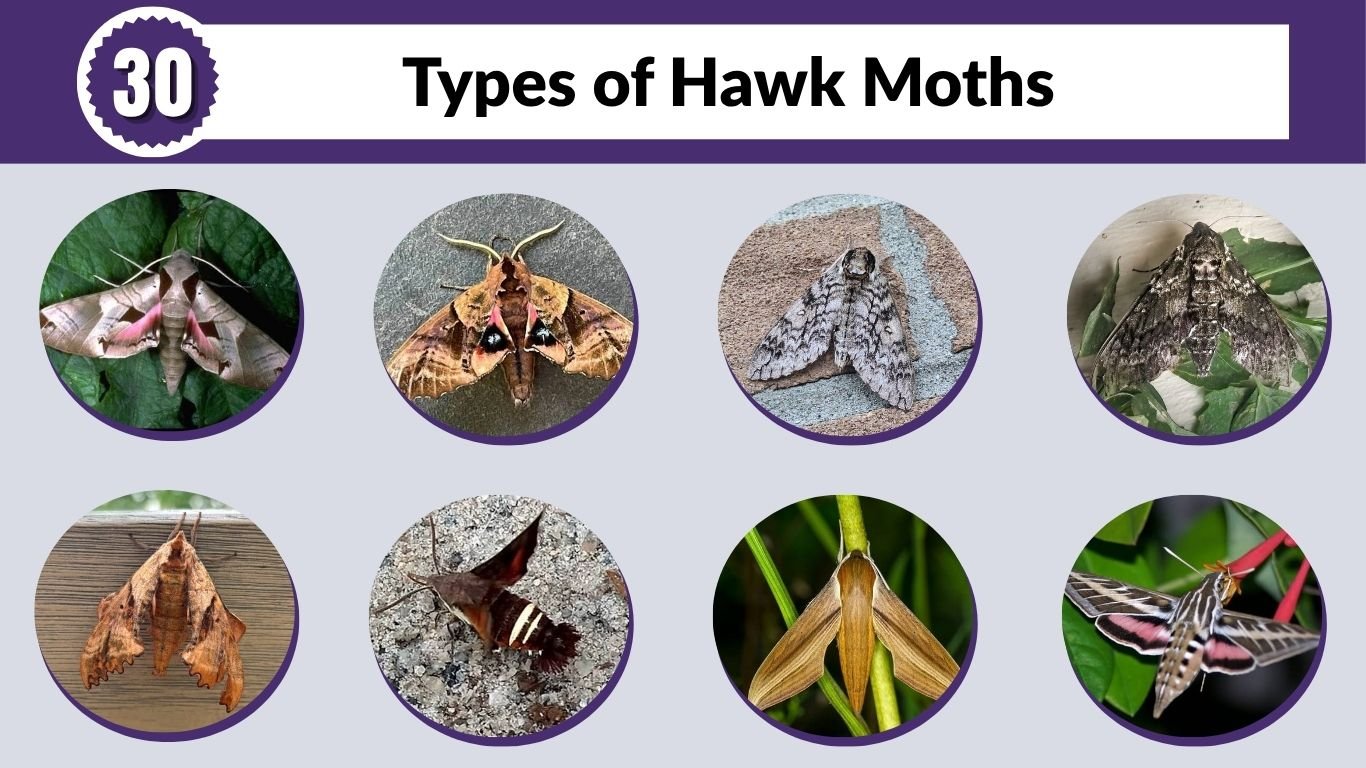
Hawk moths are among the most fascinating and powerful flying moths in the world. Known for their streamlined bodies, rapid wingbeats, and impressive hovering ability, many species can easily be mistaken for hummingbirds. These moths belong to the family Sphingidae and occur across a wide range of habitats worldwide. Some are brightly colored, while others rely on excellent camouflage to hide from predators. Below, you’ll discover 30 types of hawk moths, along with their identification features, habitats, feeding behavior, and life cycles.
1. Death’s-head Hawk Moth
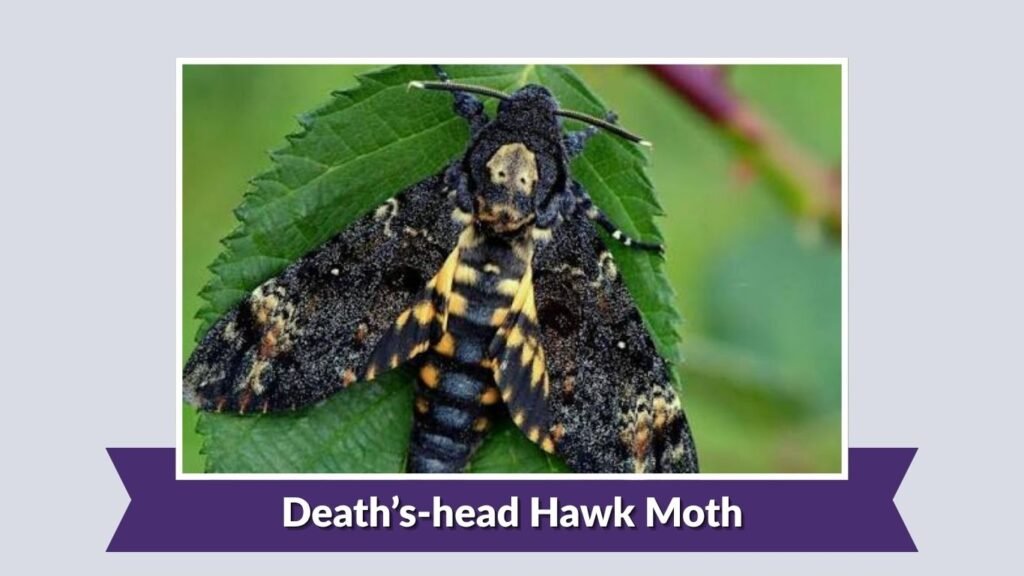
The Death’s-head Hawk Moth is one of the most recognizable hawk moths in the world. It is famous for the skull-like marking on the upper part of its thorax, which has inspired myths, folklore, and even appearances in popular culture. These large moths belong to the genus Acherontia and are powerful nighttime fliers.
Identification
- Large, heavy-bodied hawk moth with a wingspan commonly reaching about 3.5–5 inches.
- Brown and black forewings with complex mottled patterns.
- Yellow and black bands are visible across the abdomen.
- Distinctive skull-shaped marking appears on the thorax.
- Hindwings are usually yellow with dark bands.
- Thick antennae and a strong, streamlined body help distinguish it from ordinary moths.
Habitat and Distribution
Death’s-head Hawk Moths are primarily associated with Africa, parts of southern Europe, and western Asia. Some species migrate considerable distances and may occasionally appear farther north in Europe. They inhabit farmland, open woodland, gardens, scrubland, and areas containing their preferred host plants.
Warm climates are particularly favorable because both the adults and caterpillars depend on relatively high temperatures for successful development.
Feeding and Unusual Behavior
Adult Death’s-head Hawk Moths feed on nectar, plant sap, and other sugary substances. They are especially famous for entering honeybee colonies to consume honey. Their thick bodies and chemical similarities to bee-colony odors may help them avoid immediate attacks from worker bees.
Another unusual feature is their ability to produce a squeaking sound when disturbed. This behavior is uncommon among moths and adds to their mysterious reputation.
Caterpillars and Life Cycle
The caterpillars are large and may appear yellow, green, or brown depending on their developmental stage. Like many hawk moth larvae, they possess a curved horn near the rear of the body.
Larvae feed on several plants, including members of the nightshade family. After completing their growth, they usually burrow into soil and form pupae underground. Adults later emerge as powerful nocturnal moths capable of traveling long distances.
2. Elephant Hawk Moth
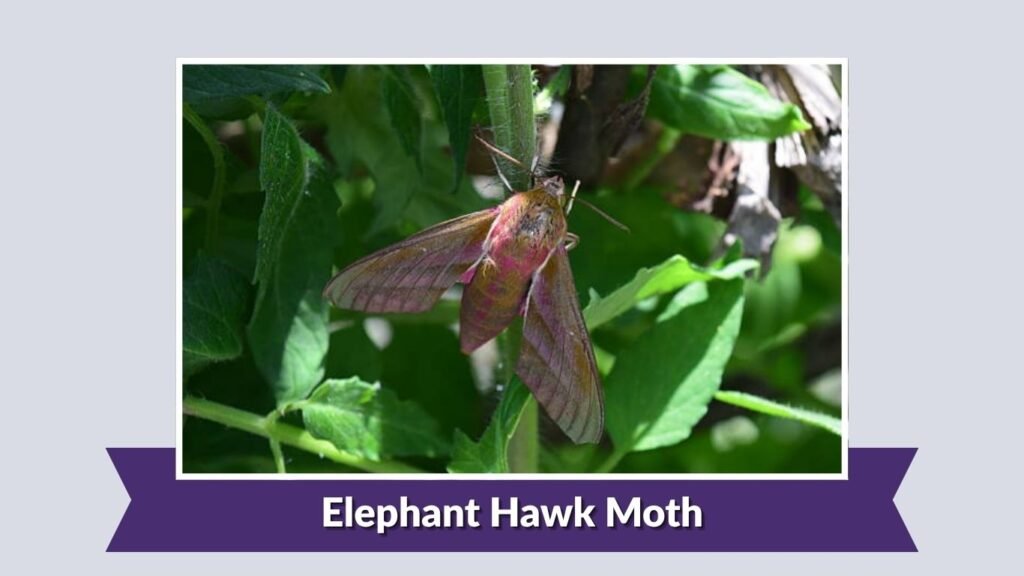
The Elephant Hawk Moth is a colorful species known for its striking pink and olive-green markings. Its common name actually comes from the caterpillar rather than the adult moth. When the caterpillar stretches forward, its long front section resembles an elephant’s trunk. This attractive species is particularly common in gardens and woodland environments.
Identification
- Medium to large hawk moth with a wingspan of roughly 2.5–3 inches.
- Forewings display olive-green areas mixed with bright pink markings.
- Hindwings are predominantly pink with darker areas.
- Body is thick, streamlined, and patterned in pink and green.
- Caterpillars are usually brown or greenish with large false eyespots.
- Larvae have the characteristic horn found on many hawk moth caterpillars.
Habitat and Range
Elephant Hawk Moths occur throughout much of Europe and parts of Asia. They are frequently found in gardens, woodland edges, grasslands, hedgerows, parks, and disturbed areas where their caterpillar food plants grow.
They have adapted well to human environments. Gardens containing willowherb and other suitable plants can support both caterpillars and visiting adults.
Feeding and Nighttime Activity
Adults are primarily nocturnal and visit flowers after sunset. Their long proboscis allows them to drink nectar while hovering in front of flowers. Honeysuckle and other strongly scented night-blooming plants are especially attractive to them.
Their large eyes provide excellent low-light vision, allowing them to navigate and locate flowers even in relatively dark conditions.
Caterpillars and Defense
Elephant Hawk Moth caterpillars are particularly impressive. When threatened, they pull their heads backward into the body, causing the enlarged section with its prominent eyespots to become more noticeable.
This makes the caterpillar resemble a small snake and may discourage birds and other predators. Once fully grown, the caterpillar forms a pupa among leaf litter or close to the soil surface. The adult eventually emerges with its characteristic bright pink and green coloration.
3. Small Elephant Hawk Moth

The Small Elephant Hawk Moth is closely related to the larger Elephant Hawk Moth but can be distinguished by differences in size, coloration, and wing patterns. Despite its name, it remains a relatively impressive moth with vivid pink and yellow-green coloration. It is primarily active at night and often visits flowers for nectar.
Identification
- Wingspan generally around 1.8–2.5 inches.
- Forewings feature bright pink and yellowish-green markings.
- Usually smaller and brighter than the Elephant Hawk Moth.
- Pink coloration is especially prominent along the wings and body.
- Hindwings often contain pink with darker central markings.
- Caterpillars may be brown or greenish and possess distinctive eyespots.
Habitat and Distribution
Small Elephant Hawk Moths are found across Europe and extend into portions of Asia. Their preferred habitats include dry grasslands, coastal dunes, woodland clearings, meadows, gardens, and areas with abundant bedstraw.
They often favor warmer and more open habitats than their larger relatives. Coastal regions can provide particularly suitable conditions because their larval host plants grow abundantly there.
Adult Feeding Behavior
Adults fly mainly from late spring through summer, although exact timing depends on climate. They become active around dusk and continue feeding throughout the night.
Using their long proboscis, the moths hover near flowers and drink nectar without necessarily landing. Honeysuckle and other nectar-rich blossoms provide important food sources.
Despite their vivid coloration, adults can be surprisingly difficult to notice during daytime because they remain motionless in sheltered vegetation.
Caterpillars and Development
The caterpillars primarily feed on bedstraw and related plants. Their coloration provides camouflage among stems and vegetation.
When disturbed, the caterpillar may enlarge the front portion of its body, exposing conspicuous eyespots. This defensive behavior creates a snake-like appearance that can frighten potential predators.
Once mature, larvae move close to the ground and pupate among vegetation or leaf litter. The adult emerges later, completing the transformation into one of the most colorful small hawk moths.
4. Lime Hawk Moth
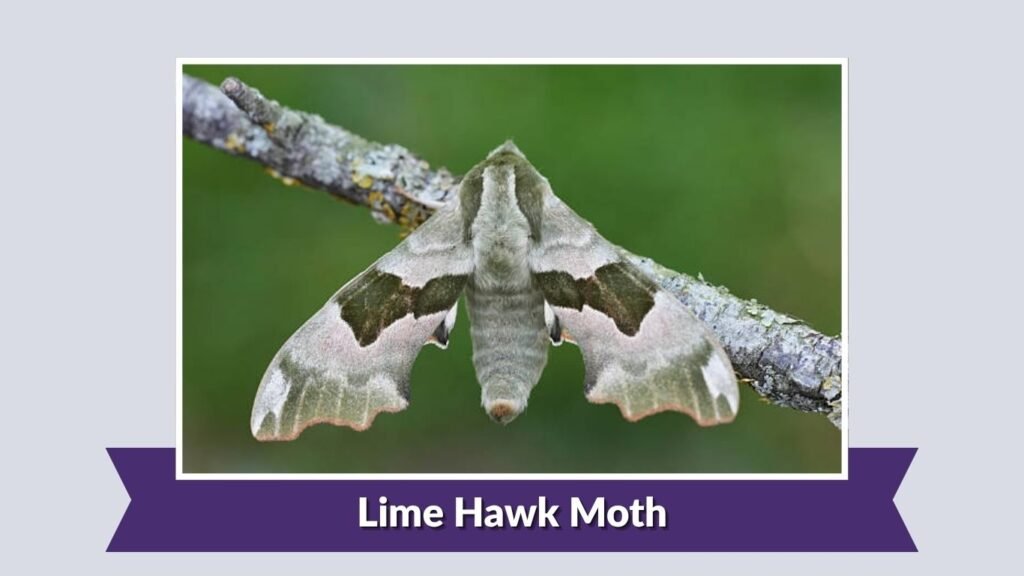
The Lime Hawk Moth is an attractive European hawk moth recognized by its angular wings and patches of green, brown, and pink. Despite its name, it is not associated with citrus limes. Instead, the name refers to lime or linden trees, which are among the primary food plants used by its caterpillars.
Identification
- Wingspan usually measures approximately 2.5–3.5 inches.
- Forewings are irregularly shaped with scalloped or angular edges.
- Colors include olive green, tan, brown, and sometimes pinkish areas.
- Large dark green patches commonly appear across the forewings.
- Hindwings are often yellowish or reddish with darker margins.
- Caterpillars are bright green and have diagonal pale stripes along their sides.
Habitat and Range
Lime Hawk Moths are widespread across much of Europe and parts of western Asia. They frequently occur in cities because lime trees are commonly planted along streets, in parks, and in residential areas.
Other suitable habitats include woodland edges, gardens, tree-lined roads, and suburban neighborhoods. Their ability to use several common deciduous trees makes them relatively adaptable.
Adult Behavior
Adults are mainly active at night and generally rest during daylight hours. Their irregular wing shape and mottled coloration allow them to blend effectively with tree bark and foliage.
Unlike many nectar-feeding hawk moths, adult Lime Hawk Moths have reduced mouthparts and normally do not feed. They survive on energy accumulated during the caterpillar stage.
Their adult lives are therefore focused primarily on finding mates and reproducing.
Caterpillar Development
Lime Hawk Moth caterpillars feed on lime, elm, alder, birch, and certain other deciduous trees. They are bright green during much of their development, which provides excellent camouflage among leaves.
Before pupating, mature larvae often change color and become duller or more brownish. They then descend from the tree and form a pupa in or near the soil.
The species typically completes its life cycle within a year, although seasonal patterns vary depending on local climate.
5. Privet Hawk Moth

The Privet Hawk Moth is one of the largest hawk moths found in Europe. Its impressive size, pink-and-black abdomen, and large striped wings make it easy to recognize. Although named after privet, its caterpillars can feed on several different shrubs and trees, helping the species survive in gardens and urban environments.
Identification
- Large moth with a wingspan commonly measuring 3.5–4.7 inches.
- Forewings are brownish gray with darker streaks and patterns.
- Hindwings display attractive pink and black bands.
- Abdomen has bold alternating pink and black stripes.
- Body is long, thick, and aerodynamic.
- Caterpillars are bright green with diagonal purple-and-white stripes and a rear horn.
Habitat and Distribution
Private Hawk Moths are distributed across Europe, North Africa, and parts of western and central Asia. They inhabit gardens, hedgerows, woodland edges, parks, suburban neighborhoods, and areas containing their caterpillar host plants.
Private hedges are especially useful to the larvae, but lilac, ash, and other plants may also support them.
The species often lives surprisingly close to humans because many of its preferred plants are commonly used in landscaping.
Adult Activity and Feeding
Adults are strong nighttime fliers. They typically begin flying around dusk and may travel between gardens, woodland edges, and flowering areas.
Using a long proboscis, they feed from nectar-rich flowers while hovering. Their rapid wingbeats and hovering behavior can sometimes cause them to be mistaken for hummingbirds in poor light.
During the daytime, adults usually remain hidden against tree trunks, fences, or vegetation.
Caterpillars and Pupation
Privet Hawk Moth caterpillars are among the largest moth larvae in their range. Their bright green bodies and diagonal stripes make them visually impressive.
Despite their large horn, they are harmless to people. The horn is simply a flexible structure used as part of their appearance.
When mature, caterpillars leave their food plants and burrow into soil. There they form large brown pupae and remain protected until the adult moth is ready to emerge.
6. Poplar Hawk Moth

The Poplar Hawk Moth is a large, unusual-looking species with broad, irregular wings that resemble dried leaves when the moth is resting. It is common across much of Europe and can often be found in gardens, parks, and woodland areas containing poplar or willow trees. Its excellent camouflage helps it remain hidden from predators during daylight hours.
Identification
- Wingspan usually ranges from around 2.7–3.9 inches.
- Forewings are grayish brown with darker wavy markings.
- Wings have noticeably irregular and scalloped edges.
- Hindwings may reveal reddish or rusty patches when exposed.
- The moth holds its wings in an unusual overlapping position while resting.
- Caterpillars are green with yellowish diagonal stripes and a prominent rear horn.
Habitat and Range
Poplar Hawk Moths occur throughout much of Europe and extend into western and central Asia. They inhabit woodland, river valleys, parks, gardens, farmland edges, and urban areas where suitable trees are available.
Poplars and willows are especially important host plants. Because these trees frequently grow near rivers and wetlands, the moth can also be common in damp habitats.
Adult Behavior
Adult Poplar Hawk Moths are nocturnal and usually remain hidden during the day. Their wings resemble damaged or dried leaves, providing effective camouflage against branches, tree trunks, and vegetation.
Adults generally do not feed because their mouthparts are poorly developed. Instead, they rely on energy reserves gathered while they were caterpillars.
At night, males use their sensitive antennae to detect female pheromones and can travel considerable distances while searching for mates.
Caterpillars and Life Cycle
The caterpillars feed mainly on poplar, willow, and occasionally related trees. Their green coloration helps them disappear among leaves.
As they mature, the caterpillars can become large and thick-bodied. When ready to pupate, they descend from the host tree and search for loose soil.
Pupation occurs underground, where the insect remains protected as it transforms. Depending on climate and season, the pupa may overwinter before the adult Poplar Hawk Moth emerges during warmer months.
7. Eyed Hawk Moth
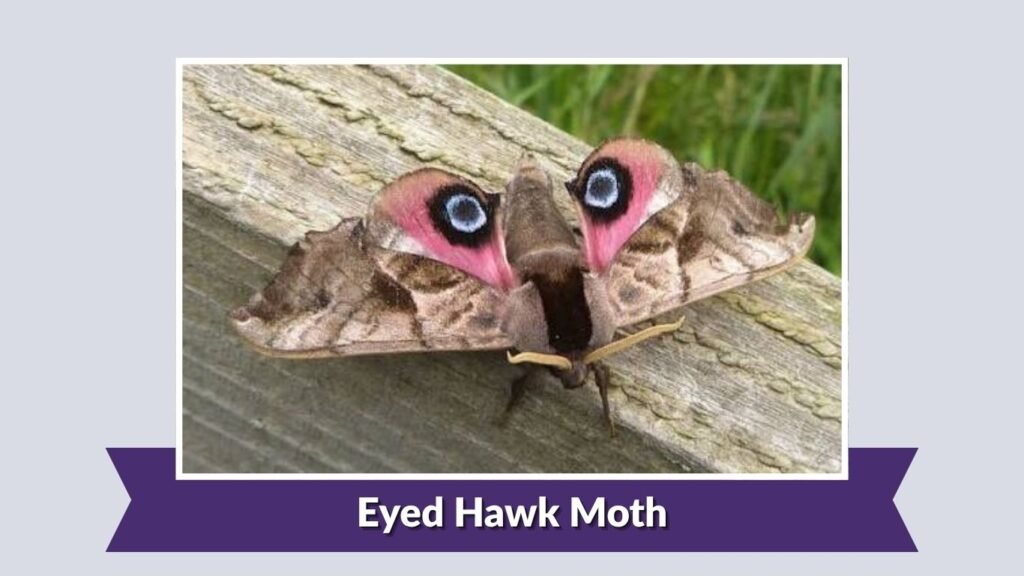
The Eyed Hawk Moth is a distinctive species named for the large eye-like markings hidden on its hindwings. When resting, these colorful markings are usually concealed beneath the forewings, allowing the moth to blend into tree bark and leaves. If disturbed, it suddenly exposes the eyespots, which may startle birds and other predators.
Identification
- Medium to large hawk moth with a wingspan of about 2.7–3.5 inches.
- Forewings are grayish brown with darker wavy markings.
- Hindwings contain large blue-and-black eyespots surrounded by pink.
- Body is thick and gray-brown.
- Forewings have scalloped edges that improve camouflage.
- Caterpillars are usually green with pale diagonal stripes and a rear horn.
Habitat and Distribution
Eyed Hawk Moths are widespread across much of Europe and parts of western and central Asia. They commonly inhabit woodland edges, gardens, parks, riverbanks, hedgerows, and other areas containing willow, poplar, or apple trees.
Because many of their host plants are common in developed areas, these moths can also appear in suburban gardens and urban parks.
Defensive Behavior and Adult Activity
The most interesting feature of the Eyed Hawk Moth is its defensive display. When resting calmly, the moth keeps its brightly colored hindwings hidden.
If threatened, it moves the forewings aside and exposes the large eyespots. These markings may make a predator believe it is facing a much larger animal.
Adults are mainly active after sunset. They are strong fliers but generally do not feed because their mouthparts are not functional. Instead, they depend on fat reserves accumulated during the larval stage.
Caterpillars and Life Cycle
The caterpillars feed primarily on willow, poplar, and apple trees. Their green coloration allows them to blend easily with leaves.
As they mature, they become relatively large and develop the characteristic curved horn near the rear of the body.
When fully grown, the caterpillars descend to the ground and form pupae in loose soil or among leaf litter. The pupal stage may last through winter, with adults emerging during spring or early summer.
8. Hummingbird Hawk Moth
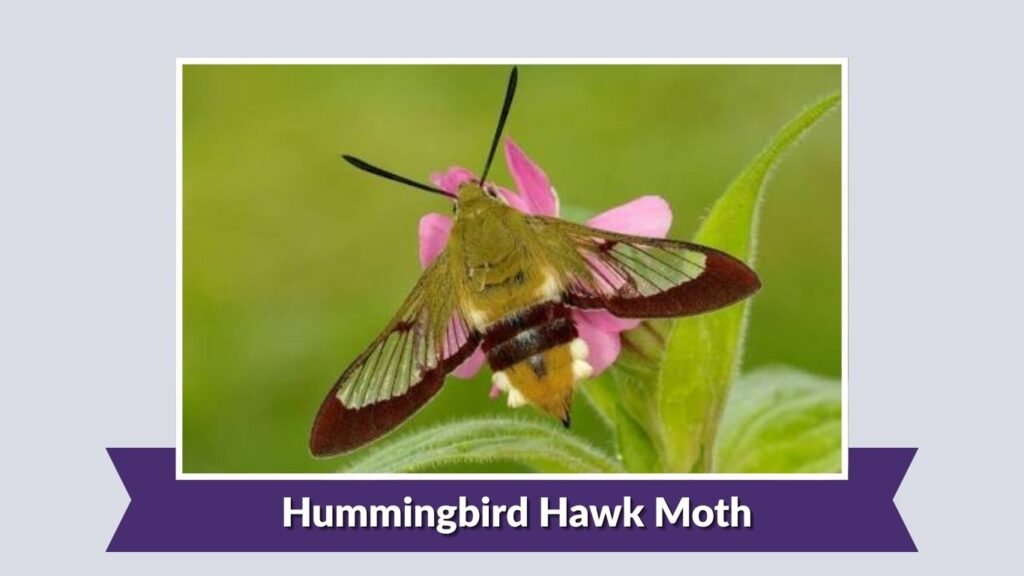
The Hummingbird Hawk Moth is famous for its remarkable resemblance to a tiny hummingbird. It hovers in front of flowers while feeding, beats its wings extremely rapidly, and moves quickly between blossoms. Its daytime activity makes it one of the easiest hawk moths to observe around gardens filled with nectar-rich flowers.
Identification
- Wingspan typically measures about 1.6–2 inches.
- Forewings are grayish brown with darker markings.
- Hindwings are bright orange with dark borders.
- Abdomen has black-and-white markings toward the rear.
- Possesses a very long proboscis for reaching nectar.
- Fast wingbeats create a humming sound during flight.
Habitat and Distribution
Hummingbird Hawk Moths occur across southern Europe, North Africa, and much of Asia. They are highly mobile and regularly migrate northward during warm seasons.
They may be found in gardens, meadows, coastal areas, woodland clearings, farmland, and sunny urban spaces. Flower-rich gardens are especially attractive because adults require frequent access to nectar.
Feeding and Flight Behavior
Unlike many hawk moths, the Hummingbird Hawk Moth is commonly active during daylight, particularly in warm sunshine.
It hovers in front of flowers rather than landing on them. The long proboscis extends into the flower while the wings continue beating rapidly.
Adults frequently visit lavender, buddleia, honeysuckle, verbena, and other nectar-rich plants. Individual moths can learn the locations of productive flowers and may return repeatedly to the same garden.
Caterpillars and Development
The caterpillars feed mainly on bedstraw and related plants. They are usually green and have pale stripes running along their bodies.
Like other hawk moth larvae, they possess a curved horn at the rear. Their coloration helps them remain hidden among vegetation.
When mature, the caterpillars form pupae among dry leaves or near the soil surface. Adults may produce more than one generation in warmer regions, while migratory individuals can travel surprisingly long distances.
9. Oleander Hawk Moth

The Oleander Hawk Moth is one of the most visually impressive hawk moths, with swirling green, cream, pink, and brown patterns covering its wings and body. These colors form excellent camouflage among foliage. It is a powerful migrant and can sometimes appear far beyond its usual tropical and subtropical range.
Identification
- Large hawk moth with a wingspan of approximately 3–4.5 inches.
- Wings display complex olive-green, cream, brown, and pink patterns.
- Body has matching green and brown camouflage markings.
- Long, narrow forewings give it a streamlined appearance.
- Caterpillars are large and usually green or brown.
- Larvae have prominent eyespots near the front of the body.
Habitat and Distribution
Oleander Hawk Moths occur naturally across Africa, southern Asia, the Middle East, and parts of the Mediterranean region.
They prefer warm environments such as gardens, scrublands, agricultural areas, tropical forests, and urban locations containing oleander plants.
The species is a strong migrant. During warm periods, individuals may travel north into parts of Europe where they are normally uncommon.
Adult Feeding and Activity
Adults are primarily nocturnal and visit flowers after sunset. Their long proboscis enables them to reach nectar from deep, tubular blossoms.
They are strong, rapid fliers and can hover while feeding. Their large size and fast movements can make them particularly impressive when observed around flowers at night.
During the daytime, their greenish patterns provide excellent camouflage against leaves.
Caterpillars and Host Plants
Oleander Hawk Moth caterpillars frequently feed on oleander, but they may also use other plants from related families.
Young larvae are generally bright green. Larger caterpillars develop distinctive eyespots that resemble the eyes of a larger animal.
When threatened, the caterpillar may retract its head and enlarge the front part of its body, making those eyespots more noticeable.
After completing development, mature larvae usually pupate among fallen leaves or close to the ground. The adults later emerge to begin another generation.
10. Convolvulus Hawk Moth

The Convolvulus Hawk Moth is a large migratory hawk moth known for its exceptionally long proboscis. This feeding tube allows it to drink nectar from deep flowers while hovering in front of them. Its gray and brown coloration is less colorful than some other hawk moths, but its impressive size and powerful flight make it easy to recognize.
Identification
- Large species with a wingspan often reaching 3.5–5 inches.
- Forewings are gray or brown with complex darker patterns.
- Abdomen contains alternating pink, black, and gray bands.
- Exceptionally long proboscis may be several inches in length.
- Large streamlined body suited to strong flight.
- Caterpillars occur in green and brown color forms.
Habitat and Distribution
Convolvulus Hawk Moths are widely distributed through Africa, southern Europe, Asia, Australia, and several surrounding regions.
They are strong migrants and can travel substantial distances during favorable weather. Individuals sometimes move into northern Europe during summer and autumn.
The species inhabits gardens, farmland, open countryside, grasslands, and habitats containing bindweed, one of its major larval host plants.
Feeding Behavior
Adults become active around dusk and continue flying during the night. Their extraordinarily long proboscis allows them to feed from flowers that many other insects cannot reach.
They often hover in front of trumpet-shaped flowers while extending the proboscis deep into the blossom.
Flowers such as tobacco plants, petunias, and other strongly scented nighttime blooms can attract these moths.
Caterpillars and Life Cycle
The caterpillars feed mainly on bindweed and related plants. They can become very large, often reaching several inches in length.
Green caterpillars blend among living foliage, while brown forms may be harder to notice near dry vegetation and soil.
A curved horn occurs at the rear of the caterpillar, a typical characteristic of hawk moth larvae.
When mature, larvae burrow into the ground to pupate. The pupa has a distinctive curved casing that protects the developing proboscis. In suitable climates, multiple generations may occur each year.
11. Spurge Hawk Moth

The Spurge Hawk Moth is a beautifully patterned species associated closely with plants in the spurge family. Adults have olive, cream, brown, and sometimes pink markings, while the caterpillars are even more striking, often displaying black, red, yellow, and white colors. The species occurs in warm, open environments across Europe, North Africa, and Asia.
Identification
- Wingspan generally ranges from about 2.5–3 inches.
- Forewings are cream or pale brown with olive-green patches.
- Hindwings contain pinkish or reddish areas with dark markings.
- The streamlined body matches the colors of the wings.
- Caterpillars are boldly colored with red, yellow, black, and white markings.
- Larvae possess a prominent rear horn.
Habitat and Distribution
Spurge Hawk Moths favor dry, sunny habitats where their host plants grow abundantly.
Typical environments include grasslands, coastal dunes, rocky slopes, sandy areas, open woodland, and disturbed ground.
Their distribution includes southern and central Europe, North Africa, and parts of western and central Asia. Migrating individuals may occasionally occur outside the normal breeding range.
Adult Feeding and Behavior
Adults are primarily nocturnal. They begin flying around dusk and visit nectar-rich flowers throughout the evening.
The moth’s long proboscis allows it to hover while feeding. During daylight hours, adults rest quietly among vegetation or on other surfaces where their mottled coloration offers protection.
They are powerful fliers and may cover significant distances when searching for mates, food, or suitable breeding areas.
Colorful Caterpillars
The caterpillars feed on several species of spurge. Their dramatic coloration makes them among the most recognizable hawk moth larvae.
Instead of relying entirely on camouflage, mature larvae use warning colors that may discourage predators. Spurge plants contain defensive chemicals, and caterpillars feeding on them can gain some protection from these compounds.
When growth is complete, larvae leave the host plant and pupate close to the ground. Depending on climate, the pupal stage may overwinter before adults appear during the following warm season.
12. Bedstraw Hawk Moth

The Bedstraw Hawk Moth is a strong-flying species recognized by its streamlined body and attractive pink, black, cream, and olive markings. It is closely associated with bedstraw plants during its larval stage. The species is widespread across parts of Europe, Asia, and North America and is capable of significant seasonal movements.
Identification
- Medium to large hawk moth with a wingspan around 2.3–3.1 inches.
- Forewings contain olive-brown and cream-colored bands.
- Hindwings are pink or reddish with dark borders.
- Abdomen has contrasting black, white, and pink markings.
- Body is long and aerodynamic.
- Caterpillars may be green, brown, or nearly black depending on age and conditions.
Habitat and Distribution
Bedstraw Hawk Moths occupy a broad geographic range across Europe, Asia, and northern portions of North America.
They prefer open habitats including meadows, grasslands, coastal areas, roadsides, gardens, and woodland clearings.
Their caterpillar host plants, particularly bedstraw and fireweed, often grow in disturbed environments, allowing this species to colonize many different habitats.
Adult Feeding and Flight
Adults are mainly active around dusk and during the night, although they may occasionally fly during daylight.
They visit numerous nectar-producing flowers and use their long proboscis while hovering. Their fast and direct flight is typical of hawk moths.
Because the species is capable of migration, adults may appear well beyond their normal breeding areas during favorable summers.
Caterpillars and Development
Bedstraw Hawk Moth caterpillars feed mainly on bedstraw, fireweed, and related plants. Their coloration varies considerably.
Some individuals are bright green with lighter markings, while others become brown or almost black. Rows of pale spots occur along the sides, and a prominent horn is present near the rear.
Mature caterpillars eventually leave their host plants and search for a protected location near the soil.
They pupate underground or among surface debris. Adults later emerge as fast-flying moths that continue the cycle by searching for flowers, mates, and suitable host plants.
13. Striped Hawk Moth

The Striped Hawk Moth is a striking species recognized by the strong pale stripe running along each forewing. Its streamlined body, pointed wings, and contrasting pink hindwings make it an attractive member of the hawk moth family. It is also a capable migrant and may appear far outside its regular breeding range during warm seasons.
Identification
- Medium-sized hawk moth with a wingspan of about 2.5–3.2 inches.
- Forewings are brown or olive with a bold cream-colored stripe.
- Hindwings are pink with dark blackish borders.
- Abdomen is long, tapered, and marked with pale lines.
- Caterpillars may be green, brown, or dark gray.
- Larvae have a noticeable horn at the rear of the body.
Habitat and Distribution
Striped Hawk Moths are widely distributed through Africa, southern Europe, the Middle East, and much of Asia. They prefer warm, open habitats such as grasslands, dry meadows, agricultural areas, gardens, scrubland, and coastal environments.
The species is highly mobile. During favorable weather, adults may migrate into cooler regions where they do not normally breed permanently.
Feeding and Flight Behavior
Adults are mostly active during dusk and nighttime. Their long proboscis allows them to reach nectar inside deep flowers while remaining airborne.
They are fast and powerful fliers and can cover considerable distances when searching for nectar or mates. Flower-rich gardens may attract wandering individuals during migration periods.
During daytime, adults generally rest among vegetation where their striped forewings provide some camouflage.
Caterpillars and Development
The caterpillars feed on several low-growing plants, including bedstraw and related species. Their body color varies, but most have longitudinal stripes and small spots.
When mature, the caterpillar leaves its food plant and searches for loose soil or plant debris where it can pupate.
In warmer climates, more than one generation may develop in a year. In cooler areas, appearances are often linked to migration rather than permanent populations.
14. Pine Hawk Moth
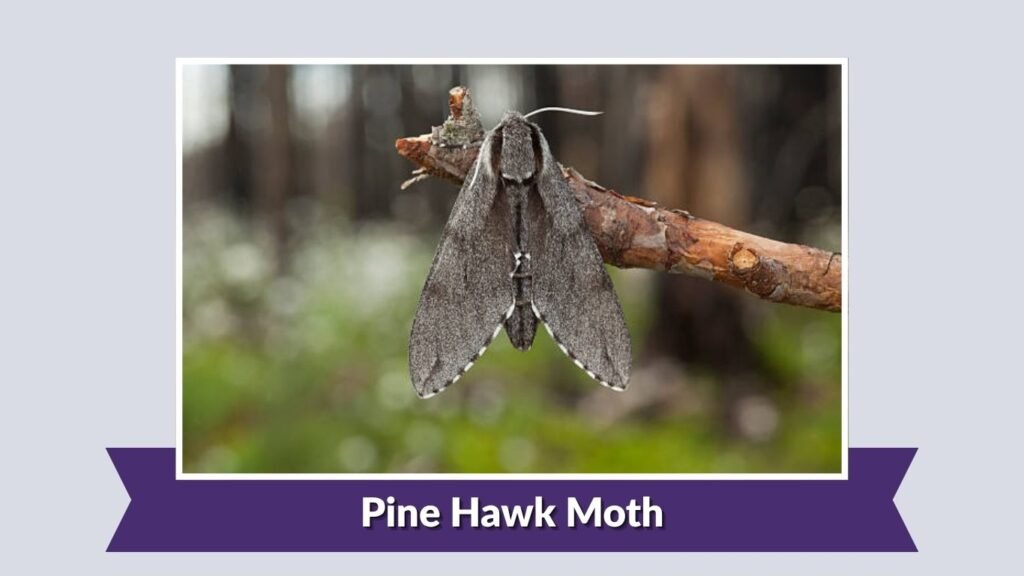
The Pine Hawk Moth is a large woodland species closely associated with pine trees. Its gray-brown coloration provides excellent camouflage when it rests on bark or branches. Although less colorful than some hawk moths, its large size, long narrow wings, and strong flight make it an impressive species.
Identification
- Large hawk moth with a wingspan of roughly 2.7–3.5 inches.
- Forewings are grayish brown with dark streaks.
- Hindwings are more uniformly brown or gray.
- The body is long, narrow, and strongly built.
- The color pattern resembles pine bark.
- Caterpillars are green with pale lines and a rear horn.
Habitat and Distribution
Pine Hawk Moths occur throughout much of Europe and extend into parts of Asia. They are most strongly associated with coniferous woodland, especially forests containing Scots pine and other pine species.
They can also occur in plantations, suburban areas, parks, and large gardens where suitable conifers are planted.
Because the larvae depend heavily on pine needles, the distribution of host trees strongly influences where the moth can successfully reproduce.
Adult Activity
Adults are mainly nocturnal and often begin flying shortly after sunset. Their elongated wings allow for fast, direct flight through woodland.
They may visit nectar-rich flowers using their long proboscis, although their activity is often concentrated around forest edges and clearings.
During the day, adults rest vertically on tree trunks or branches. Their bark-like coloration helps them remain almost invisible to birds and other predators.
Caterpillars and Host Trees
The caterpillars feed primarily on pine needles, although they may occasionally use other coniferous trees.
Young larvae are relatively small and green, while mature caterpillars become large and display pale stripes along the sides.
The rear horn is long and noticeable but harmless. Once fully grown, the larva descends from the tree and pupates in soil or among forest litter.
The pupa may remain underground during winter before the adult emerges in warmer weather.
15. Willowherb Hawk Moth

The Willowherb Hawk Moth is a relatively uncommon and attractive species associated with willowherb and related plants. Adults have elegant brown, olive, and pinkish markings that provide effective camouflage when resting. Like many hawk moths, it is a strong flyer and is most active around dusk and after dark.
Identification
- Medium-sized moths with a wingspan generally around 2.2–2.8 inches.
- Forewings are brown or olive with lighter streaks and patches.
- Hindwings may show pinkish or reddish coloration.
- Body is streamlined and matches the pattern of the wings.
- Caterpillars are usually green or brown.
- Larvae have diagonal side markings and a curved rear horn.
Habitat and Distribution
Willowherb Hawk Moths occur in parts of Europe and western Asia. They are usually associated with sunny habitats where willowherb grows naturally.
Typical locations include woodland clearings, riverbanks, forest edges, meadows, disturbed ground, and areas near streams.
Because the species relies on specific larval food plants, it tends to be more localized than some widespread hawk moths.
Adult Feeding and Behavior
Adults usually fly during the evening and night. Their long proboscis allows them to visit tubular flowers and drink nectar while hovering.
They are capable of rapid flight and may travel between separated patches of suitable habitat.
During the day, the adults remain hidden among vegetation. Their muted brown and olive coloration allows them to blend effectively with leaves, stems, and tree bark.
Caterpillars and Life Cycle
The caterpillars feed mainly on willowherb and related plants. Their coloring helps them remain concealed among leaves and stems.
As they grow, they develop the characteristic hawk moth horn near the rear. Mature larvae may become quite large compared with the adult’s body width.
When ready to pupate, the caterpillar leaves its host plant and moves toward the ground. Pupation generally occurs in loose soil or among plant debris.
Depending on local conditions, the pupal stage may last through colder months before adults emerge the following season.
16. White-lined Sphinx
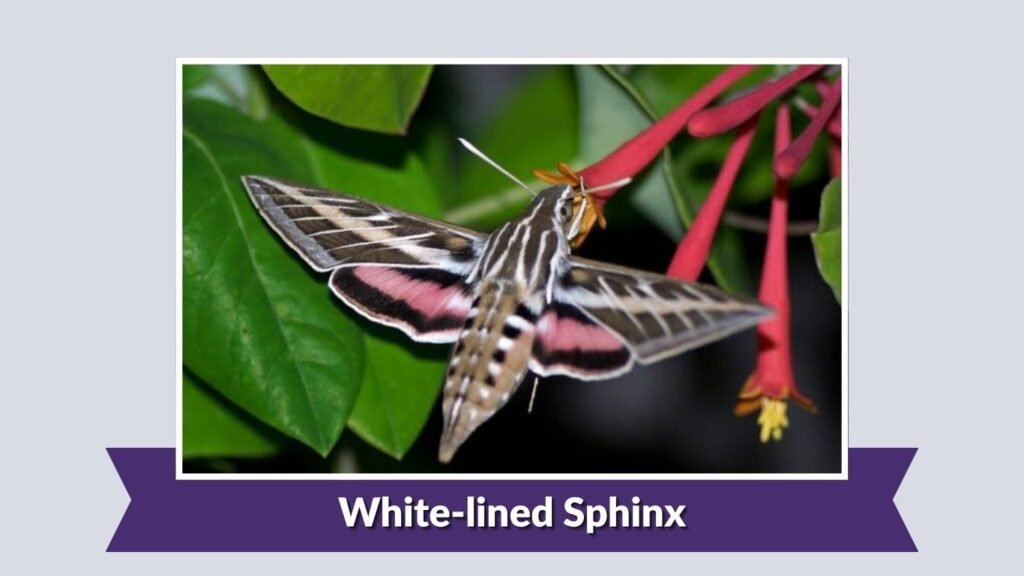
The White-lined Sphinx is one of the most widespread and recognizable hawk moths in North America. It gets its name from the bold white stripe extending along each forewing. Because adults frequently hover in front of flowers during daylight or twilight, they are often mistaken for hummingbirds.
Identification
- Wingspan usually ranges from about 2–3.5 inches.
- Forewings are brown with a strong white diagonal stripe.
- Hindwings are pink with black borders.
- Abdomen has alternating black and white markings.
- Body is thick and streamlined.
- Caterpillars occur in green, yellow, brown, and black forms.
Habitat and Distribution
White-lined Sphinx moths are widespread across North America and also occur in Central America. They can survive in a remarkable variety of environments.
Common habitats include deserts, prairies, gardens, farmland, open woodland, roadsides, and suburban landscapes.
They are especially abundant in areas where both larval food plants and nectar-producing flowers are plentiful. Population numbers can increase dramatically in favorable years.
Feeding and Hummingbird-Like Flight
Adults are active around dusk, at night, and sometimes during daylight. Their rapid wingbeats and hovering behavior closely resemble those of hummingbirds.
They visit many kinds of flowers, including petunias, evening primrose, columbine, and honeysuckle.
A long proboscis allows the moth to reach deep inside flowers without landing. This makes the White-lined Sphinx an effective pollinator of several plant species.
Caterpillars and Life Cycle
The caterpillars feed on a wide variety of plants, including evening primrose, purslane, grape, and several garden plants.
Their appearance is extremely variable. Some are bright green, while others are dark brown or nearly black. Most have spots or stripes and a prominent rear horn.
Large numbers of caterpillars may sometimes be seen crossing roads or open ground when searching for pupation sites.
They burrow into soil to pupate, and adults later emerge to continue one of the most adaptable hawk moth life cycles.
17. Carolina Sphinx

The Carolina Sphinx is a large North American hawk moth best known because its caterpillar is the tobacco hornworm. The adult moth is mostly gray and brown, providing excellent camouflage, while the caterpillar is bright green and commonly encountered on tobacco, tomato, and other nightshade-family plants.
Identification
- Large moth with a wingspan of approximately 3.5–5 inches.
- Forewings are grayish brown with dark irregular markings.
- Hindwings have alternating light and dark bands.
- Abdomen displays several orange or yellow spots along the sides.
- Caterpillars are bright green with diagonal white stripes.
- Tobacco hornworms have a reddish horn at the rear.
Habitat and Distribution
Carolina Sphinx moths are widespread through much of the United States and extend into parts of Canada, Mexico, and Central America.
They inhabit gardens, agricultural fields, woodland edges, grasslands, and suburban areas.
They are particularly common wherever tobacco, tomatoes, peppers, or other members of the nightshade family are cultivated.
Adult Feeding and Activity
Adults are powerful nocturnal fliers. They typically emerge after sunset and visit large, pale, fragrant flowers.
Their long proboscis allows them to feed on nectar while hovering. Tobacco flowers and other deep tubular blossoms are especially suitable.
The moth’s rapid wingbeats and large body can make it resemble a small bird when observed briefly in low light.
Tobacco Hornworm Caterpillar
The caterpillar stage is commonly known as the tobacco hornworm. It feeds heavily on leaves and can consume substantial amounts of plant material as it grows.
Although the prominent rear horn can look threatening, the caterpillar cannot sting and is generally harmless to people.
Tobacco hornworms are sometimes confused with tomato hornworms. One useful difference is that tobacco hornworms usually have diagonal white stripes and a red horn.
When mature, they burrow into soil and form large brown pupae before later emerging as adult Carolina Sphinx moths.
18. Five-spotted Hawk Moth

The Five-spotted Hawk Moth is a large North American species whose caterpillar is widely known as the tomato hornworm. Adult moths are gray and brown with yellow-orange abdominal spots, while their caterpillars are large, green, and frequently discovered feeding on tomato plants in gardens.
Identification
- Large adult moth with a wingspan of roughly 3.5–5 inches.
- Forewings are mottled gray and brown.
- Abdomen usually has five pairs of yellow or orange spots.
- Hindwings show alternating dark and pale bands.
- Caterpillars are green with V-shaped white markings.
- Tomato hornworms usually have a dark blue or black rear horn.
Habitat and Distribution
Five-spotted Hawk Moths are widespread across much of North America. They occur in gardens, farms, open woodland, grasslands, and suburban areas.
The species often thrives around vegetable gardens because its caterpillars feed on tomato and other members of the nightshade family.
Adults may travel considerable distances at night, especially when searching for nectar sources or mates.
Adult Feeding Behavior
Adult Five-spotted Hawk Moths are mainly active after sunset. They possess a long proboscis and hover while drinking nectar from deep flowers.
Large, pale, strongly scented flowers are particularly attractive because they are easier to locate at night.
The adults are strong fliers and can move rapidly between flowering areas. During the daytime, they usually remain hidden against bark, walls, or vegetation where their mottled coloration provides camouflage.
Tomato Hornworm Caterpillar
The caterpillar is commonly called the tomato hornworm and is well known to vegetable gardeners.
It feeds on tomatoes, potatoes, eggplants, peppers, and related plants. Because the caterpillars grow rapidly, a large individual can remove significant amounts of foliage.
Despite its large horn and intimidating appearance, it is harmless to people.
Tomato hornworms can be distinguished from tobacco hornworms by their V-shaped white side markings and darker horn. When mature, they enter the soil and form brown pupae. Adults later emerge as large Five-spotted Hawk Moths.
19. Rustic Sphinx

The Rustic Sphinx is a large and impressive hawk moth found across much of the Americas. Its mottled gray, brown, and black coloration gives it excellent camouflage when resting on tree bark or wooden surfaces. Although the adult looks rather subdued, its caterpillars can be large and colorful, with noticeable striping and the typical rear horn seen in many hawk moth larvae.
Identification
- Large hawk moth with a wingspan commonly around 3.5–5 inches.
- Forewings are gray to dark brown with irregular black markings.
- Hindwings have alternating pale and dark bands.
- Abdomen is long with contrasting black and pale markings.
- Body is thick and strongly built for fast flight.
- Caterpillars may be green, brown, or dark with diagonal markings and a rear horn.
Habitat and Distribution
Rustic Sphinx moths occur from the southern United States through Mexico, Central America, the Caribbean, and into South America. They are especially common in warm climates.
They inhabit gardens, woodland edges, tropical and subtropical forests, agricultural areas, and urban landscapes. Because their caterpillars can use several different host plants, they are able to survive in a wide variety of environments.
In the United States, they are most frequently encountered in southern regions, although wandering adults may sometimes appear farther north.
Adult Feeding and Behavior
Adults are mainly active at night. Their powerful wings allow them to fly quickly between nectar sources and suitable breeding habitats.
They visit fragrant flowers and use a long proboscis to drink nectar while hovering. During the daytime, Rustic Sphinx moths usually remain motionless on tree trunks, fences, or walls.
Their bark-like wing pattern makes them surprisingly difficult to spot when resting.
Caterpillars and Life Cycle
Rustic Sphinx caterpillars feed on several shrubs, trees, and ornamental plants. Depending on age and location, their coloration can vary considerably.
The larvae grow rapidly and may become quite large before pupation. Their rear horn looks intimidating but is harmless.
When mature, the caterpillar usually descends to the ground and enters loose soil to pupate. The brown pupa remains protected underground until environmental conditions are suitable for the adult moth to emerge.
20. Tersa Sphinx

The Tersa Sphinx is a slender and elegant hawk moth known for its pointed wings and distinctive brown-and-tan pattern. Its caterpillar is equally remarkable, featuring large false eyespots that can make it resemble a small snake. This species is commonly encountered in warm parts of the Americas and is often attracted to flowering gardens.
Identification
- Medium-sized hawk moth with a wingspan of about 2.5–3.2 inches.
- Forewings are long and sharply pointed.
- Wings are light brown with several dark longitudinal lines.
- Hindwings contain dark and pale bands.
- Abdomen is narrow compared with many heavier hawk moths.
- Caterpillars have prominent false eyespots near the front of the body.
Habitat and Distribution
Tersa Sphinx moths occur from the southeastern United States through Mexico, Central America, the Caribbean, and parts of South America.
They favor warm habitats such as gardens, woodland borders, open forests, subtropical environments, and areas containing abundant flowering plants.
In North America, they are especially common in Florida and other southern states. During warm weather, individuals may occasionally move farther north.
Feeding and Nighttime Activity
Adults are most active around dusk and during the night. They fly quickly between flowers and use their long proboscis to obtain nectar.
They may visit honeysuckle, pentas, and other tubular flowers. Their hovering feeding style is typical of hawk moths and can make them resemble tiny birds when viewed from a distance.
During daylight, adults rest in sheltered locations where their brown coloration blends with dried vegetation.
Caterpillar Defense
Tersa Sphinx caterpillars are especially well known for their impressive eyespots. When disturbed, they withdraw the head and enlarge the front portion of the body.
This makes the eyespots more prominent and creates a snake-like appearance that may frighten birds and other predators.
Caterpillars feed on several broad-leaved plants, including buttonplant and related species. They may occur in green or brown forms.
After completing their growth, larvae usually pupate in shallow soil or among leaf litter before eventually emerging as adults.
21. Nessus Sphinx
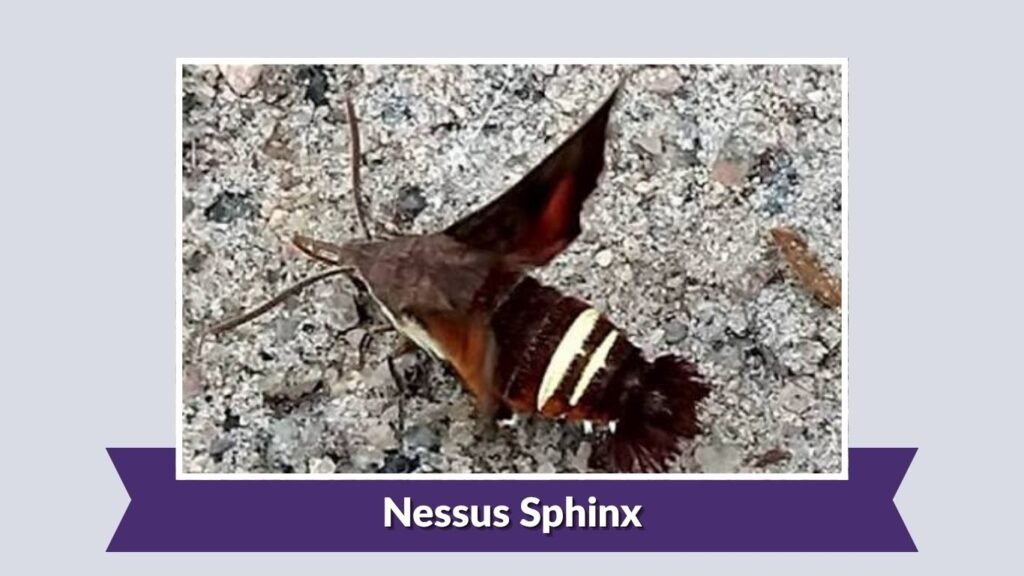
The Nessus Sphinx is an attractive North American hawk moth recognized by the two pale bands crossing its dark abdomen. Its combination of chocolate-brown wings, yellow markings, and streamlined body gives it a distinctive appearance. Unlike many hawk moths that are strictly nocturnal, Nessus Sphinx moths may occasionally be active around dusk or even during daylight.
Identification
- Medium-sized hawk moth with a wingspan of roughly 3–4 inches.
- Forewings are dark brown with lighter gray or tan markings.
- Abdomen has two prominent pale yellow or cream-colored bands.
- Hindwings are reddish or pinkish with darker borders.
- Body is thick toward the front and tapers toward the rear.
- Caterpillars are usually green or brown with a horn at the rear.
Habitat and Distribution
Nessus Sphinx moths are widely distributed across eastern and central North America.
They can be found in woodland, gardens, farmland, forest edges, parks, and suburban areas. They are often associated with habitats containing grapevines and Virginia creeper because these are important caterpillar food plants.
The species adapts well to areas influenced by humans, particularly where native vines and flowering plants remain available.
Feeding and Flight
Adults feed from flowers using a long proboscis. They may fly at dusk, nighttime, and occasionally during sunny periods.
Nessus Sphinx moths are fast and agile in flight. While feeding, they frequently hover in front of flowers rather than landing.
The combination of rapid wing movement and a thick body can sometimes cause them to be confused with hummingbirds or large bees.
Caterpillars and Development
The caterpillars feed on grapevine, Virginia creeper, peppervine, and related plants. Their body coloration may change as they mature.
Young larvae often possess the familiar hawk moth horn. In later stages, the horn may become less prominent or change appearance.
Their green coloration provides camouflage among leaves, while brown forms can blend with stems and dried vegetation.
Once mature, the larvae leave their host plants and pupate in soil or protected debris. Adults emerge later and begin searching for flowers and mates, continuing the seasonal cycle.
22. Blinded Sphinx
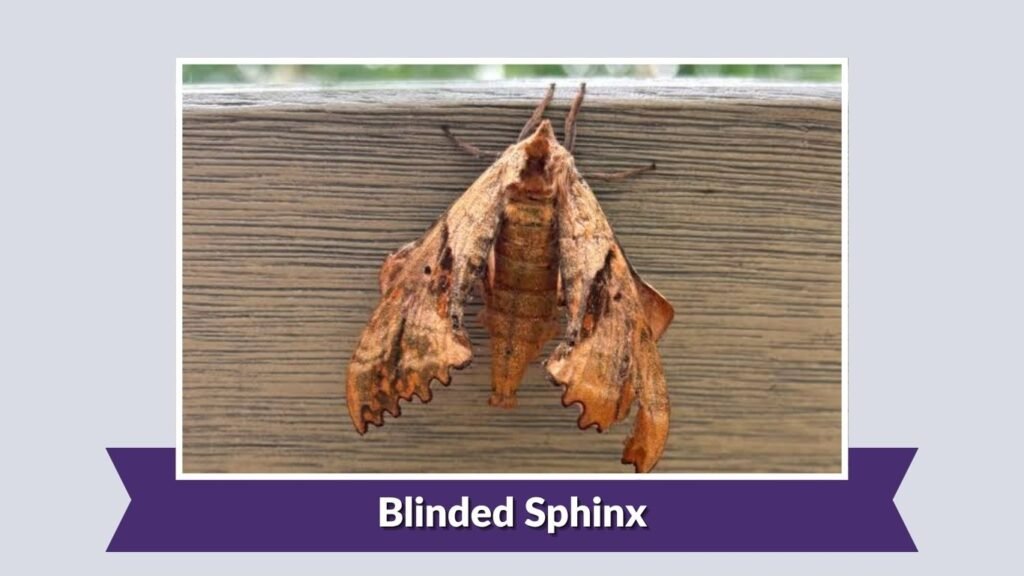
The Blinded Sphinx is a beautiful North American hawk moth named for the eye-like markings on its hindwings. Unlike the fully developed eyespots of some related species, the central areas appear less distinct, giving rise to the name “blinded.” Its subdued brown and gray forewings provide excellent camouflage while it rests during the day.
Identification
- Medium to large moth with a wingspan commonly around 2.5–3.5 inches.
- Forewings are brown or gray with wavy darker markings.
- Hindwings contain blue-black eyespots surrounded by pink or reddish coloration.
- Wing edges are slightly scalloped.
- Body is thick and covered with gray-brown scales.
- Caterpillars are green with diagonal pale lines and a short rear horn.
Habitat and Distribution
Blinded Sphinx moths occur across much of the United States and southern Canada.
They are found in deciduous woodland, parks, gardens, riverbanks, forest edges, and suburban landscapes. Their caterpillars feed on several common trees, making suitable habitat relatively widespread.
Willow, poplar, birch, and cherry are among the plants that may support their larvae.
Defensive Display
During the day, the moth usually rests with its forewings covering much of the brightly colored hindwings.
When threatened, it can suddenly reveal the hindwing markings. The contrasting eyespot pattern may surprise a predator and provide the moth with an opportunity to escape.
Adults generally do not feed because their mouthparts are reduced. Energy stored during the caterpillar stage supports their adult activities.
Caterpillars and Life Cycle
Blinded Sphinx caterpillars are typically green and blend effectively with foliage. Pale diagonal lines along the sides help break up the outline of the body.
The caterpillars spend most of their development eating leaves and storing the energy required for the adult stage.
Once fully grown, they move to the ground and enter soil or leaf litter to pupate.
The pupal stage may overwinter in colder climates. When temperatures rise again, adults emerge, mate, and lay eggs on suitable host trees to begin a new generation.
23. Twin-spotted Sphinx

The Twin-spotted Sphinx is a large hawk moth best recognized by the colorful eyespots on its hindwings. Its brown and gray forewings provide camouflage, while the hidden hindwing markings may help deter predators. This woodland species occurs across much of North America and is closely associated with deciduous trees during its caterpillar stage.
Identification
- Large hawk moth with a wingspan of approximately 2.5–3.5 inches.
- Forewings are grayish brown with complex dark patterns.
- Hindwings feature two prominent blue-and-black eyespot markings.
- Pink or reddish coloration surrounds portions of the hindwing spots.
- Wing edges are irregular and slightly scalloped.
- Caterpillars are green with pale side markings and a noticeable rear horn.
Habitat and Distribution
Twin-spotted Sphinx moths are found across large portions of the United States and southern Canada.
They inhabit deciduous forests, woodland edges, parks, river corridors, gardens, and suburban areas containing suitable host trees.
Common caterpillar food plants include apple, elm, birch, willow, and other broad-leaved trees. This broad host range helps the species survive in both natural and developed landscapes.
Adult Behavior
Adults are primarily nocturnal. During daylight hours, they usually remain still on tree trunks or branches.
The brown patterned forewings closely resemble bark and provide effective camouflage.
When disturbed, the moth may expose its brightly colored hindwings. The large eyespots can create the impression of a much larger animal and may discourage birds.
Adult Twin-spotted Sphinx moths have reduced mouthparts and generally do not feed.
Caterpillars and Pupation
The caterpillars spend their growing period feeding on leaves from host trees. Their green coloration allows them to blend easily with surrounding foliage.
As they become larger, their pale diagonal markings and rear horn become easier to notice.
Despite their appearance, the horn is harmless and cannot sting.
When development is complete, the caterpillar descends from the tree and enters loose soil. It forms a pupa underground, where it is protected from predators and harsh weather.
In colder areas, the species usually spends winter in the pupal stage before adult moths emerge the following season.
24. Walnut Sphinx

The Walnut Sphinx is a large North American hawk moth associated mainly with walnut, hickory, and related trees. Its muted brown coloration makes it difficult to notice when resting on bark. The caterpillar is particularly interesting because it can produce squeaking or whistling sounds when disturbed, an unusual defensive behavior among caterpillars.
Identification
- Large moths with a wingspan generally around 2.5–3.5 inches.
- Forewings are brown, gray, or tan with darker wavy patterns.
- Hindwings are relatively plain compared with many other sphinx moths.
- The body is broad and heavily covered with scales.
- Caterpillars are green with pale diagonal stripes.
- Larvae have a somewhat rough or textured appearance rather than a prominent long horn.
Habitat and Distribution
Walnut Sphinx moths are widely distributed throughout much of eastern North America.
They occur in deciduous forests, woodland edges, parks, orchards, and suburban areas where walnut and hickory trees grow.
Other trees may occasionally serve as larval hosts, but walnuts and hickories are especially important.
Because mature trees are required to provide sufficient foliage, the moth is often associated with established woodland and mature residential landscapes.
Adult Behavior
Adults are mainly active after dark. Unlike nectar-feeding hawk moths, Walnut Sphinx adults have reduced mouthparts and do not normally eat.
Their adult stage is therefore primarily devoted to reproduction. Stored energy from the caterpillar stage supports flight, mating, and egg production.
During daylight, adults rest on bark where their muted wing patterns help them avoid detection.
Noisy Caterpillars and Life Cycle
Walnut Sphinx caterpillars possess one of the more unusual defenses among hawk moth larvae.
When disturbed, they can force air through specialized openings and produce squeaking or whistling noises. These sounds may surprise predators and discourage further attack.
The larvae feed extensively on walnut, hickory, and related tree leaves while building energy reserves.
When fully grown, they descend to the ground and pupate in soil.
The pupa may remain underground through winter in colder regions. Adults emerge during warmer months and begin another generation by locating suitable host trees for egg laying.
25. Laurel Sphinx

The Laurel Sphinx is a large North American hawk moth recognized by its long wings, sturdy body, and subdued gray-brown coloration. Although the adult is not as brightly colored as some other sphinx moths, its streamlined shape makes it an impressive flier. The caterpillars feed on several woody plants and can become large before pupating.
Identification
- Large sphinx moth with a wingspan of roughly 3–4 inches.
- Forewings are grayish brown with darker wavy lines and streaks.
- Hindwings are generally darker with contrasting pale bands.
- Abdomen is long, thick, and tapered toward the end.
- Caterpillars are usually green with pale diagonal markings.
- Larvae have a noticeable horn at the rear of the body.
Habitat and Distribution
Laurel Sphinx moths occur across parts of eastern and central North America. They are generally associated with deciduous woodland, forest edges, gardens, parks, and areas where suitable host shrubs and trees are available.
Their larvae may feed on plants such as lilac, ash, privet, and related species. Because several of these plants are widely grown in landscaped areas, the moth can sometimes be found in suburban neighborhoods as well as natural habitats.
Adults are most common during the warmer months.
Adult Feeding and Activity
Laurel Sphinx moths are primarily nocturnal. They begin flying around dusk and may remain active for much of the night.
Adults use their long proboscis to obtain nectar from flowers. Like many hawk moths, they can hover in front of blossoms while feeding rather than settling completely on the plant.
Their strong wings allow them to fly rapidly over considerable distances when searching for food and mates.
During daylight hours, adults generally rest on tree trunks or other sheltered surfaces. Their gray-brown patterns help them blend with bark.
Caterpillars and Life Cycle
The caterpillars spend most of their growing stage feeding on leaves. Their green coloration allows them to remain difficult to notice among foliage.
As they mature, the larvae become thick-bodied and develop prominent pale side markings. The rear horn is harmless despite its pointed appearance.
When fully grown, the caterpillar leaves the host plant and searches for loose soil.
It pupates underground, where the developing moth remains protected. In colder areas, the pupal stage may last through winter before the adult Laurel Sphinx emerges during the following warm season.
26. Pawpaw Sphinx
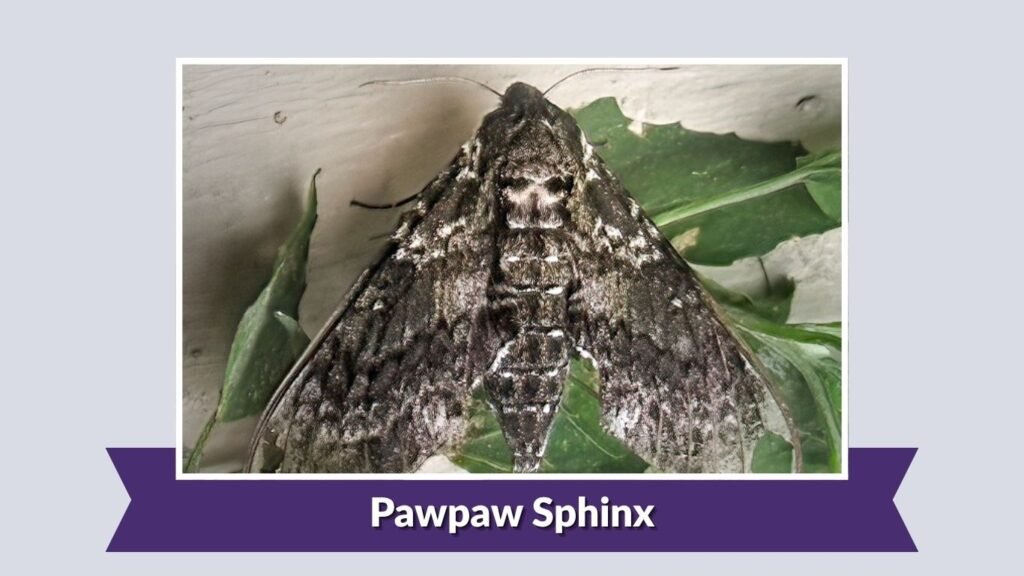
The Pawpaw Sphinx is a North American hawk moth associated with pawpaw trees and several related plants. Its brown and gray wings provide excellent camouflage, making adults difficult to notice while resting. Like other hawk moths, it has a strong, streamlined body built for rapid nighttime flight.
Identification
- Medium to large hawk moth with broad gray-brown forewings.
- Dark lines and patches create a bark-like appearance.
- Hindwings are usually darker than the forewings.
- The body is thick near the thorax and narrows toward the abdomen.
- Caterpillars are generally green with pale diagonal markings.
- A horn or horn-like projection occurs near the rear of the larva.
Habitat and Distribution
Pawpaw Sphinx moths occur mainly in regions of North America where pawpaw and other suitable host plants grow.
They are typically found in deciduous forests, river valleys, woodland edges, thickets, and moist habitats containing dense vegetation.
Pawpaw trees often grow naturally beneath taller forest canopies, so the moth may inhabit relatively shaded environments compared with species that prefer open grasslands.
Adults can also occasionally appear around gardens located near wooded areas.
Adult Behavior
Adults are mainly active during the evening and at night. Their strong wings allow them to move quickly through woodland openings and along forest edges.
They may visit flowering plants to obtain nectar, especially during the first hours after sunset.
During daytime, Pawpaw Sphinx moths remain motionless against tree bark or beneath vegetation. Their mottled coloration makes them difficult for predators to detect.
Like many sphinx moths, they are attracted to lights at night and may occasionally be discovered resting near porches or outdoor buildings the following morning.
Caterpillars and Development
Pawpaw Sphinx caterpillars feed on the leaves of their host trees and shrubs. Pawpaw is one of the plants commonly associated with their development.
The caterpillars rely heavily on camouflage and often remain along leaf stems or branches while feeding.
They grow through several stages before reaching their full size. Once mature, they leave the plant and travel to the ground.
Pupation normally occurs in soil or protected leaf litter. The pupa may remain dormant during unfavorable weather, particularly winter.
When conditions become suitable, the adult emerges, expands its wings, and begins searching for mates and appropriate host plants for the next generation.
27. Abbott’s Sphinx
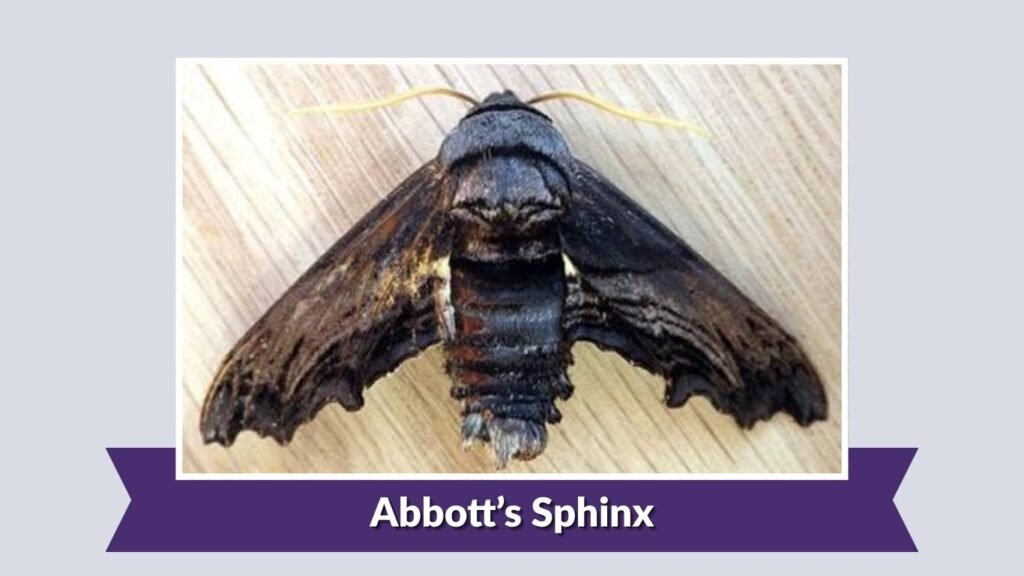
Abbott’s Sphinx is a distinctive North American hawk moth with a rugged, bark-like appearance. Its forewings contain irregular brown, gray, and olive markings that help it disappear against trees. The caterpillar is also unusual because mature individuals often have a hardened eye-like knob instead of the long horn seen on many other hawk moth larvae.
Identification
- Medium-sized hawk moth with a wingspan of about 2.5–3 inches.
- Forewings are mottled brown, gray, and olive.
- Wing patterns closely resemble tree bark or dried leaves.
- Hindwings may show yellowish coloration with darker bands.
- Caterpillars can be green, brown, or patterned with eye-like markings.
- Mature larvae often have a rounded knob instead of a long rear horn.
Habitat and Distribution
Abbott’s Sphinx occurs throughout much of eastern North America. It is commonly associated with deciduous forests, woodland edges, vineyards, gardens, and areas where grape-family plants grow.
Grapevines and Virginia creeper are especially important caterpillar food plants.
Because these vines grow in both natural forests and landscaped areas, Abbott’s Sphinx can occur surprisingly close to homes and gardens.
Adults are most often seen from late spring through summer, depending on latitude and local climate.
Adult Feeding and Behavior
Adults are mainly nocturnal, although they may begin flying before complete darkness.
They visit flowers for nectar and use their long feeding tube to reach blossoms. Their powerful flight allows them to move quickly between feeding locations.
During the day, their unusual wing pattern provides excellent camouflage against bark and rough vegetation.
When disturbed, they can take off rapidly and disappear into surrounding woodland.
Caterpillar Defense
Abbott’s Sphinx caterpillars have one of the more unusual appearances among hawk moth larvae.
Young caterpillars possess a more typical horn, but older larvae develop a rounded eye-like structure near the rear. Their bodies may also contain markings that create an unusual animal-like appearance.
When threatened, the caterpillar may pull its head inward and change its posture, making its defensive markings more noticeable.
The larvae feed heavily on grape and Virginia creeper before leaving the host plant to pupate.
Pupation occurs near or beneath the soil surface. After completing metamorphosis, the adult emerges as the heavily camouflaged Abbott’s Sphinx.
28. Waved Sphinx
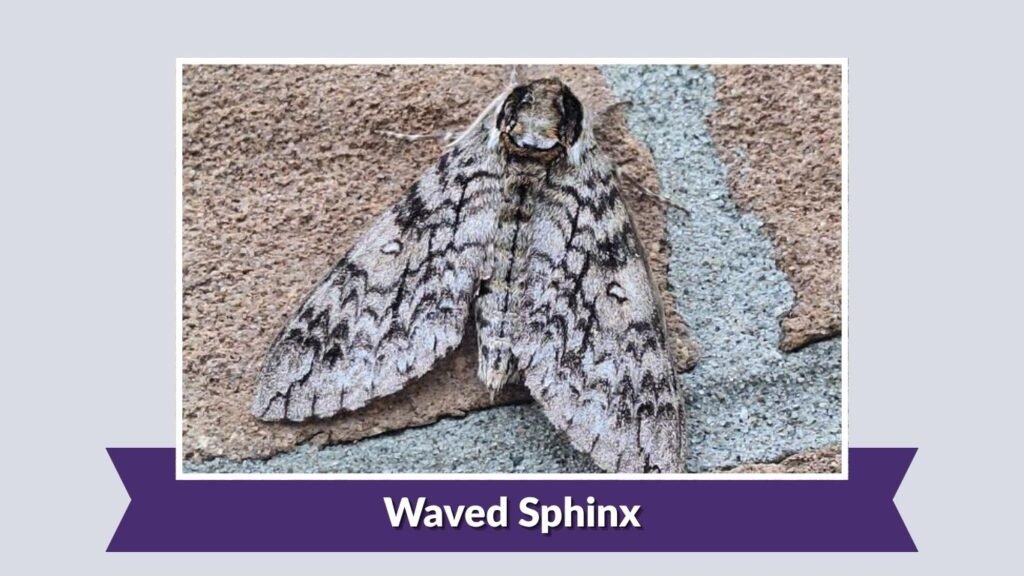
The Waved Sphinx is a large eastern North American hawk moth named for the flowing, wave-like patterns across its forewings. Its gray and brown coloration resembles tree bark, allowing it to remain well hidden during daylight. The species is commonly associated with forests and wooded neighborhoods containing ash and other deciduous trees.
Identification
- Large moths with a wingspan commonly around 3–4 inches.
- Forewings are grayish brown with dark wavy lines.
- Hindwings have muted brown and gray patterns.
- Thorax is broad and covered in dense scales.
- Caterpillars are generally green with pale diagonal stripes.
- Larvae possess a noticeable horn at the rear.
Habitat and Distribution
Waved Sphinx moths occur across much of eastern North America, from southern Canada into the United States.
They inhabit deciduous forests, woodland edges, parks, gardens, and suburban neighborhoods containing mature host trees.
Ash trees are among their commonly used larval hosts, although caterpillars may feed on other woody plants as well.
Because adults are nocturnal and well camouflaged, they may be present in an area without being frequently noticed.
Adult Activity
Adults usually begin flying around dusk and remain active through the night.
They may visit nectar-rich flowers, especially large or fragrant blossoms that are easy to locate after dark.
Their flight is fast and direct, powered by a thick body and long wings.
During daylight, Waved Sphinx moths rest with their forewings covering most of the body. The irregular gray pattern makes them resemble a patch of bark.
They may also be attracted to artificial lights and occasionally rest near buildings the following morning.
Caterpillars and Pupation
Waved Sphinx caterpillars feed on the foliage of host trees for several weeks.
The larvae are typically green, which provides effective camouflage among leaves. Pale diagonal lines along the sides help break up their body outline.
The rear horn may appear threatening but is completely harmless.
Once the caterpillar reaches full size, it descends from the tree and enters loose soil.
There it forms a brown pupa. In areas with cold winters, the species can remain in this stage for several months.
Adults emerge when warmer temperatures return, completing the life cycle and beginning another generation.
29. Catalpa Sphinx
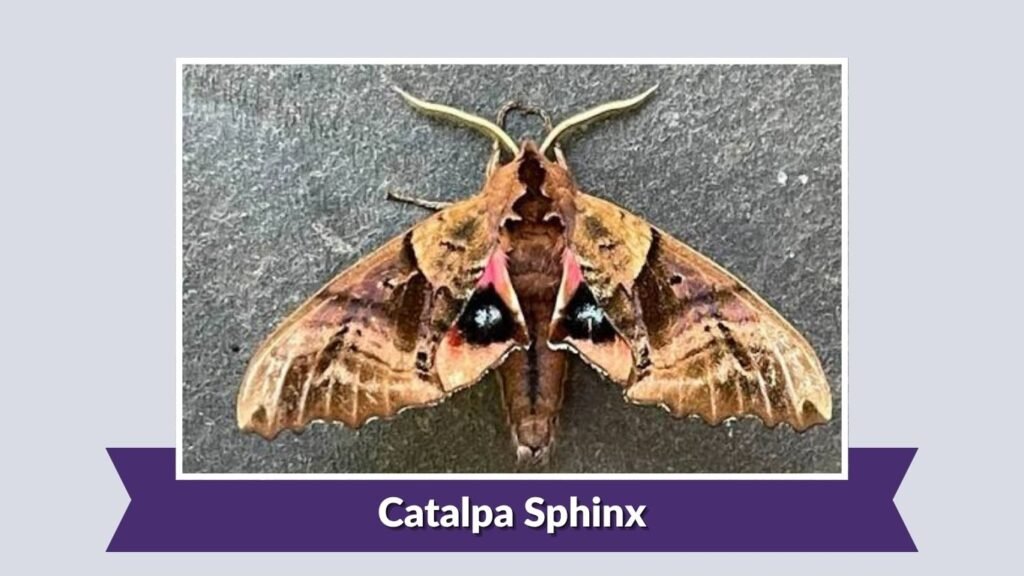
The Catalpa Sphinx is a widespread North American hawk moth best known for its caterpillar, commonly called the catalpa worm. These caterpillars sometimes occur in large groups on catalpa trees and can remove substantial amounts of foliage. The adult moth is much less conspicuous, with brown and gray wings that provide excellent camouflage.
Identification
- Adult wingspan usually measures around 2.5–3.5 inches.
- Forewings are brown or gray with irregular dark markings.
- Hindwings are darker with pale or yellowish areas.
- The adult body is thick and streamlined.
- Caterpillars are often yellow, greenish, or pale with bold black markings.
- A dark horn is present near the rear of the caterpillar.
Habitat and Distribution
Catalpa Sphinx moths are widely distributed across eastern and central North America.
Their distribution is strongly connected to catalpa trees, which serve as the primary food source for their caterpillars.
They occur in forests, parks, gardens, roadsides, farms, and suburban neighborhoods wherever catalpa trees are established.
Because catalpas are commonly planted as ornamental or shade trees, the moth can occur well outside completely natural woodland.
Adult Behavior
Adult Catalpa Sphinx moths are mainly active at night.
Their brown and gray wing patterns make them difficult to notice during the daytime, especially when resting against tree trunks.
Adults may visit flowers, although they are far less noticeable than their caterpillars.
At night, they search for mates and suitable catalpa trees where females can deposit eggs.
The eggs are generally laid on the leaves, providing newly hatched larvae immediate access to food.
Catalpa Worm Caterpillars
Catalpa Sphinx caterpillars are commonly called catalpa worms. They are among the better-known sphinx moth caterpillars because they may appear in large numbers on a single tree.
Their bodies typically have bold black markings combined with yellow or pale coloration.
Heavy populations can strip many leaves from a catalpa tree, although healthy mature trees often recover.
Catalpa worms are also traditionally used as fishing bait in parts of the United States.
When the larvae finish feeding, they descend to the ground and burrow into soil.
They form pupae underground, and depending on climate, one or more generations may develop during a warm season.
30. Achemon Sphinx

The Achemon Sphinx is a large and attractive North American hawk moth found across much of the continent. Adults have soft brown, tan, and pinkish colors, while their caterpillars can become remarkably large. The species is closely associated with grapevines and related plants, making it relatively common around vineyards, gardens, and woodland edges.
Identification
- Large hawk moth with a wingspan of approximately 3–4 inches.
- Forewings are tan or light brown with darker patches.
- Hindwings display pink or reddish coloration with dark borders.
- Abdomen is thick, tapered, and patterned with pale markings.
- Caterpillars may be green, reddish brown, or darker.
- Mature larvae often lose the long horn and develop a small eye-like bump instead.
Habitat and Distribution
Achemon Sphinx moths occur throughout much of the United States, southern Canada, and northern Mexico.
They are found in vineyards, gardens, woodland edges, river valleys, open forests, and suburban areas.
Grape and Virginia creeper are among the most important larval food plants. Because these plants are widespread, the moth can occupy many different habitats.
It is especially noticeable in regions containing large areas of wild or cultivated grapevines.
Adult Feeding and Flight
Adults are mostly active around dusk and at night.
They are strong fliers and visit a variety of flowers for nectar. Their long proboscis enables them to hover while feeding from deep blossoms.
The pink hindwings can become particularly noticeable during flight but are partly hidden when the moth is resting.
During daytime, adults remain relatively inconspicuous because their tan forewings blend with bark, dry leaves, and surrounding vegetation.
Caterpillars and Development
Achemon Sphinx caterpillars can grow to an impressive size and consume large quantities of grape or Virginia creeper foliage.
Younger caterpillars have a noticeable horn near the rear. As they mature, this horn becomes reduced and is often replaced by a small rounded bump resembling an eye.
Body color varies considerably. Some individuals are bright green, while mature caterpillars may become pinkish brown or reddish before pupation.
Despite their large size, they are harmless to people.
Once mature, the caterpillar leaves its food plant and burrows into the ground. It forms a pupa beneath the soil and may remain there through winter.
The adult Achemon Sphinx later emerges as a powerful nighttime flier, completing the final entry in this group of 30 hawk moths.
FAQs
1. Are hawk moths dangerous to humans?
No, hawk moths are generally harmless to humans. Adult hawk moths do not sting, and most do not bite. Their large size and rapid flight can sometimes look intimidating, but they are not aggressive. Hawk moth caterpillars may have a pointed horn on the rear of their bodies, but this horn is not a stinger and cannot inject venom.
2. What do hawk moths eat?
Adult hawk moths commonly feed on flower nectar using a long proboscis. Many species hover in front of flowers while feeding, much like hummingbirds. However, some species, including the Poplar Hawk Moth and Eyed Hawk Moth, have reduced mouthparts and do not feed as adults. Hawk moth caterpillars eat leaves from specific host plants such as grape, willow, tomato, pine, bedstraw, and privet.
3. Are hawk moths the same as sphinx moths?
Yes. The terms hawk moth and sphinx moth generally refer to moths belonging to the family Sphingidae. “Hawk moth” is more commonly used in some parts of Europe, while “sphinx moth” is widely used in North America. The name sphinx comes from the posture some caterpillars adopt when disturbed.
4. Why do hawk moths look like hummingbirds?
Some hawk moths have large bodies, extremely fast wingbeats, and the ability to hover while drinking nectar. These characteristics can make them look surprisingly similar to hummingbirds. The Hummingbird Hawk Moth and White-lined Sphinx are particularly well known for this behavior. Their hovering ability allows them to feed efficiently from deep, tubular flowers.
5. Are hawk moths good for gardens?
Hawk moths can be beneficial because many adults are important pollinators. They transfer pollen while visiting flowers for nectar, particularly plants that bloom or release strong fragrances at night. However, some caterpillars, such as tomato and tobacco hornworms, can damage vegetable plants by eating large amounts of foliage. Their overall role in nature remains important because they also provide food for birds, bats, and other wildlife.