
A hornet is a large, robust social wasp with a broad head, narrow waist, powerful jaws, six legs, and two pairs of wings. True hornets belong to the genus Vespa and are generally larger and heavier-bodied than common yellowjackets and paper wasps. Their colors vary by species, ranging from reddish-brown and yellow to black, white, or orange. In North America, the European hornet is a well-known true hornet, while the so-called bald-faced hornet is actually a large black-and-white yellowjacket. Nest shape, body markings, and size can all help with identification.
What Does a Hornet Look Like?
True hornets have the classic wasp body shape but tend to be noticeably large and sturdy.
Typical features include:
- Six jointed legs
- Two pairs of transparent wings
- Long antennae
- Large compound eyes
- Narrow waist between thorax and abdomen
- Strong mandibles
- Smooth rather than fuzzy body
- Yellow, brown, red, orange, or black markings
- Stinger in females
A hornet’s head is proportionally large, and the abdomen is usually broader than that of a slender paper wasp.
| Feature | Typical Hornet |
| Body | Large and robust |
| Legs | 6 |
| Wings | 4 |
| Antennae | Long and segmented |
| Body covering | Relatively smooth |
| Waist | Narrow |
| Sting | Females can sting |
| Lifestyle | Social |
| Nest | Papery colony nest |
What Does a European Hornet Look Like?
The European hornet (Vespa crabro) is one of the easiest true hornets to encounter in eastern North America.
Workers can reach approximately 1 inch (25 mm), while queens can grow to about 1.3 inches (35 mm).
Identification
A European hornet typically has:
- Red-brown and yellow head
- Reddish-brown thorax
- Yellow abdomen with brown or black markings
- Large body
- Brownish wings
- Yellow face
- Strong jaws
Its abdomen is predominantly yellow toward the rear with characteristic dark teardrop-shaped markings.
European hornets often look more brown and reddish than ordinary black-and-yellow yellowjackets.
What Does a Bald-Faced Hornet Look Like?

The bald-faced hornet (Dolichovespula maculata) has one of the most recognizable color patterns.
It is mostly:
- Shiny black
- Ivory-white on the face
- White-marked on the abdomen
- Black-legged
Adults generally measure about 13–20 mm, with queens usually being the largest members of a colony.
Despite its common name, the bald-faced hornet is not a true hornet. It belongs to the yellowjacket group.
Its white face explains the names “bald-faced hornet” and “white-faced hornet.”
What Does a Black Hornet Look Like?
In North America, people describing a “black hornet” are often looking at a bald-faced hornet.
It has:
- Predominantly black body
- White face
- White abdominal bands
- Dark translucent wings
Other dark wasps can also be called black hornets, so color alone is not sufficient for identification.
Pay attention to body shape, nest type, geographic location, and facial markings.
What Does a Hornet Look Like Compared With a Wasp?
All true hornets are wasps, but not all wasps are hornets.
| Feature | Hornet | Paper Wasp |
| Build | Thick and robust | Slender |
| Head | Broad | Smaller |
| Waist | Narrow | Very narrow |
| Legs in flight | Less conspicuous | Often hang down |
| Colony | Social | Social |
| Nest | Usually enclosed or in cavity | Open comb |
| Sting | Yes | Yes |
Paper wasps tend to look much more elongated, with especially long legs and a narrow body.
Hornets generally look heavier and more muscular.
What Does a Queen Hornet Look Like?
A queen hornet looks similar to a worker but is usually larger and heavier-bodied.
For European hornets, workers reach about 25 mm while queens can reach around 35 mm.
A queen may have:
- Larger abdomen
- Broader thorax
- Overall greater body length
- Same basic color pattern as workers
In spring, a single large hornet flying alone may be an overwintered queen searching for a nesting site.
Once a colony is established, queens spend most of their time inside the nest.
What Does a Hornet Nest Look Like?

Hornet nests vary considerably depending on species.
Most social hornets construct nests from chewed wood fibers mixed with saliva, producing a gray or tan paper-like material.
European Hornet Nest
European hornets usually build their nests inside protected cavities such as:
- Hollow trees
- Wall voids
- Attics
- Barns
- Other enclosed spaces
Unlike bald-faced hornets, European hornets usually do not construct a large exposed football-shaped nest.
Only the entrance may be visible from outside.
Bald-Faced Hornet Nest
A bald-faced hornet nest is much easier to recognize.
It usually looks like:
- Gray paper
- Round when young
- Football or teardrop shaped when mature
- Completely enclosed
- Single entrance near the lower portion
Nests commonly hang from:
- Tree branches
- Shrubs
- Building eaves
- Utility structures
They grow throughout summer as workers add additional paper layers.
What Does the Inside of a Hornet Nest Look Like?
Inside an enclosed hornet nest are multiple horizontal layers of hexagonal brood cells.
These layers are called combs.
Inside individual cells, you may find:
- Eggs
- Larvae
- Pupae
Workers continuously expand, feed, defend, and maintain the colony.
The outside envelope provides some protection from weather and predators.
Never cut open an occupied hornet nest simply to inspect it. Social wasps can respond aggressively when their colony is disturbed.
What Does the Beginning of a Hornet Nest Look Like?

A new nest begins very small.
In spring, an overwintered queen creates only a few paper cells and raises the first workers herself.
As those workers mature, they take over:
- Building
- Foraging
- Feeding larvae
- Colony defense
The nest then expands rapidly.
A young aerial nest may initially appear about the size of a golf ball before becoming much larger later in summer.
What Does a Ground Hornet Look Like?
“Ground hornet” is usually an informal name rather than a precise species.
People often use it for:
- Cicada killers
- Ground-nesting yellowjackets
- Other large burrowing wasps
The eastern cicada killer can approach 2 inches and has a black abdomen with yellow markings. Unlike social hornets, each female digs her own underground nest, although many may nest close together.
A busy hole in the soil surrounded by many small aggressive wasps is more likely to be a yellowjacket colony than a true hornet nest.
What Does a “Murder Hornet” Look Like?
The insect formerly widely nicknamed the “murder hornet” is the northern giant hornet (Vespa mandarinia).
It is the world’s largest hornet.
Identification features include:
- About 1.5–2 inches long
- Very large yellow-orange head
- Black eyes
- Mostly dark thorax
- Alternating yellow/orange and dark abdominal bands
USDA reports that the northern giant hornet has now been eradicated from Washington State and the United States, following several years without confirmed detections.
So a huge yellow-and-brown wasp currently seen elsewhere in the U.S. is much more likely to be a native look-alike, European hornet, or cicada killer.
What Does a Hornet Sting Look Like?

A hornet sting commonly causes:
- Immediate sharp or burning pain
- Redness
- Raised welt
- Local swelling
- Itching or tenderness
A sting mark alone usually cannot tell you which wasp or hornet species caused it.
Most mild reactions improve on their own. However, wasp and hornet venom can trigger a severe allergic reaction in some people.
Seek emergency medical help for symptoms such as:
- Trouble breathing
- Swelling of the lips, tongue, face, or throat
- Fainting or severe dizziness
- Widespread hives
- Weak rapid pulse
What Does a Hornet Stinger Look Like?
The stinger is located at the tip of a female’s abdomen and is normally difficult to see unless extended.
Unlike a worker honey bee, a hornet’s stinger is not strongly barbed.
This means a hornet can generally sting repeatedly rather than losing the stinger after one sting.
Males do not possess functional stingers.
European Hornet vs. Northern Giant Hornet
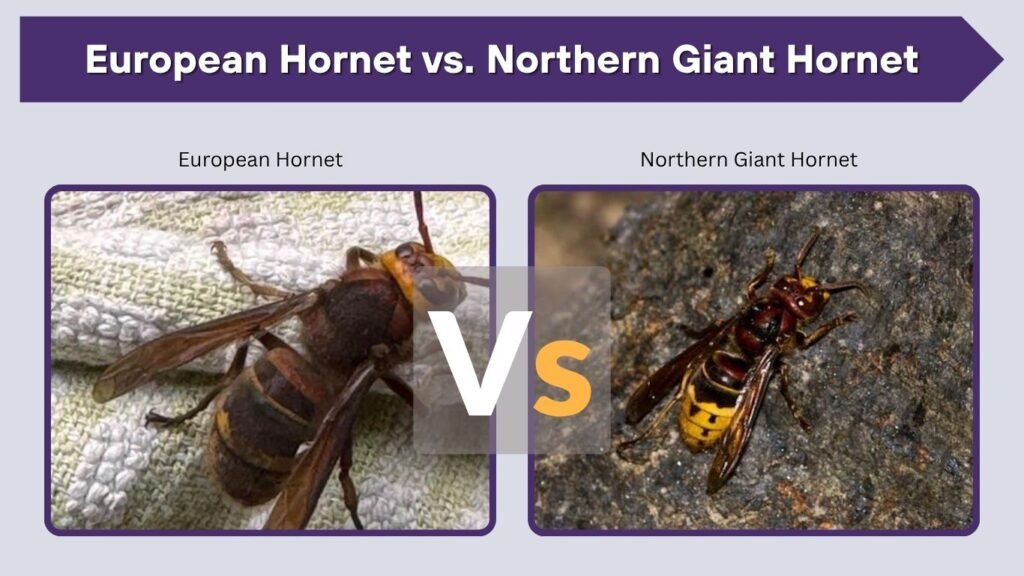
These two large species are commonly confused.
| Feature | European Hornet | Northern Giant Hornet |
| Scientific name | Vespa crabro | Vespa mandarinia |
| Worker size | Up to ~1 inch | Up to ~1.5–2 inches |
| Head | Red-brown and yellow | Large yellow-orange |
| Thorax | Red-brown/black | Mostly dark |
| Abdomen | Mostly yellow with dark marks | Strong alternating bands |
| U.S. status | Established in East | Eradicated |
European hornets remain widespread in eastern North America.
Are Hornets Aggressive?
Hornets do not normally spend their time searching for people to sting.
Their strongest defensive behavior occurs when someone approaches or disturbs their nest.
Social wasps defend nests because the colony contains their queen and is developing young.
Avoid:
- Hitting a nest
- Blocking its entrance
- Cutting branches containing a nest
- Mowing directly beside a ground nest
- Spraying a large colony from close range without appropriate precautions
A hornet feeding away from its nest is usually much less defensive.
FAQs
1. What does a typical hornet look like?
A hornet usually has a large, sturdy wasp-like body, six legs, four wings, long antennae, a narrow waist, and yellow, brown, black, orange, or reddish markings. True hornets belong to the genus Vespa.
2. What does a hornet nest look like?
Hornet nests are made from papery material created from chewed wood. Some species build enclosed gray aerial nests, while European hornets usually nest inside hollow trees, walls, attics, and other protected cavities.
3. What does a queen hornet look like?
A queen generally resembles the workers but is noticeably larger. A European hornet queen can reach approximately 35 mm compared with workers that reach about 25 mm.
4. What does a bald-faced hornet look like?
Bald-faced hornets are predominantly black with bright ivory-white markings across the face and abdomen. Despite their common name, they are actually large aerial yellowjackets rather than true hornets.
5. What does a hornet sting look like?
A typical sting produces a painful red welt with localized swelling and sometimes itching. Appearance alone cannot reliably identify the insect responsible. Trouble breathing, facial or throat swelling, fainting, or widespread hives requires emergency medical attention.