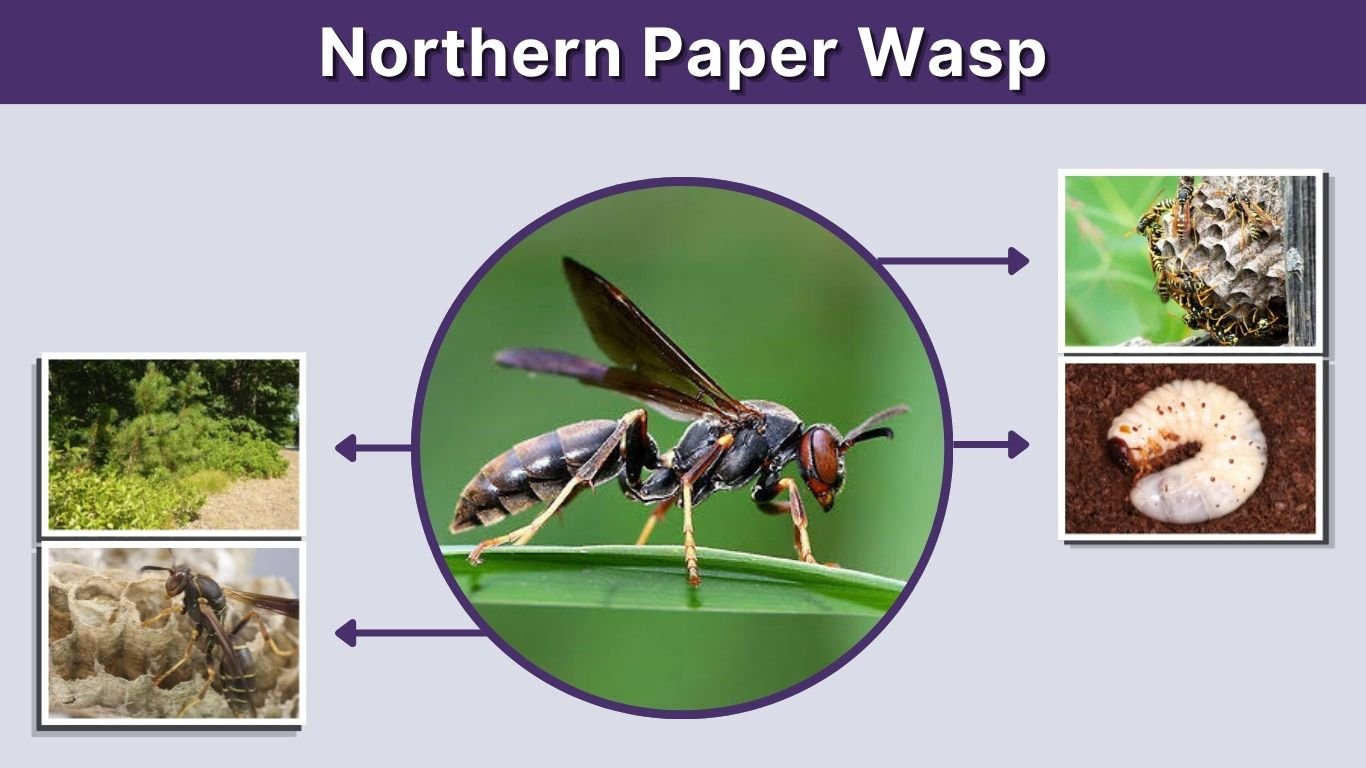
The Northern paper wasp (Polistes fuscatus) is a native North American wasp recognized by its slender body, dangling legs, and exposed paper nest. It is commonly found in woodlands, gardens, farms, and around buildings. These wasps benefit gardens by hunting caterpillars and other plant-eating insects. However, females can deliver painful stings when their colony is disturbed, especially when a nest is hidden near doors, decks, outdoor furniture, or frequently used equipment.
Northern Paper Wasp Identification
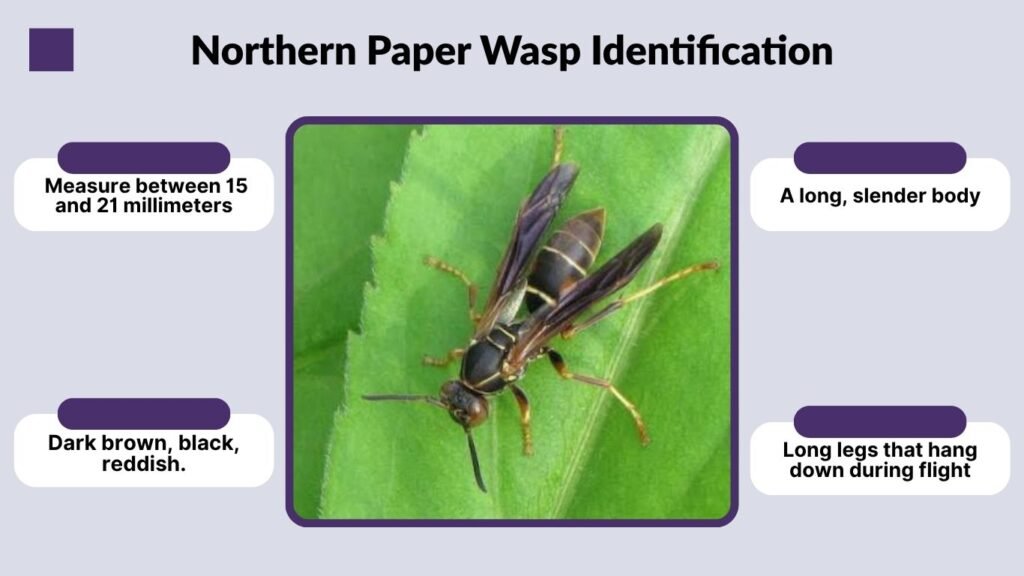
The Northern paper wasp is also called the dark paper wasp. It belongs to the family Vespidae and the genus Polistes, whose members are commonly known as umbrella paper wasps.
Size, Color, and Characteristics
Adult Northern paper wasps generally measure between 15 and 21 millimeters, or approximately ⅝ to ⅞ inch long. Their appearance varies considerably across their range, making color alone an unreliable identification method.
Common characteristics include:
- A long, slender body
- A clearly pinched waist
- Dark brown, black, reddish, or golden coloration
- Variable yellow markings on the face and abdomen
- Long legs that hang down during flight
- Narrow, smoky-brown wings
- Long antennae
- A smooth body with relatively little visible hair
Northern individuals are often predominantly black or dark brown with limited yellow markings. Wasps from southern populations may have more reddish-brown, orange, or yellow coloring. According to BugGuide’s species record, this unusually variable coloration can make Polistes fuscatus difficult to separate from related paper wasps.
Northern Paper Wasp Queen vs. Worker
The queen and workers are both female and look nearly identical. Unlike honey bee queens, Northern paper wasp queens do not have dramatically enlarged bodies.
A queen is usually:
- Slightly larger or more robust
- Reproductively active
- Seen alone during early spring
- Responsible for establishing the nest
- More likely to remain on the nest after workers emerge
Workers are non-reproductive or less reproductive females. They expand the nest, collect wood fibers and water, capture insects, feed larvae, and defend the colony. Because their sizes overlap, behavior and season are often more useful than appearance when distinguishing queens from workers.
Male vs. Female Northern Paper Wasps
Males usually appear during late summer and early fall. They often have a more yellow or pale face, longer curved antennae, and a somewhat narrower abdomen. Precise identification may require examining details of the antennae and abdominal segments.
Females have six externally visible abdominal segments, whereas males have seven. Most importantly, males cannot sting. A wasp’s stinger develops from an egg-laying structure, so only queens and female workers possess functional stingers.
Habitat and Geographic Range
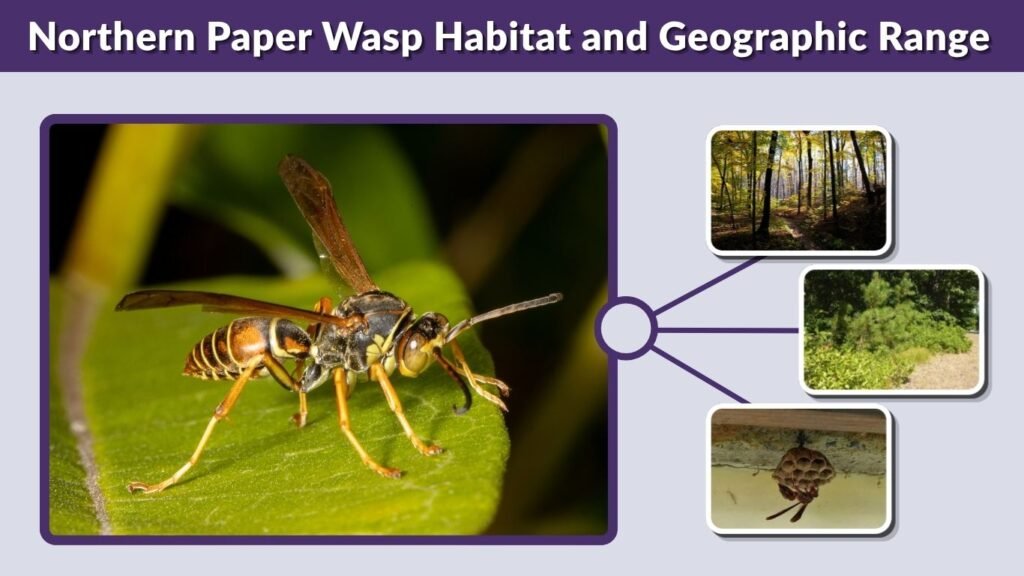
Northern paper wasps occupy forests, woodland edges, grasslands, farms, gardens, and suburban neighborhoods. They do particularly well in places where weathered wood provides nest material and sheltered structures provide dry nesting locations.
Where Do Northern Paper Wasps Live?
Their main range covers eastern North America, extending from southern Canada through much of the eastern and central United States. Records stretch from Nova Scotia westward into parts of the Canadian Prairies and south toward Texas and Florida.
They are common in states such as:
- Massachusetts and New Jersey
- Pennsylvania and Ohio
- Michigan and Wisconsin
- Alabama and Georgia
- Florida and Texas
The species is not native to the United Kingdom. A paper wasp found in the UK is likely another species or an accidentally transported individual.
Reports of a “Northern paper wasp” in California may involve confusion with the golden paper wasp, Polistes aurifer. It was previously treated as a western form of P. fuscatus but is now generally recognized as a separate species.
Why They Enter Houses
Northern paper wasps do not normally establish large colonies inside living rooms. However, fertilized queens may enter wall gaps, attics, siding, window frames, or other protected spaces to survive winter.
Warm indoor temperatures can awaken a dormant queen, causing her to appear near a window during winter or early spring. One or several wasps inside at this time do not necessarily indicate an active nest. University of Minnesota Extension notes that overwintering paper wasp queens may shelter in groups and later wander indoors.
Northern Paper Wasp Nest
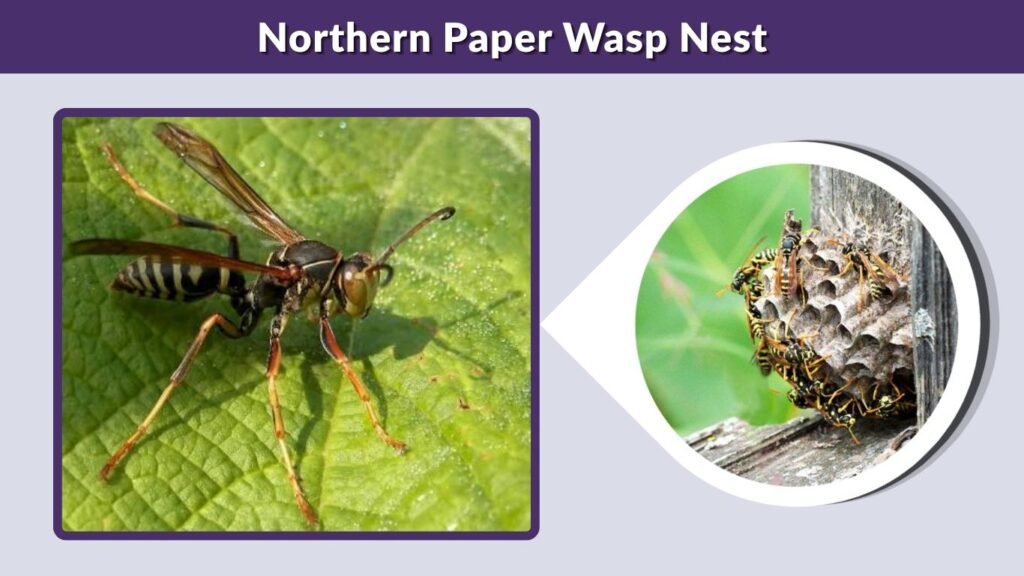
Northern paper wasps construct the open, umbrella-shaped nest typical of the genus Polistes. Their colonies are annual, meaning the active nest usually lasts only one season.
Nest Appearance
The nest consists of a single exposed comb attached to a surface by a narrow stalk called a petiole. Its downward-facing hexagonal cells remain visible because the comb has no protective outer envelope.
The nest may begin with fewer than ten cells but gradually expand as the colony grows. Inside the cells, you may see:
- Tiny white eggs
- Cream-colored larvae
- Open cells containing developing young
- White silk caps covering pupae
Workers build the nest by scraping fibers from dead or weathered wood. They mix the fibers with saliva and shape the pulp into thin paper walls.
Common Nest Locations
Northern paper wasps prefer sheltered areas protected from heavy rain. Nests may be found beneath:
- Roof eaves and porch ceilings
- Decks and railings
- Window ledges and shutters
- Tree branches and hollow trees
- Barns, sheds, and garages
- Mailboxes and birdhouses
- Outdoor furniture
- Playground equipment
- Open wall cavities
They normally nest above ground. A concealed colony underground is more likely to belong to yellow jackets.
Diet, Behavior, and Predators
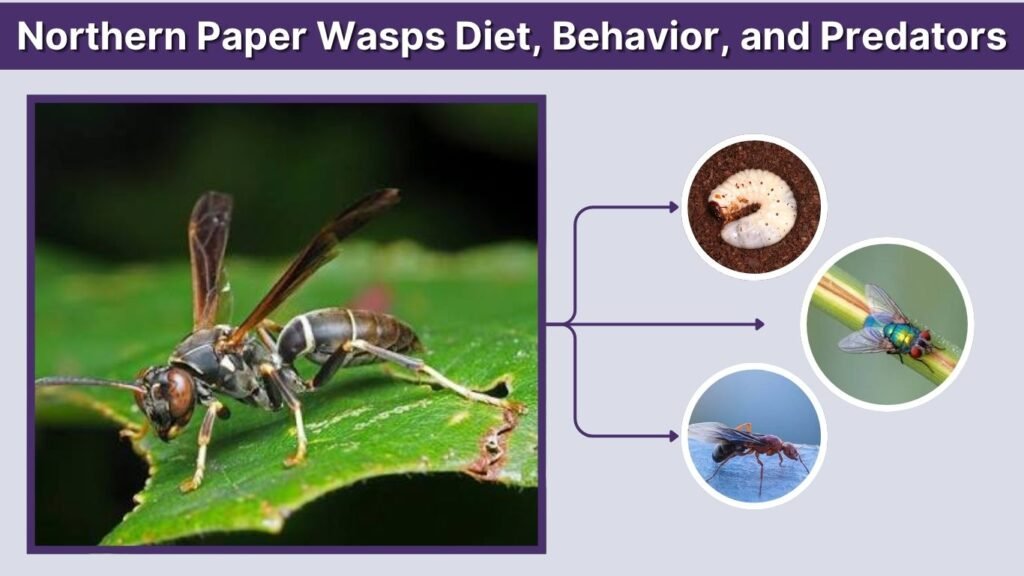
Northern paper wasps are beneficial predators and occasional flower visitors. Adults and larvae have different nutritional requirements, so workers collect both sugary liquids and animal protein.
What Do Northern Paper Wasps Eat?
Adult wasps mainly consume nectar, fruit juices, plant sap, and honeydew produced by aphids. They may visit flowers and transfer pollen while feeding, although they are less specialized pollinators than bees.
Workers capture protein-rich prey for their larvae, including:
- Caterpillars
- Beetle larvae
- Flies
- Winged ants
- Termites
- Spiders
- Other small arthropods
A worker chews its catch into a soft pulp before feeding it to developing larvae. This predatory behavior can reduce populations of caterpillars that damage vegetables, fruit trees, and ornamental plants.
Are Northern Paper Wasps Aggressive?
Northern paper wasps are generally less aggressive than yellow jackets. A foraging wasp away from its colony is unlikely to sting unless it is grabbed, trapped against the skin, or stepped on.
The colony will defend its nest, however. Defensive behavior can be triggered by:
- Touching or shaking the nest
- Operating equipment containing a hidden nest
- Repeated movement close to the comb
- Striking or spraying the colony
- Blocking the wasps’ flight path
Defensiveness usually increases as the colony becomes larger. Avoid swatting at approaching wasps because sudden movements may intensify their response.
Natural Predators
Northern paper wasps and their developing larvae may be eaten by birds, spiders, praying mantises, dragonflies, ants, and small mammals. Raccoons and rodents may tear apart accessible nests to reach the larvae.
The colony may also be affected by parasitic insects and pathogens. Ants are particularly dangerous to an unguarded nest, which is one reason paper wasps coat the nest’s supporting stalk with chemicals that help discourage them.
Northern Paper Wasp Life Cycle
A colony develops from a single overwintered female or, occasionally, a small group of cooperating females. Only newly fertilized queens normally survive the cold season.
Colony Development Through the Year
The life cycle follows four main periods:
- Spring founding: A fertilized queen emerges from winter shelter, selects a location, builds the first cells, and lays eggs.
- Early colony growth: The queen hunts alone, feeds her larvae, guards the comb, and continues construction.
- Worker period: The first adult daughters become workers. They take over hunting, construction, nest defense, and larval care while the queen concentrates on laying eggs.
- Reproductive period: Late-season colonies produce males and new reproductive females. They mate, after which the new queens find winter shelters.
The old queen, workers, and males die as cold weather arrives. The abandoned nest is not actively reused, although a new queen may build another nest nearby the following spring.
Northern Paper Wasp Sting
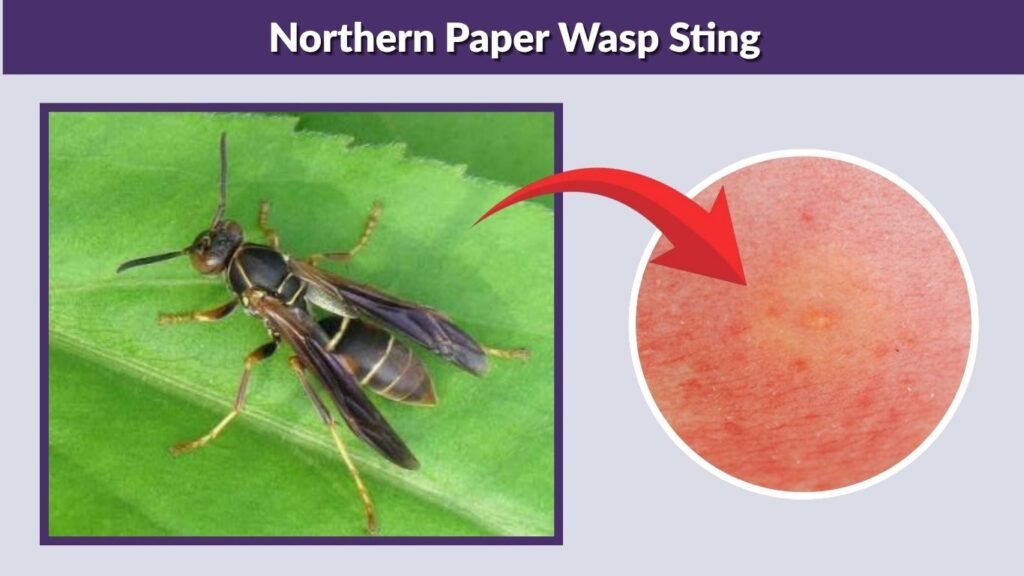
Female Northern paper wasps possess venom and can sting repeatedly. They do not leave their stingers behind or die after stinging as worker honey bees usually do.
Symptoms and Sting Pain
A sting commonly causes immediate sharp or burning pain, followed by redness, itching, warmth, and swelling. Local discomfort may continue for several hours or days.
Pain ratings are subjective; a pain-index number cannot predict how seriously someone will react. The major concern is venom allergy rather than pain intensity. Multiple stings can also be medically significant, even in someone without a known allergy.
Northern Paper Wasp Sting Treatment
Move to a protected area before treating the sting. Then:
- Wash the affected skin with soap and water.
- Apply a cold pack wrapped in cloth for 10–15 minutes.
- Elevate a swollen arm or leg when possible.
- Avoid scratching the area.
- Use an appropriate pain reliever, antihistamine, or anti-itch treatment according to its label and medical guidance.
Seek emergency help for difficulty breathing, facial or throat swelling, widespread hives, dizziness, fainting, confusion, or repeated vomiting. Anyone prescribed an epinephrine auto-injector should use it as directed and obtain emergency medical attention.
Northern vs. European Paper Wasp vs. Yellow Jacket
All three wasps can occur around homes, but their colors, nests, and behavior differ.
| Feature | Northern paper wasp | European paper wasp | Yellow jacket |
|---|---|---|---|
| Scientific name | Polistes fuscatus | Polistes dominula | Vespula species |
| Native status | Native to North America | Introduced in North America | Several native species |
| Color | Highly variable; often dark or reddish | Black and bright yellow | Bold black and yellow |
| Antennae | Usually dark | Usually orange | Usually dark |
| Body | Long and slender | Long and slender | Short and compact |
| Nest | Exposed open comb | Exposed open comb | Enclosed paper nest |
| Aggression | Moderate near nest | Moderate near nest | Often strongly defensive |
| Food habits | Insect predator and nectar feeder | Insect predator and nectar feeder | Often scavenges human food |
How to Get Rid of Northern Paper Wasps
A nest in a remote corner of the property can often remain because the wasps control garden pests. Removal is more appropriate when a colony is close to doors, children, pets, walkways, or people with sting allergies.
Prevention and Safe Removal
Inspect sheltered structures in early spring while nests are small. Seal cracks, repair screens, cover openings in outdoor equipment, and remove empty nests during winter.
Do not burn, crush, flood, or knock down an occupied nest. If treating a small accessible nest, use only a product labeled for wasps and follow its directions exactly. Treatment is generally less hazardous after dark when most workers are present and flight activity is lower.
Contact a licensed pest-control professional for nests inside walls, at dangerous heights, near electrical equipment, or in places without a clear escape route. Ordinary traps may catch wandering wasps but rarely eliminate a paper wasp colony.
FAQs
Are Northern paper wasps dangerous?
Northern paper wasps are not normally dangerous when foraging away from their colony. However, females can sting repeatedly when their nest is disturbed. The greatest risks involve hidden nests, multiple stings, and severe allergic reactions requiring immediate emergency medical treatment.
Do Northern paper wasps sting people?
Yes. Queens and workers can sting, but males cannot. Most incidents occur when someone touches a nest, uses equipment containing a hidden colony, or traps a wasp against the skin. They are generally less likely to attack than yellow jackets.
How can I identify a Northern paper wasp queen?
The queen is usually a slightly larger, more robust female seen establishing a nest during spring. Once workers emerge, appearance alone may not separate them reliably. The individual remaining on the comb and laying eggs is normally the dominant reproductive queen.
Should I kill a Northern paper wasp nest?
Not necessarily. A nest away from people can provide natural caterpillar control and will be abandoned after the season. Consider removal when routine activity may disturb it, someone nearby has a serious sting allergy, or the colony occupies a building cavity.
What should I do with a Northern paper wasp inside my house?
Keep people and pets away, open a nearby exterior window, and allow the wasp to leave. Alternatively, capture it beneath a container if this can be done safely. Repeated appearances may indicate overwintering queens entering through structural gaps, not an active indoor colony.