
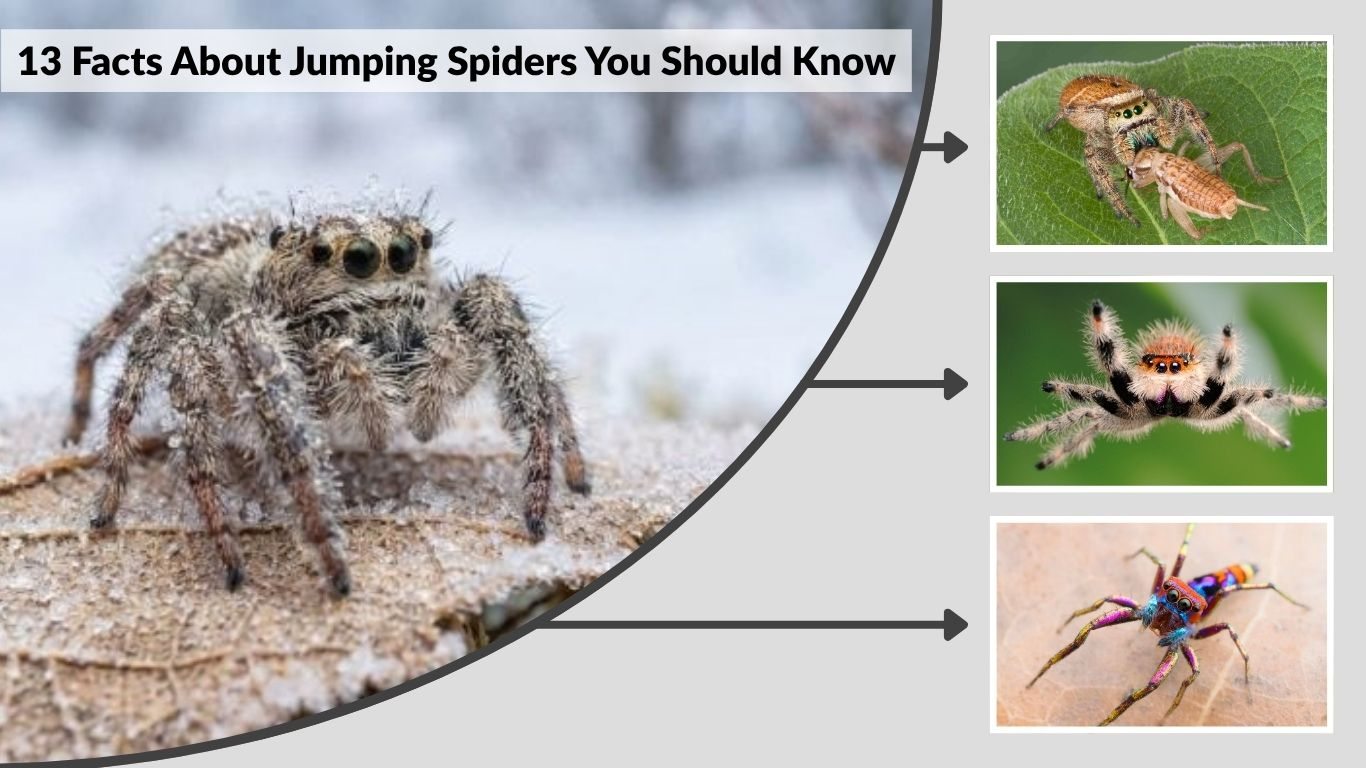
Jumping spiders are some of the most interesting spiders in the world. They are small, alert, colorful, and famous for their big front eyes. Unlike many spiders that wait in webs, jumping spiders actively hunt by watching, stalking, and leaping onto prey. Their curious behavior often makes them look less frightening than other spiders. These 13 facts explain why jumping spiders are so unique.
1. Jumping Spiders Belong to the Salticidae Family
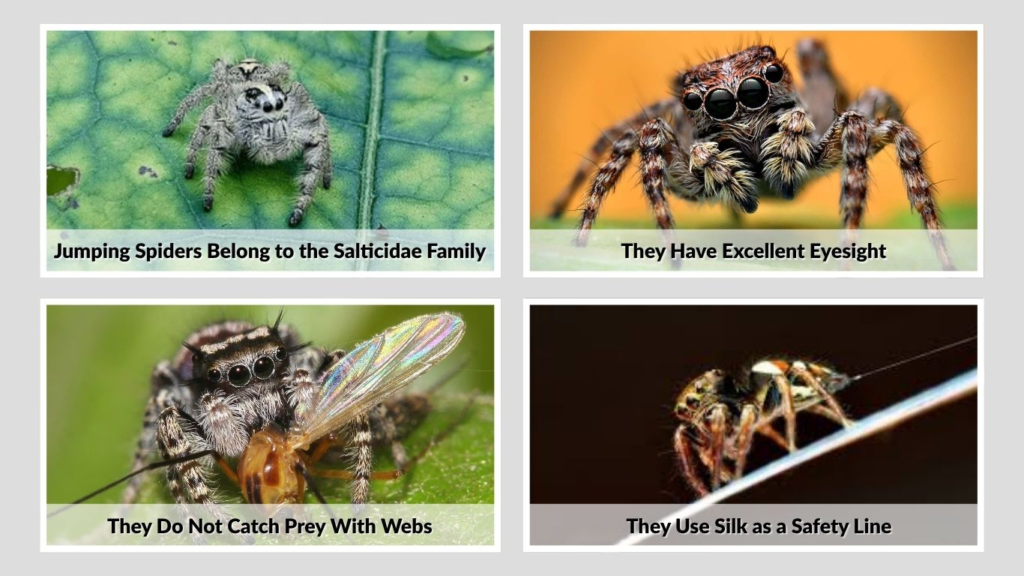
Jumping spiders belong to the family Salticidae, one of the largest spider families. There are thousands of jumping spider species around the world, and they live in many different habitats. You may find them in gardens, forests, grasslands, walls, windowsills, tree bark, and even inside homes.
They are usually small, but their behavior makes them easy to notice. Many species move in short bursts, stop suddenly, look around, and then jump. This active style is very different from web-building spiders that stay hidden and wait for prey.
Their body shape can vary by species. Some are compact and furry, while others are sleek, colorful, or patterned. Many have bright markings that help with identification or mating displays.
2. They Have Excellent Eyesight
One of the most famous facts about jumping spiders is their incredible vision. They have eight eyes, but the two large front eyes are the most noticeable. These front eyes help them see detail, judge distance, and focus on prey.
Their side eyes help detect movement around them. This gives them a strong awareness of their surroundings. If something moves nearby, a jumping spider may turn its body to look directly at it.
This eyesight is one reason they seem curious. When a person moves close, a jumping spider may stop and appear to “look back.” It is not trying to be friendly like a pet, but it is carefully watching movement and deciding whether the object is food, danger, or something to ignore.
3. They Do Not Catch Prey With Webs
Many people think all spiders use webs to catch food, but jumping spiders usually do not hunt that way. Instead of building sticky traps, they use vision and quick movement.
A jumping spider first spots its prey, such as a fly, mosquito, gnat, moth, or tiny insect. Then it slowly approaches, often moving in careful steps. When it gets close enough, it jumps and grabs the prey with its front legs.
This hunting style makes jumping spiders active predators. They are more like tiny cats than web-trap spiders because they stalk, calculate, and pounce.
4. They Use Silk as a Safety Line
Even though jumping spiders do not usually use webs to catch prey, they still produce silk. Before jumping, they often attach a silk thread to the surface. This thread works like a safety line.
If the spider misses its target or falls, the silk line can help it avoid a dangerous drop. It may climb back up using the thread. This is especially useful when hunting on walls, leaves, branches, or other raised surfaces.
Jumping spiders may also use silk to make small shelters. These shelters can protect them while resting, molting, hiding from danger, or laying eggs.
5. They Can Jump Many Times Their Body Length
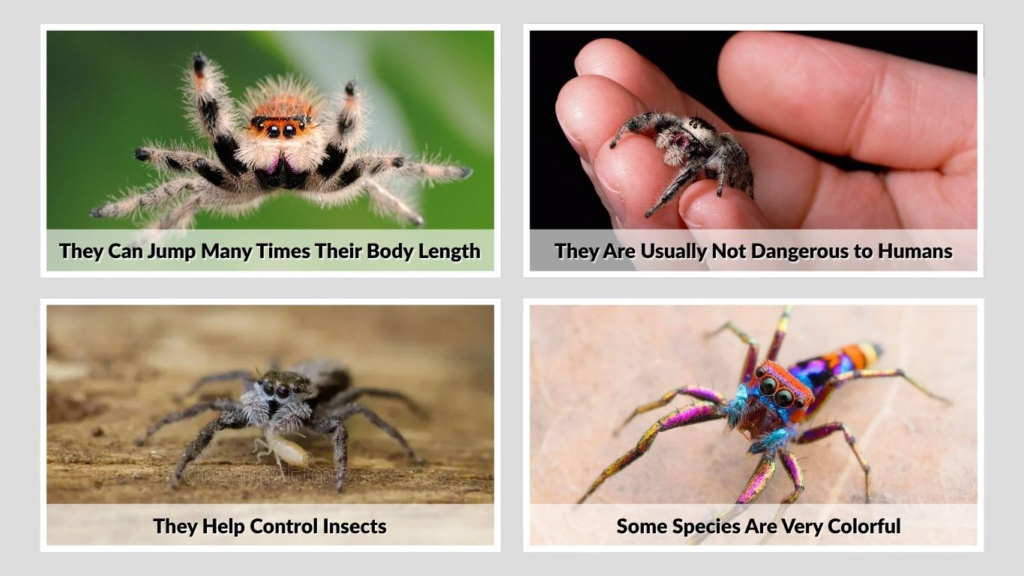
Jumping spiders are famous for their impressive jumps. Some species can leap several times their own body length. Their jumps are not random. They usually pause, aim, and then launch themselves toward a target.
They do not jump using large leg muscles the same way grasshoppers do. Instead, spiders use changes in body pressure to extend their legs quickly. This helps them spring forward with speed and accuracy.
Their jumping ability helps them catch prey, escape predators, and move across gaps. For such a small animal, this is an amazing survival skill.
6. They Are Usually Not Dangerous to Humans
Jumping spiders have venom because they need it to subdue insects and other small prey. However, their venom is not considered dangerous to humans. A jumping spider bite is uncommon and usually happens only if the spider is trapped, squeezed, or handled roughly.
If a bite occurs, it may cause mild redness, itching, or swelling, similar to a minor insect bite. Serious reactions are rare, but anyone with strong swelling, breathing problems, spreading redness, or severe pain should seek medical help.
In most cases, jumping spiders are better viewed as helpful predators rather than dangerous pests.
7. They Help Control Insects
Jumping spiders eat many small insects. This makes them useful in gardens, yards, and homes. They may feed on flies, mosquitoes, ants, moths, beetles, aphids, and other tiny arthropods.
Because they hunt actively during the day, they can reduce small pest populations naturally. In gardens, they may help protect plants by eating insects that damage leaves and stems.
They are not a complete pest control solution, but they are part of a healthy ecosystem. Seeing a jumping spider in the garden is usually a good sign.
8. Some Species Are Very Colorful
Not all jumping spiders are plain brown or black. Some species have bright colors, metallic markings, stripes, spots, or iridescent hairs. Peacock spiders are especially famous for their vivid colors and courtship displays.
Male jumping spiders are often more colorful than females. These colors may help them attract mates or communicate during courtship. In some species, males raise their legs, wave, vibrate, or display bright body parts to impress females.
Their small size makes these colors easy to miss, but under a camera lens or magnifier, jumping spiders can look surprisingly beautiful.
9. They Have Complex Courtship Behavior
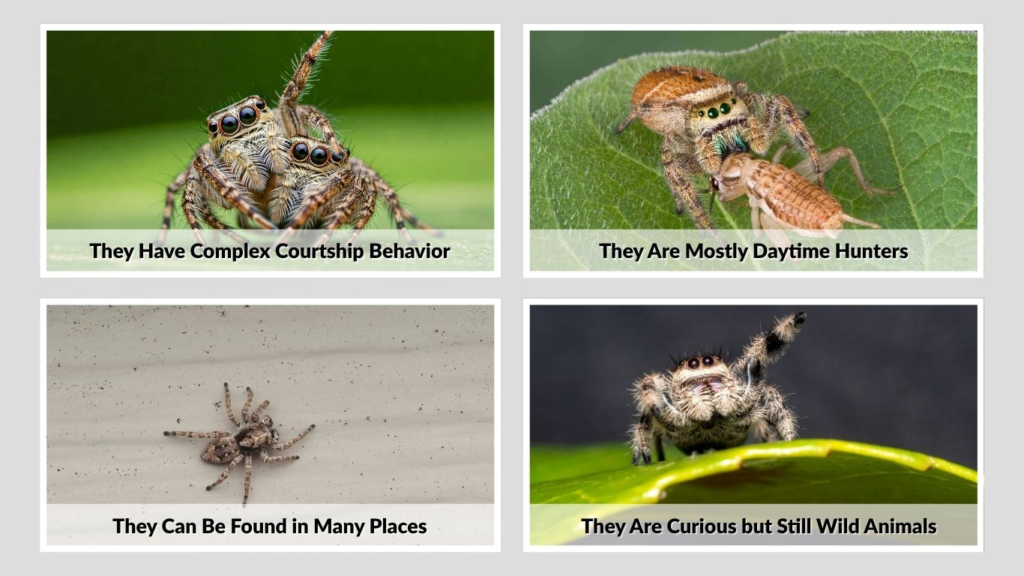
Jumping spider courtship can be very detailed. A male may approach a female carefully, then perform movements to show that he is a potential mate rather than prey. These movements may include leg waving, body shaking, tapping, zigzag walking, or colorful displays.
This behavior is important because jumping spiders are predators. If the female does not accept the male, she may attack him. The male’s display helps reduce that risk and improves his chance of mating.
Some species also use vibrations. The male may send tiny signals through the ground or plant surface. These signals can be part of the mating display.
10. They Are Mostly Daytime Hunters
Jumping spiders are usually active during the day. This makes sense because they rely heavily on vision. Bright light helps them see prey, judge distance, and navigate their environment.
You may see them on sunny walls, leaves, fences, windows, or outdoor furniture. They often stop and turn as they move, scanning the area.
At night or during bad weather, many jumping spiders hide in silk retreats. These retreats help them stay protected until conditions are better for hunting.
11. They Can Be Found in Many Places
Jumping spiders live on nearly every continent except Antarctica. They are common in warm regions, but some species can live in cooler places too. Different species prefer different habitats.
Common places to find them include:
- Garden plants and flowers
- Tree bark and leaves
- Grass and shrubs
- House walls and ceilings
- Windowsills and door frames
- Rocks, fences, and outdoor furniture
They often appear near places where insects are common. A sunny window with flies nearby can attract a jumping spider.
12. They Are Curious but Still Wild Animals
Many people describe jumping spiders as curious because they turn toward movement and watch nearby objects. Their large eyes and alert posture make them look expressive. This has made them popular among spider enthusiasts.
However, they are still wild animals. They do not understand humans the way pets do. Their “curiosity” is really a survival behavior based on vision and movement detection.
If you see one indoors, you can gently relocate it outside using a cup and paper. Avoid grabbing it with your fingers, because rough handling can injure the spider or cause a defensive bite.
13. They Play an Important Role in Nature
Jumping spiders may be small, but they are important predators. They help control insect populations and serve as food for birds, reptiles, wasps, and other animals. Their presence supports balance in local ecosystems.
They also help scientists learn about animal vision, behavior, communication, and movement. Because jumping spiders have advanced eyesight and complex hunting behavior, researchers study them to better understand how small animals process information.
For homeowners and gardeners, jumping spiders are usually harmless guests. They do not damage furniture, spread disease, or build large messy webs. In many cases, they are useful little hunters that quietly reduce insects around the home and garden.
FAQs
Are jumping spiders dangerous?
Jumping spiders are not considered dangerous to humans. They have venom for catching prey, but their venom is usually mild for people. Bites are uncommon and typically happen only when the spider is trapped or handled roughly. Most jumping spiders prefer to escape rather than bite.
Why do jumping spiders look at people?
Jumping spiders rely on vision to understand their surroundings. When they turn and look at you, they are likely reacting to movement and checking whether you are food, danger, or something harmless. Their large front eyes make this behavior look very curious and expressive.
Do jumping spiders make webs?
Jumping spiders make silk, but they usually do not build webs to catch prey. Instead, they hunt by stalking and jumping. They use silk as a safety line before leaping and may build small silk shelters for resting, hiding, molting, or protecting eggs.
What do jumping spiders eat?
Jumping spiders mostly eat small insects and other tiny arthropods. Their diet can include flies, mosquitoes, gnats, moths, ants, beetles, and plant pests. This makes them helpful in gardens and homes because they naturally reduce some unwanted insects.
Should I remove jumping spiders from my house?
You do not always need to remove them because they are usually harmless and may eat small pests. If you do not want one indoors, gently guide it into a cup and release it outside. Avoid crushing or grabbing it, as they are beneficial animals.
